My First Encounter With A Computer and How I Nearly Destroyed It
A childhood memory of blinking cursors, floppy disks, and the magic of C:\>
My First Encounter With A Computer and How I Nearly Destroyed It
A childhood memory of blinking cursors, floppy disks, and the magic of C:>
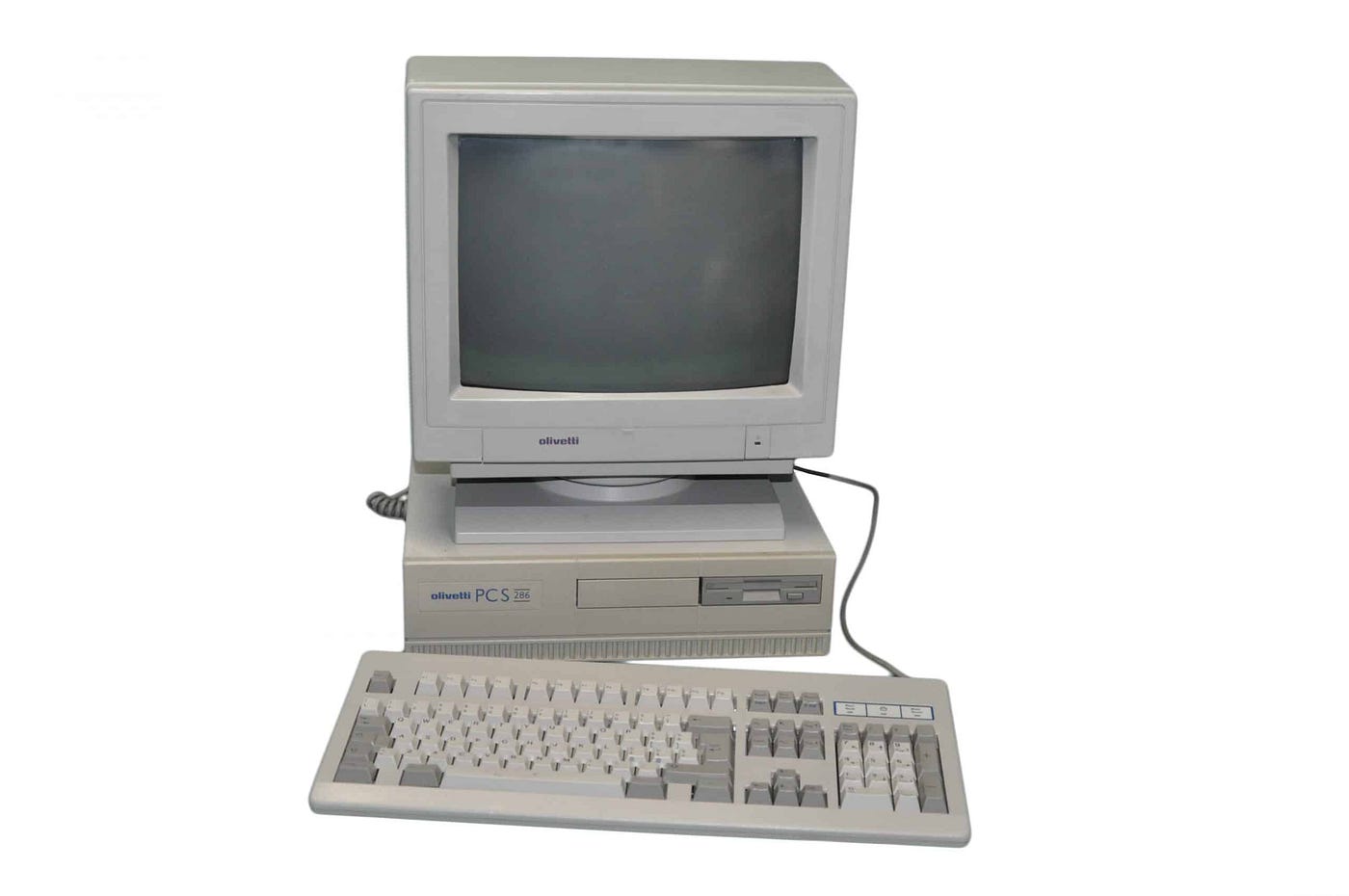
Olivetti PC S 286: oliveria.de
There is a particular kind of wonder that only exists in childhood, the kind where something completely incomprehensible becomes the most fascinating thing in the world, simply because you cannot look away from it. For me, that thing was a grey box sitting on a desk in our family home in 1991. An Olivetti PCS 286. And it changed everything.
The Machine
Before I talk about the games, the commands, or the sheer thrill of navigating between drives, let me tell you about the hardware itself, because even now, knowing what I know, I find it remarkable.
The Olivetti PCS 286 was powered by an Intel 80286 processor running at 12 MHz. It came with 1 MB of RAM, that’s one megabyte and a 40 MB hard drive paired with a 1.44 MB 3.5-inch floppy drive. Graphics were handled by built-in VGA support, which at the time was genuinely impressive.
By today’s standards, those numbers are almost comically small. My phone has more processing power in the notification bar. But in 1991, to a child staring wide-eyed at that glowing monitor, this machine was a portal to another world.
Watching My Dad Like a Hawk
I didn’t get to use the computer at first. I watched.
My Dad was the operator. He’d sit down, the machine would go through its start-up routine, and then that screen. A black void with a single blinking cursor and two characters that meant everything:
C:\>That was it. No icons. No mouse pointer dancing across a desktop. No friendly welcome screen. Just the command line, a blinking cursor, and the expectation that you knew what you were doing.
My Dad knew what he was doing.
I’d pull up a chair beside him and study every keystroke like I was memorising a spell. He’d slide a 3.5-inch floppy disk into the drive with a satisfying click, type a command, hit Enter, and something would happen. A game would load. A program would start. The machine would respond.
The relationship between the human and the machine felt direct, almost intimate. There was no layer of abstraction between intention and execution. You typed a command. The machine obeyed. Or it didn’t, and you had to figure out why.
I was absolutely captivated.
The Games
Of course, the games helped.
There was Pong, a simple, clean, two-paddles and a bouncing square. There was Pac-Man, which needs no introduction. And there was a Grand Prix Circuit racing game that I loved, despite or perhaps because of the fact that it rendered the entire world in exactly four colours. The track was a different colour from the car. The car was a different colour from the sky. That was the full palette, and it was glorious.

Grand Prix Circuit: classicreload.com
But the game that stands out most in memory is one I probably shouldn’t have been playing at my age: Leisure Suit Larry in the Land of the Lounge Lizards.
For the uninitiated, Leisure Suit Larry was a 1987 *Sierra On-Line* adventure game, a comedic, slightly risqué point-and-click (well, text-parser in the early version) about a middle-aged man named Larry Laffer trying to find love in a city of neon lights and dubious establishments. It was, by design, not a children’s game.
Leisure Suit Larry: littlebitsofgaming.com
I didn’t understand most of it. I didn’t need to. The pixel art cities, the jazzy soundtrack bleeping through the PC speaker, the feeling that I was navigating a world that was enough. It planted something in me: the idea that computers could contain entire fictional universes. That they weren’t just tools, they were spaces.
C:\ and D:\
One of my earliest and proudest achievements on that machine was learning to navigate between drives, entering folders and running executable game files.
C:\> D:
D:\> cd Games
D:\Games> dir
D:\Games> grandprix.exe
That’s all it took. Switch the drive, step into the directory, list the contents, run the file. But I remember the first time I did it on my own, watching the prompt change from **C:\> to `D:>**, finding the right folder withcd`, scanning the file list with **dir*, and then typing the name of the executable and pressing Enter, and feeling like I had done something real*. Something technical. A small sequence of commands that the machine followed because I had learned its language, even just those few words of it.
It sounds trivial now. It was not trivial then. It was the first time I felt that the computer wasn’t just something I watched, it was something I could talk to. And once you’ve felt that, you can’t unfeel it!
The Day I Accidentally Deleted Everything
Confidence, as any seasoned engineer will tell you, is a dangerous thing in the hands of someone who doesn’t yet know what they don’t know.
Armed with my new superpower, the ability to switch between drives, I began exploring. Poking around directories. Reading the names of files I didn’t understand. And one day, at ten years old, sitting alone at the machine in the full flush of self-assurance, I typed a command I’d seen somewhere and decided to try:
C:\> del *.*
All files in directory will be deleted!
Are you sure (Y/N)?
I had no idea what it did. Not really. **del delete, presumably. And ***.* well, the asterisks looked like wildcards, but the full implication of every file, all extensions, in the current directory was entirely lost on me.
The machine paused. Then it asked, in that flat, unhurried way that DOS had, whether I was sure I wanted to delete the contents of the directory.
I typed **Y** and hit Enter, and then silence. No progress bar, no confirmation, no list of what was being deleted. DOS would just return you to the prompt:
C:\>What followed was a quiet, efficient, and utterly catastrophic purge. The computer did exactly what I told it to do, because that’s what computers do. They don’t second-guess you. They don’t say “are you certain you’ve thought this through?” They execute. And so it executed, methodically wiping file after file while I watched, not yet understanding that I was watching a disaster unfold in real time.
My Dad was not happy.
But here’s the thing, and this is the part that stayed with me far longer than the dread of the moment, he was more surprised than angry. Surprised that his ten-year-old had navigated to the root of the C: drive, typed a command that even cautious adults sometimes feared, confirmed the prompt, and watched it run. He managed to recover about 80% of the files, which in 1991, without the safety nets we take for granted today, was actually a remarkable outcome.
The lesson was immediate, visceral and permanent: commands are not suggestions. The machine has no undo button in its soul. When you tell it to do something, it will do it, completely, obediently, and without question.
I have never forgotten it.
In a strange way, that single catastrophic day taught me more about computing than any of the games had. It taught me that the system had power, and that power had consequences, and that understanding what a command actually does before you run it is not optional, it’s the whole job. That instinct, that slight pause before pressing Enter to ask “wait, what does this actually do?” I thought it would be the last time I’d ever do that again, and eh, it wasn’t!
Seed Planted
I couldn’t have told you in 1991 that this machine would set the trajectory for my entire professional life. I was just a child watching my Dad type commands into a black screen, sneaking in sessions when I could, learning the names of files and directories like a new geography.
But something took root. A fascination with systems. A comfort with the command line that never left me. A belief, still held, that understanding what’s happening underneath matters. That the blinking cursor isn’t something to be afraid of; it’s an invitation.
The Olivetti PCS 286 is long gone, of course. But that **C:\>** prompt? It never really went away.
This is the first in a series of articles tracing my journey through technology, from that grey box in 1991 to understanding everything I could about how computers and technology actually functions and my current journey towards system analysis and security. I hope you’ll follow along.
[embed]Intersectionality Celebrating the spaces betweenmedium.com
메타데이터
- post_id
- b82a1fdf9b98
- slug
- my-first-encounter-with-a-computer-and-how-i-nearly-destroyed-it-b82a1fdf9b98
- url
- https://medium.com/intersectionality/my-first-encounter-with-a-computer-and-how-i-nearly-destroyed-it-b82a1fdf9b98
- canonical_url
- https://medium.com/intersectionality/my-first-encounter-with-a-computer-and-how-i-nearly-destroyed-it-b82a1fdf9b98
- author_url
- https://medium.com/@alanogorman
- status
- ok
- fetched_at
- 2026-06-14 11:28:49