“PINK GOES GOOD WITH GREEN!”: How the film Wicked improves our society through two colors
Admit it: at least once this year you have likely found yourself scrolling through social media only to stumble upon content dominated by…
“PINK GOES GOOD WITH GREEN!”: How the film Wicked improves our society through two colors

Admit it: at least once this year you have likely found yourself scrolling through social media only to stumble upon content dominated by the colours pink or green — or both. This is no coincidence but rather a true communicative phenomenon that does not escape a thorough semiotic analysis. From the second half of 2024 and throughout 2025, pink and green have become the undisputed protagonists of countless media trends for different reasons, ultimately converging in the film adaptation of the Broadway musical Wicked.

Pink, in its most kitsch and eccentric shade, rose to prominence after the August 2023 release of Barbie. Once a symbol of the woman constrained by social norms, the doll was transformed into an emblem of female empowerment and gender awareness — albeit within a deeply paradoxical framework. The lead actress (Margot Robbie) still embodies the traditional standard of beauty: the quintessential blue-eyed blonde who fits perfectly into society’s aesthetic rules. Similarly, pink still appears overly glossy and superficial to become a true symbol of emancipation. In my view, the film’s impact succeeded almost by miracle — perhaps once again because of the sheer power of social media and modern communication. Yet nothing escapes the attentive gaze of those who study such phenomena.

By contrast, the summer of 2024 finally brought the long-desired emancipation — not only for women, but for all those who do not identify with any socially imposed standard, and who seek to live in complete freedom and consistency with their individual values, which often expand into shared values within wider groups (particularly among young people).
I am referring to the socio-media phenomenon known as “BRAT” — a term that literally means “bad kid,” but is often used in the feminine sense of a cheeky, bold, unapologetic girl, imbued with pride and self-determination rather than blame. The trend originates from the album BRAT by British electro-pop singer-songwriter Charli XCX, which disrupted both the music and social-media landscapes. The movement began — without dwelling here on the album’s lively, innovative, and intelligent production — with the album cover: an acid-green background with a blurred, low-definition, lowercase black “brat,” expressly chosen, as the artist stated, to celebrate “an offensive and unsettling shade of green, something that could trigger the feeling that something was not quite right.”
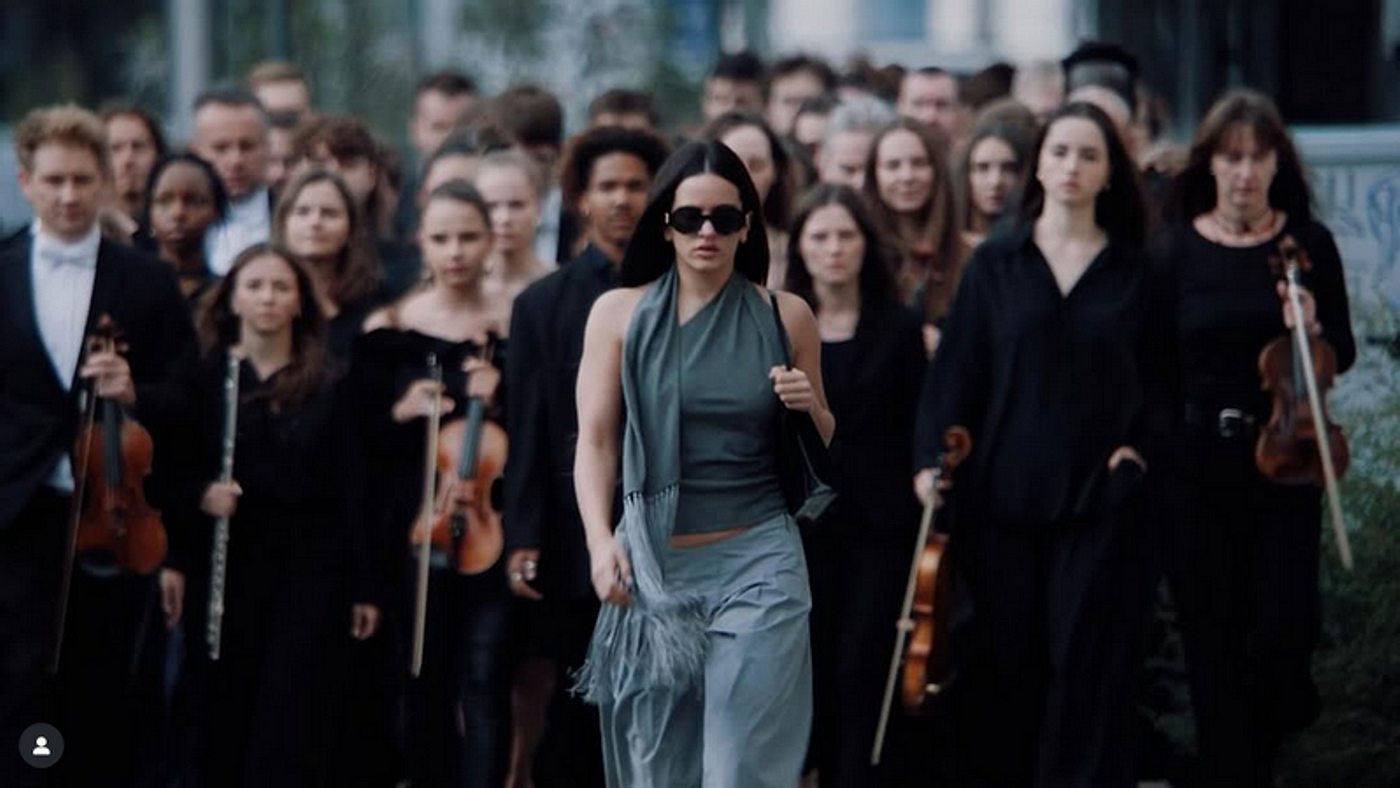
This strong visual element turned green into a symbol of irreverence, self-assertion, and personal freedom. It justified being a bit dishevelled, wearing dark sunglasses early in the morning among men in suits, and saying “no” when something feels wrong — rejecting the superficial belief that society can change without our active involvement.
This cultural backdrop prepared “the inhabitants of the social-media world” to embrace the magnus opus of this innovative socio-cultural wave: Wicked. With stars such as Cynthia Erivo and Ariana Grande bringing to life the timeless characters of Elphaba and Glinda, the imaginary world of Oz becomes a mirror of our society, where morality, politics, and power dynamics operate much as they do on Earth.

On the left the poster of the musical Wicked, on the right the poster of the movie
Before approaching a semiotic interpretation of the 2024 film (whose second part was released in November 2025), it is useful to revisit its origins. Wicked began in 1995 as a dark-fantasy novel by Gregory Maguire (Wicked: The Life and Times of the Wicked Witch of the West), inspired by L. Frank Baum’s 1900 classic The Wonderful Wizard of Oz. Maguire’s book explores the childhood and adolescence of Elphaba, the Wicked Witch of the West, and her friendship with Glinda, the Good Witch of the East, prior to Dorothy’s arrival. In 2003, the novel became a musical (Wicked: The Untold Story of the Witches of Oz), in which Stephen Schwartz reinterpreted the relationship between Elphaba and Glinda for Broadway and the world.
Building on the musical, director Jon M. Chu adapted the story for cinema, casting two performers who embody significant cultural visibility for younger generations. Cynthia Erivo is one of the most acclaimed theatre actresses in the English-speaking world, holding an Emmy, a Grammy, and a Tony Award, along with multiple nominations for Oscars, Golden Globes, BAFTAs, Critics Choice Awards, and SAG Awards — placing her among the few artists close to completing the EGOT. Ariana Grande, known primarily for her music career and for her work in youth entertainment, serves as an icon for today’s twenty- and thirty-somethings, accumulating numerous accolades including two Grammy Awards and nominations for the Golden Globes and Oscars. Together, they bridge the legacy of musical theatre with that of contemporary pop, ready to enrich these traditions with symbolic values of goodness, altruism, and social awareness.

Turning now to the symbolic role of pink and green in Wicked, one scene stands out: the opening sequence, in which Glinda (Ariana Grande) performs the famous song No One Mourns the Wicked.
[embed]
Although placed at the beginning — before any narrative tension develops — it is remarkably powerful. Glinda’s lyrical voice announces the death of the Wicked Witch of the West (Elphaba) at Dorothy’s hands, restoring peace across Oz. From a narrative standpoint, this scene is essential, serving as the hinge that temporally orients a complex storyline: it follows the ending of The Wizard of Oz and precedes the long flashback that forms the bulk of Wicked, eventually concluding in the second film, Wicked: For Good (released in November). In this sense, the entire cinematic narrative leads to this scene — even though it appears at the beginning — producing a retrospective understanding in the viewer.
Emotionally and symbolically, No One Mourns the Wicked is equally rich. Through a Peircean semiotic analysis, we may examine its icons (firstness), indices (secondness), and symbols (thirdness).
At the level of firstness, Peirce focuses on pure quality — immediate emotion, possibilities not yet shaped by causal relations. Here, we may analyse the visual elements (camera movement, framing, lighting, costumes), the sound (music and effects, crucial in a musical), and even syntactic, graphic, and verbal features.

The scene opens with the crowd celebrating the witch’s death. Wide shots of vast tulip fields, men and women going about daily life, and citizens gathering along the Yellow Brick Road emphasise this festive mood. Colours play a central role: bright tones on clothing, Glinda’s pink dress, the blue sky, and luminous gold hues dominate the scene.
With Glinda’s arrival, the atmosphere shifts. Technically, the alternation between wide shots of Oz’s citizens and close-ups of Glinda’s face reveals her psychology and unspoken emotions, especially since verbal communication is minimal and the focus lies on the song. Although No One Mourns the Wicked recounts the circumstances of the witch’s death, it also serves as Glinda’s introspective moment.
The soundscape is equally crucial: joyful bells, children’s chatter, the citizens’ cheers, and finally the first notes of Glinda’s song, introduced by the sharp exclamation “Look! It’s Glinda!” The music is lyrical, written for a soprano range (which Grande executes beautifully), and supported by airy orchestration reflecting Glinda’s authority.

Contrasting these harmonious elements, the scene displays propaganda objects targeting the Wicked Witch of the West — flyers, banners, and a large wooden effigy — introducing dissonance amid the pastel colours and flowing shapes.
These technical choices lead us to the level of secondness — indices — where meaning emerges through context and cause-and-effect. Here, the opening scene becomes truly instructive: it teaches the viewer how to read the film. Glinda appears as an absolute authority, surrounded by ritualistic elements: the citizens’ choreography, the ringing bells, her dramatic arrival in a bubble, and the climactic moment in which she burns the wooden sculpture of her adversary. The world moves around her to celebrate her, yet she maintains an institutional distance.

Colours also acquire indexical meaning: the pastel palette now signals peace restored and the triumph of good. Pink, above all, becomes Glinda’s colour — representing her goodness, regal nature, and generosity, making her stand out while still belonging to the scene. Her arrival — floating in a luminous bubble, descending gently with her wand and shimmering pink gown — symbolises sweetness, lightness, and fragility.
Yet beneath this institutional façade lies a more human Glinda, one we fully understand only after knowing the full story: she is devastated by the loss of her friend. The close-ups gain explanatory power, exposing an inner turmoil that contradicts her public role — and, consequently, the lyrics of her song. Musical numbers typically express what characters cannot say aloud, but here the dynamic is reversed: Glinda sings festive lines like “Good news!” and “She died alone,” while internally grieving Elphaba. The orchestral grandeur reinforces the ritualistic nature of the event — but also Glinda’s elegance and the weight of her role.
It is at the level of thirdness — symbol — that the meaning becomes universal. Here we understand why pink and green have become viral on social media, and why they carry moral and civic weight. Glinda and Elphaba become allegories of good and evil, overshadowing their human complexity. Society creates these roles in an attempt to rationalise ambiguous human nature, assigning blame and praise through simplification. This is the symbolic purpose of the ritual in No One Mourns the Wicked: the social triumph of good over evil, while Glinda quietly reveals the darkness behind this supposed “victory.”
The films, especially with the release of Wicked: For Good, deepen this theme. Elphaba is not truly wicked; she has good intentions and seeks to expose the greatest lie in Oz: that the Wizard has no real power. To protect himself, the Wizard labels her “wicked,” turning good intentions into something evil and persecutable. Evil, then, is not absolute but relative — a matter of perspective.

Thus green — the strange, the repellent, the rebellious — acquires a new figurative meaning: misunderstanding, unjust judgement, moral integrity, charisma, freedom, irreverence, and refusal to conform. Does this sound familiar? Yes: even Elphaba, the Wicked Witch of the West, is unmistakably “Brat.”

Glinda’s story is even more bittersweet. She appears triumphant — an influential public figure mastering magic — but this is merely what society expects from her. In reality, she faces a profound personal struggle. In No One Mourns the Wicked, she must bid farewell to her best friend, pretending to celebrate a moment that tears her apart. She serves a system that shaped who she is supposed to be, but not who she truly is. Her pink, unlike the failed Barbie experiment, becomes a genuine colour of emancipation. Though still associated with artificiality, it acquires depth, symbolising gentle strength, grace in adversity, resilience, sacrifice for self-recovery, quiet ambition, and — as Italo Calvino would say — “being heavy in one’s lightness.”
Through thirdness, the scene reveals the didactic nature of the entire film. It gives us tools to read our own world, encouraging us not to bow to imposed norms and to understand others beyond stereotypes. The film demonstrates the arbitrariness of moral categories rather than treating them as fixed. Glinda and Elphaba are two sides of the same coin, yin and yang; one could not exist without the other. It is society, in its anxious quest for simplicity and control, that forces categorizations onto complex realities.

This peaceful subversion — and the blend of good and evil — emerges clearly in the promotional poster for Wicked: For Good, which invites further semiotic reflection. Following Roland Barthes’ model for advertising, we may distinguish linguistic and iconic messages.
Denotatively, the poster shows the two protagonists in the foreground: Glinda with her bubble and wand, Elphaba with her broom and pointed hat. They fly over Oz, with the Yellow Brick Road and Emerald City in the distance. Connotatively, this becomes a powerful image of encounter and separation: they reach toward each other without touching, evoking both Michelangelo’s Creation of Adam and their complementarity — forever united yet divided by circumstance. The director himself has noted the curved, rounded shapes throughout the composition, with Elphaba forming the “Z” of Oz, the one who bursts the bubble and disrupts the status quo.
The linguistic message, consisting of “You will be changed” and the subtitle “for good,” reinforces the idea of positive transformation surrounding the title Wicked. Words and images work together to highlight the allegorical, moral dimension of the protagonists, and the way the shades of pink and green blending into the sky reflect the merging of good and evil into meaningful change.
In conclusion, if Barbie (superficially) and Charli XCX’s Brat destabilised a dusty and rigid social order, Wicked has set new standards for a more mature, conscious, even relativistic society — one that does not categorise good and evil rigidly but lives moral experience through its nuances, which are what make us human. A kind of magic — like that in the film — or, for rationalists, a perfect Hegelian synthesis, emerging at precisely the right moment in a cultural environment ready for a new interpretation of reality. Among young people especially — naturally receptive to new trends and deeper reflections — this has sown a spark of sensitivity and hope during particularly dark times.
In a single word: humanity. And truly, after watching this film you will be “changed for good”, because, as Glinda suggests to Elphaba: “Pink goes good with green!”
…
References
· Barthes, R. (1990). O óbvio e o obtuso: ensaios sobre fotografia, cinema, teatro e música. Rio de Janeiro: Nova Fronteira. (Capitolo: “A retórica da imagem”)
· Colangeli, S. (2024, 23 novembre). Wicked, di cosa parla davvero il musical con Ariana Grande e Cynthia Erivo. GQ Italia. https://www.gqitalia.it/article/wicked-film-recensione-di-cosa-parla-davvero GQ Italia
· Cosmopolitan Italia. Wicked: trama, recensione, significato. Cosmopolitan. https://www.cosmopolitan.com/it/lifestyle/cinema/a63016979/wicked-film-trama-recensione-significato/
· Ferrara, L. D. A. (anno). Semiótica e comunicação: ciências em fronteiras.
· GQ Italia. Wicked, di cosa parla davvero il musical con Ariana Grande e Cynthia Erivo. GQ Italia.
· Il Post. (2024, 24 luglio). Cosa vuol dire “brat”. Il Post. https://www.ilpost.it/2024/07/24/brat-significato/ Il Post
· Il Post. (2024, 27 giugno). Una copertina bruttissima e riuscitissima. Il Post. https://www.ilpost.it/2024/06/27/brat-copertina-brutta/ Il Post
· Militello, A. (2024, 2 dicembre). Wicked — la recensione del film. Critical Eye. https://www.criticaleye.it/wicked/ Critical Eye
· Vanity Fair Italia. (2024). Ariana Grande e Cynthia Erivo sul set di Wicked: le prime foto in esclusiva. Vanity Fair. https://www.vanityfair.it/article/wicked-part-1-film-foto-esclusiva Vanity Fair Italia
메타데이터
- post_id
- b838932007ea
- slug
- pink-goes-good-with-green-how-the-film-wicked-improves-our-society-through-two-colors-b838932007ea
- url
- https://medium.com/culturaliteraria/pink-goes-good-with-green-how-the-film-wicked-improves-our-society-through-two-colors-b838932007ea
- canonical_url
- https://medium.com/culturaliteraria/pink-goes-good-with-green-how-the-film-wicked-improves-our-society-through-two-colors-b838932007ea
- author_url
- https://medium.com/@daddieromita
- status
- ok
- fetched_at
- 2026-07-14 23:08:55