How Can You Automate Daily Grocery Store Operations and Improve Efficiency with LOGIC ERP Software?
Modern Logic ERP Grocery Store Software helps automate daily grocery store operations, including billing, inventory, procurement, and…
How Can You Automate Daily Grocery Store Operations and Improve Efficiency with LOGIC ERP Software?

Work Smarter, Sell Faster with LOGIC ERP Grocery Software!
Modern Logic ERP Grocery Store Software helps automate daily grocery store operations, including billing, inventory, procurement, and reporting. By streamlining workflows and improving efficiency, businesses can reduce costs, enhance customer service, and drive growth.
Key Takeaways
- Automating daily operations with Logic ERP Grocery Software helps grocery stores improve efficiency, reduce work, and streamline business processes.
- Real-time inventory tracking through Grocery ERP Software enables better stock control, accurate replenishment, and reduced inventory losses.
- Faster checkout experiences powered by Grocery POS Software help enhance customer satisfaction and improve billing accuracy.
- Centralized management capabilities within Grocery Retail Software simplify multi-store operations and provide complete business visibility.
- Automated tax calculations and reporting using Grocery Billing Software help ensure GST compliance while minimizing administrative effort.
- Cloud-enabled access through Grocery Store Software by Logic ERP allows retailers to manage operations anytime, anywhere with real-time insights.
Introduction
The grocery retail industry is evolving rapidly, driven by changing consumer expectations, increasing competition, rising operational costs, and the growing demand for digital transformation. Grocery stores today manage thousands of products, multiple suppliers, complex inventory requirements, billing operations, customer loyalty programs, and financial transactions on a daily basis. Managing these activities manually often leads to inefficiencies, errors, stock discrepancies, and reduced profitability. To stay competitive, grocery businesses need intelligent automation solutions that streamline operations and improve overall efficiency.
This is where Logic ERP Grocery Software becomes a game-changing solution. As a comprehensive Grocery Store Software, LOGIC ERP helps retailers automate important business processes including billing, inventory management, procurement, accounting, CRM, warehouse operations, and analytics. By leveraging advanced automation, AI-driven insights, and real-time business visibility, grocery stores can significantly improve productivity, reduce operational costs, and enhance customer experiences.
[embed]
Watch this video to know more about Logic ERP Grocery, POS, Billing & Inventory Software for Retail Stores & Shops!
Why Automation is Important for Modern Grocery Stores
Automation has become a necessity rather than a luxury for grocery retailers. Traditional non-automated processes can no longer support the speed, accuracy, and scalability required in today’s retail environment.
Modern grocery stores face several operational challenges:
- Manual Billing Errors: Arise due to human mistakes in data entry, pricing, or calculations during the billing process.
- Inventory Inaccuracies: Occur when stock records do not match actual physical inventory levels in the store or warehouse.
- Frequent Stockouts and Overstocking: Result from poor demand planning, leading to either product shortages or excess unused stock.
- Delayed Procurement Processes: Happen when purchase planning and supplier coordination are not automated or efficiently managed.
- Lack of Real-Time Business Visibility: Limits the ability to monitor sales, inventory, and operations instantly across the business.
- Complex GST Compliance Requirements: Create challenges in maintaining accurate tax calculations, reporting, and regulatory filings.
- Customer Retention Challenges: Occur when businesses struggle to engage customers and encourage repeat purchases effectively.
- High Operational Costs: Result from inefficient processes, manual work, and lack of automation in daily operations.
- Multi-Store Management Complexities: Arise when coordinating inventory, sales, and operations across multiple locations without centralized control.
Implementing a robust Grocery ERP Software solution enables businesses to automate repetitive tasks, improve decision-making, and create a seamless retail ecosystem.
Understanding LOGIC ERP Grocery Software
Logic ERP Grocery Software is a comprehensive retail automation platform developed specifically for grocery stores, supermarkets, hypermarkets, convenience stores, and retail chains.
The software integrates multiple business functions into a single centralized platform, including:
- Billing and POS: Enables fast, accurate, and GST-compliant billing with efficient point-of-sale operations for smooth customer checkout experiences.
- Inventory Management: Helps track and control stock levels in real time to ensure optimal availability and reduce inventory discrepancies.
- Procurement: Streamlines purchasing processes by automating purchase orders, supplier coordination, and stock replenishment planning.
- Warehouse Management: Improves storage, tracking, and movement of goods within warehouses for better efficiency and accuracy.
- CRM and Loyalty Management: Strengthens customer relationships through personalized engagement, loyalty programs, and targeted marketing campaigns.
- Financial Accounting: Automates financial tracking, reporting, and reconciliation to ensure accurate and transparent business records.
- GST Compliance: Ensures accurate tax calculations, invoicing, and reporting to meet all regulatory compliance requirements.
- Multi-Store Management: Enables centralized control and monitoring of multiple store locations for consistent operations and performance tracking.
- Business Analytics: Provides actionable insights through data analysis and reporting to support informed and strategic decision-making.
This integrated approach helps businesses eliminate operational silos and achieve complete control over daily operations.
How LOGIC ERP Automates Daily Grocery Store Operations
LOGIC ERP automates important grocery store functions such as billing, inventory management, procurement, accounting, and customer engagement, helping businesses reduce effort and improve productivity. Its integrated platform streamlines daily operations, enabling grocery retailers to achieve greater efficiency, accuracy, and operational control.
1. Automated Billing and Checkout Management
Billing is one of the most frequent activities in grocery retail. Slow checkout processes can negatively impact customer experiences and store productivity.
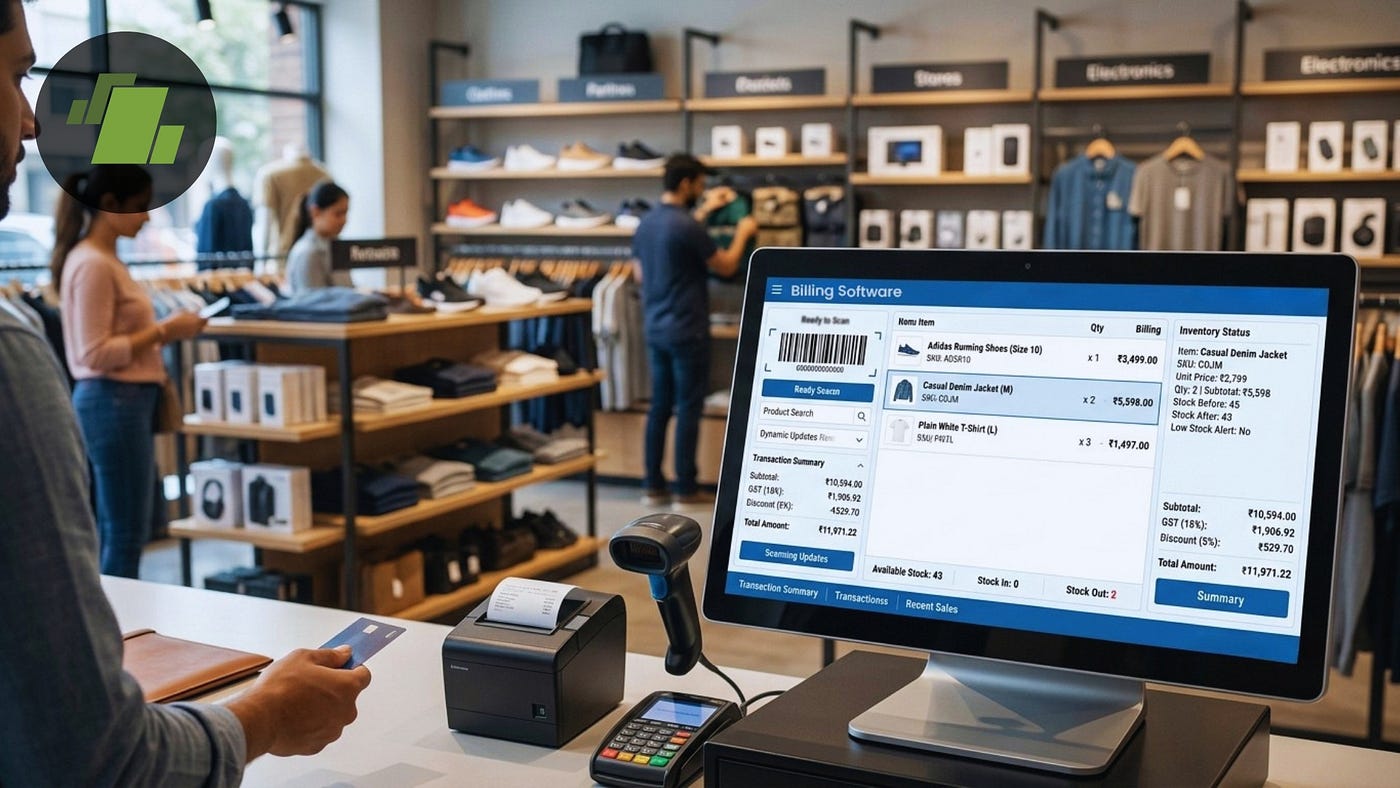
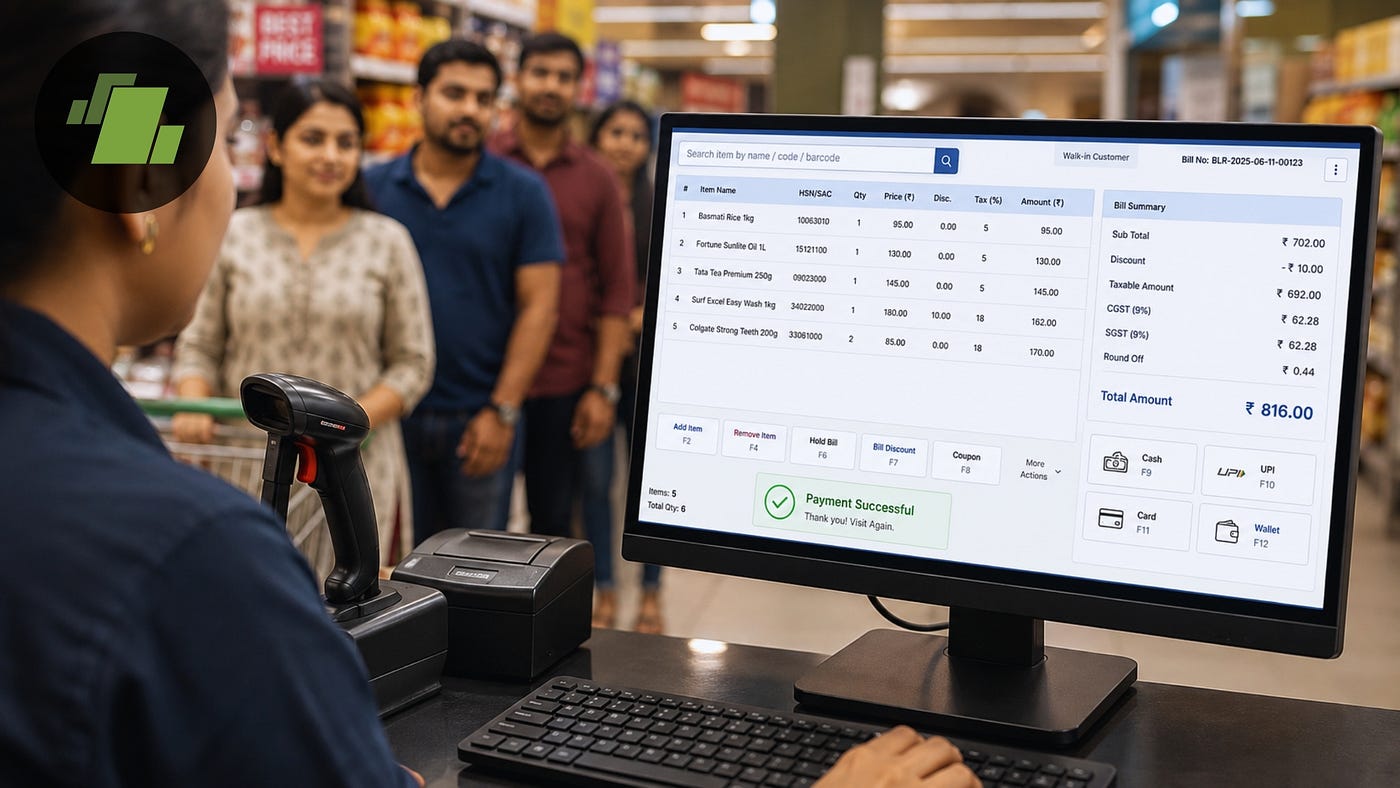
Grocery Billing Software from LOGIC ERP automates billing operations through:
- Fast POS Billing: Enables quick and seamless checkout by accelerating billing transactions and reducing customer wait times. This significantly reduces checkout times and improves customer satisfaction.
- Automated Tax Calculations: Ensures accurate tax computation by automatically applying GST and other applicable taxes during every transaction. This reduces non-automated calculation errors, simplifies compliance processes, and ensures accurate tax reporting.
- Digital Billing: Enables paperless invoicing by delivering bills electronically, improving convenience for both customers and retailers. This reduces paper consumption, enhances customer convenience, and supports environmentally sustainable retail operations.
2. Intelligent Inventory Management Automation
Inventory management is one of the most important functions in grocery retail. It helps grocery retailers maintain optimal stock levels through real-time tracking, automated replenishment, and data-driven inventory control.
Grocery Store Software by Logic ERP automates inventory operations by providing:
- Real-Time Inventory Tracking: Provides instant visibility into stock levels by automatically updating inventory data whenever products are sold, received, transferred, or returned. This ensures accurate stock visibility across the organization.
- Automated Replenishment: Automatically monitors stock levels and generates replenishment recommendations to ensure optimal inventory availability and prevent stock shortages. This prevents stockouts while minimizing excess inventory.
- Inventory Alerts: Provides timely notifications for low stock, overstock situations, inventory discrepancies, and near-expiry products to support proactive inventory management.
3. Procurement Automation
Procurement is a important process that directly impacts inventory availability and profitability. It streamlines purchasing processes by automatically managing stock requirements, supplier coordination, and purchase order generation, ensuring timely and efficient inventory replenishment.
LOGIC ERP automates procurement through:
- Purchase Order Generation: Automatically creates purchase orders based on inventory requirements. This helps ensure timely replenishment, reduces non-automated effort, and improves procurement efficiency.
- Supplier Management: Efficiently manages vendors and procurement relationships. This helps businesses strengthen supplier relationships, improve procurement efficiency, and make better purchasing decisions.
- Approval Workflows: Streamlines procurement approvals through automated workflows and authorization controls. This improves procurement efficiency, enhances control, and ensures compliance with purchasing policies.
4. Warehouse Management Automation
Warehouse operations significantly influence inventory accuracy and fulfillment efficiency. This helps streamline storage, inventory movement, and fulfillment processes, improving accuracy, efficiency, and overall warehouse productivity.
The Grocery Retail Software includes advanced warehouse management capabilities such as:
- Bin Management: Improves warehouse organization by assigning specific storage locations for products, ensuring easy identification and retrieval. This helps optimize space utilization and reduces time spent locating inventory items.
- Goods Receipt Processing: Streamlines the process of recording incoming stock from suppliers into the system. It ensures accurate verification, documentation, and updating of inventory levels in real time.
- Dispatch Management: Manages the efficient movement of goods from warehouse to stores or customers. It ensures timely order fulfillment and reduces delivery delays.
- Batch Tracking: Enables monitoring of products based on batch numbers for better traceability. It helps manage quality control, recalls, and expiry tracking effectively.
- Stock Transfers: Facilitates smooth movement of inventory between different stores or warehouses. It ensures balanced stock distribution and prevents shortages or overstocking.
- Inventory Audits: Supports systematic verification of physical stock against recorded data. It helps identify discrepancies, prevent losses, and maintain inventory accuracy.
These features improve warehouse productivity and reduce operational bottlenecks.
5. Multi-Store Management Automation
Many grocery businesses operate multiple stores across different locations. It enables grocery retailers to centrally manage operations, inventory, pricing, and reporting across multiple locations with greater efficiency and control.
Grocery ERP Software enables centralized management of:
- Inventory: Tracks real-time stock levels across all stores and warehouses to ensure accurate availability. Helps reduce stock discrepancies, stockouts, and overstocking through centralized control.
- Pricing: Enables centralized pricing control across all locations for consistency and accuracy. Allows quick updates based on market trends, margins, and promotional strategies.
- Promotions: Manages discount campaigns, offers, and seasonal promotions across multiple stores. Ensures uniform promotional execution and improved customer engagement.
- Procurement: Automates purchase planning, supplier coordination, and order generation processes. Helps maintain optimal inventory levels while reducing procurement efforts.
- Financial Reporting: Generates accurate financial reports with real-time data from all store operations. Provides insights into profitability, expenses, and overall business performance.
Managers can monitor all locations through a unified dashboard while maintaining location-specific controls.
6. AI-Powered Demand Forecasting
Artificial Intelligence is transforming grocery retail operations. AI-powered demand forecasting helps grocery retailers predict future product demand accurately, enabling smarter inventory planning, optimized procurement, and reduced stock-related risks.
LOGIC ERP utilizes advanced analytics and forecasting capabilities to help businesses:
- Predict Demand: AI analyzes historical sales data, seasonal trends, customer buying behavior, and product performance to accurately forecast future demand and support smarter inventory planning.
- Optimize Inventory: The software recommends ideal inventory levels based on predicted demand. This ensures better stock availability while reducing excess inventory and improving overall cost efficiency.
- Improve Procurement Planning: Retailers can make informed purchasing decisions that reduce inventory costs and improve stock availability.
7. CRM and Customer Loyalty Automation
Customer retention is important in grocery retail. CRM and customer loyalty automation help grocery retailers strengthen customer relationships, increase retention, and drive repeat purchases through personalized engagement and reward programs.
LOGIC ERP automates customer engagement through:
- Loyalty Programs: Retailers can create reward points programs, membership benefits, customer tiers, and special promotions to enhance customer engagement and encourage repeat purchases.
- Personalized Marketing: The system uses customer data to deliver targeted offers and campaigns. This helps improve customer engagement and increase repeat purchases through relevant promotions.
- Customer Analytics: Businesses gain insights into purchase behavior, customer preferences, shopping frequency, and customer lifetime value to make more informed marketing and customer retention decisions.
8. GST Compliance and Accounting Automation
Managing GST compliance manually can be time-consuming and error-prone. GST compliance and accounting automation streamline tax calculations, invoicing, reporting, and financial record-keeping to ensure accuracy, transparency, and regulatory compliance for grocery businesses.
Grocery Billing Software automates:
- GST Calculations: Automatically computes GST for every transaction based on applicable tax rules and product categories. Ensures accurate tax application, reducing errors and improving compliance efficiency.
- Invoice Generation: Generates GST-compliant invoices instantly during billing with complete tax breakdowns. Helps maintain standardized billing formats and improves documentation accuracy.
- Tax Reporting: Creates detailed GST reports for sales, purchases, and tax liabilities in real time. Assists businesses in monitoring tax obligations and maintaining regulatory compliance.
- Filing Preparation: Organizes all important & required tax data required for smooth GST return filing. Reduces preparation time and ensures accuracy during submission processes.
- Financial Reconciliation: Matches accounting records with GST data to ensure financial accuracy. Helps identify discrepancies and maintain transparent financial reporting.
The software also integrates accounting functions to provide accurate financial visibility.
9. Cloud-Based Grocery Store Management
Cloud technology enables retailers to access business data from anywhere. Cloud-based grocery store management enables retailers to access, monitor, and control business operations in real time from anywhere, ensuring flexibility, scalability, and centralized data management.
Benefits include:
- Real-time Synchronization: Ensures instant updates of data across all stores, warehouses, and systems without delays. Helps maintain consistent and accurate information across the entire retail network.
- Remote Accessibility: Allows users to access business data anytime and from any location using cloud-based systems. Enables better decision-making and operational control even while managing multiple store locations.
- Centralized Management: Provides a single platform to manage inventory, sales, procurement, and reporting across all outlets. Improves efficiency by eliminating data silos and ensuring unified business operations.
- Data Security: Protects sensitive business and customer information through advanced encryption and secure access controls. Reduces risks of data breaches while ensuring safe and reliable system operations.
- Scalability: Supports business growth by easily handling increasing stores, products, and transaction volumes. Ensures smooth performance as the business expands without system limitations.
Cloud-based Grocery Software ensures seamless operations across multiple locations.
Key Benefits of Automating Grocery Store Operations with LOGIC ERP
Automating grocery store operations with LOGIC ERP helps retailers streamline daily processes, reduce workload, and improve overall business efficiency. It enables faster decision-making, better accuracy, and enhanced customer satisfaction across all store functions.
- Increased Operational Efficiency: Automation eliminates repetitive tasks, enabling employees to focus on higher-value activities.
- Improved Inventory Accuracy: Real-time inventory tracking reduces discrepancies and improves stock management.
- Faster Billing Processes: Automated POS systems improve checkout speed and customer experiences.
- Better Decision-Making: Real-time analytics provide actionable business insights.
- Reduced Operational Costs: Automation minimizes labor-intensive processes and improves resource utilization.
- Enhanced Customer Satisfaction: Improved service quality leads to higher customer loyalty and retention.
- Greater Scalability: Businesses can expand operations without significantly increasing administrative complexity.
Advanced Features That Make LOGIC ERP the Preferred Grocery Store Software
LOGIC ERP stands out as a comprehensive solution developed to meet the complex needs of modern grocery retail businesses. Its advanced features combine automation, intelligence, and scalability to improve operational efficiency and business performance.
- AI-Driven Forecasting: Uses advanced algorithms to predict future demand and improve inventory and sales planning accuracy.
- Real-Time Analytics: Provides instant insights into business performance, enabling faster and more informed decision-making.
- Multi-Store Management: Enables centralized control and monitoring of multiple retail locations from a single platform.
- Cloud Deployment: Allows secure, scalable, and remote access to business operations through cloud-based infrastructure.
- Warehouse Automation: Streamlines warehouse operations through automated processes for storage, tracking, and dispatch.
- CRM Integration: Connects customer relationship modules to improve engagement, loyalty, and personalized marketing.
- Mobile Accessibility: Enables users to manage business operations anytime, anywhere using mobile devices.
- GST Compliance: Ensures accurate tax calculation, reporting, and filing in accordance with regulatory requirements.
- Inventory Optimization: Helps maintain ideal stock levels by balancing demand forecasting and real-time inventory data.
- Business Intelligence Dashboards: Provides visual analytics and reports to monitor KPIs and support strategic business decisions.
These capabilities position LOGIC ERP as a leading Grocery Retail Software solution for modern retailers.
Future Trends in Grocery Store Automation
Grocery store automation is rapidly evolving with advanced technologies that are reshaping how retailers manage operations and customer experiences. These innovations are driving smarter, faster, and more efficient retail ecosystems for the future.
The future of grocery retail automation will be shaped by:
- Artificial Intelligence: Uses intelligent systems to simulate human decision-making and improve automation in retail operations.
- Predictive Analytics: Analyzes historical and real-time data to forecast trends and support better business decisions.
- Machine Learning: Enables systems to learn from data patterns and continuously improve performance without non-automated intervention.
- Smart Inventory Management: Optimizes stock levels using automated tracking, demand analysis, and real-time updates.
- Automated Supply Chains: Streamlines procurement, warehousing, and distribution processes for faster and more efficient operations.
- Omnichannel Retailing: Integrates online and offline sales channels to provide a seamless shopping experience for customers.
- Cloud-Based Retail Ecosystems: Provides centralized, cloud-driven platforms for managing all retail operations in real time.
- Customer Personalization: Delivers tailored offers and experiences based on customer behavior and preferences.
- IoT Integration: Connects smart devices and sensors to improve real-time tracking and operational efficiency.
- Real-Time Business Intelligence: Provides instant insights into sales, inventory, and performance metrics for faster decision-making.
Retailers adopting advanced automation technologies today will gain significant competitive advantages in the future.
Why Grocery Businesses Choose LOGIC ERP
Leading grocery retailers choose Grocery Store Software by Logic ERP because it combines automation, scalability, intelligence, and industry-specific functionality within a single platform.
Key reasons include:
- Comprehensive Business Automation: Enables end-to-end automation of grocery store operations including billing, inventory, procurement, and reporting.
- Retail-Focused Features: Provides industry-specific modules developed to meet the unique needs of grocery and supermarket businesses.
- Real-Time Visibility: Offers instant access to sales, inventory, and operational data for better monitoring and control.
- AI-Powered Insights: Delivers intelligent analytics and forecasts to support smarter business decisions and demand planning.
- Seamless Scalability: Supports business expansion by easily handling more stores, products, and transactions without disruption.
- Improved Profitability: Helps optimize costs, reduce wastage, and increase operational efficiency for higher profit margins.
- Enhanced Customer Experiences: Improves service quality through faster billing, better product availability, and personalized engagement.
- Multi-Location Management Capabilities: Allows centralized control of multiple stores with unified reporting and coordinated operations.
Conclusion
Automation has become the foundation of successful grocery retail operations. As competition intensifies and customer expectations continue to rise, businesses need intelligent technology solutions that streamline operations, improve efficiency, and support sustainable growth.
Logic ERP Grocery Software empowers grocery stores to automate billing, inventory management, procurement, warehouse operations, CRM, accounting, and business analytics through a unified platform. By leveraging advanced automation, AI-powered insights, cloud accessibility, and real-time visibility, retailers can improve productivity, reduce operational costs, enhance customer experiences, and drive long-term profitability.
For grocery businesses looking to modernize operations and achieve operational excellence, LOGIC ERP provides a future-ready solution that supports both current business needs and future growth ambitions.
Call at +91–73411–41176/75 or send us an email at sales@logicerp.com to **book a free demo** today!
Frequently Asked Questions (FAQs)
Q1. How does LOGIC ERP automate grocery store operations?
LOGIC ERP automates billing, inventory management, procurement, warehouse operations, accounting, CRM, and reporting through a centralized platform.
Q2. Is LOGIC ERP suitable for multi-store grocery chains?
Yes. LOGIC ERP provides centralized management, real-time synchronization, and complete visibility across multiple locations.
Q3. Can LOGIC ERP improve inventory management?
Yes. Logic ERP software offers real-time inventory tracking, automated replenishment, demand forecasting, and inventory optimization.
Q4. Does LOGIC ERP support GST compliance?
Yes. LOGIC ERP automates GST calculations, invoicing, tax reporting, and compliance processes.
Q5. What makes LOGIC ERP different from other Grocery Store Software solutions?
LOGIC ERP Grocery Store Software solutions is retail-specific functionality, AI-driven insights, cloud accessibility, automation capabilities, and scalability make it a preferred choice for grocery businesses.
메타데이터
- post_id
- b844b65af970
- slug
- how-can-you-automate-daily-grocery-store-operations-and-improve-efficiency-with-logic-erp-software-b844b65af970
- url
- https://medium.com/@logicerp/how-can-you-automate-daily-grocery-store-operations-and-improve-efficiency-with-logic-erp-software-b844b65af970
- canonical_url
- https://medium.com/@logicerp/how-can-you-automate-daily-grocery-store-operations-and-improve-efficiency-with-logic-erp-software-b844b65af970
- author_url
- https://medium.com/@logicerp
- status
- ok
- fetched_at
- 2026-08-21 20:01:08