5 Ways Modular DA Cuts Costs — Without Losing Security
How data availability layers slash rollup fees, shrink infra bills, and keep “can we reconstruct the state?” security intact.
5 Ways Modular DA Cuts Costs — Without Losing Security
How data availability layers slash rollup fees, shrink infra bills, and keep “can we reconstruct the state?” security intact.
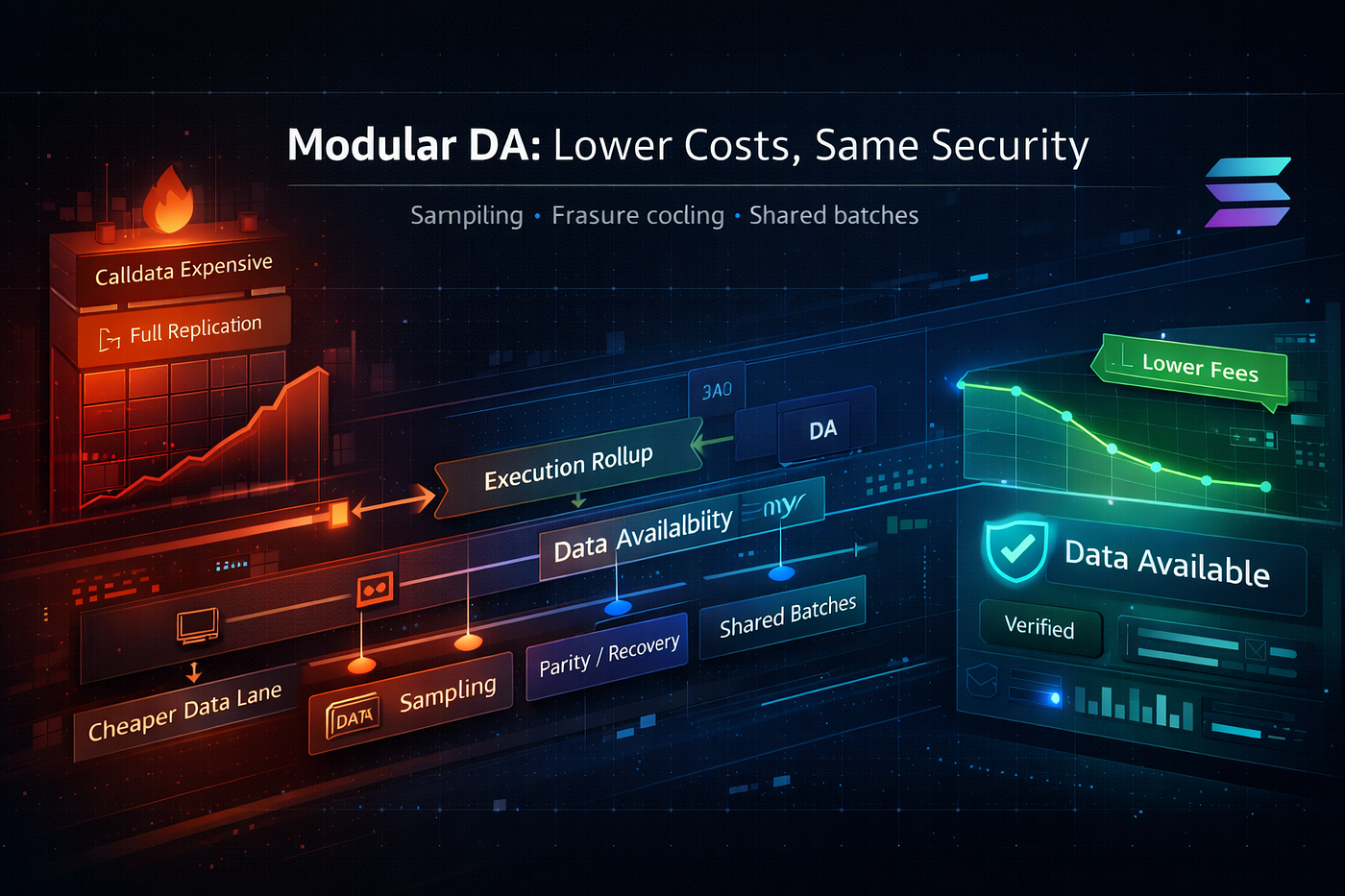
Modular DA lowers rollup costs with blob-style data markets, sampling, shared throughput, and smarter encoding — without weakening security guarantees.
You’ve probably heard the pitch: “Modular is cheaper.” And sure, that’s often true. But the interesting part is why it stays secure even as the bill drops.
Because data availability (DA) is the one piece you can’t hand-wave. If users can’t access the data needed to verify state transitions, your rollup isn’t “cheap.” It’s just… unverifiable.
So let’s walk through five concrete, production-minded ways modular DA reduces costs without turning security into a vibe check.
The quick mental model: what modular DA is actually doing
In a monolithic chain, the base layer does everything:
[Consensus] + [Execution] + [Data Availability] + [Settlement]In a modular setup, you split the responsibilities:
+-------------------+
           |   Execution Rollup|
Users ---> | (state, tx logic) | ----+
           +-------------------+     |
                                      v
                              +-----------------+
                              | Data Availability|
                              | (publish data)   |
                              +-----------------+
                                      |
                                      v
                              +-----------------+
                              | Settlement / L1 |
                              +-----------------+
The rollup executes. The DA layer guarantees the data is retrievable. And settlement anchors the result.
That separation is where the cost wins show up.
1) You stop paying execution-layer prices for “just data”
Let’s be real: a lot of rollup cost is simply paying L1 rates to store calldata.
Modular DA flips that: instead of shoving large data payloads into an execution-centric chain’s fee market, you buy data space from a system designed specifically for bandwidth and DA guarantees.
Ethereum’s blob approach (proto-danksharding / EIP-4844) is the clearest mainstream example of this logic: rollups post data in a cheaper, purpose-built data lane rather than paying the same way they would for permanent onchain storage.
Why security doesn’t drop
The security requirement is not “the data must live forever on every node.” It’s “the data must be available long enough for verification and dispute windows.”
Blob-style DA keeps the verification path intact while making the pricing model reflect what’s actually being bought: bandwidth and availability, not general-purpose computation.
2) Data availability sampling replaces “everyone downloads everything”
Old-school thinking assumes security comes from lots of nodes fully downloading and storing full blocks. That’s expensive — bandwidth, storage, ops, everything.
Modern DA layers lean on Data Availability Sampling (DAS): light clients randomly sample parts of the data and can still detect withholding with high probability.
Cost win
- Fewer full-data replicas required across the network
- Cheaper hardware profiles for many participants
- Lower ongoing bandwidth costs for “security monitoring” nodes
Tiny probability intuition (no heavy math, I promise)
If a block producer withholds a meaningful fraction of the data, a sampler making enough random requests will almost certainly hit a missing piece.
# Toy intuition: probability you *don't* hit missing data after n samples
# if fraction_missing is p, then miss_prob ~= (1 - p) ** n
def miss_probability(fraction_missing: float, samples: int) -> float:
    return (1 - fraction_missing) ** samples

print(miss_probability(0.10, 50))  # 10% missing, 50 samples -> tiny
The point: you can get strong guarantees without forcing everyone to download everything.
3) Erasure coding turns “withholding” into “recoverable” — and that’s huge
Sampling is only half the story. The other half is erasure coding: expand the data with parity so the original can be reconstructed even if some pieces are missing.
Cost win
Erasure coding shifts the economics:
- You don’t need brute-force replication for safety.
- You need smart redundancy that’s provably sufficient.
Security becomes “can the network reconstruct the data?” rather than “did every node store every byte forever?” That’s a cheaper path to the same assurance.
4) Shared DA gives you economies of scale (and surprisingly big fee smoothing)
Here’s the underappreciated truth: most rollups don’t produce enough data to fill a whole “posting unit” efficiently. If you’re buying capacity in coarse chunks, small rollups tend to overpay.
This is why shared DA and batching are so powerful. Multiple rollups can share the same DA infrastructure and even the same “container” of posted data.
Cost win
- Better utilization of fixed-size posting units
- More predictable pricing (less “I posted at the worst time” pain)
- Shared infra overhead across many teams
Why security doesn’t drop
You’re not reducing data availability guarantees — you’re just packing the data more efficiently before publishing it under the same DA rules.
5) You can buy “just DA,” not an entire validator + execution ecosystem
There’s a hidden institutional cost in monolithic land: if you want security, you often inherit the whole stack.
- execution constraints
- validator economics
- storage expectations
- full-node burdens
A modular DA layer is closer to “cloud storage with cryptographic receipts,” except it’s decentralized and consensus-backed.
Cost win
- Rollup teams can optimize execution environments independently
- DA providers compete on throughput and pricing
- Teams avoid paying for execution-oriented overhead when all they need is data publication + guarantees
Security stays intact because…
DA is the check. If data is posted and provably available, anyone can reconstruct and verify. The rollup doesn’t need every participant to run a full execution node; it needs the option for anyone to verify when it matters.
The practical takeaway: modular DA is “cheaper security,” not “cheaper security theater”
Modular DA cuts costs in ways that are refreshingly concrete:
- Cheaper data lanes instead of execution-priced calldata
- Sampling reduces bandwidth/storage burdens for broad verification
- Erasure coding makes withholding detectable and recoverable
- Shared posting improves utilization and smooths fees
- Specialization lets teams pay for DA guarantees without inheriting the whole stack
And the security story remains the same at the core: data must be available for verification. Modular DA just makes meeting that requirement less wasteful.
Conclusion: If you’re optimizing rollup costs, start with DA design
If your rollup roadmap includes “reduce fees,” DA is not a footnote. It’s the battleground.
Ask yourself:
- Are we paying execution-layer pricing for raw data?
- Can we batch or share posting units?
- Do we have a plan for sampling/verification?
- Are we architected to swap DA providers without rewriting everything?
If this article sparked an idea (or a disagreement), comment with your hottest DA take — and follow for more deep dives on modular architecture that’s actually shippable.
메타데이터
- post_id
- b85d87f8919e
- slug
- 5-ways-modular-da-cuts-costs-without-losing-security-b85d87f8919e
- url
- https://medium.com/@Modexa/5-ways-modular-da-cuts-costs-without-losing-security-b85d87f8919e
- canonical_url
- https://medium.com/@Modexa/5-ways-modular-da-cuts-costs-without-losing-security-b85d87f8919e
- author_url
- https://medium.com/@Modexa
- status
- ok
- fetched_at
- 2026-07-20 18:16:01