The Horse’s Name was Friday!
Preface:
The Horse’s Name was Friday! It’s not Obvious Why it’s Obvious: Mathematical Triviality, Autodidacticity, and Driving in the Fog
Preface:
I make the disclaimer that this essay is but one of many components extracted out of its natural context from a much larger piece in which it is situated in. It is true, as written in the title, a a subⁿchapter — and yes, you read that right: it is a subchapter within a subchapter within a subchapter (chapter(chapter(chapter(…))) of a much larger “pseudo-book” that is incumbent to progressing labor. As such, the disclaimer as obvious: there may be certain references, ideas, etc. which seem unmotivated in present context; there may be various pieces of commentary which seem ever so unprompted or spontaneous, seemingly random discussions which butt in with an insulting and irrational lack of justification.
Anyhow, having yet not completed the full body of the aforementioned “pseudo-book” (and it is truly lengthy, some several hundred pages), I decided that it was still ever worthwhile to publish snippets of those constituent subⁿchapters as hors d’oeuvres in the meantime.
Without further ado, enjoy.
⸸⸸⸸
⊛(sub³)-Chapter 3.2.5:
The Horse’s Name was Friday! It’s not Obvious Why it’s Obvious: Mathematical Triviality, Autodidacticity, and Driving in the Fog
“If there is something I would like to teach, it’s curiosity.”
–Alain Aspect (Nobel Physics 2022)
“Only a little, a tiny seed is needed: let him cast it into the soul of a simple an, and it will not die, it will live in his soul all his life, hiding there amidst the darkness, amidst the stench of his sins, as a bright point, as a great reminder. And there is no need, no need of much explaining and teaching, he will understand everything simply”
– Fyodor Dostoevsky (The Brothers Karamazov)
“What is the most resilient parasite? Bacteria? A virus? An intestinal worm? An idea. Resilient… highly contagious. Once an idea has taken hold of the brain it’s almost impossible to eradicate. An idea that is fully formed — fully understood — that sticks; right in there somewhere […] Listen, there’s something you should know about me… about inception. An idea is like a virus, resilient, highly contagious. The smallest seed of an idea can grow. It can grow to define or destroy you.”
– Dominic Cobb (Christopher Nolan’s 2010 Inception)
“If you want to build a ship, don’t drum up the men to gather wood, divide the work and give orders. Instead, teach them to yearn for the vast and endless sea.”
– Antoine de Saint-Exupéry
“You can lead a horse to water, but you can’t make it drink!”
*– *Apocryphal**
Horses are usually given names; we tend to personalize, indeed anthropomorphize even, those animals which become intimately involved in our lives. It is not even strict to animals: we may even give names to appliances, cars, pet-names to people, people-names to pets, and whatever else. This is all of course: obvious. And I do not mean to infantilize, we are merely stating trivialities here. Horses are usually given names. Names can take all kinds of forms; they are proper nouns, as subsets of nouns– in some ways they are separate from all other words in that they describe none another than what it is identified by the name itself, insofar as there is no intrinsic meaning to the word “Alice”. But there is no rule, linguistically speaking, on what makes a name a name– it is self-referential in that way: I’ve certainly known many cats named by adjectives, even once a dog named “dog”, I shall not be so bold to conjecture that there are no verb nor adverb given names, a word becomes a name when it has been named to something. Tautological? Maybe. I digress. Nevertheless, it is a fact: Horses are usually given names, and this name could be, well– anything.
This is all obvious, sure. And yet I am nevertheless certain– it is obvious to me– that it is entirely unobvious, why, and of what use these trivialities shall ever grant to us. It shall in time, perhaps, serve as quite a clever solution to a problem which has yet to introduce itself to us; and ever, as always, it will not even be obvious why the solution shall be clever, it will not be obvious why this picayune introduction was necessary to begin with, it will not even be obvious why this trivial fact is worth remembering, and it will certainly not be obvious what makes it all so obviously obvious.
Nevermind. It will in time, be obvious– or so I hope.
In any case. Of the argument we so rudely interrupted ourselves with, we shall see to it that there is perhaps more than anything a counter-effectivity to the sensationalist woes of science popularization. It is this infantilization, the pseudo-democratization we wield in artifice of the lowest common denominator; it kills real learning, it kills curiosity– and as we shall soon see, it is perhaps curiosity at its quintessence which is our only true and reliable well-spring of knowledge. To speak in trite, and rather oxymoronically to that end: there is no free lunch, and if there is free lunch, it shall kill your appetite– so there can be no free lunch (somehow it is always when free pizza is available that I am least hungry, I am reluctant to think this is merely bad timing). Free knowledge, easy knowledge, is thereof a false service, it is a backhanded patronization: the platter is served with only starvation– insofar as we can “give men fish to eat, but if not to teach man how to fish, then…”. As paradoxical, and perhaps heretical, so be it, I shall contend that true learning occurs in a set entirely disjoint from “teaching”: that is not to say that it happens necessarily in the absence of “teaching”, nor that teaching is in any way inconducive, but that the true moment of comprehension happens– and can only happen– in a Casimir’ian adiabaticity entirely within the self*.

The Rising Sea I (Colin McLarty) Footnote: Grothendieck makes similar remarks in his magnum opus, “Reaping and Sowing”, a similar kind of pseudo-biography albeit much superior in both size and content to mine here obviously. He has an entire chapter dedicated to “The Art of Being Alone”, as loosely translated from French– speaking to the necessity of the researcher to bring forth the epiphanies of the universe nurtured from isolation; scientific discovery and scientific learning are siblings adjacent in this sense. After all, discovery is merely learning that which nobody else has taught before. To him, research, pedagogy, heutagogy, andragogy: one and the same, up to isomorphism of the target space.*
Perhaps this is all melodramatic bagatelle, to spout of Socratic aphorisms: “I cannot teach anybody anything; I can only make them think”. Nevertheless, stating obvious things seems to be one of my specialties– and besides: “Everything that needs to be said has already been said. But since no one was listening, everything must be said again” as André Gide would quip back; moreover, it is the very moral of this sub³-chapter to discuss the nature of obviousities, this is all perhaps obvious, and yet perhaps it is unobvious what it is that makes up something to be obvious at all: alas we proceed!
Autodidacticism, I shall ensue to claim, is hardly mere subset of learning. It is, in every sense, the quintessence of true learning– at least of any kind worthy. It shall even lend us some motivation as to why our Mathematical textbooks (and our snarkily hilarious Mathematician friends; if you are blessed enough to have any in your life, then you are surely familiar– and if you are not, well, befriending a mathematician shall be left as an exercise to the reader!) very often enjoy to condemn us into pedagogical solitude, with the infamously beautiful: “The proof is trivial, and it is left as an exercise to the reader”. What follows is perhaps nothing more than anecdotal remark, but so be it– I can hardly discount it however trifling. I have a great friend– Mathematician, of course– who is in all things rather eccentric. She tends to call them “truth almonds”: and of such truth almonds– where a Mathematical text will seemingly, out of nowhere, reveal to you some incredibly profound theorem or fact as if it were simply god-given legality, with not its ounce weight of supporting evidence, motivation, nor explanation– I used to think they were merely affects of lazy writing, or simply poor pedagogy.
“Obvious is the most dangerous word in Mathematics”
– Eric Temple Bell
“Pauli was lecturing, and he said “this is obvious“. A student raises his hand and says “sorry professor, I don’t think that is obvious“. Pauli stares at the board, back at the students. He thinks for a bit. He starts pacing in front of the class, thinking. He looks back at the board. Eventually he leaves the room, comes back 20 minutes later and says “I’ve thought about it and yes, it is obvious“.”
[…]
“In Princeton’s Fine Hall, Boas recalls, someone once posted a “Scale of Obviousness”:
If Wedderburn says it’s obvious, everybody in the room has seen it ten minutes ago. If Bohnenblust says it’s obvious, it’s obvious. If Bochner says it’s obvious, you can figure it out in half an hour. If von Neumann says it’s obvious, you can prove it in three months if you’re a genius. If Lefschetz says it’s obvious, it’s wrong.
– Two Funny Jokes on Mathematical “Obviousness” (Apocryphal)

*There is another thing about Mathematical obviousness, Grothendieck once put it: “One should never try to prove anything that is not almost obvious”; in some sense, in Mathematics, we can only ever do, obvious things. Is this not the point of row-reduction in linear algebra? Or at that– even basic arithmetic!: there is no sense in which Fields medallists nor kindergarteners alike, are truly capable in computing “3821593 + 1923543”, it is too unobvious. What we can do, instead, is to break up the unobvious problem into 7 obvious problems, computing the sum by digit places: we convert a big arithmetical nuisance into 7 iterative instances of trivial single-digit arithmetic. Mathematics, really is, all about taking one “really hard problem” and transforming them into a collection of trivial ones. Stated plainly, it sounds rather silly in teleology: “Mathematicians cannot solve hard problems. What they can do, is turn hard problems into easy problems, solve the easy problems, then turn them back into hard answers; Mathematicians do not prove theorems, they turn theorems into lemmas, and prove the lemmas”. It is not clear why this works: how there is even any intellectual profit to be made at all, is rather miraculous. This is one of those silly platitudes that stenches of blatant nonsensicality at first glance, and yet matures into great profundity once one has climbed the Wittgensteinian ladder to see past the tautologicality; another such platitude which comes to mind, as we shall discuss later, “the way you solve a differential equation, is by first knowing the solution”. In any case, we’ll talk more about this “step-ification” process later with a beautiful Terence Tao remark, and what this Mathematical approach might have to tell us about the learning process as a whole.
I was wrong. I misunderstood the proof left as exercise, there is a benevolence– and even a rather presciently prognostic one; there is a pedagogical genius to it which deserves credit. I’ve come to think (and surely many of them are, perhaps, indeed merely products of laziness or poor efforts at exposition– though, we ignore this case, lest we allow the few bad apples to spoil the bunch) that oftentimes, Mathematical writers condemn us with these “Proof is trivial, left as an exercise…” truth-almonds with great intention– and in some of the greatest texts– with delightful precision in consideration of the pedagogy of it all; as if the author had somehow foreseen the architecture of the entire book at just a moments glance. Oftentimes, past the infuriation of these truth-almonds or “reader exercises”, you discover later that they were planted with clairvoyant fidelity– that the author had intentionally left some things vague, or unclear, so that you must lead yourself to autodidactically discover the motivation or propositional circumvention. It gives you a kind of appreciation, gratefulness– or anticipatory intuition even, simulating the moment of discovery just as it had first been glimpsed by its pioneer; what great a pleasure it is to re-derive some famous result all on your own*– for a theorem that the author only grants later in the text.
“The job of an educator is to teach students to see vitality in themselves.”
– Joseph Campbell
Autodidacticity is not simply one way to learn, nor the best way to learn (indeed, even this proposition is rather counter-intuitive; the very premise to schooling is the belief in subscription that autodidacticity must somehow or another be reserved only for the most genius among us. It shall turn out that this is untrue), it is, in every sense, the only way we ever learn– it is all, essentially, autodidactic. Beneath the lectures in sleight of hand, it shall turn out that the mark of a Professor is hardly ever to teach you of anything. Subsumed, therein, however thick the illusion, it is true that the agency to consume knowledge is something of a private act. I shall even claim that this is hardly polemic, I am not stating anything novel here, I claim that you have known this all along.
What’s the saying? “You can lead a horse to water, but you can’t make it drink”.
However subtle the distinction it may be, it is an important one. Functionally it is perhaps all the same, but morally, fundamentally altering in perspective– and this makes all the difference (indeed it is these subtle shifts which lend to great fruit even if only psychological guardrail; I am reminded of the first time I learned of the subtleties that go for pull-ups: instead of thinking about pulling yourself up, think about pulling your elbows down– it makes all the difference, though it may look identical relative to endpoints. It is a neurological trick which employs the latissimus dorsi to greater fruition). Realize, that a teacher shall never truly be able to teach you anything; it is rather a second order term, they teach you how to teach yourself (“Teaching²”). The act of conviction, to be convinced, can hardly be lent out as a task. In such a sense, even the very act of persuasion is illude all the same– for you never truly convince anyone of anything, one merely suggests an interlocutor to convince themselves, and thereof: the unconvinced can never be persuaded of anything, provided it does not come as automorphism, persuasion can only be a repermutation of thought from within. We shall come back to this as a deeper moral lemma, in good time. A great teacher can show you, how to think about an idea– but they should not, and in fact, cannot– ever really learn it for you. Inasmuch as it would remark rather insensible to all other tinges of qualia, to show a blind person the color red, or to smell something for someone, to be a surrogate-experiencer, understanding is perhaps a qualia of its own– the essence of which, perhaps, is a necessarily private structure. Thereof, nobody can understand an idea for you: a great teacher can give you open-ended analogies and conducive idea biscuits to chew on– but you have to choose to swallow; even spoon-fed consumption is not free. How each person decides to compel themselves to take the leap, irregardless to however alluring a teacher’s rhetoric may be, is necessarily and entirely an autodidactic task. You can’t make the horse drink, and that’s more than just fine; for feature not bug: the divinity of comprehension is a gift most intimate, most durable; not only can it not be taken away from you, it is a taste reserved to the privilege of your experience, and your* experience only. Talk about eruditic selfishness.
*Footnote:
There is the saying: “explaining a joke is like dissecting a frog; you understand it better, but the frog dies in the process”. This is, actually, quite faithful to the Mathematical intents of “leaving things as exercises”. This makes for a rather pedagogical non-triviality, wherein sometimes the best way to teach, is to not teach. Inasmuch as we may ruin a joke for our listener by explaining it, we may ruin an idea by attempting to ~understand it for our reader; it is best left as an exercise. We shall discuss this later, in the context of scientific-popularization, insofar as it goes towards the modern decree to infantilize via ELI5.
I shall venture to even further claims of heresy. There is rather something of a subtle popular misconception to the mechanisms by which learning occurs, by which “understanding” occurs at the critical-point of its phase transition– as does water rather suddenly become ice, confusion rather suddenly manifests into comprehension. There is a profoundly erroneous truism, spoused by diletanttes and cheap salesmen of motivation alike– indeed its popularity shall hardly suffice for truth, lest we conflate familiarity for correctness. It is the grand phrase that your middle-school math teacher probably eloped with in excuse for your poor performance at every other parent-teacher conference: “practice makes perfect!”. Even generally speaking, this is hardly true at even a neurological level. Indeed, to practice a golf swing incorrectly 10,000 times shall only make me that much worse, and only ever that much more hopeless to avail. “Practice makes permanent”, is perhaps of greater fidelity. Nevertheless, pedantries aside, we shall broadly fathom what it is that this truism has sought to get at: indeed, good practice, to practice well and to do it right, can hardly be denied as good advice. Though even so, these shallow notions hardly import to the notion of “understanding” and true comprehension. Indeed, I shall be able to practice the Kumon sort of arithmetical tortures up to bulletproof reliability– there is, however, no moral guarantee whatsoever that it implies of my “understanding” of the concepts therein; indeed this is the case for much of a highschool curriculum, in such a case, practice makes for lexical parrots with nothing more than a trivial level of pattern recognition. There is indeed, as we shall come to see, something about the essence of true comprehension which is nontrivially and necessarily immethodical; “study” and “practice” is simply the act of gaining familiarity with the method of the madness (or rather, the lackthereof). How it is, at even a mere schematic level nevermind the neurological rigors, that the “understanding” of an idea fulfills a closed circuit and changes phase into an unambiguous certainty, is by no means a settled science. We had already– what feels like long ago now– discussed Von Neumann’s remark: “Young man, in mathematics you don’t understand things. You just get used to them”. We, rather collectively, as low-resolution truism, seem to have this notion, for something as rigorous and seemingly mechanical as Mathematics, that one can simply improve their Mathematical abilities by way of practice. This is not strictly untrue, though nevertheless a misconflation. It shall in fact, turn out to be incredibly nontrivial, how it is that “practice” aids unto Mathematical ability, how “practice” and repetition actually works to conduce understanding; for at one moment, you are banging your head against the wall as you have been for the last day or two, and then all of a sudden, it just, clicks*.
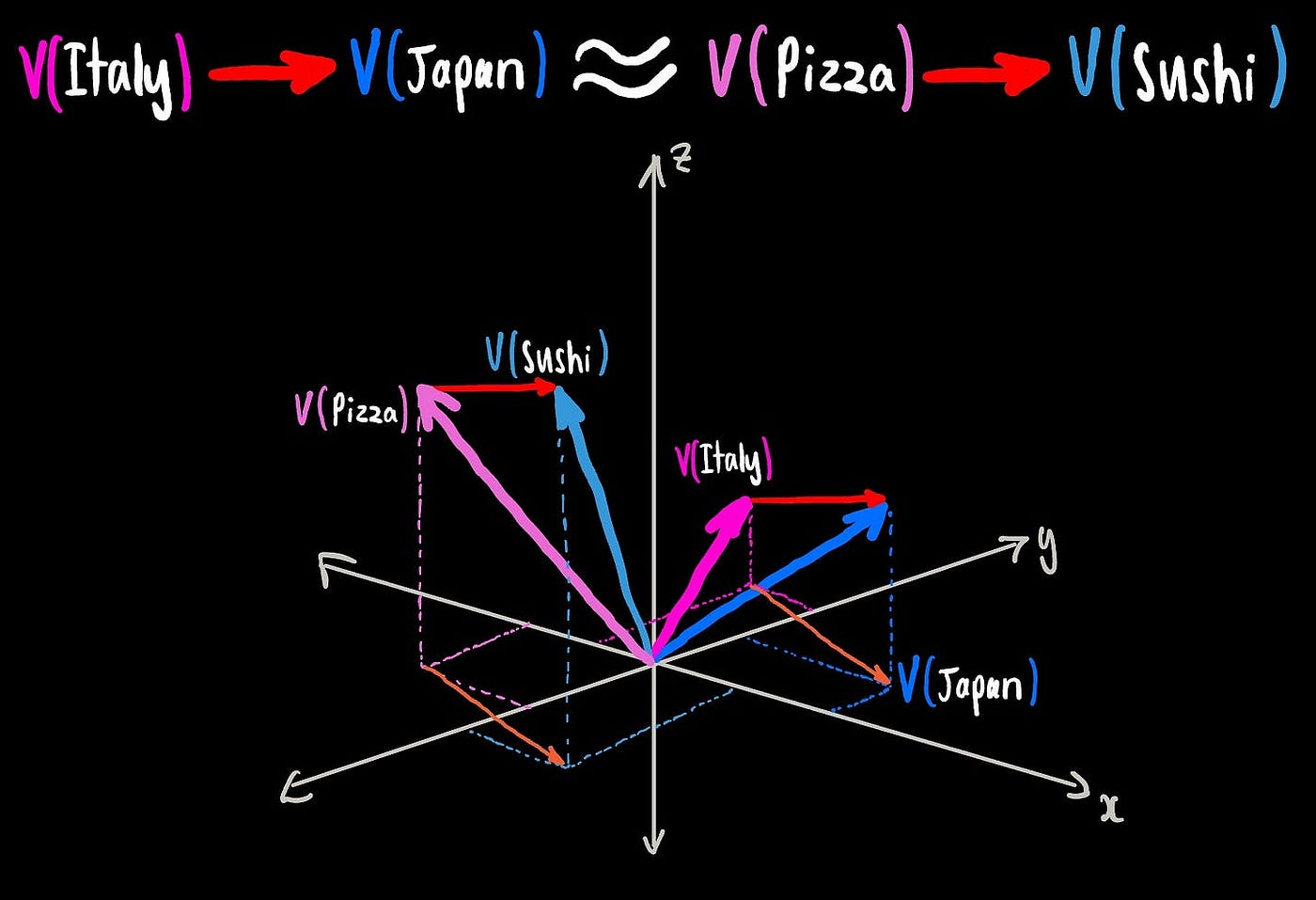
*And an especially hot topic I might add, in this era where we have giant linear algebraic blackboxes spitting mellifluous lyrics of knowledge, all the while unclear of whether or not these algorithms truly “understand” the syllogistics and semiotics of whatever it is we mean by “meaning”.
“All problems in Mathematics are psychological.”
– Pierre Deligne
It is not as if Mathematical thinking is a simply iterative task: no two problems are ever explicitly the same, it is not as though it were merely technê as of trade or craftsmanship; inasfar as repetition in the kitchen makes for a perfect pasta sauce (though even then, cooking is hardly a deterministic craft either– up to the variables uncontrolled in the environment; the culinary art, is then, in some ways the science of arriving at the same reliable destination from ever-so-slightly varied initial conditions), while on the other hand in Mathematics solving the same exercise again and again bears no intellectual profit. Of Mathematics, a problem solved cannot be unsolved– and therein, every puzzle is, and must be, ever so slightly different. The notion of practice in Mathematics, is rather misleading: it is not technê. The fruit bears not from the explicitries, hardly ever, not as one might perfect a golf-stroke or a tennis backhand: it’s about gaining a back-pocket intuition for things. Mathematics is highly technical– make no mistake, there are no shortage of explicit techniques, tools, and computational skills one needs to develop– but it is in most Mathematical impasses, at least of any impasse worthy unto struggle, where abstractive intuitive prowess is what’s truly at play. It isn’t entirely clear, how one goes about developing their intuition, besides the immethodical madness of brute familiarity. There is rather an archetypality to the savannah of Mathematical problems, the Mathematician is therefore not technician in sense of surgical execution, but diagnostician in the sense of pattern-recognizance; we are not computers, neither should we try to be, to which the technê may be happily outsourced. There is no doubt that chess is a game of great technical skill, one cannot do without the study and training of one’s skills in closed-environment drills– but we must also engage in the playful sparring, it is only through our game-experience that we can hone our intuition for where a rook may trade; chess is more than anything a pattern-recognition exercise rather than a calculative exercise, insofar as even the chess-engines do not perform the probabilistic computations outright (they couldn’t, it’s “intractable”, it would exceed our cosmological budget).
As of the novelties unto any two games of chess, Mathematics is ever the same. It is not as though we can so simply, so bijectively, “import” our practice into play– at least not straight forwardly. There are many such cases of Mathematics (especially those of tackling an infinite sequence or some tricky integral; I shall insist if for nothing else but neurological fascination to give a watch of some of those integration bees on YouTube, it is provocatively evident how the Mathematician’s intuition comes in to play. Not that Mathematics in synecdoche is necessarily about solving integrals, of course), whereof no menial labor is in slack, no room for mere computation to be made: it must amount to something of an idle patience, a submission even, a quiet welcoming to those strikes of epiphanic recognizance; “Oh! Wait a minute, this thing is just X! This integral must cancel out into zero!” we mutter to ourselves. They are made up of rather subtle, but key observations– in fact, it is these key observations which are most often so fundamental, so simple, and it is this that we blame for not having seen it to begin with; on that account of innocent subtlety, it is the nature of such problems that they are all the more impenetrable to mere bruteforce (*in fact, perhaps counter-productive; busywork keeps the mind active but perhaps only as distracting veneer, a waste of mental cavalry as Whitehead would put it). There are no amount of pages which can fulfill the scratch work to solving such a problem– you shall either see the solution at whole, at once, or not at all, there is no “work in progress” of such a riddle (indeed, it is precisely like a riddle). Then of what sense here do we mean by practice? Whereof, and what of, such problems, are we practicing? It were not as though we were working through an integration-by-parts worksheet, not as though we were practicing a repeatable and verifiable golf-swing– we can have no doubt that these weekly problem sets and exercises of some unseen proofs are immensely accommodating to our skills, though it seems rather gratuitous as to how; it is not as though I will ever solve exactly this problem again. Thereof, it must be: we practice, in this novel Mathematical sense, only as a service to the pattern-recognition blackbox which rests atop our shoulders. Perhaps we are no better than the silicon variety we so often berate on account of rational crypticity. There is the vogue pedagogical doctrine so often and so casually spouted, that “we ought teach kids how to think, not what to think”– as if it could ever be so simple; whether we like it or not, subjected to our neurological whims, this is how it is (though Grothendieck would perhaps disagree, it is true he is an outlier to this dictum). I am just as poor a fan of wanton and senseless regurgitation/memorization of facts, but it is otherwise true that the brain requires a number of factual examples to use as precedence– it is over this collection, that we begin to generalize, unto the recognizance of deeper structural reason; there can be no **how’s of thought spun in the cognitive web of things, if there are no vertices of fact to snare between them. It is only with this cognitive marination, over great deals of time, and experience, and all of the repetitions thereof, which lends to the subconscious familiarity; and thereof what shall manifest as the intuition to recognize those moments of “Cosine!” collapse. It is the Mathematician’s field-work intuition, their little box of tricks. This is perhaps even hardly restrict to Mathematics. Inasmuch as these little wisdoms, in all walks of life, can never be so simply purchased in textbook: the Mathematician’s intuition exacts a similarly vacuous cost, earned, over maturity; such, of Mathematical maturity, is almost merely a product of hardy patience.
*Footnote:
“It is a profoundly erroneous truism, repeated by all copy books and by eminent people when they are making speeches, that we should cultivate the habit of thinking of what we are doing. The precise opposite is the case. Civilization advances by extending the number of important operations which we can perform without thinking about them.” … “By relieving the brain of all unnecessary work, a good notation sets it free to concentrate on more advanced problems, and, in effect, increases the mental power of the race.” Both quotes of the great Alfred North Whitehead.
https://www.youtube.com/watch?v=eFnV6EM-wzY
“To mangle a Feynman quote, you should always keep in the back of your mind your 12 favorite problems and your 12 favorite tricks for solving problems; eventually something will match up and everyone will call you a genius.”
– Frederick Manners (Math 262A Syllabus)
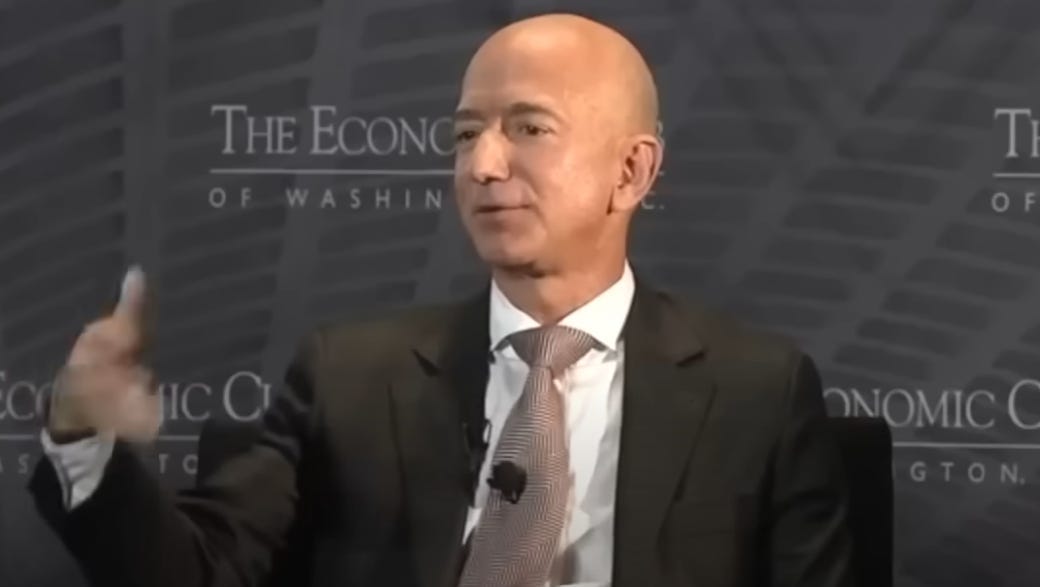
My friend Joe and I were working on a very difficult partial differential equations problem set one night. And there was one problem that we worked on for three hours and we made no headway whatsoever. And we looked up at each other at the same time and we said, “Yosanta”. So, we went to Yosanta’s dorm room and he was there. […] And we said, “Yosanta, we’re having trouble solving this partial differential equation. Would you mind taking a look?” And he said, “Of course.” […] And so, he looked at our problem and he stared at it for just a few seconds, maybe 10 seconds, and he said, “cosine.” And I said, “What do you mean, Yosanta? What do you mean cosine?” He said, “That’s the answer.” And I said, “No, no, no, come on.” And he said, “Let me show you.” And he took out some paper and he wrote down three pages of equations, everything canceled out, and the answer was cosine. […] And I said, “Yosanta, did you do that in your head?” And he said, “Oh, no. That would be impossible. A few years ago I solved a similar problem and I could map this problem onto that problem, and then it was immediately obvious that the answer was cosine.
– Jeff Bezos (Cosine: The exact moment Jeff Bezos decided not to become a physicist)
I like to say that, in Mathematics, you often have the opposite of “too good to be true”. Some problems are “too hard to be true”. The student reading this shall perhaps be more than familiar, no stranger up to even mortal enemy. A problem, often faced by some baroque war crime of notation, we tend to think (or at least, we rather refuse to believe otherwise): “this is too hard to be true as stated; it must somehow or another collapse into something trivial, the algebra as cursed origami, a monster made of cardboard. There must, we insist, lie some clever symmetry– which when observed, unfolds into elegant triviality. Somewhere in here is a one-line proof hiding behind a curtain of noise. I insist that it’s a baroque mousetrap of a problem– way too ornate to be real. Something must snap beautifully if I touch it the right way”. And alas, we sit there. We wait. We stare. For what else is there we can do? The pencil is short to dormant impotency here, the paper remains bare. We refuse to even attempt what is clearly a provocation of byzantine insult. We observe, and silently, inactively; stress testing the metaphorical table joints in your head like building a cognitive ikea desk.
It is rather, indeed, akin to solving a riddle. Mathematical problems of this kind, are indeed bearing of great resemblance to this nature of puzzle. There shall hardly be anything methodical you can do. No scratch work attended to– we are not in middle-school anymore, arithmetic shall be left to our silicon friends. Recall the first time you heard:
“A man rides into town on Friday, stays for 3 days, and leaves on Friday. How?”.
Utterly baffling. It seems even constructed in so great an audacity, to appear in every obvious sense provocatively impossible. It is even insulting, in such a way, as if it is an intellectual taunt– encouraging the detour along those backroads of thought. Alas, in good time, the solution comes to reveal itself: and therein, all of a sudden, all is immediately trivial! “The horse’s name was Friday!”.
“A mathematician is a person who can find analogies between theorems; a better mathematician is one who can see analogies between proofs and the best mathematician can notice analogies between theories. One can imagine that the ultimate mathematician is one who can see analogies between analogies.”
– Stefan Banach
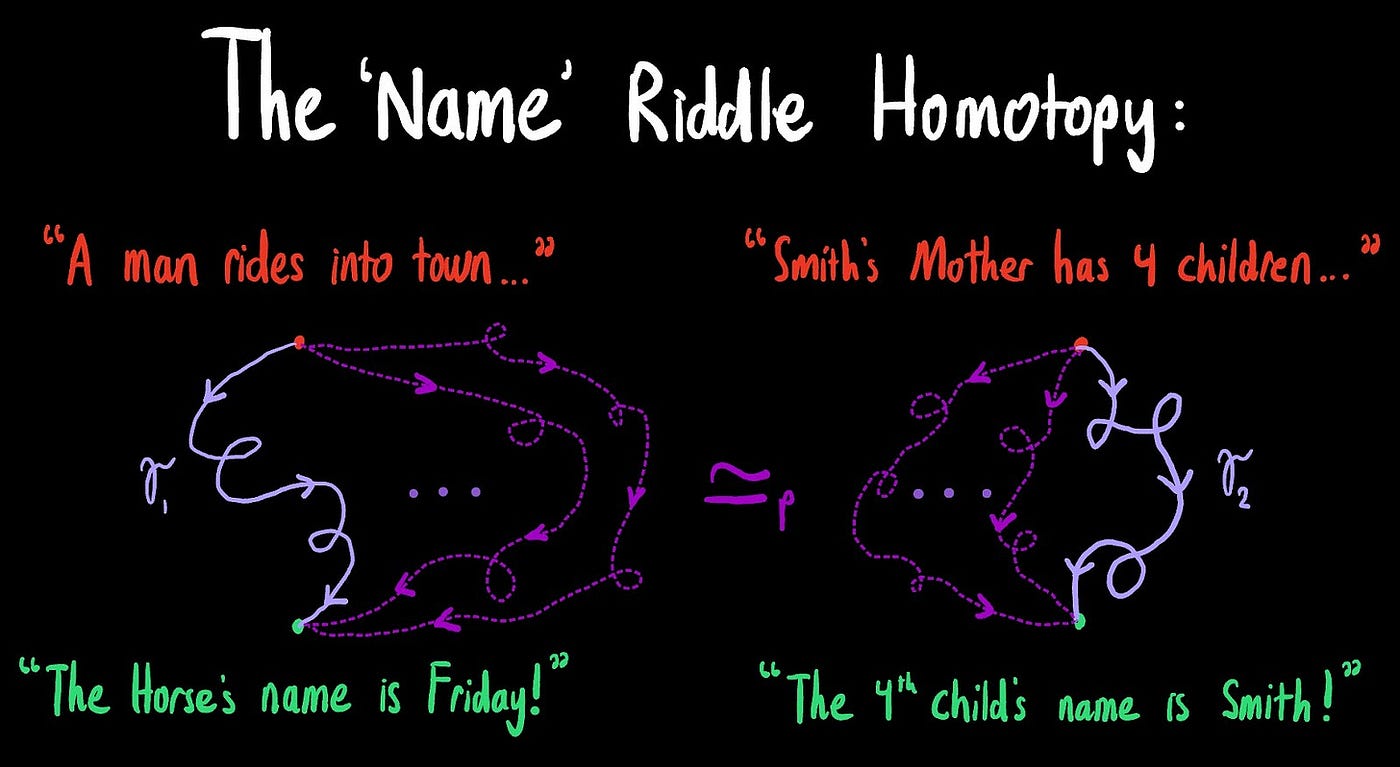
Let γ₁ be the solution, the “path” from the query to the answer of the ‘Friday’ riddle. Let γ₂ be the solution, the “path” from the query to the answer of the ‘Smith’ riddle. We say that these two solutions, these two “paths”, are homotopic to one another; that is, there is a “path” between the “paths”, insofar as we can smoothly deform one path into the other. This is precisely the Banach’ian sense in which homotopy theory gives us the credence of motivation to category theory: the first order is to form paths between points, then paths between the paths, paths between those paths– to higher and higher orders of paths between (paths of (paths of (…)))– inasmuch as it is the categorical dictum to form analogies, analogies between analogies, and so on. The ultimate perspective, to the God’s eye view of generality, Mathematics then becomes as Hercules was to Harmodius; there is no need to solve each of these “Name riddles”, we simply categorize them into classes, so that we may find one analogical solution to kill them all.
And after hearing enough similarly instantiated riddles, you equip a kind of cognitive intuition, an instinct that helps you map one riddle to another, augmenting the solutions in whatever way necessary having recognized the various kind of tricks and solution styles to these riddles. Having now studied the solution to “… horse’s name was Friday”, you begin to develop a rigorous intuition to poke riddles for where they mislead you, and therein where their solutions lie, your mental cartography charting the landscape for mapping one riddle onto another; it is this experiential intuition in knowing how to transform each problem and their associated solutions to novel problems never encountered before. Say: “Mr Smith’s mother has four children: April, May, June, and…?”. At first glance, it seems a riddle different altogether to “… horse’s name was Friday”, no trivial isomorphism. But after having heard enough of these kinds of riddles, you develop a deep intuition for how one might construct such a mapping: you know where to look for wordplay, where to poke it for the answer. You’ve come to recognize that the latter half of the riddle is often a misdirective herring, a false pattern– that the solution lies in the former half, disguised in triviality. “Mr Smith’s mother! Therefore Smith is the 4th child!”; and thereof we come to discover that both riddles share a Mathematical structure, they belong to the same ~class/~category of riddles, those which reside on the linguistic play of anthimeria. Discerning the heart of this structure in its naked generality, allows one to perhaps anticipate, or even craft of their own, other such riddles in this class: we take the syntaxial ambiguity between verbs and names, say “Chase”, “Bob”, “Pat”, “Grant”, “Mark”, “Bill”, and therein we lay the trap for linguistic herrings. It is precisely this– up to isomorphism even, an ‘analogy of analogies’ as Banach said– kind of rigorous collation which makes up the Mathematician’s prowess; while you can never explicitly train for the next riddle– they are never the same: always unknown and exotic to you*– after hearing/practicing with enough riddles, there are intuitive tools that you can keep in your back pocket, a handy toolbox of analogies to map onto wherever else it may find use.
*Footnote:
Emily Riehl: “The category-theoretic perspective can function as a simplifying abstraction, isolating propositions that hold for formal reasons from those whose proofs require techniques particular to a given mathematical discipline”. There is a sense, and indeed rather faithful (by another quote which follows) that Category theory is a language which helps us sift what is obvious from what is not so; it is a measure of which things are more or less obvious from others. Peter Freyd: “[the point of Category theory is] to take statements that appear trivial, and show that they really are trivially trivial”. That is to say, that Category theory is a way of chaffing away that which is formally true from that which is conceptually true; to discern what is “simply true by definition” from what is not so. Of course, at the God’s Eye View: all of Mathematics is ~path-connected and therefore simply true by definition in one big tautology. Nevertheless, we cannot shake off the bearing of sense that some things really have a canonicality, that some things are more obvious than others. For example: a theorem in algebra, say, “every finite group is cyclic” is a bona fide theorem in algebra; on the other hand, “kernels are normal”, is a statement dressed in algebra, but is true for entirely formal reasons– you could, prove it blindfolded so-to-speak, insofar as its proof does not leverage anything about algebra in particular. Some sentences in natural language are the same way: “Mary was late for her train because the train left earlier than it should have”, or “he took his last breath before he died”, is a sentence which is true for entirely formal reasons; “Sharks have 5 gills, usually” is true and yet decidedly not “obvious” insofar as it cannot be known apriori. There is some sense in which this bears resemblance, to say in a Kant’ian breath: the difference between an analytic and a synthetic proposition; the former is “formally true and self contained”, the latter is dependent unto reality and is hard to know apriori. Nevermind; I do not want to get too far affield in category theory here.
.
“It is through logic that we prove, but through intuition that we discover…”
– Henri Poincaré (“Science and Method”)
“I make all my decisions on intuition. But then I must know why I made that decision. I throw a spear into the darkness. That is intuition. Then I must send an army into the darkness to find the spear. That is intellect.”*
– Ingmar Bergman (“Ingmar Bergman Confides in Students”, NYT 1981)
**This is certainly what “computing” objects like the fundamental group, or homology, etc. is like. Rather than a clear chain of logical deduction– as it was in your calculus class– it is more so of this spear-throwing intuition. We must first intuit the answer, we then labor a proof to confirm our intuition. The art of differential equations offers a similar prescience, the “ansatz” solution as we shall later discuss. That is, put rather absurdly: “How do you solve a differential equation, Professor?”, “You solve a differential equation by first knowing the solution, then showing that it is indeed, the solution”. I shall always remember vividly a remark from my Graph Theory professor regarding a proof of some coloring theorem: “You should first stare at this diagram and convince yourself that this works, and then and only then will the proof make sense. If you don’t yet intuitively buy this claim, the proof will not convince you. Only after you are convinced, then the proof will make sense, and even then appear unnecessary”.*
This is rather the funny thing about “Mathematical obviousness”: it may be totally unobvious how, or why, something is obvious– whether or not you know it to be obvious (in fact I’ve even often found it possible to forget why, or how, something is obvious, as thus alluded to in the aforementioned Pauli joke). To every student of Mathematics, there is something of a canonical experience to be had when learning some new theorem or idea: the “trivial and left as an exercise” that Professors and textbooks delight with such pedagogical (or as properly claimed: heutagogy, really) amusement.
“… So then, obviously it must follow that 𝜙 is in fact exactly equal to X… This proof is trivial and left as an exercise for you to figure out after class…”
The student shall therein be stung with confusion, dare even insecurity. You wonder: “how could this possibly be obvious? Is this a testament to my stupidity? Have I not understood something imperative in the meanwhile, have I missed a class or something? Is everybody else understanding something I’m not, am I the butt of some joke– some elephant in the room I am so clearly irreverent to?”. It is natural, perhaps even a necessary despair, as rite of passage or otherwise. It is even funny, of a curious sense; how “the horse’s name was Friday!” is simultaneously elusive to deduce and painstakingly trivial afterthefact: Mathematical theorems (or lemmas, more aptly, perhaps; as per the following quote) are exactly of this nature. And perhaps it must surely be so, by necessity– it is precisely the mystique of paradoxically inexorable genius which gives it its profundity, in the intransigent gray between nebulous complexity and inevitable logical elegance; the greatest ideas in Science and Mathematics are those which are somehow both ingeniously clever and ridiculously trivial, so much so that one wonders why it had not been invented/discovered sooner. “Oh yeah! Duh! This is trivial! The riddle states that the man rides on Friday, and Friday can be a name!”. The great lemma must, in this way, perhaps give a student a faux-confidence, misplaced conviction that “even I too, could have come up with this!” inasfar as the true ingenuity is slipped into one’s hands as a magicians sleight: the true cognitive load-bearing task in-and-of such problems is not so much in solving the puzzle, but in finding the right floor lamp which illuminates the puzzle appropriately; thus the true genius, is in finding the right “viewpoint” — as Grothendieck had put it– inasmuch as the solutions therein come naturally, thereof they do not appear as solutions at all, but mere inevitable consequences.
“My propositions serve as elucidations in the following way: anyone who understands me eventually recognizes them as nonsensical, when he has used them — as steps — to climb beyond them. (He must, so to speak, throw away the ladder after he has climbed up it.)”
–Wittgenstein (Tractatus Logico-Philosophicus)
“All problems in Mathematics are psychological.”
– Pierre Deligne
“The essence of Mathematics is proving theorems and so, that is what mathematicians do: they prove theorems. But to tell the truth, what they really want to prove once in their lifetime, is a lemma, like the one by Fatou in Analysis, the lemma of Gauss in Number Theory, or the Burnside-Frobenius lemma in Combinatorics.
Now what makes a mathematical statement a true lemma? First, it should be applicable to a wide variety of instances, even seemingly unrelated problems. Secondly, the statement should, once you have seen it, be completely obvious. The reaction of the reader might well be one of faint envy: Why haven’t I noticed this before? And thirdly, on an esthetic level, the lemma including its proof should be beautiful!”
– Aigner & Ziegler (“Proofs from the Book”).
In any case, however necessary the bath of intuition, it is not as though it were any more or less determinant of understanding– it is even hardly reliable, and seemingly never with manners for punctuality; were it not so unreliable, thinking would hardly be worth epiphany! This essay would reduce into all the more trivialities if “intuition” were a satisfactory answer unto the phenomenologies of comprehension. The epiphany of triviality has, dare I say, a rather sadistic sense of humor; she wants to see you suffer, like a date who manufactures delay, perhaps she peeks through the window to watch you squirm nervously behold the candles and white tablecloth, stalling the waiter: all in good time, she will come, it is a test of patience! And when the patience pays off, by the time your entrées have arrived, the worries have long since ceased into laughabilities; it’s trivial, oh does it now become immediately evident that there was no confusion at all to begin with! The path had never been fogged to begin with, how couldn’t you have seen it before! It is trivial, in fact it always was trivial, rather oxymoronically– you just did not realize, did not have the primed state of mind, to notice its state of dishabille obviousness. It’s trivial, it’s obvious– though it’s not obvious why it’s obvious. Wittgenstein had once put it, that it is akin to discarding a ladder after having already climbed it; the vantage point of reaching the conclusion of the theorem gives one a sort of clarity that makes all to be seemingly obvious, so much so, that it becomes unclear what purpose the ladder had served at all. Oftentimes, the proofs of such “obvious” and powerful theorems will appear this way in retrospect: once you have used the machinery of the proof to climb to its conclusion, it will suddenly appear as if the proof was unnecessary– that it was all obvious to begin with, and the proof simply becomes a chaff of abstractive nonsense.
I had made earlier the observation to Grothendieck’s philosophy on “only ever being able to prove obvious things” in a footnote. It is perhaps too honest a remark to abandon there, it deserves some elaboration. If there shall be at all one pithy moral I would expedite in a take-out box, from my study of Mathematics, perhaps it is precisely this: “Nobody can solve a hard problem. The only problems we ever solve, the only problems we can ever solve, are those which are already obvious”, and thereof the pleasure of Mathematics merely ensues as the art of transforming hard problems into easy problems. Indeed it is true, “the only things worth proving are those which are already almost obvious”: you shall need the moral proof before you can ever hope to write its formal proof; you must first understand why it ought be true– it is this obvious, intuitive, morality which then gives you a strategy to attack it formally. How we are at all enabled to alchemize a free lunch in this way, is perhaps a Wigner’ian epistemology which reserves for later discussion. Under some heuristic budget, there is even a way in which those very strategies of “transforming hard problems into easy ones” gives rather a moral classification to the various philosophies and continents of Mathematics:
(1) Dichotomy, to divide and conquer; a very algebraic notion, to decompose a hard problem into atomics/simples/irreducibles, to break down a theorem into lemmas and then those lemmas into propositions … this is perhaps the most common strategy: it is true even of elementary addition– insofar as we never really solve 14385+82313, instead we compute (1+8, 4+2, 3+3, 8+1, 5+3) by the digit places, breaking a hard problem into 5 iteratedly easy problems. This continues to be true, even of the field extension yoga, of intersection numbers and emulsifying algebraic varieties. (2) Perspective, the change of notation, a change of coordinates to elute a convenient and obvious solution; this is perhaps the heart of geometry– in an abstract vulgarity, this is what geometry is really about, not the naive sense of shapes and angles. There is a joke that geometry is the study of objects invariant under change of notation; that is to say, the geometric spirit is to study how properties remain/differ when viewed under different “perspectives” (in the general sense, need not be strictly “spatial”). (3) Flood the Valley/The Rising Sea, to rewrite the very defining language in such a way that the problem becomes “obvious”, it is no longer a solution but a sterile inevitability. It is often we find then, that the incumbent language already has redundancies built into it; thereof, rewriting the very language of the theory allows us to sift out the unnecessary details, to reflux what is persistent and to isolate the crux of what really determines the structure of an idea. This is the Grothendieck’ian style of abstraction. (4) Symmetry and forcing the elephant, to recognize a symmetry in the overarching branches in the broader family of a set of problems, then we allow these solutions to permute with one another– much as family members take turns at a portrait event. Taking into account this larger family album “upstairs”, studying how permuting the question respectively permutes the answer, allows us to recognize poles of congenital stability. Then we move “upstairs”, cover the heads with a blanket (as with the three blind men and the elephant) as to blind oneself, and thereof– not unlike the neuroplasticity of sensory compensation (the blind who develop sharpened hearing, touch etc.)– we are forced to see only the most blatant generalities which kill the n-birds with one stone. This is the Galois spirit.
Perhaps you are right that it would be inappropriately brisk to reduce all of Mathematics to so laconic a T-shirt quote– I err not to say that this summary suffices anything close to the pleasure and beauty of taking up a Math degree. As we had cautioned earlier of platitudes and dollar-store truisms: there is of course hardly any meaning nor merit to abridging all of Homer’s Odyssey into merely some guru-slogan about “man never stepping in the same river twice…”. It is trite, and all as much it is true– though, even so, this summary is perhaps only ever meaningful post-facto, it is a take-out meal worthy only to those who have done the work to suffer for the supper. Nevertheless, gun to my head, “what lessons did you learn from your Mathematics education?”: this would be it. It is more than just true that Mathematics so often turns out to be comically obvious in hindsight, that it is not obvious why things are obvious; the converse is true as well, giving us a kind of tautology: of course Mathematics shall always turn out to be obvious, the only Mathematics we can do is that which must be obvious.
So how did it happen when you were a toddler, that you truly comprehended the meaning of the number 3? Or any number for that matter. It’s not as if the number 3 can be found in any empirical material essence, captured to be displayed in a case of glass somewhere, extracted from its platonic ineffability. It would even seem that any attempt to describe the number 3 seems helplessly and bizarrely tautological: “There are 3 apples here because, well look! One, two, three! There are 3 apples!”. So how is it, and when is it, that such a seemingly delphic idea finally clicks? How do we understand, what is understanding? We know merely how to conduce it, how to coax and cozy up to the summit of comprehension– but in that liminal gap between education and comprehension, there is satori: a magic occurs that no man has ever seen, and oh dear, much less methodized. The examples we serve, the exercises, the practice– it serves only as the lead is to the horse, the practice brings us to the watering hole; but to make the horse drink? It remains a mystery, what this final, essential step is in pedagogical transmission, is no short of miracle. This is not to say that examples are obfuscative (though we concede that Grothendieck would perhaps take issue with that; he would say that examples are obfuscative to naked abstraction, in a way) or unnecessary, they are necessary but insufficient: it is least we can do, to provide the soils for which we hope the natural tendrils of analogy will come to root in the child’s mind: “Here are 3 apples”, “Here are 3 birds”, “Here are 3– oh! I get it now!”.
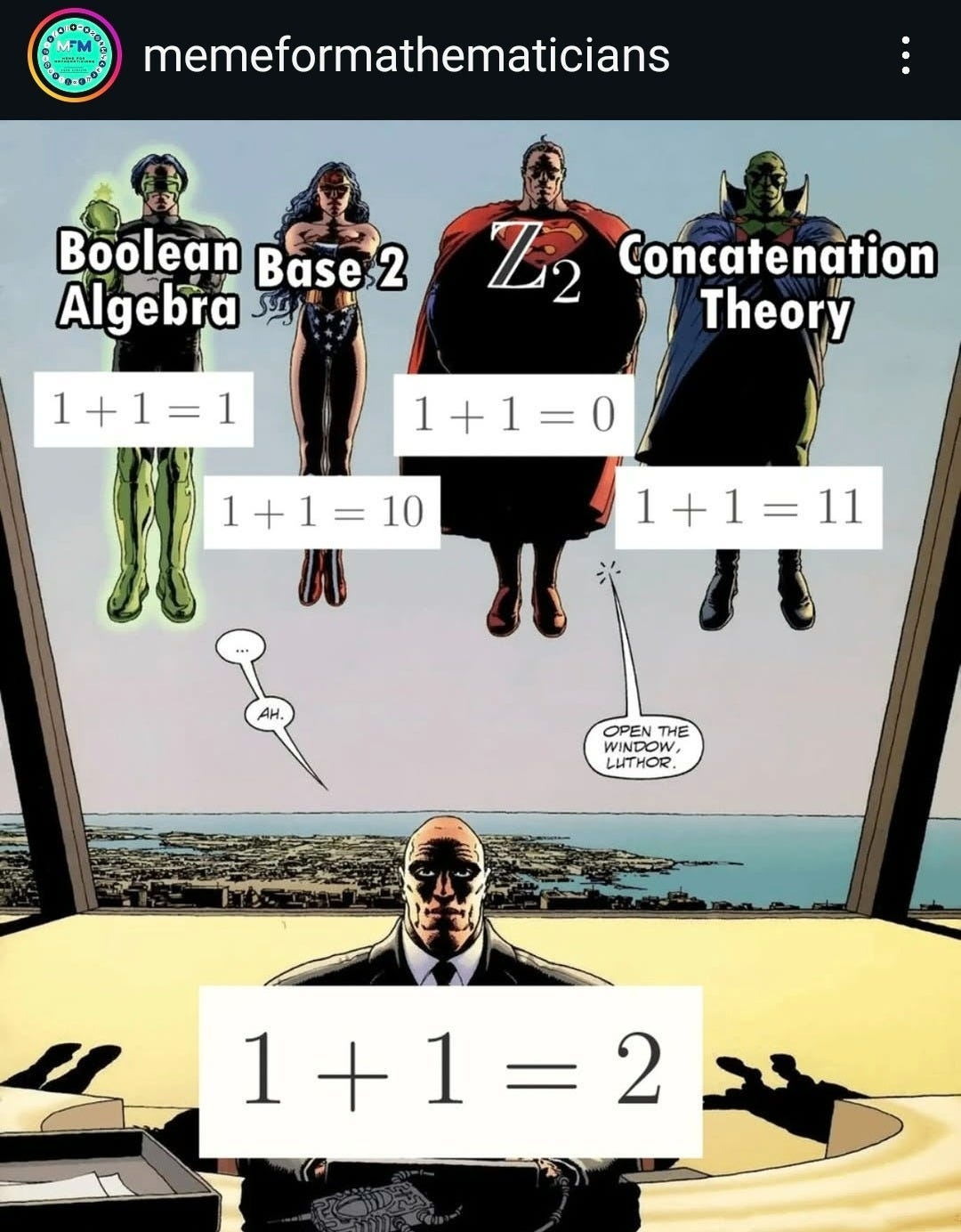
This is a rather standard gnoseological observation to the Mathematician, I do not claim to be shouting heretics here. Take, of even the tersity in the foundations of Mathematics, it isn’t exactly trivial why 1+1=2; why’s are somewhat infelicitous queries, at least so far as they take up a contrivance with the spirit of Mathematics in formality, proofs are hardly satisfactory answers at this level; re: Mathematics Morally as we have discussed some many chapters ago. 1+1=2 is hardly a fact, it is rather a consequence of a collection of assumptions. Sure, should we take the Peano axioms (axioms, which by definition cannot be proved) for granted as our vanilla, our default flavor of arithmetic– then sure, it is true, and even maybe obvious, insofar as we define 2 to be the successor of 1, define the + operator as is; it is familiar, but familiarity is no substitute for truth and much less an obviousity of a truth– it is very much the basis of propaganda which yields upon this conflation between familiarity and truth. There too are plenty other Mathematical frameworks where 1+1 does not equal 2: in Boolean algebra, in concatenation theory, or in Tropical Algebras for example, where we define the + operator as a minimum function, giving us 1+1=1. Empirics are not to be trusted, they serve only as retrospective examples– we can find no empirical proof that 1+1=2, only ad-hoc examples in which 1+1=2 is a suitable definition; take for example the arithmetic of water-droplets: one water droplet, plus another water droplet, makes one big water droplet: 1+1=1? There is no hard-code present in the womb of our species that gives us some god-given empirical fact that 1+1=2, independent of any given rule-set of assumptions, hence why children struggle with it– despite the parrotting of preening pompous adults of an adolescent mathematical maturity, “it’s as simple as 1+1=2” they’ll say, they love to wield arithmetic as a pride-and-prejudice, an anecdote of objectivity; it couldn’t be more inappropriate. The Mathematician knows that 1+1=2 is not at all obvious, and perhaps not even strictly correct (dependent on our chosen axioms). “I have one apple, and I’m given another apple, now I have two apples!”, “I have one pencil, Bob gives me another pencil, now I have two pencils!”, “I have one ice cream– oh! I get it now!”: it all sounds ridiculously tautological; our pedagogy of this elementary arithmetic comprises simply of gavaging example after example, we bang our children’s heads against the wall repeating the same nonsensical “one plus one equals two, because, one plus one equals two; can’t you see!?” tautology until it somehow or another miraculously clicks. The irony is not lost: perhaps there is something to the accusations of abuse in K-12 Mathematics education, this is after all, epistemological gaslighting.
You can lead a horse to water, but you can’t make it drink. One can coax, conduce– but that mysterious liminal chasm between teaching and learning, is a magic entirely of its own solitude. How it happens, how concept truly embeds into the psyche, is a chaos undetermined: a storm of the mind ungovernable, and– therein, perhaps, insofar as man should not meddle with that which he does not understand, to fix problems which are not so clearly problems at all*: it should be left as so, a beast best left to roam unadorned.
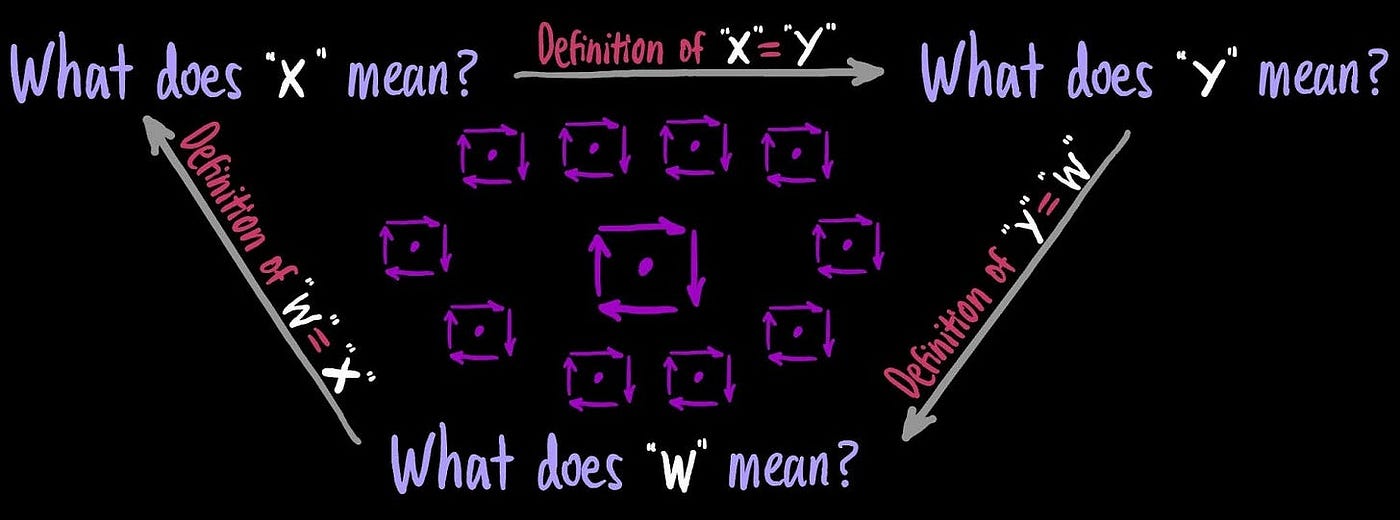
*There is a similar Chomsky’ian mystery here with how children develop to learn languages, which is perhaps isomorphic to the tautologial inevitability of teaching a child 1+1=2. It is unclear how children learn to associate words with definitions, considering that definitions are themselves composed of words. Surely, if you’ve interacted with children this is meaningfully apparent: when asked what X means, you respond “X means Y”, to which the child then asks “but what does Y mean?”, and so on so forth; consider how you would even go about defining the word “word” or “what” or “the” to a child without using those same words. There is even a nontrivial topology with regards to the self-referentiality of morphemic definition, where one discovers tautological loops of a sort: say if the definition of “strange” were given as “weird/odd”, but the definition of “weird” were given as “strange/odd”, and the definition of “odd” were given as “strange/weird”; it’s a closed Escherian loop, “X means Y”, “Y means W”, “W means X”. There is the humorous example: “Kidneys are described as bean-shaped, yet kidney beans are described as looking like kidneys; that is to say, kidneys are the organ which look like beans, and beans are the vegetable which look like kidneys. Tautology?”.
*“My theory is that the best way to teach is to have no philosophy, [it] is to be chaotic and [to] confuse it in the sense that you use every possible way of doing it. That’s the only way I can see to answer it, so as to catch this guy or that guy on different hooks as you go along […] I really don’t know how to do it. I don’t know how to answer this question of different kinds of minds with different kinds of interests — what hooks them on, what makes them interested, how you direct them to become interested. One way is by a kind of force, you have to pass this course, you have to take this examination. It’s a very effective way. Many people go through schools that way and it may be a more effective way. I’m sorry, after many, many years of trying to teach and trying all different kinds of methods, I really don’t know how to do it.”*
– Richard Feynman, The Pleasure Of Finding Things Out
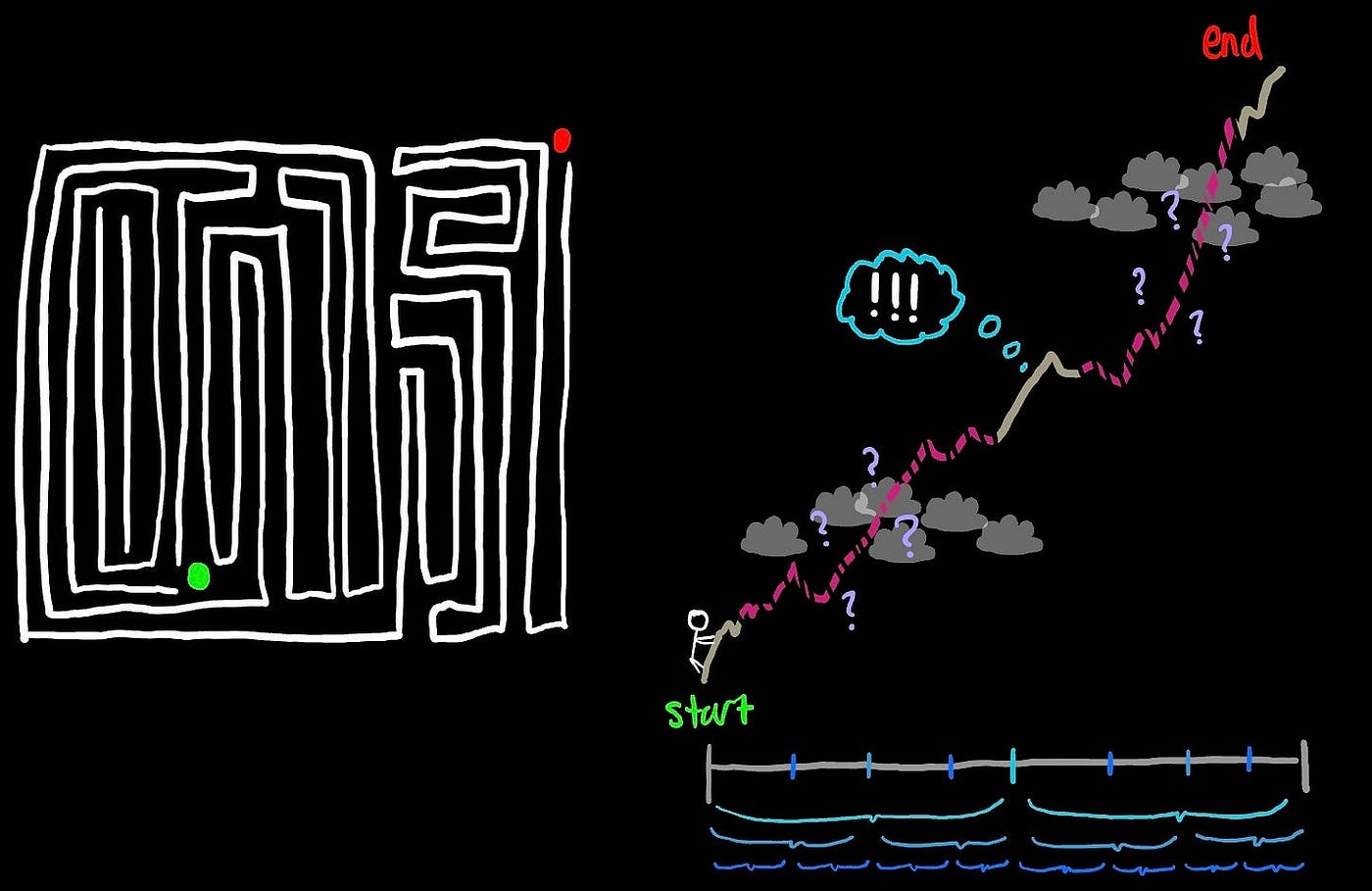
We shall speak hereof, this prescient faith in the chaos, the courage– not to dissect– but to embrace the fog even and especially absent of direction nor reason. The intuitional senses, which we have thus far spoken of to the Mathematician, is hardly restrict. Indeed, it is perhaps even all the more broadly characterizing; of the Algebraic sixth sense, to the chemist’s synthesis mindscape, the film-makers vision to synopsis, the painter’s phantasmagoria. It is, by all means, perhaps precisely this which hypostatizes an art form. The artist in wield of expedition, of faith in their vision, to see the whole orchestra unfold forth to a private sight before even the first brush has been committed to canvas. They see compositions on paper, hear sounds on empty scores, they can imagine– no, they see, it is given unto the artist more so as discovery than invention, revealed in piecewise fashion. The writer knows, before having yet even typed the first word, how the paragraphs shall seek to interlock voices, how the first whisper of introduction leads inexorably to the final word– of course, all the while, the intermediate grammatical details linger in an uncertain fog; it is so clear, so obvious, and yet so unobvious how it shall all come to reify. Is this not precisely what defines, what enspirits, the living ecstasy in any and all creative endeavors? The clairvoyance to dive oneself off the deep end, allocating the foot to castles in the air, staircases on no foundation at all– and yet, there is an unambiguous solidity to it, a resolve of certainty to something more real than real. If so, it is absolutely clear, that the Mathematician is artist by quintessence.
*Footnote:
Hadamard writes in superior detail on all this, in his book “The Mathematician’s Mind: The Psychology of Invention in the Mathematical Field”. This measly exposition of mine shall not compare in the slightest. There is a wonderful chapter, aptly titled: “Discovery as Synthesis”.
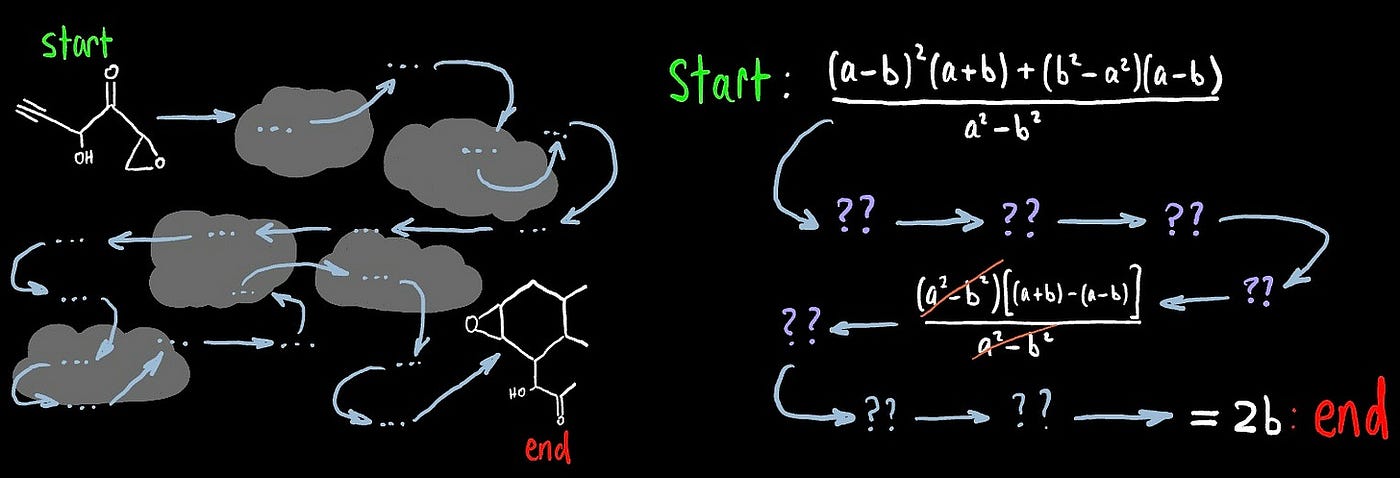
“Writing is like driving at night in the fog. You can only see as far as your headlights, but you can make the whole trip that way.”
–E. L Doctorow
It is this paradoxical simultaneity, of myopia and vision. Of certainty and uncertainty, as of the proof which cannot be made constructive– it resides in a positivist haze; certain to truth, and yet uncertain to its composition. The painter sits before the canvas with an image reverent and unquestionable, and yet this incontrovertibility is only half the battle– it is almost beyond any such chronological order in labor, the details linger in vague, not knowing where the first stroke ought begin, how each quadrant of the canvas shall ever end up in agreement with one another. It is the lawn-chair borne epiphany of the film-maker, I correct myself: perhaps it is more than half the battle. And therein the idea is born, the unassailable confidence in theme is spurred to a kind of deposition, the half-thoughts and the half-notions collect to a stable temperature, from gaseous instability into something palpable– the rest are merely details which exact the necessary labors to patience, time, the commitment to paper and organization. The Mathematician and the Chemist are too, very much clairvoyant artists in this sense; Edward Frenkel once remarked on the sensation of Mathematical research: “Charles Darwin actually wrote that Mathematicians are endowed with an extra sense […] Imagine there is this deep fog, you know there is something there but you don’t know what. And then occasionally […] the mist kind of starts dissolving, and you see the contours of the trees, or a castle, or some exotic animal– and then maybe it will close again. You don’t feel that you invent something, that you come up with something just on your own. You feel like it’s always been there, but obscured by our inability to see in the midst– only the destination*”.
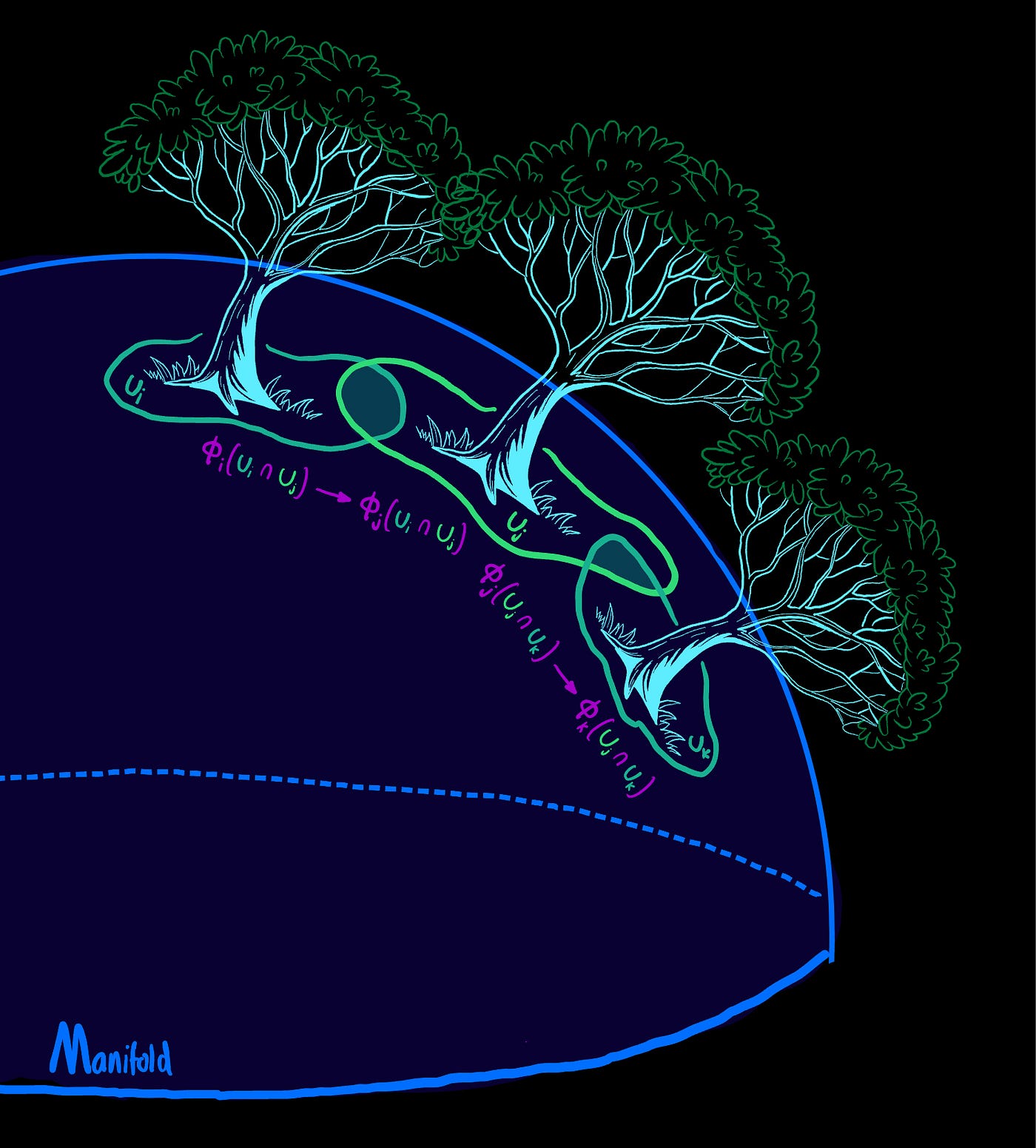
We shall ever and always be in concession to our limits as mere humans– there is, after all, only so much lent to our cognitive horizon, only so much we can render in distance provided our flesh-bound computational constraints. It shall hardly be fruitful to insist on sights of the image in whole, as if we could even dare to tolerate it: our senses, delimited, to see the manifold as a whole and not in piecewise charts; I would think it an insanity, overwhelming, perhaps. We take what we can, we work on what we can see, we have faith in what we cannot. Of the blind men and the elephant, do not insist to conquer the elephant in whole by one sense of touch. It will illude you. Touch it in parts, concede to these localities, and it shall come of this reverent patience– should you have faith to functoriality– that the senses glue together, and that all in good time shall become clear. No Chemist shall be able to see at a moments glance the synthesis in whole, to divinate a mental future in which each and every sequential mechanism leads lucidly from one intermediate to the next and all the way home to a desired product. Nevertheless, this myopic constraint is perhaps sufficient, moreover it is perhaps all the more empowering: “perhaps the headlights are all we need, we can make the whole trip that way”. Perhaps it is a rite of patience, a litmus to resolve. It is this barrier to the heavenly of epiphany; perhaps nature demands of us, to resign, to renounce control, to submit to uncertainty. The fog commits us to only single steps at a time, ever unable to see the process in whole– it is only ever relative to the endpoints; it is a test of the algebraician to be faced with notational monstrosity. The commitment thereof, is in a kind of olfaction: to trust in the senses given to our intrinsic scent, equipped by birthright, if only at the very least to faintly smell which of the split-forks yields the smoother paved road. And it shall be rewarded. There is a beautiful moment, nothing short of rhapsody: when the algebraic nightmare transmutes into elegance, and thereof the Mathematician’s sixth sense is knowing where and when to submit– where to touch, where not to, when to respect the form, when to split things open in times of ripe, how to use monsters to fight monsters, how to inoculate the self-annihilating disease.
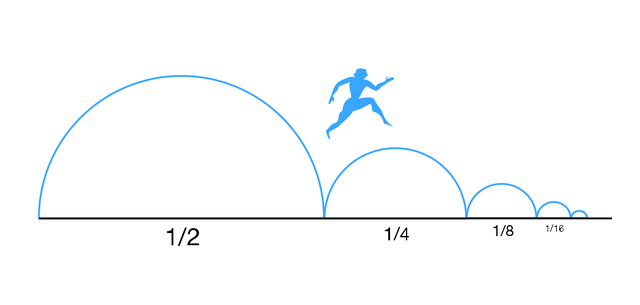
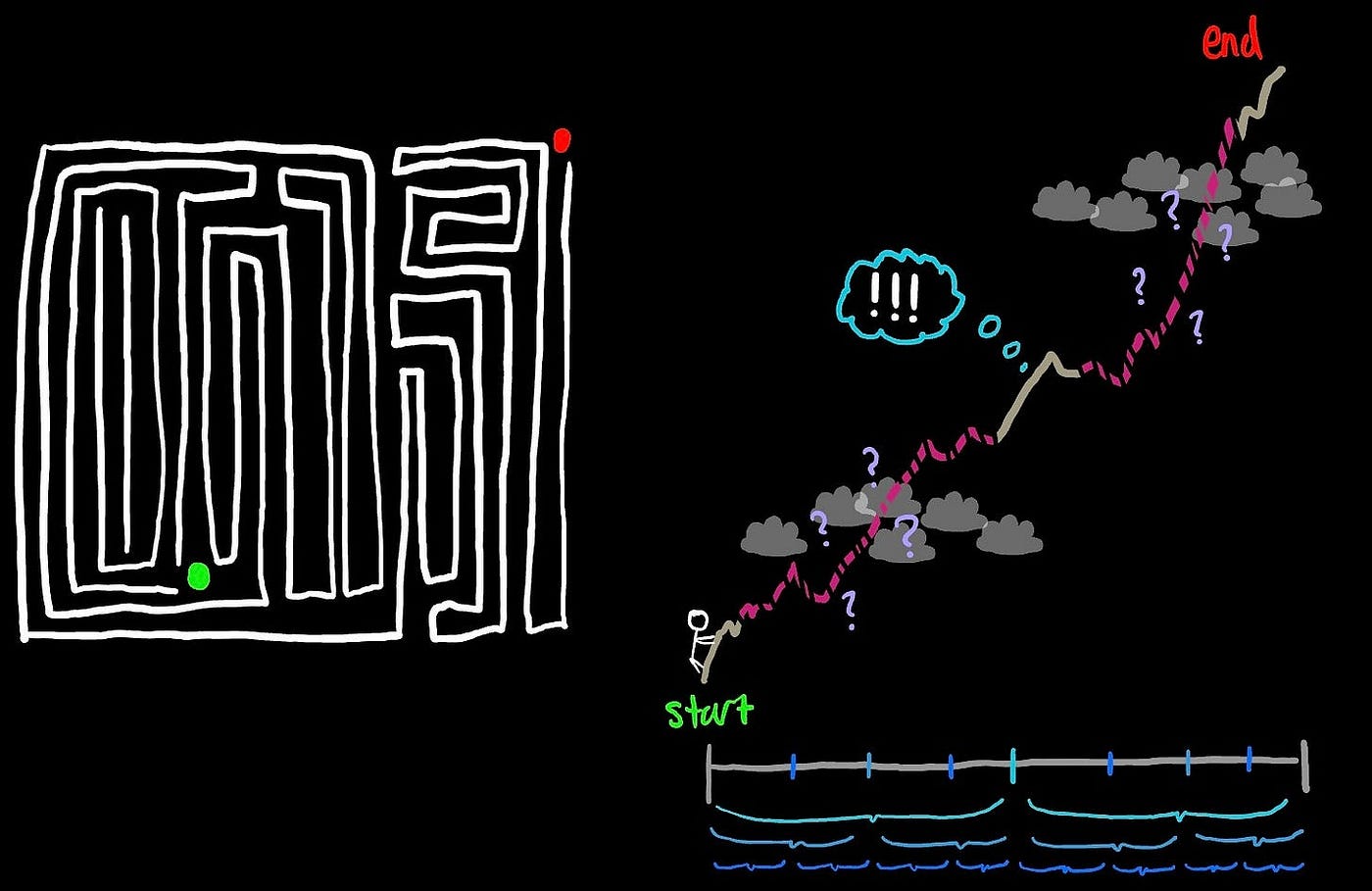
The very art itself of problem solving, is hardly an exact science; if the act of problem-solving were itself solved, then problems would cease to be problems at all, merely societal errands. There is an inexplicability, hence, the artistry– even paradox: there is a way in which problem solving may present itself as did Zeno’s walk to the park, or the preferred directionality of an asymmetric maze. It is quite often taken for granted, a truism often spouted– which, when inspected, is not at all obvious, even epistemologically mysterious: it can be oftentimes easier to solve a problem by working backwards. This shall be evident as left to the reader’s anecdotal experiences. That is, what the Chemists call retrosynthesis– to start at product and work backwards to reagent– or what the Mathematicians call (a variety of different proof philosophies, but most explicitly) the “Proof by contradiction” or the “backward chaining”; that is, instead of proving “If A, then B” directly, you prove the logically equivalent “If not-B, then not-A”, or to start with the goal (conclusion) and works backward to find which premises must be true. It is not entirely clear why this simple flip of deductive directionality is so effective, after all: why would problem-solving be chiral? It is not as if we picture that Nature had constructed logic in an order of preferred directionality and asymmetry: “If I’m at the start of a foggy cobblestone path in the forest trying to get to a safehouse, it shouldn’t be any easier to start at the safehouse and think my way backwards to the starting point… right?”. And yet, rather mysteriously, this does appear to be the case– whether that is an artifact of the human’s cognitive vantage, or of nature herself: there are a great many ⇔ theorems which somehow or another yield asymmetric proofs, where one direction of implication ⇒ is more elegantly proved than the other ⇐, however mysterious that may be in contrary to our intuition.
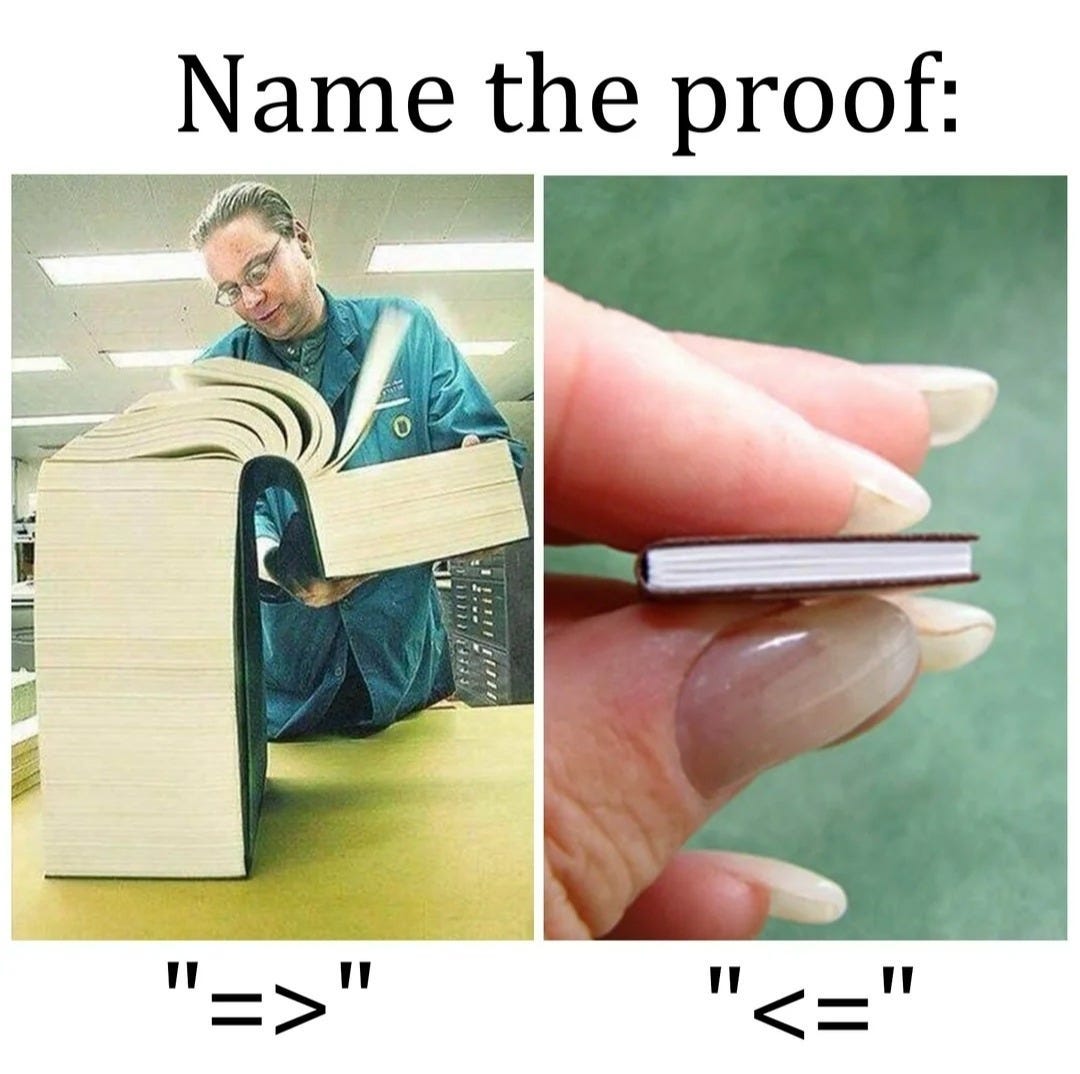
There is indeed, a rather epistemological discomfort in the fact that some theorems are proved more “naturally” in one direction as opposed to the other. If we subscribe to Feynman’s ontology of the universe as a grand woven fabric, all things connected to each other, there should be no good reason in which A is more closely related to B, than B is related to A; therein the space of concept is not just asymmetric, but fails entirely to possess notion of distance, we cannot metricize “distance” between concepts. It is almost as if one must be left to suppose that Mathematics has, indeed, some canonical chronological order to its construction; as if God had written the universe into existence on a schedule, the book of existence was written left to right. Perhaps God even has a Mathematical favoritism of a kind, insofar as some objects bear greater canonicality than others, there is very clearly an absence of egalitarianism in Mathematical objects, some truly are superior to others.
It is ridiculous, and yet, it works– it works confidently, one can check that it works, it is clear why it works, and all the while it remains ridiculous, in fact all the more confidently ridiculous, apropos to some gut-feeling that we have weaponized the letter of the law against‡ the spirit of the law. That is, put rather absurdly: “How do you solve a differential equation, Professor?”; “To solve a differential equation, you must first know the solution, then show that it is indeed, the solution”. By what means can we start with a solution to a problem, in fact, the very problem for which we are solving? Nonsense, apparently; and yet, hereof, there is fine print. We must start somewhere, *even if we start wrong. We must start with a solution, now lest we fall into tautology, it need not be the correct solution! That is to say: by a word you are otherwise familiar with, though perhaps one you never expected to see in Mathematical context, we guess. It is perhaps even to an extent that it feels like cheating (it is true, logically: it does not suffice as a proof to simply assume the conclusion and then show that, it is, indeed, true. Thus it really does sound like cheating; though the contrapositive remains legal, that is, to assume the conclusion is untrue, and then show that the premises are accordingly untrue). This strategy has a professional moniker in the art of differential equations, that is: an “ansatz solution”. It is perhaps counterintuitive, or rather, unfamiliar– at least to how one conventionally solves Mathematical equations in most of one’s arithmetical career. And yet, the ansatz solution is perhaps entirely native, more “realistic” to the pragmatisms therein of problem solving in everyday life. It is a criticism wielded most often by Mathematical-opponents, who spouse “when will I ever solve a problem like this in real life?!”; perhaps they did not get far enough in their career: solving differential equations bears more than anything else a frustrating resemblance to the real world, insofar as we lose the sanctuary of first-order deducibility, heck– solutions are not even guaranteed, there are problems for which the solution is a conclusion that there can be no possible solution, and therein the spirit of attack remains the same.
*Footnote:
A keen eye may observe that this “ansatz” methodology sounds a lot like the fraudulence of fudge-factoring, that is: to simply take experimental data and work backwards to “curve fit” and confabulate a model that appears to perfectly fit the observed data at the behest of your parameter tweaking. Le Verrier very much used a kind of ansatz method in deducing the existence of Neptune, but took it too far when he ended up fudge-factoring into existence the hypothetical intra-Mercurial planet Vulcan. For that matter, is “Dark Matter” and Einstein’s cosmological constant too not but a form of ansatz fudge-factoring? When is it responsible deduction, and when does it go too far? Is the Neutrino not just a “Dark Matter” fudge factor of a kind?
‡Footnote:
There is a well defined term for this: pettifoggery, the act of arbitraging the letter of the law against the spirit of the law. Wiser heads are well aware that even for so pedantic and precise a syntax as the legal code, there are prosodic ambiguities, semantic loopholes to take advantage of. There were once courts of chancery, which sought to settle such crimes on a moral basis rather than a strictly legal basis; that is, to ask whether the act committed obeyed the spirit of the law, notwithstanding those petulant fine-prints about syntaxial precision. Is the legal system, for all of its tricky and clever successes as well as its immoral enforcabilities, not precisely a testimony to this
Do not attempt to solve a differential equation, it cannot be done– there is no sensible place to begin, no canonical checklist to attend to, any place to start is almost as good as any other. Instead, you make an intuitive guess: one that is surely going to be wrong to some margin of error, but you are counting on being wrong– like playing darts blindfolded– because the methodology allows you at least to capture “how wrong you are, and by what margin”. You make this inexact guess of a solution, and work backwards to satisfy the equality as to give you an exact index of error, quantifying just exactly “how wrong you were”. You can now go back and augment your initial guess by exactly this margin of error, some scalar constant 𝐶 or some scalar function 𝑓, but only after verifying that your initial guess was wrong. So that now, having gone back to the start, your initial guess is modified precisely on its discrepancy to the expected outcome. You need to throw the darts blindfolded, but now having done so– you can gain insightful evaluation that “you were 19 cm too far to the left” to work backwards in using this information to retool your initially arbitrary guess.
The dilettante believes of a Mathematician, that their analytical nature make them otherwise repugnant to guesswork: this could not be further from the truth. The Mathematician– the analyst, more precisely– has perfected the art of guesswork, to the most rigorous extreme (oxymoronic? Maybe. Nevertheless it is true, at a level beyond words); the Mathematician coats the spear of intuition with faith, with courage, ansatz, it is the Mathematician who trusts intuition more than anyone else. The Mathematician understands its utility, where it cannot overstep: the spear of intuition is thrown to find the beast, to wound it, not as coup de grâce; nevertheless, every hunt must begin by spoor.
“You know you can’t really call your shots in mathematics. Some problems, the tools are not there. It doesn’t matter how smart or quick you are. The analogy I have is like climbing, if you want to climb a cliff that’s 10 meters high […] you do it with the right tools and equipment, but you know… if it’s a sheer cliff face, a mile high and there’s no handholds whatsoever, […] just forget it. It doesn’t matter how strong you are or whatever, you have to wait until there’s some sort of breakthrough, like some opening occurs like halfway through, halfway up the cliff and now you have some easier sub-goal. You know there’s some speculation, there’s some possible ways to attack the conjecture but nothing is really promising currently. You’re not climbing that cliff, but if a few foot holes appear […] Yeah, yeah yeah! You know it would… this is the way it works, whenever there’s an exciting breakthrough like everyone nearby in the area just sort of takes a look at their favorite list of open problems, “okay maybe this new trick can give you some advance”. It’s very hard to rule out that there’s some major breakthrough in something which seemed impossible suddenly becomes very very feasible.”
– Terence Tao (On the Riemann Hypothesis)
“The most difficult step often in solving a really hard mathematics problem, is to figure out the key intermediate– like you want to prove A implies B– if you can find the right statement C, which is halfway between A and B, so that you can prove A implies C and C implies B, and each of those steps is half as difficult as the usual problem. That’s a major major advance. And so sometimes just finding the key intermediate thing to do is essential, and maybe AI will one day become good at that. We don’t have data for that, so… AI so far only works when you have a lot of data […] We don’t have good data on how mathematicians actually write proofs– sometimes I joke that what we need is to strap cameras on mathematicians and actually watch them… do their job.”
– Terence Tao (The Potential for AI in Science and Mathematics, Oxford Lecture 2024)
Dichotomy, to divide and conquer. We shall need to be careful, to entertain division as an operation shall require a number of caveats to attend. Lest we run into Zeno on the way to the park. Though perhaps this is hardly of despair, there is a sense in which the Zeno phenomenon of problem solving shall present to rather beautiful and empowering a strategy to the alpinism of Mathematical progress. Terence Tao has thus illustrated: that it may be often helpful, even essential, to a cut a large problem into halves– then those halves into halves, and so on– so that each sub-goal becomes exactly half as difficult as its encompassing objective. The paradox of course, is that cutting a problem into half– while it certainly makes the sub-goal easier– does not, or rather should not, give you any leniency on the problem as a whole: since now you simply have two problems to solve, each half the difficulty of the whole, but in totality nothing’s really changed… right? And yet the mystery thereof, is that nature seems ever so gracious, that there is a cosmic discount granted to working in this partition. And I do not mean trivially, of the sense in which labor can be divied to collaboration. I mean of even a deep, genuine, epistemological sense in which Nature seems to appreciate this compartmentalization; on one hand, she is unified, the universe after all comes with prefix uni-, and yet on the other hand she seems to incentivize this “Lemma’ization”, as if her book comes naturally published in chapters, in paradigms. Why there ought be any sort of advantage to be had from walking halfway to the park, then half the remaining distance, then half that– seems entirely counterintuitive, but then again, so is the notion that Zeno ever arrives to the park at all. One must suppose there is some infinitesimal magic that occurs in between, a discount levied in the calculus of differentiation.
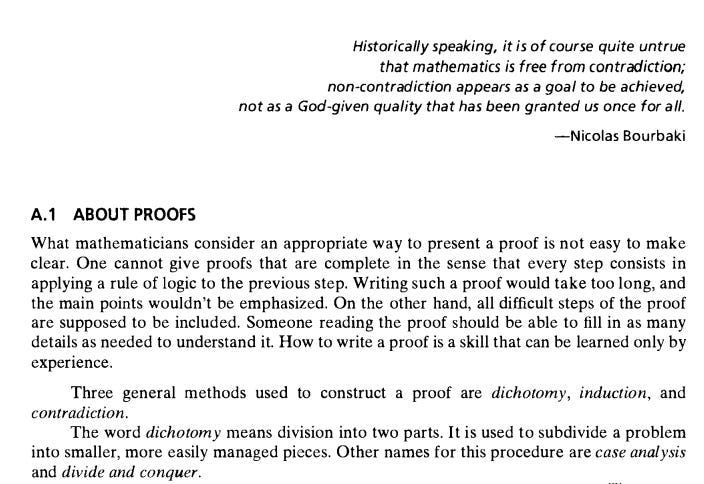
Michael Artin (Algebra 1991). Dichotomy; divide and conquer– somehow or another, we make free lunch this way. It is, and perhaps merely an artifact of human psychology, somehow easier to think of a theorem to prove as a collection of lemmas rather than as a unitary body of a problem.
And therein, of the process which is partaken to research and problem solving, perhaps we shall take some notes of inspiration unto the pedagogical process. After all, they are rather nontrivially related up to functoriality– for novel research, scholarship, is perhaps simply pedagogy in automorphism; it is simply to teach yourself that which nobody else has taught before. And so, perhaps pedagogy ought share a similar reverence for this intuitive chaos– voilà, serendipity; the structure of a syllabus should be exactly that: unstructured. Was that not moral of Feynman’s method to the madness– as he did in his famous class at Caltech, Physics X? In the true quintessences of learning: that the method is simply not to have a method, that the depths of the fog shall hardly be interpreted as obstacles, but in fact the very substance which draws into sublimation the questions which loom from the chaos of the subconscious. Perhaps merely knowing what the “next question” to ask, one headlight flickering in the dark, is sufficient in learning and in pedagogy– perhaps thats all there is to it, and all that should be left to it. It is more emulatory this way, natural, insofar as it is a reproduction– of the excitement, the banality, the suspense, the doubt, and everything inbetween– which shall come to follow as experience of the young student’s future scholarly career, in the real world of research. Therein, it is perhaps more than anything an obfuscation of structure– faux-structure as protocolized by syllabi– inasfar as we muzzle the senses of wandering curiosity, it is perhaps these natural chains of questions which are all the more native to the intellectual canon than any biblical reification. Curiosity is sufficient a sense of olfaction is it not? To leave the syllabus to the natural occurrence of where one question may lead to the next, to trust the gut-brain axis– the hunger for answers and the intellect for inquiries. Are we so sure it couldn’t be effective any other way? With the canon of the structured syllabus as we’ve remained complacent to for centuries– are we slave to something that works, merely because it works (“The purpose of a system is what it does” -Stafford Beer)? Is it canonical because we’ve found it to be most optimal? Are there opportunity costs invisible to our relented cultural habituation to it? All things considered in this (maybe not so) subtle digression, do we kill curiosity by defogging the lands? A lamp-post illuminated too intensely on the mere earthly low hanging fruit before us, alas, we have become blind to the stars. Where is the line between lazy pedagogy, obfuscative pretentionism, and spoon-feeding of the lowest common denominator?
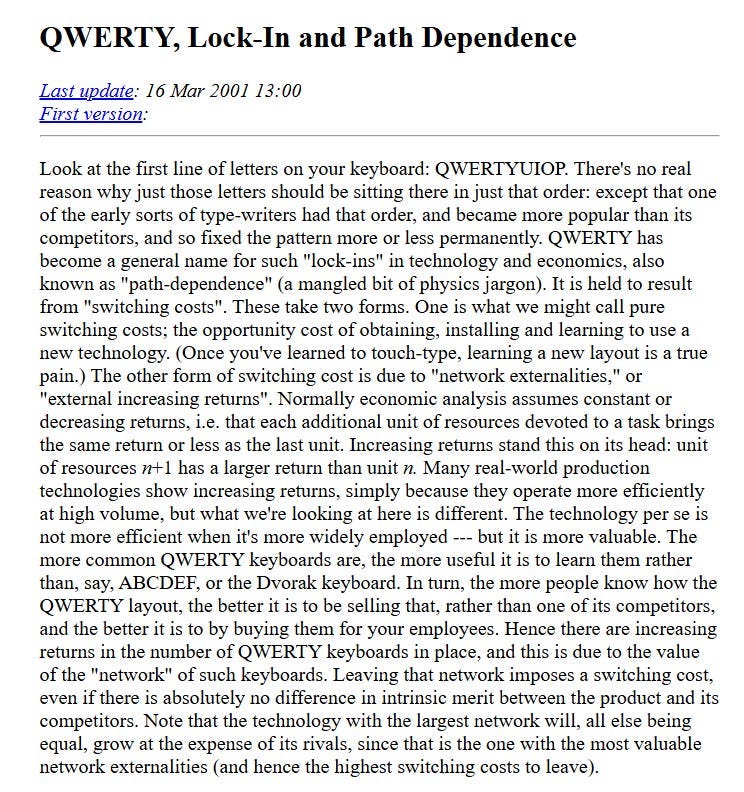
Such self-fulfilling incarcerations are often called “lock-in’s” in the context of Stafford Beer’s technological complacence. It is litmus of market failure, QWERTY has had no good reason for market success beyond the circumstantial flaws of physical typewriters which have long since become vestigial anyways. It has “locked-in”, it works, not well, but satiably to an extent that does not merit the opportunity cost to devest in it. There is perhaps a complacence paralogue here to pedagogical traditions, even modern AI-infrastructure; there is a sense in which LLMs+GPUs may avalanche into the QWERTY of our times, our grandchildren may wonder why we entrenched ourselves in so fallible an architecture.
“I have a foreboding of an America in my children’s or grandchildren’s time — when the United States is a service and information economy; when nearly all the manufacturing industries have slipped away to other countries; when awesome technological powers are in the hands of a very few, and no one representing the public interest can even grasp the issues; when the people have lost the ability to set their own agendas or knowledgeably question those in authority; when, clutching our crystals and nervously consulting our horoscopes, our critical faculties in decline, unable to distinguish between what feels good and what’s true, we slide, almost without noticing, back into superstition and darkness […] The dumbing down of American is most evident in the slow decay of substantive content in the enormously influential media, the 30 second sound bites (now down to 10 seconds or less), **lowest common denominator programming, credulous presentations on pseudoscience and superstition, but especially a kind of celebration of ignorance.**”
– Carl Sagan (The Demon-Haunted World: Science as a Candle in the Dark)
⸸⸸⸸
메타데이터
- post_id
- b87ea7916790
- slug
- the-horses-name-was-friday-b87ea7916790
- url
- https://medium.com/@ntendian/the-horses-name-was-friday-b87ea7916790
- canonical_url
- https://medium.com/@ntendian/the-horses-name-was-friday-b87ea7916790
- author_url
- https://medium.com/@ntendian
- status
- ok
- fetched_at
- 2026-06-24 04:09:36