A Visit, One Evening
A Visit, One Evening — traducere 14–27 februarie 2011
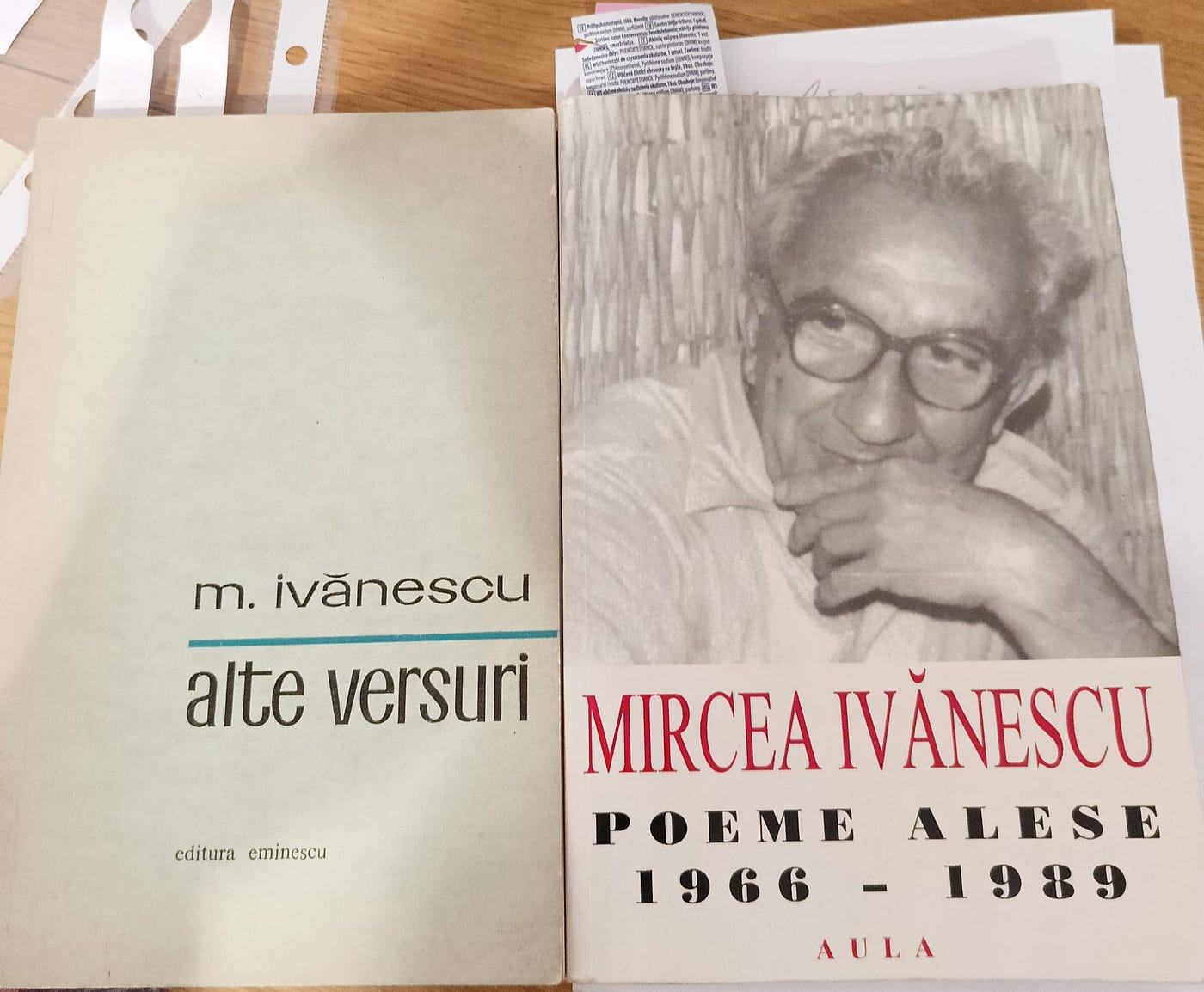
A Visit, One Evening — O vizita, seara by Mircea Ivanescu. Translated 14–27 Feb. 2011 by Nick Popa
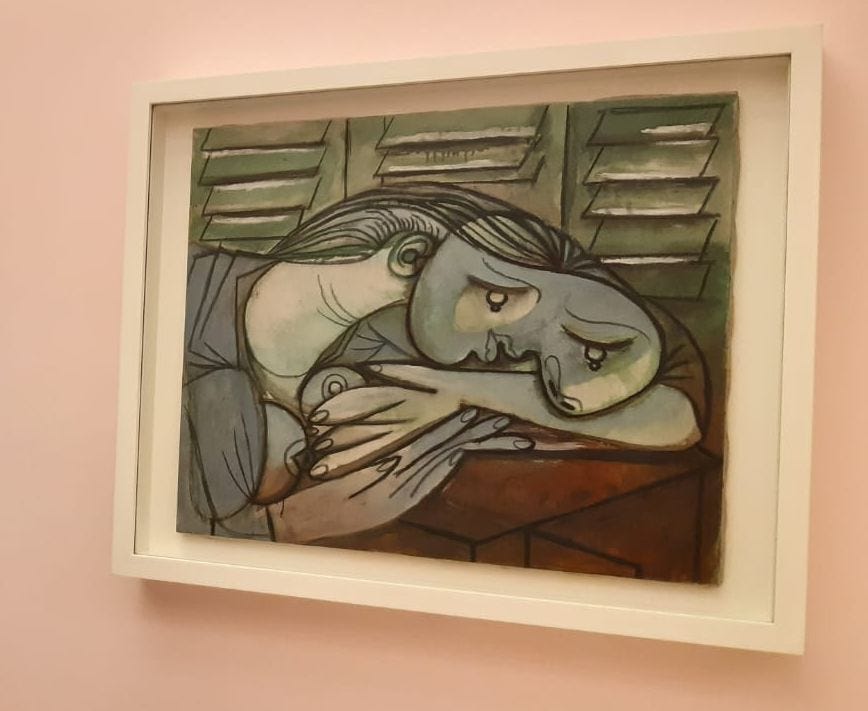
Let’s write a winter’s tale, and recall
later, how we spent the night at her place,
and how the dim light was falling tiresomely
around her crouched body on the edge of the bed
(as we were spying on her) and how low her voice was
when she was talking to us, thoughtfully, without knowing
she was talking to someone else, that she was not alone.
Let us try to describe the narrowest
lines of any gesture of hers, so as to
render her movements fluid, prolonged in time
and gain the meaning of a story –
let’s make up a story, a fairy tale with lots of deeds
about the evening we had stood beside her,
and it was as if we had crossed
the long corridors of hearing -
and time was measured in sounds,
of which silence was the meekest of all,
a meekness of winter. Let us also say how we tried
to always think of her differently –
and how every new beginning
of her image was a story,
next to the others, as if you threw
a hairbrush in a fairytale and that would
turn into a forest — and you pass through it –
and the afternoon light changes at every step.
Every step in our time beside her
and her image dispersing…
First, something about our journey towards her [1]– but of our
long and winding road through the snow –
like those of carol singers in the night –
I could always talk about,
because my paths towards these beings from without
are part of my waiting (and I, of waiting
know many learned things[2]).
This time around our journey to her was not through the snow
nor through the hopelessness made setting,
but the ascent of a ladder. I was climbing the rungs to reach her,
as in a very old memory,
so there were only time spirals, without consequence,
and I, on one of them, and then, knowing
I am also on another — that only one of them is the real one –
and all the rest — if I only knew where I stood –
all the rest would perish. (A long time ago, in my childhood,
I gazed on faces drawn in a book — and one
image showed a man descending some stairs,
his face panting — his eyes big and lost,
towards a girl looking at him, as he was descending
ever lower — and an ever colourless sadness spreading,
as if it were a lied about a story
you consider a lie. It was, in truth,
a fragment barely recalled from a film –
and piano music playing, Chopin –[3]
and he was descending the stairs,
and outside there was the war, and he would never return. )
the rungs I climbed were much like these,
except I was climbing them to reach her.
Would that mean, had we now talked about
our assent to her, would that possibly mean
I had been expecting something in return that night?
would it be true if I had said I had wanted to lie
face downward in her bed — and wait to touch her hands-
of which I know not if they were cold
or, on the contrary, as deep as a fever?
would that be true, if I had said it? how and at this point
is there talk of the poet who shut himself up in a tower
and walked through the sand to the edge of the ski as huge as a sea,
waiting for the silent flutter of angels? (but that would be
the highest rung of expectation). [4]
Would it be true, if I raised my eyes suddenly
Whenever resting on my elbow
in the cone of a prolonged penumbra
thrown over her bed, looking at her,
waiting for an answer — an answer
that would not be the pettiest of signs? Would that
be true, would that be true? Oh, but the waiting
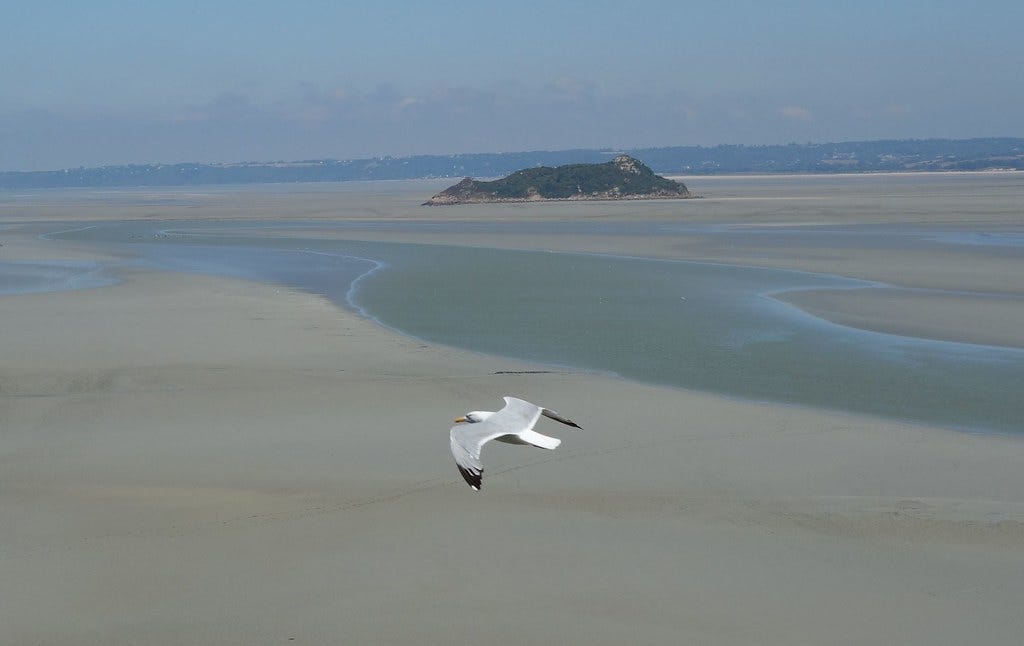
is a long strip of sand by the seaside –
and waves leave traces in the sand, like the footmarks of giants,
and should you look towards the ski, you’d tumble –
and the sand becomes a marsh and it drags you
down to the depths, leaving no trace of you.
(But lies, the lies are truly
a marshland in which you get lost — and you sink
and it topples you — as in that strange poem
in which the poet is buried neck deep
in silty fog, and feels their footsteps around,
pacing gloomily — hunting him? Lies are,
when you choose to talk about them, less real –
as it is always about intentions here,
when we speak about them, than the ever detailed story
of what had happened outside of us?
and lies — or what had not been
-on the outside- rests inside? And if I
narrate it, am I lying?)
And I, from the edge of the bed, and watching her,
and then, a chill climbing up from under me –
as if I had stopped in a marshland
(and the surrounding trees — casting shadows, dragging me
to the deep) — but it was only the vase of apple flowers
which she had toppled earlier,
and now the humidity of those branches,
forgotten on the shelf — pulled me towards the branchy
and bulbous time of flowers — of the awe, of the surreal
silence on the shelf, on her bed.
And there was nothing more to that.
And this would have been the beginning.[5]
Here’s an engraving with thin lines
(as the lips of a real woman — as they say)
that will hang on the wall some time later — and from time to time
she would look at it — and on her portraits
she’d remain somehow unrecognizable, in the background –
when she will show the photo to someone else — to look at herself –
and this moment of our presence, long forgotten,
to remain for nobody to understand. Her of course,
with her body bent forward a little bit,
her hands at ease just over the blanket,
her voice indifferent — and us, right here
without looking at her, without ever feeling
this time — thinking
one cannot live for the moment –
this futile evening, as the flowers from the vase,
to which I should have turned to from time to time
and look at them — and I only seldom did,
recalling, and then I would look at them
without feeling I was looking at them — without this
meaning nothing, nothing to me.
Let’s first mention how she opened [6]
the door to us, and stood in the doorway, slender,
and so vulnerable that we had wanted
to grab her by the wrist, and tell her
we know — but we didn’t even exist
for her in this manner. She was
alone- that’s the word — (and her flowing hair
covering her face in gold — and us,
far, far, far away).
But later, we began to make a comeback,
and picture her in our memories.
She was dressed in a dark, childish dress,
(and we also imagined, without looking at her,
so as we wouldn’t see that it was not true,
we imagined she had a high collar,
covering her chin — and of course, painfully deepening
under her eyes, her dark rings), and black socks,
she resembled the schoolgirl from an English novel
in love with a much older man,[7]
and going through a canvas of great loneliness,
and feeling what uselessness feels like… if we
had touched her slim wrist then,
she would have turned her eyes towards us, — and then
we’d tumble, collapsing with awkward gestures
in her eyes, and nothing would have been further known about us.
At a given moment — as they say in books–
I started pacing the room. It was
night time, surreal, a time
stripped of any intentions — or, as I read somewhere
void of any relational eventuality (in other words
I was very far away from her, but then again
was I ever, at another time,
close to her?)[8]. It was as if
I had divided myself into multiple I-s,
all like myself — and each
was departing more and more
from the other — like the characters from a fresco,
each, in the manner of byzantine figurines,
in a unique hieratical gesture, far away.
Later on I would use this to justify
my thoughts about intentionalities…
I could describe it differently from evoking
my childhood fears when I pictured
loneliness, at night, in the unknown rooms,
I could tell differently what I felt when I paused
all by myself, in the dark, in her other room,
and looking out the window, outside, below, in the street,
and feeling my loneliness the way one feels his fever in the night,
(I could, but I was waiting then, as it was
the moment of waiting — a blind openness).
Some of the so many of myselves[9] then
looking for the syllables of moments, waiting that is,
another feeling the loneliness crouched as in preparation for a leap
towards the window — in waiting,
another knowing that it’s her room, and that she’s near,
in the shadow of the lamp near her bedside,[10] and her heavy voice,
and thinking she would come after him,
in waiting — another, crawling on the rug,
far away from her, his still face under the furniture,
remembering the road he took to reach her
-in waiting, and another waiting somewhat differently,
and in the middle the one on whom time tumbles over
and is no longer waiting for anything.
Sooner — or later — this scene
is not marked by the time without causality — her, leaning,
and me, resting on my elbow, and talking,
and touching my forehead with my hand continuously, until she
asked me if the circle I was imagining
tight around my forehead was real — and very slowly
leaned over the light — and the shadow fell
over my idle and evil being[11] –
While I, trying to open myself up like a flower
-and knowing it was not at all true, but telling myself
she was real then — to my blinded eyes
-that her shadow was real.[12]
But time, time slowly dismantling
her words, until what she was saying (how easy it can be,
she said, to achieve reality for another person
by a gesture lacking any importance — ) was no longer
true. As gestures never stand there without
any meaning — they reverberate here,
in the one who receives them, and the echo
becomes as timeless as a sea, and fades — and afterwards
nothing is no longer true……[13]
Was she in truth there next to me,
at the window, and turning my head
towards her, gazing at her, failing
to hold on to her image for the time
that was to follow, the time is now, when she
is not even real anymore. Was she
then there, right there, and the street, just down,
her room, in the darkness, and she was living
for the loneliness that for a moment
was real for us. She was close,
so close that one of my I-s could have really
raised his arm and touch her shoulder,
the darkness in that room was as real
as my childhood fancies –
and I was afraid……
Without looking at her, picturing
her profile, made clearer in the round light
of the low lit light bulb [14]
on the short table near the bed,
listening to music telling her how I
turned round like a burnt piece of paper
piano playing in the background –
and her, absorbed in thought, confessing her slow escape
down the dark corridors.
Her hand, next to mine, on the blanket,
among the shifting sounds fragmenting in time……
I’ll play a trick on her — said I unto myself –
I’ll let her cross this limit,
and then I’ll crumble the sand that is time
the time of now, from under her feet
(her slender ankles, over which grass grows
wrapping them, and me forgetting them),
I’ll trace her footsteps, and when she
least expects I’ll make sounds
as of the leaves lowering down on her
off the branches — I’ll surround her with leaves,
and when she’ll tilt her head backwards –
and time would have changed in the meantime — and she
would be different, would be different.
Afterwards, turning her head towards me — her portrait,
(only that I hated that evening — come to think of it,
I know why — she was cold –
too alone — and I knew well that
transparent as I was, for her, I could not
change that look of hers — that’s why I didn’t pause
to see her blind eyes from the portrait).
Her telling me — I forgot what exactly –
and me, hesitating to look at her — and knowing
as I always kept in mind that evening-
that time was passing. (The passing of time
being in fact the story I knew
I had to tell about that evening. This was it –
time wasting, and me, still far away –
and not even wanting to go through the sand
to the edge of her very fluid presence
as clouds over the sea.)
Let us imagine it altogether differently - that she had left –
and that we were not sent away, without looking back,
let us imagine her leaving again
into the solitude we know, but which
is not at all real to us — her only loneliness.
Would that be any easier? Would that gesture
have been more real than all the ones
we had imagined the night we spent beside her?
Her leaving, and us, crouched, cold, around her,
telling her one last time what she is — telling her
how the dark rings descend down her face, and whisper
that from here on we have to measure our heavy steps
towards the edge of silence, that not in three
or four ever wider circles trembling
-as if she had thrown a stone — telling her we know
how to keep her stillness in our waters. And
the most hidden of our inner eyes
open and look at her. (And her
not understanding — letting her heavy eyelid
over our fancies.) From here on,
from her departure onwards, embraced in vain by us,
begins the time of her new absence.
The gesture of our memory encircling her, and her
somewhere, in the middle, hidden, but as a star
trembling in a blue hue the light of her look
until we no longer had any record of how
the reflection of the outer world into hers breaks –
and believe her to be crying and the teardrops
rolling down, hazing the globe of her wonder
that we are part of, as we gathered
to tell her detailed words about her leaving.
She’s hearing us, but our words now break
into a huge sadness. We have reached
the edge of our age, and in mournful
voice begging her — with bitter
wrinkles write around her eyes a distance
detached from us, of our dance in the wind,
constrained……
From here on let us open her reality
in a time in which he hasn’t yet entered,
but in which thus we can bring her –
and imagine anything — how the light at dusk
(she so well knows from her window so high up –
that we’ve known since childhood, just above the garden
just over the street — and we still get chills
because of the lonesome echo) how the light at dusk
is real to her — and she
is more real in our time, our daily time
that we know not what being with a green
and a hazel eye and beautiful voice
and small gestures. And thus gain the feeling
of her presence — do we lie? But lies are
no less real — are they? than any other thing
we are doing now.
This was the night we stood beside her. We can always
write about it, always in the same way, even though
we always think we paint new hues of the fall of light
on her sad face. There is nothing
true — but truth is only
the simplest way of understanding time –
right? and the time of her presence is not at all simple,
not reducible to the words that have meaning.
Everything is different as she herself is different,
and her truth, as we know it,
is this, and it becomes a story, and a low light,
and an echoless memory — that we can tell
thinking it can be different, as we did in sagacious ending
here, and as we can continue to do, and her not ever knowing–
how true it all is, and how deep, in fact.
Short commentary
As I was translating this poem, it became more and more obvious to me it is a parody in its most refined sense of Eminescu’s Luceafarul. The themes that are most successfully pastiched are the waiting, the play of absence and presence, the Western topos of the window sill in erotic poetry, the Dantean exchange of gazes, the possibility of the genius achieving earthly happiness and so on; and not the least, the valorization of the domestic space. In Dante’s The Paradise, the poet achieves higher knowledge and virtue by exchanging glances with Beatrice. There is a whole tradition of the ‘holy’ gaze, ranging from Christ’s miracles performed on the blind to secular erotic love where the eye becomes the locus of desire.
Let us briefly consider the manner in which Eminescu expresses exchanges of glances in Luceafarul and compare his style with that of Ivanescu.
The key to understanding how gazing is performed in the poem, one has to notice Hyperion’s thirst for the empirical senses: Ca in camara ta sa vin, / Sa te privesc de-aproape, / Am coborat cu-al meu senin/ Si m-am nascut din ape. (In thy chamber to arrive/ And look at you from up close/ I came down from the firmament/ And born from the sea)
and Catalina’s way of looking through but never AT Hyperion. The way she looks perceives him is always in a dreamy, hazy way: Iar umbra fetei stravezii… (Hyperion’s translucid face).
The impression Hyerion makes on her is only on her face turned away from him: Si din oglinda luminis/ Pe trupu-I se revarsa, / Pe ochii mari batand inchisi, / Pe fata ei intoarsa.
( From the mirror light shone/ Down on her body/ On her big, closed eyes/ On faces turned from him).
Catalina does not literally SEE Hyperion. The way she looks far into the horizons is as close as she can empirically reach him: Privea in zare cum pe mari/ Rasare si straluce, / Pe miscatoarele carari/ Corabii negre duce
(She looked into horizons/ How on seas it rises and it shines/ On moving paths as he/ Carries tar-like ships)
But Catalina’s issue with Hyperion does not stop there. She confesses she cannot understand him:
Desi vorbesti pe inteles/ Eu nu te pot pricepe (Although you speak in plain words/ I cannot understand you)
I believe the main themes Ivanescu paraphrased in A Visit, One Evening have a lot to do with the premises I’ve mentioned: namely the issue of SEEING and of UNDERSTANDING. The third dimension would be the medium of FICTIONALITY.
The three elements seem to make up a semiotic triangle, but a lot more complex than the classical one because the poem lacks what would be called a CENTRE. Both the poet’s ego is displaced, it is an instance of Arthur Rimbaud’s Je est un autre. The object (the girl) is always in a process of change. As for the context of the various “utterances”, the classic sender- receiver relationship is distorted. The only exchange of words that the poem records is:
and me, resting on my elbow, and talking,
and touching my forehead with my hand continuously, until she
asked me if the circle I was imagining
tight around my forehead was real — and very slowly
leaned over the light — and the shadow fell
over my idle and evil being –
While I, trying to open myself up like a flower
-and knowing it was not at all true, but telling myself
she was real then — to my blinded eyes
-that her shadow was real.[15]
A poem that says a lot about discourse reaffirms monologue. Perhaps this “scene” represents an important moment in the poem. Before this section, the ‘radical’ fiction of both the poet’s voice and the feminine presence has been established by engaging and dismembering them into the various cultural tropes. This is the only attempt to achieve a dialogue between two fictional characters. The poet is “talking” and the girl responds by questioning nothing less than the reality not of the words he utters, but of the gesture he performs. This is a key point. Words are already in a fictional state, that is shocking but becoming more and more obvious for both sides. The only chance for an ‘objective’ reality to exist is checking the concreteness of the real.
A last resort is her striving for concreteness by trying to let her shadow on the being of the poet.
“Shadow” is a term loaded with Platonic meaning: the shadow affirms a secondary existence to what the REAL is. The real of Ideas is the REAL in Plato’s conception, while EMPIRICAL REALITY consists of copies of ideal entities.
Ogden & Richard’s (1923) famous triangle of meaning implies that the referent of an expression (a word or another sign or symbol) is relative to different language users: With the terminology of Peirce: “A sign, or representamen, is something which stands to somebody for something in some respect or capacity. It addresses somebody, that is, creates in the mind of that person an equivalent sign, or perhaps a more developed sign. That sign which it creates I call the interpretant of the first sign. The sign stands for something, its object [or referent]. It stands for that object, not in all respects, but in reference to a sort of idea, which I have sometimes called the ground of the representamen.” (Peirce, 1931–1958, 2, 228).
[1] Parodierea stilului majestic eminescian despre descendenta divina a Luceafarului si insistarea pe un aspect secundar unei intalniri erotice: parodierea importantei “descrierii scenei” — The parody of Eminescu’s majestic/ grand style about the divine descent of Hyperion and the insistence on a secondary aspect of the erotic encounter: the description of the road to her as a pretext form cultural tropes — the translation of these lines is in the commentary at the end of this poem.
Din sfera mea venii cu greu/ Ca sa-ti urmez chemarea, / Iar cerul este tatal meu /Si muma-mea e marea.
Ca in camara ta sa vin, / Sa te privesc de-aproape, / Am coborat cu-al meu senin/ Si m-am nascut din ape.
Luceafarul trebuie sa coboare, sa se umileasca. In traditia poeziei erotice de la trubaduri incoace, poetul-indragostit trebuie sa urce, sa asedieze castelul launtric al iubitei.
[2] Announcing intertextuality
[3] Symbolist poetry and the importance of music
[4] Rilke Duino Elegies + The Scale of Perfection, Medieval topos
[5] The road to her was actually a pretext for a cultural detour in Western poetry.
Also, notice the commonness of the event chosen as a pretext for spying on the loved one: immersion into the “thingness” of the humidity of the toppled flower vase
[6] Wait, the poem begins anew when everybody thought we had finished the introduction already.
[7] Erudition seems to stand in the way of the “feelings” of the poet to be expressed.
[8] Maximal intimacy may be actually a fiction, the poet warns.
[9] My coinage (poetic license)
[10] I have to check this one, I’m not sure about it yet, sorry
[11] peste fiinta mea inceata si rea.
[12] Discourse is fiction, fiction is imminent “Sooner — or later –“
[13] Poetry is a critique of the semiotics of the “real”: the fictionality of the code of the real itself
[14] The inconsistency of being
[15] Discourse is fiction, fiction is imminent “Sooner — or later –“
메타데이터
- post_id
- b87f76e1b250
- slug
- a-visit-one-evening-b87f76e1b250
- url
- https://medium.com/@nicolaeandreipopa/a-visit-one-evening-b87f76e1b250
- canonical_url
- https://medium.com/@nicolaeandreipopa/a-visit-one-evening-b87f76e1b250
- author_url
- https://medium.com/@nicolaeandreipopa
- status
- ok
- fetched_at
- 2026-07-25 03:40:03