Fujifilm X-T5, walk this way
Fujifilm X-T5 goes back to its origins, to be the first professional choice for street photography and reportage, and takes off the role of…
Fujifilm X-T5, walk this way
Fujifilm X-T5 goes back to its origins, to be the first professional choice for street photography and reportage, and takes off the role of the flagship thanks to the presence of X-H2 and X-H2s behind it.
Dated in early November, Fujifilm X-T5 presents many of the characteristics of the flagship X-H2 announced just a month earlier: same 40 Mpxl sensor, same 7 stop IBIS stabilization, same processor, same AF system. To differ just the video potential. And the body is just what makes the X-T5 a true street and reportage camera.
I spent a week with X-T5. To tell the truth, I had already had it in my hands shortly after the official announcement but that half hour wasn’t enough for me to really understand it fully. Because this is a camera to understand, not just to use. Before trying it I read and saw some reviews; I’ve heard some discussions and many of them were about “how much was taken off compared to X-T4” and “how much was equal compared to X-H2”. All correct clarifications but actually show how much this model has been misunderstood by many, following the trend that is most popular today: simply reading the technical specifications. But a camera must be “felt”.
I may be a strange person but I tend to believe that every object, from cars to cameras especially, has a soul of its own; you start by giving it a name, then things come by themselves. Now, before talking about characteristics and impressions in the field, I would like to “against” those who have misunderstood X-T5. I do it by writing what this camera (which is never just a camera) has transmitted to me.
The soul of Fujifilm X-T5 is street photography, reportage. This was the reason why the X-T line saw the light, this is the path taken by Fujifilm for these models. But something is cracked with X-T4. Due to an increasingly demanding market, and in the absence of a real spearhead at the top of the professional pyramid, Fujifilm was almost forced to transform the X-T into something different. To make them wear the clothes, in my opinion, a bit uncomfortable, of the flagship. For this reason, a huge burst was added to make her sporty; a reinforced mount to support the MKX optics to make it versatile also for cine productions; a larger body thanks to a vertical grip to increase its longevity and comfort in long shooting sessions as if it were a studio camera. ***True, the X-H1*** was on the price list but it was not yet known what would happen to that project.
In short, a dress that certainly fell well but certainly not without flaws. Which? The first: is the ergonomics of the keys and dials which, for the professional professions described above, were certainly not the most ideal or intuitive solution in the world. The second, in the specific case of sport: is the lack of a Stacked sensor much faster than a classic CMOS. A sort of internal dualism has been created. The company that wanted to somehow preserve this “vintage soul” was also the same one that wanted to push the X-T line beyond its limits. The blanket was a bit short, the photographer always had to make some compromises. But now things change. Now Fujifilm has not one, but two flagships: a sporty one, *X-H2s, and a studio one, [X-H2](https://www-fotografia-it.translate.goog/fotocamere/x-h2/?_x_tr_sl=it&_x_tr_tl=en&_x_tr_hl=it&_x_tr_pto=wapp)*. And so the X-T can take its soul back and, finally, go back to just doing the XT. A street photography and reportage camera doesn’t need 20 fps, 15 may be enough; it doesn’t need a reinforced graft, it’s not a cine camera; you don’t need a vertical grip, it’s not made to be held in your hands for hours and hours at a time.. also because, on the road, you need to have a discreet, ready and light car in your hands, certainly not a “brick”.
For this reason, I agree with all the “shortcomings” of the X-T5, they are precisely those that make it perfect as it is. The “is equal to X-H2” speech remains. And that is to be addressed in the price point that has been chosen for both models. Debut with “it only costs €200 less, you might as well get the flagship” it means you have a lot of confusion in your head. But, above all, not having understood the product. Companies typically segment their templates by the intended audience. They separate the apex of the pyramid from the more generic ones: therefore there is the flagship up there and just below the professional ones for the sportsman, the portraitist, the videomaker, and the street photographer. And, as always, the public must make a choice that also takes into account the wallet: either spends a lot or spend half and make compromises on resolution, burst, sensor, etc. But X-T5 and X-H2, photographically speaking, are identical. So Fujifilm is implicitly saying to the professional: “You don’t have to give up, you just have to choose the product that best suits you in terms of ergonomics and comfort in your area of use. If you deal with study and ceremony, and you need autonomy and practicality, perhaps it is better that you choose X-H2. But if you do reportage, if you do street, if you want an all-rounder without having to compromise, then you have to choose the X-T5.”
Infinite speech, perhaps the classic juniper. However, this is how I understood the process that led to this model. But it is a vision, albeit extremely romantic, which is also very personal. Now let’s move on to the less subjective and more objective things; let’s talk about the characteristics of this Fujifilm X-T5 and how it behaves in its natural habitat: the road.
Fujifilm X-T5: Specifications
The features are first class. The sensor is a 40 Mpxl APS-C X-Trans CMOS 5 HR, the one that marks the future standard for Fujifilm’s very high-profile models: the same chromatic peculiarities that have made this solution famous, in a very high-resolution format. For this reason, the stabilization has been raised from 5 stops to 7 stops, an increase necessary to counter blur and shake that could be generated by a similar pixel density, and the burst has remained (compared to X-H2) at 15 fps (down from 20 fps on X-T4 which however had a 26 Mpxl sensor). To tell the truth, 20 fps can also be achieved here, as long as you accept a 1.29x crop on the file. The processor is the same X-Processor 5 as the flagships and, consequently, it is equipped with the same AI algorithms in support of the 425-point phase and contrast detection AF system capable of recognizing subjects such as humans, animals, birds, cars, trains, motorcycles, bicycles, and planes.
The video is the only thing to change, or almost, compared to X-H2. If the flagship could go to the 8K format, X-T5 stops at a 6.2K (6240 x 3510) 30p, in addition to DCI 4K HQ (4096 x 2160) and DCI 4K (4096 x 2160) 60p. All recorded internally to SD UHS III cards rated V60 and higher.
Fujifilm X-T5: Design
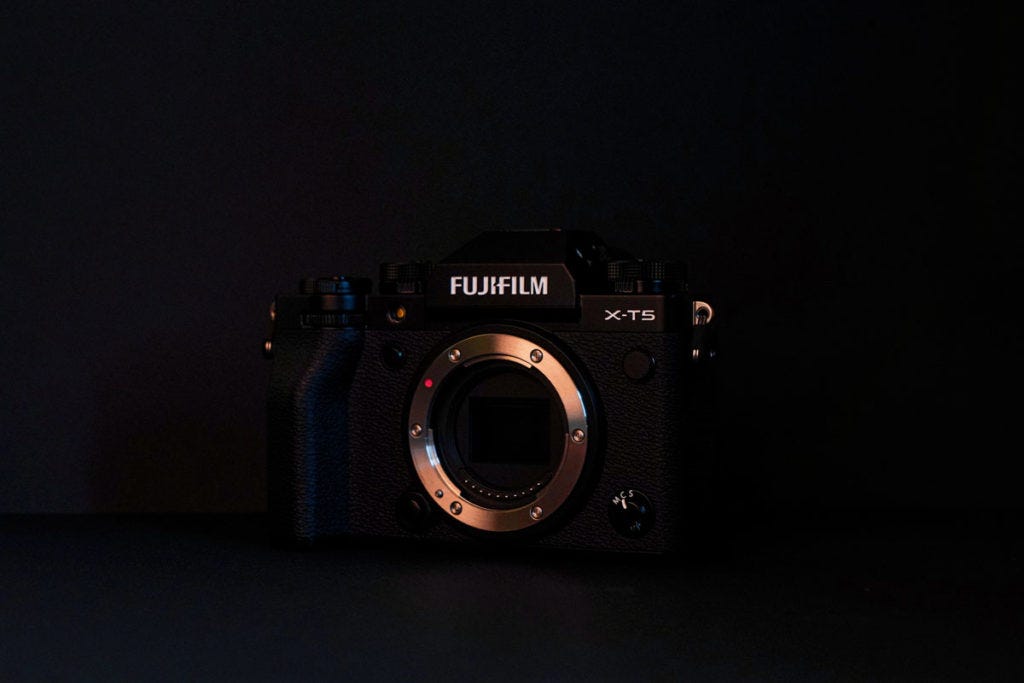
X-T5 retraces, as it should be, the vintage classicism of the previous models and which made the fortunes of this long-lasting line. The front is dominated by the Fujifilm logo just above the mount which, unlike the X-T4, is not “reinforced” to support the MKX optics; not that it’s not resistant, indeed it is, but a classic magnesium alloy cage (which distinguishes the remaining 100% of the cameras) can be enough..as it always was. Under the “X-T5” logo, the classic focus selectors M (manual), C (continuous), and S (single).
The top is distinguished by the rings: on the left of the eyepiece the ISO one while on the right those for the times, with the coaxial ring for the photo/video switch (still/movie) and for the calibration of the exposure meter. On the back on the left are the trash and play buttons, on the right AF ON, Q (fn), and between them the customizable aperture ring depending on the lens used. The 3″ touch display has 1.84 million dots and is of the three-way directional type; to its right the exposure lock, the AF joystick and the four-way selector with the Menu button in the center. The EVF viewfinder is identical to that of the X-T4 in terms of resolution and size: a 0.5″ Oled with 3.69 million dots which, however, unlike the one mounted on the previous machine, it has a better magnification ratio of up to 0.8x (from 0.75x).
Fujifilm X-T5: hands on
This type of vintage model always has something extra. The first thing that occurs to you as soon as you take them out of the box is to put an SD in the slot and go out to shoot. I’m not just talking about X-T5, even when I tried ***Nikon Z fc I had the same feeling, that desires to take to the street and “feel”* the dials under my fingers. I don’t know, it’s probably just me but I think that only models with this type of design are able to give this kind of emotion. Romance aside, the Fujifilm X-T5 is street photography made of a camera**.

The first thing you need to do is abandon the fear of blur. The 7-stop stabilization is safe even with such a capacitive sensor; allows you to shoot freehand with absolute precision up to 1/50s but, for the more daring, even up to 1/20s you just need to trust your blood circulation! Seriously, I came out with two different focal lengths: ***Fujinon XF 30mm F2.8 R LM WR Macro and [Fujinon XF 56mm F1.2 R WR](https://www-fotografia-it.translate.goog/obiettivi/fujinon-xf-56mm-f1-2-r-wr/?_x_tr_sl=it&_x_tr_tl=en&_x_tr_hl=it&_x_tr_pto=wapp)***so I had to rely totally on the IBIS of the camera body. The desire to use it as a point-and-shoot was strong, especially with the 30mm. The stabilization follows well and actually, even without paying too much attention to the movements, the result is always brought home. And then you can count on 40 million points and a Raw file of about 80 MB!
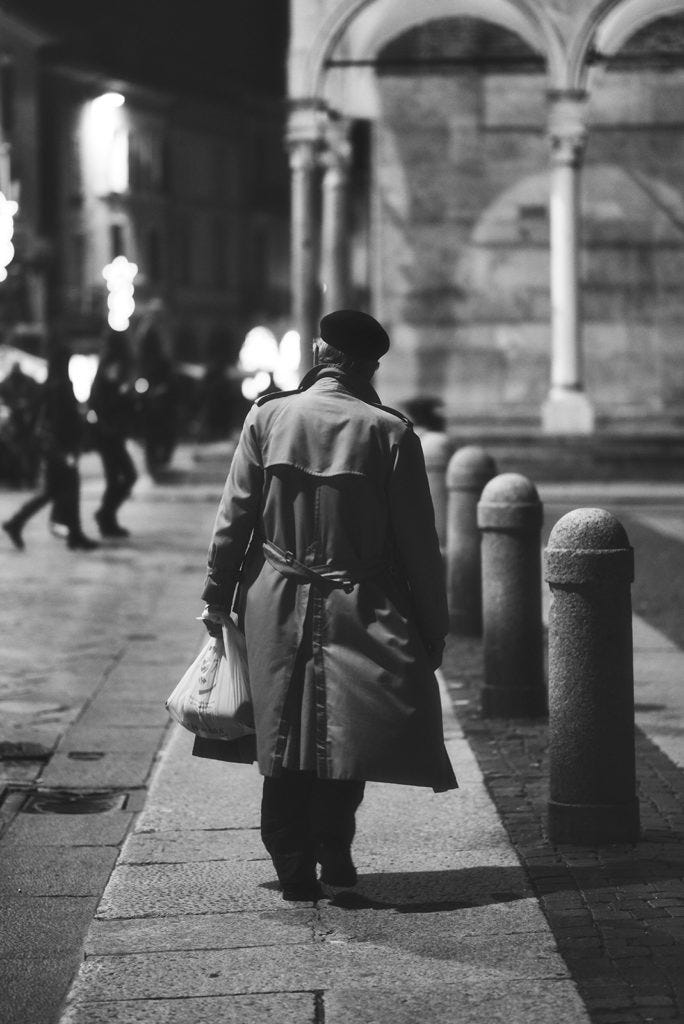

The AF system is the same with which the X-H2 and X-H2s also wrap: 425 points supported by AI for the recognition of humans, animals, birds, cars, trains, motorcycles, bicycles, and planes. It happens by shape and is very precise: it manages to detect a person even if this is very far from the lens and is small in the frame. And even if its back is turned. Working with the whole sensor, it tends to prefer that it is in a better position also from the point of view of lighting.
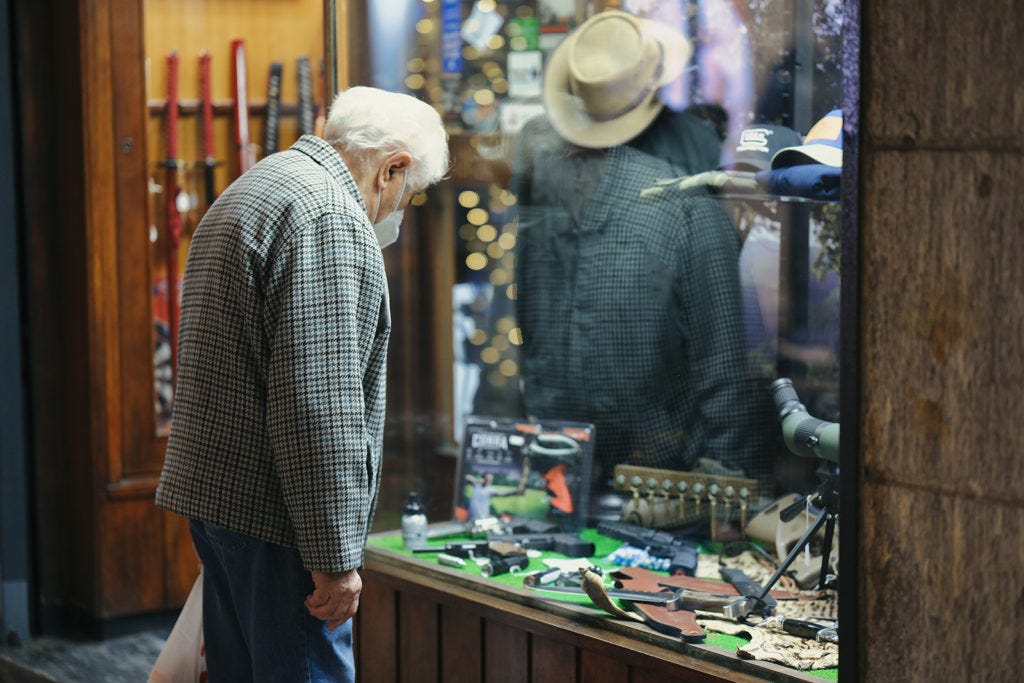
In borderline cases, however, complications can arise. In cases where you want to take a picture of a subject in the background, perhaps even in dim light, the system will automatically direct you to the “simplest” one to capture even if this is outside the area or single point you are working with. In this case, since the hook is really firm, you will have to detach yourself and frame again; nothing can happen but if it’s a non-repeatable shot you could lose it. Having said that, a system like this is better than an inaccurate AF. This is for humans, for racing cars ***I refer you to the test of X-H2s***


The shooting experience is top-notch. The car is comfortable, fast, and discreet. True, the body can be a bit short for those with big enough hands but all in all, it’s not that uncomfortable having to put the little finger under the battery compartment..at least as far as I’m concerned. The viewfinder with this new magnification ratio is much more comfortable than that of the X-T4, despite the fact that the multiplication factor seems almost negligible. A note to make to Fujifilm but I have it: make a bigger AF joystick! Objectively it has always been an Achilles heel of the XT series. I realize that the tactile surface cannot be exponentially increased, also because it would ruin this beautiful vintage design, but this is really too small. It would be enough to increase its size slightly so that it can be easily used not only with the fingertip but also with what I improperly call ”half finger”.
Fujifilm X-T5: Conclusions
What can I say, we are dealing with a camera designed and built to be a faithful companion in street photography and reportage. It is comfortable, light, discreet, and fast. And extremely reliable thanks to a stabilization that counteracts blur and shake and a precise AF. All with a firepower of 40 Mpxl. As I said initially, the XT line rediscovers its original soul, stripped of those uncomfortable flagship obligations that I believe have never been in its comfort zone. Fujifilm X-T5 is this and much more: it’s a vintage-flavored shooting experience that everyone should do, even for a little while.
In this gallery all the images taken with Fujifilm X-T5, Fujinon XF 30mm F2.8 R LM WR Macro and Fujinon XF 56mm F1.2 R WR:
https://www.fotografia.it/gallery/fujifilm-x-t5-prova-sul-campo/
Originally published at https://www.fotografia.it on November 30, 2022.
메타데이터
- post_id
- b88e55f6ff18
- slug
- fujifilm-x-t5-walk-this-way-b88e55f6ff18
- url
- https://medium.com/@francesco_frenk/fujifilm-x-t5-walk-this-way-b88e55f6ff18
- canonical_url
- https://medium.com/@francesco_frenk/fujifilm-x-t5-walk-this-way-b88e55f6ff18
- author_url
- https://medium.com/@francesco_frenk
- status
- ok
- fetched_at
- 2026-07-26 10:31:45