Why Most Shopify Stores Fail Before They Ever Get Started.
A properly built Shopify store does not just exist it sells.
Why Most Shopify Stores Fail Before They Ever Get Started.
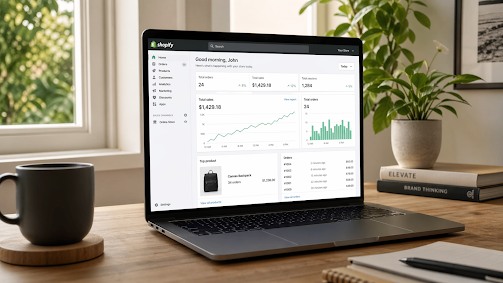
A properly built Shopify store does not just exist it sells.
Every week thousands of new Shopify stores go live. Most of them will be inactive within three months. Not because dropshipping does not work. Not because the market is too competitive. But because the people launching those stores are following a version of the model that stopped working years ago and nobody told them.
The image of dropshipping that most people carry when they start is built on outdated information. Find a cheap product on AliExpress, upload it to a free theme, run a few Facebook ads, and wait for the money to come in. That picture is not entirely wrong it is just missing the ten things that determine whether any of it actually produces a real business or an expensive lesson.
The stores that are genuinely thriving on Shopify in 2025 look nothing like that. They are branded. They are fast. They are built around specific customers with specific problems. And they are operated with the same discipline and attention that any serious retail business demands.
The Product Research Problem Nobody Talks About Honestly:

The product you choose determines everything that comes after it.
Most people starting a dropshipping store pick products based on what looks interesting to them personally or what they saw in a YouTube video two weeks ago. By the time that information reaches a YouTube video it has already passed through the hands of enough people that the margin is thin and the competition is fierce.
Real product research starts with demand validation. Is there evidence that people are actively searching for this product or a solution to the problem it solves. Is the market growing or shrinking. Are there established competitors doing well because competitors doing well means the market exists, which is actually a good sign rather than a reason to walk away.
From there the product itself needs to meet a specific set of criteria. It needs a healthy margin after product cost, shipping, platform fees, and advertising spend. It needs to be something that photographs and videos well because your entire marketing case will be made visually. It needs to solve a recognisable problem or satisfy a clear desire. And it needs a supplier who can fulfill orders reliably and consistently without turning your customer service inbox into a daily crisis.
The stores that build real revenue are almost always built around one product or one tightly defined product category. Not a general store trying to sell everything to everyone. A focused store built around a specific customer who has a specific need and a product that addresses it better than anything else they can easily find.
Why Your Store Design Is Losing You Sales Before Anyone Reads a Word:

Trust is decided in seconds. Your store design either builds it or destroys it.
A visitor lands on your Shopify store and within three seconds they have already formed a judgment about whether this is a legitimate place to spend their money. That judgment is made almost entirely on visual impression before a single word of copy is read or a single product feature is considered.
Generic themes with default settings, stock photography that looks like it came from a template, no clear brand identity, inconsistent fonts and colors, a homepage that tries to show every product category at once these are the signals that tell a visitor this store was not built with any particular care and probably should not be trusted with a credit card number.
A properly built Shopify store communicates trustworthiness immediately. A clean, focused hero section that speaks directly to the customer it is built for. Product pages that answer every question a reasonable buyer would have before needing to ask. Social proof placed exactly where hesitation is most likely to occur. A checkout flow with no unnecessary steps between the add to cart and the order confirmation.
The technical side matters just as much as the visual. Page load speed on mobile is a direct conversion factor. A store that takes four seconds to load on a phone loses a significant portion of its traffic before those visitors ever see what is being sold. Shopify gives you the platform but the configuration, the theme choices, the app stack, and the page architecture all determine whether that platform performs or underperforms for your specific store.
The Supplier Relationship Most Dropshippers Get Completely Wrong:

Your supplier is your silent business partner. Choose them like one.
The supplier is the part of the dropshipping model that most people treat as an afterthought and most experienced operators treat as one of the most critical business decisions they make.
A bad supplier will ship products that do not match the listing photos, fulfill orders inconsistently, provide no tracking information, and take two weeks to respond to a question about a missing package. Every one of those failures lands in your customer service inbox as your problem to solve even though the fault sits entirely with a supplier you trusted without verifying.
Vetting a supplier properly before committing to them means ordering samples of every product you plan to sell. It means testing their communication response time and quality before you have an urgent problem. It means understanding exactly where your products ship from, how long fulfillment realistically takes, and what their process is when something goes wrong with an order.
The best dropshipping operations in 2025 are increasingly moving toward suppliers who offer branded packaging, faster regional shipping options, and direct integration with Shopify so order fulfillment is automated rather than manual. These relationships take longer to build but they are the foundation of a store that can scale without the customer experience falling apart under the weight of the volume.
Paid Advertising for Dropshipping Stores Is a Different Game Than Most People: Expect:
Running paid traffic to a dropshipping store is not the same as running ads for an established brand with years of customer data and a loyal audience. You are asking people who have never heard of you to trust you enough to hand over their payment details for a product they cannot physically touch or examine.
That trust gap is the central challenge of dropshipping advertising and everything in your ad strategy needs to be built around closing it.
The creative is the most important variable. Video content that shows the product being used in a realistic context, that demonstrates the problem it solves and the experience of using it, consistently outperforms static image ads for cold audiences. The first three seconds need to stop the scroll. The next fifteen need to make the value proposition completely clear. And the call to action needs to remove as much friction from the next step as possible.
Retargeting is where the money is made. The customers who visited your store, watched your video ad, or added a product to cart without completing the purchase are your most valuable audience. They already showed interest. A well-structured retargeting sequence with the right creative and the right offer will convert a significant percentage of that audience into paying customers at a fraction of the cost of cold acquisition.
What Separates a Real Shopify Business From a Store That Never Gets Off the Ground:

The difference between a failing store and a thriving one.
The stores that build into real businesses share a set of qualities that have nothing to do with luck or timing. They are built on validated products with reliable suppliers. They present themselves with the visual credibility that earns a stranger’s trust in three seconds. They are connected to a marketing strategy that understands the difference between cold and warm audiences and speaks to each one appropriately. And they are operated with the discipline to test continuously, cut what does not work, and double down on what does.
None of this is complicated. All of it requires genuine effort and the willingness to build properly rather than quickly.
Ready to Build a Shopify Store That Actually Sells
If you have been thinking about launching a Shopify dropshipping store or you have an existing store that is not performing the way it should, the gap between where you are and where you want to be is almost always a strategic and structural one not a product or market problem.
At Zaibify Digital Solutions we build Shopify stores from the ground up with every element designed to convert. Product research, store design, supplier sourcing, ad strategy, and ongoing optimisation handled as one connected system rather than a collection of disconnected tasks.
We have helped businesses build Shopify stores that generate consistent revenue because we treat every store we build as if our own reputation depends on it performing. Because it does.
Visit us at www.zaibifydigitalsolutions.online and let us show you what a properly built Shopify dropshipping business looks like from the inside.
The market is ready. The platform is ready. The question is whether your store is built well enough to take advantage of both.
Zaibify Digital Solutions Shopify Store Creation · Dropshipping · Performance Marketing · Web and App Development · POS Software
메타데이터
- post_id
- b89c286a80c3
- slug
- why-most-shopify-stores-fail-before-they-ever-get-started-b89c286a80c3
- url
- https://medium.com/@zaibifydigitalsolutions/why-most-shopify-stores-fail-before-they-ever-get-started-b89c286a80c3
- canonical_url
- https://medium.com/@zaibifydigitalsolutions/why-most-shopify-stores-fail-before-they-ever-get-started-b89c286a80c3
- author_url
- https://medium.com/@zaibifydigitalsolutions
- status
- ok
- fetched_at
- 2026-07-15 15:14:59