*The Śūdra in All of Us: What It Really Means*
The Śūdra in All of Us: What It Really Means
Among the four varṇas of Indic thought, the Śūdra is perhaps the most misunderstood. In popular imagination, the word has become an insult – a permanent stamp of inferiority. But in the original Dharmic framework, Śūdra was never meant to be derogatory.
Part of this confusion comes from failing to distinguish between jāti (community by birth) and varṇa (inner disposition and way of action). Varṇa is not a hereditary cage but a dynamic reflection of our qualities and deeds.
The Bhagavad Gītā offers clarity. In Chapter 4, verse 13, Krishna declares:
“cāturvarṇyaṁ mayā sṛṣṭaṁ guṇa‑karma‑vibhāgaśaḥ”
“The fourfold varṇa was created by Me, according to the divisions of guṇa (qualities of nature) and karma (actions).”
Here, Krishna is categorical – varṇa is defined by guṇa and karma, not by birth. To call someone a Śūdra is not to condemn them forever, but to describe the mode of being they are in at a given time.
Yet over centuries, this subtle philosophy was lost, leaving only the shell of caste hierarchy. To reclaim Dharma, we must return to this original meaning.
⸻
The 5‑Point Dharma Compass
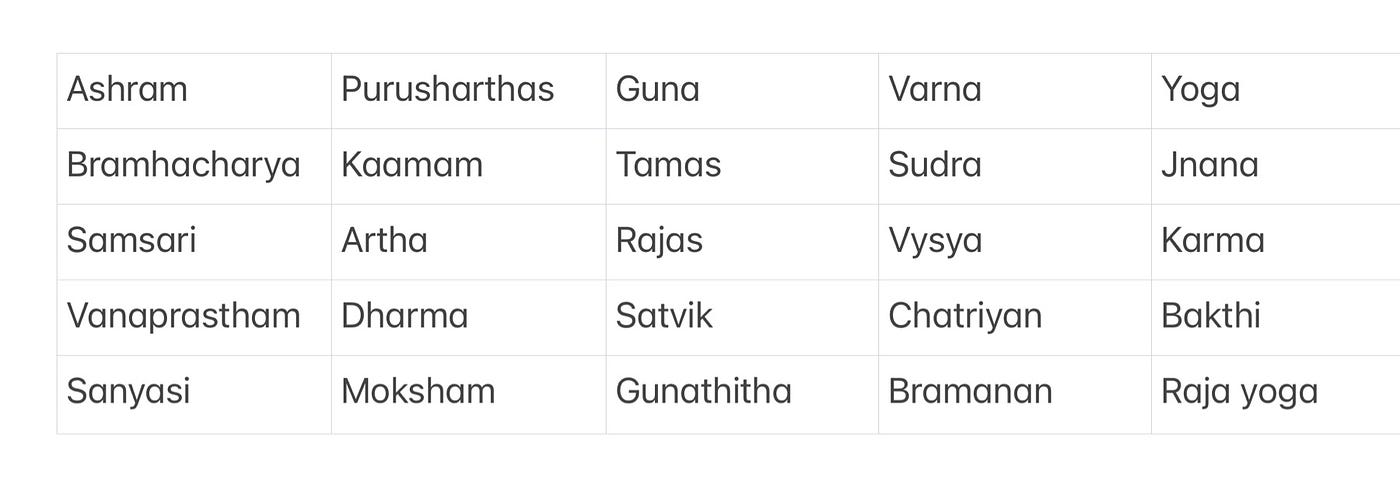
To make sense of varṇa in modern life, I propose what I call the 5‑Point Dharma Compass. This is not a new invention; it is simply a unifying lens that brings together principles already present in Indic philosophy:
-
Āśrama – Stage of life (Brahmacharya, Gṛhastha, Vānaprastha, Sannyāsa)
-
Puruṣārtha – The four goals of life (Kāma, Artha, Dharma, Mokṣa)
-
Guṇa – Dominant quality (Tamas, Rajas, Sattva, Guṇātīta)
-
Varṇa – Nature or disposition (Śūdra, Vaiśya, Kṣatriya, Brāhmaṇa)
-
Yoga – The spiritual path most suitable (Jñāna, Karma, Bhakti, Rāja Yoga)
Each of these five already exists in the Indic framework. The Dharma Compass simply places them together, so we can analyze our actions with clarity.
⸻
What Mahābhārata Says
The Mahābhārata also affirms this. In the Āraṇyaka Parva, Yudhiṣṭhira tells Nahusha:
“He in whom the qualities of a Brāhmaṇa are not found is no Brāhmaṇa; while a Śūdra who shows the qualities of a Brāhmaṇa should be regarded as a Brāhmaṇa. Before initiation, everyone is a Śūdra.”
This is a striking reminder: birth is secondary, conduct is primary.
Elsewhere, Mahābhārata elaborates that a person driven solely by kāma (pleasure) and lacking higher pursuits of Artha, Dharma, or Mokṣa, behaves like a Śūdra.
This dimension – the kāma‑driven Śūdra mode – is rarely spoken about today. Most people only know the “service” angle of Śūdra, but Mahābhārata reminds us that Śūdra also signifies a desire‑oriented state of being. It is this angle I wish to explore with the Dharma Compass.
Mapping Varṇa and Puruṣārtha
If we align the four Puruṣārthas with the four Varṇas, the picture becomes clear:
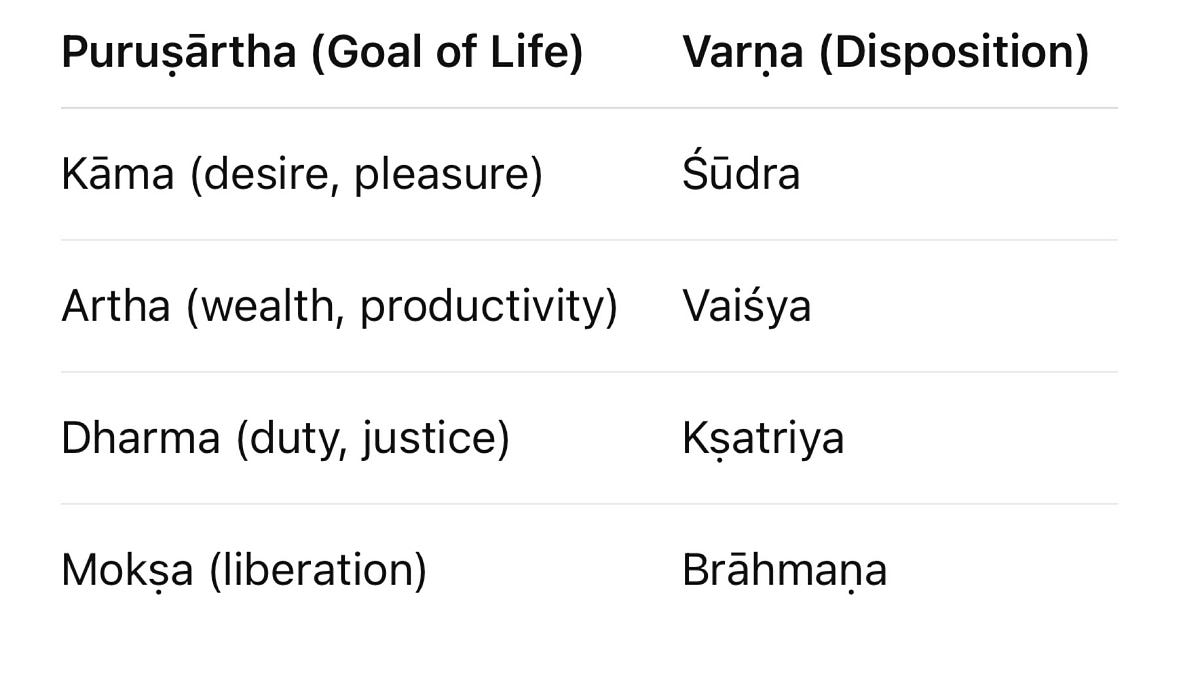
This mapping shows why Śūdra should not be seen as a permanent “label.” Whenever we act only for bodily pleasure, we are in Śūdra‑mode. In other moments, we may be Vaiśya, Kṣatriya, or Brāhmaṇa.
Picture 1: Brahmacharya Phase

Consider the stage of Brahmacharya (youth, before marriage). At this point in life, Kāma is naturally dominant. Tamasika guṇa is strong, and so the Śūdra tendency is prominent.
This is not a shameful truth but a natural one. It simply means that the spiritual practice best suited for youth is Jñāna Yoga, because inquiry, study, and clarity help refine the raw energy of desire. Bhakti Yoga at this stage may slip into blind dependence; Jñāna Yoga helps sharpen discrimination.
Seen in this light, Śūdra is not a slur but a phase of life. Normalising this understanding removes stigma.
Picture 2: The Natural Evolution of Life
If we map Puruṣārtha and Guṇa across all four Āśramas, a natural rhythm of life emerges:
• Brahmacharya → Kāma dominates → Tamas prevails.
• Gṛhastha (householder) → Artha dominates → Rajas prevails.
• Vānaprastha (retirement) → Dharma dominates → Sattva prevails.
• Sannyāsa → Mokṣa dominates → transcending guṇas.
Life is thus designed as a gradual evolution of guṇa and karma – from the Śūdra‑mode of desire in youth, to the Brāhmaṇa‑mode of wisdom in old age.
⸻
The Daily Cycle of Varṇas
The Dharma Compass does not apply only across a lifetime; it also plays out in the rhythm of a single day.
• In the morning, after good rest, the mind is calm and Sattva dominates. We are naturally in Brāhmaṇa‑mode – the best time for meditation, study, or prayer.
• In the daytime, as we engage in work, Rajas dominates. We function as Vaiśya (wealth‑creator) and Kṣatriya (protector, decision‑maker).
• In the evening, fatigue sets in, desires rise, and Tamas dominates. We slip into Śūdra‑mode, craving comfort, food, or indulgence.
This cycle is natural, but it can be refined. To avoid ending the day in tamas and kāma, we can consciously bring in Sattvika practices. The simplest is gratitude:
• In the morning, reflect on what you do not yet have – this sparks aspiration.
• In the night, reflect on all that you already have – this brings contentment.
In this way, the Śūdra tendency of nightfall is transformed into peace and fulfilment.
⸻
Removing the Stigma
By seeing Śūdra as a phase of life and a mode of action, rather than a fixed identity, we remove the centuries‑old stigma attached to the word. Everyone has a Śūdra within them – whenever we act only for bodily pleasure, we are in that state.
But Śūdra is also the foundation of seva (service), humility, and surrender – qualities that Sri Aurobindo described as some of the “most beautiful elements of our greatest perfection.”
Rather than treating Śūdra as an insult, we can see it as the starting point of evolution, both in life and in every day.
⸻
Conclusion: A Service to Dharma
Clarifying the meaning of Śūdra is not just an intellectual exercise – it is a service to Dharma. For too long, the word has been used as a weapon of division. By returning to the original Indic understanding – guṇa and karma as the basis of varṇa – we restore both truth and dignity.
When we understand Śūdra rightly, we see not a caste label but a mirror of human instincts, a reminder of our beginnings, and an invitation to rise.
So the real question is: When I act only for bodily pleasure, am I stuck in Śūdra‑mode, or am I ready to rise higher?
메타데이터
- post_id
- b89dfd9a775c
- slug
- the-śūdra-in-all-of-us-what-it-really-means-b89dfd9a775c
- url
- https://medium.com/@rajeshragothaman/the-%C5%9B%C5%ABdra-in-all-of-us-what-it-really-means-b89dfd9a775c
- canonical_url
- https://medium.com/@rajeshragothaman/the-%C5%9B%C5%ABdra-in-all-of-us-what-it-really-means-b89dfd9a775c
- author_url
- https://medium.com/@rajeshragothaman
- status
- ok
- fetched_at
- 2026-07-17 09:40:45