Predictive DevOps 2026: Reducing Build Failures with AI-Driven CI/CD
How predictive analytics and autonomous remediation are transforming the developer experience from reactive firefighting to proactive…
Predictive DevOps 2026: Reducing Build Failures with AI-Driven CI/CD
How predictive analytics and autonomous remediation are transforming the developer experience from reactive firefighting to proactive stability.
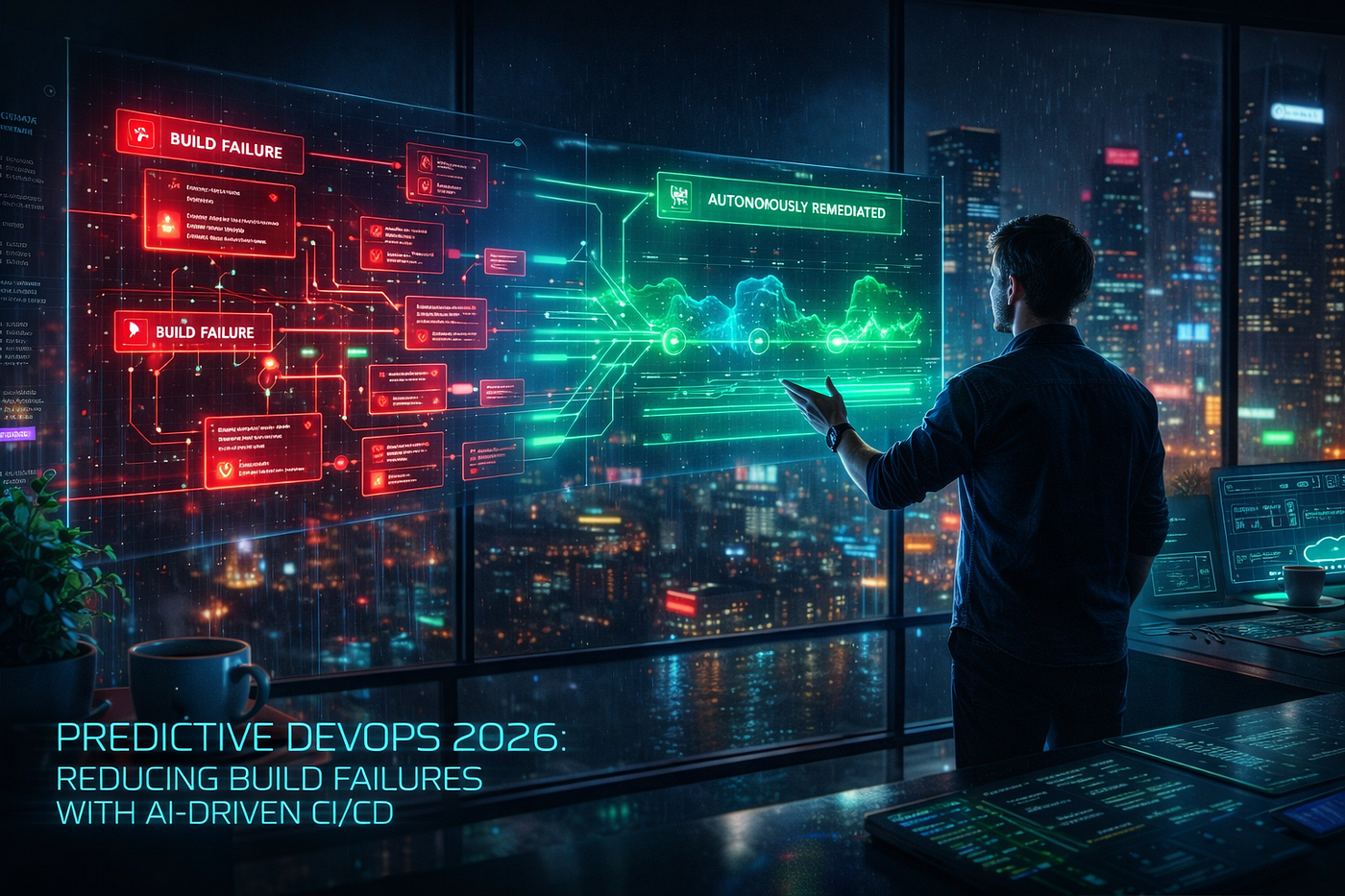
In a futuristic cityscape, a developer interacts with a holographic screen displaying AI-driven solutions for reducing build failures, showcasing the advancements in predictive DevOps by 2026.
The era of “breaking the build” is evolving. In 2026, the traditional CI/CD pipeline — once a rigid conveyor belt for code — has become an intelligent, adaptive ecosystem. As software complexity explodes through distributed microservices and cloud-native architectures, manual reasoning alone is no longer sufficient to maintain system stability.
For DevOps leads and engineering managers, the focus has shifted from merely automating tasks to augmenting them with context and prediction. Predictive AI is now the primary lever used to reduce build failures, optimize resource allocation, and ensure that “shifting left” is a data-driven reality rather than just a strategic goal.
The Current State of DevOps in 2026
In 2025, approximately 76% of DevOps teams had already integrated AI into their CI/CD workflows. By early 2026, this integration has matured from passive dashboards to predictive, automated response chains.
The primary challenge driving this adoption is “Automation Noise.” Static rules often fail to keep up with dynamic environments, leading to alert fatigue and brittle pipelines. Modern AI-driven DevOps addresses this by moving from execution to enablement — building “paved roads” that allow developers to move faster without increasing the risk of a production outage.
Core Framework: The Predictive Build Protocol
Predictive AI reduces build failures through three specific layers of analysis:
- Risk Estimation: Systems analyze dependency graphs and historical failure patterns to estimate the likelihood of a build failing before it even runs.
- Intelligent Test Selection: Instead of running a full regression suite for every minor change, AI selects only the most relevant test cases based on the specific code touched, significantly reducing pipeline duration and “flaky” test noise.
- Autonomous Root Cause Analysis (RCA): When a failure does occur, AI analyzes logs and stack traces in real-time to pinpoint the exact cause and suggest — or even apply — the necessary fix.
Real-World Example: Predictive Rollbacks
Note: This is a documented application of AIOps in 2026 environments.
A financial services platform utilizing AIOps can now detect a memory leak or unusual traffic pattern during a canary release. Instead of waiting for a human engineer to intervene, the system identifies the anomaly against 2025–2026 historical baselines and automatically triggers a rollback within seconds, maintaining near-zero downtime.
AI Tools and Resources for 2026
Modern DevOps teams are transitioning from generic automation toward specialized agents designed to target specific failure points. Here are the leading tools defining the 2026 landscape:
- Qodo (formerly Codium): A staple for teams prioritizing code integrity, Qodo provides agentic code reviews and context-aware refactoring suggestions directly within the pull request workflow.
- Harness: Ideal for large-scale enterprises managing complex delivery lifecycles, this platform leverages AI to automate the entire software delivery process, including sophisticated, ongoing error tracking.
- Spacelift (Saturnhead AI): Transforming infrastructure management for teams using Terraform or OpenTofu, Saturnhead AI analyzes runner logs to provide actionable feedback that previously required hours of manual investigation.
- Dynatrace: The gold standard for observability in multi-cloud environments, it correlates signals across metrics and traces to accurately predict failure windows before they impact the end-user experience.
- GitHub Copilot: Far beyond simple code completions, Copilot has evolved into a productivity engine that suggests optimized algorithms specifically designed to prevent common logic-based build failures.
Practical Application: Implementing Predictive Gates
To transition your pipeline to a predictive model in 2026, follow this phased approach:
- Phase 1: Anomaly Detection: Start by feeding historical build logs and deployment metrics into an AIOps tool to establish “normal” behavior.
- Phase 2: Shadow Mode: Allow the AI to predict failures and suggest fixes without executing them. Validate these suggestions against actual human troubleshooting for 30 days.
- Phase 3: Automated Intervention: Gradually enable autonomous remediation for low-risk scenarios, such as restarting failed pods or rolling back minor UI changes based on error rate spikes.
Risks, Trade-offs, and Limitations
Despite the efficiency gains — where enterprises using AI in DevOps report a 30–50% reduction in incident resolution time — there are critical constraints to consider:
- Data Quality Dependency: If the underlying logs or telemetry data are “messy” or inconsistent, the AI will generate poor suggestions or false positives.
- The “Black Box” Risk: Over-reliance on autonomous systems can make recovery harder if the AI misbehaves and the team has lost the manual skills to intervene.
- Failure Scenario: Imagine an AI model trained on a period of low traffic that interprets a legitimate 2026 viral marketing spike as a DDoS attack, automatically throttling resources and causing a self-inflicted outage. Warning sign: AI-driven thresholds that do not account for external business calendars.
Key Takeaways
- Predict, Don’t Just React: By 2026, leading teams use AI to estimate build failure probability before execution.
- Efficiency Gains: AI-powered cloud optimization can cut infrastructure costs by 20–40% while improving uptime.
- Human-in-the-Loop: AI should be treated as a high-level assistant that handles repetitive “grunt work,” allowing engineers to focus on architecture and innovation.
- Strategic Growth: As organizations scale, they are increasingly looking toward specialized hubs for mobile app development in Georgia to build the resilient, high-performance backends required for AI-driven platforms.
FAQ
Q: Does predictive AI replace the need for DevOps engineers?
A: No. It shifts their role from manual troubleshooting to “enabling,” where they spend more time training AI systems and designing resilient architectures.
Q: What is the most common starting point for AI in CI/CD?
A: Most teams start with automated testing, as it is repetitive and provides the easiest path to immediate ROI.
Q: How does AI handle “flaky” tests?
A: Machine learning models can detect and prioritize unreliable tests, preventing them from stopping the pipeline unnecessarily.
Q: Is specific hardware required for predictive CI/CD?
A: No, but high-performance runners are recommended to handle real-time log analysis and model training.
Q: How long is the typical AI training period?
A: Most systems require 30 days of historical build data to establish reliable failure prediction baselines.
Beyond the Build: Shaping the Next Phase
Finding reliable, battle-tested insights on predictive DevOps is notoriously difficult. Most practical knowledge remains locked within engineering teams or buried in fragmented real-world post-mortems.
I’m considering making Autonomous Remediation Frameworks our next deep dive. Does your team need a breakdown of how to move from “predicting” failures to “auto-fixing” them without human intervention?
Let me know in the comments:
- Type “Yes” if you want that topic covered next.
- Share the specific bottleneck or cultural hurdle preventing your team from trusting automated fixes.
Your feedback directly determines which technical challenges we tackle in the upcoming article.
I especially want to hear from:
- DevOps Engineers and SREs
- Platform Architects
- Engineering Managers
- CI/CD Pipeline Specialists
If we move forward with this, I’ll include a modular Remediation Trust Logic Framework to help you audit and safely deploy autonomous scripts.

👋 If you find this helpful, please click the clap 👏 button below a few times to show your support for the author 👇
🚀Join FAUN.dev() & get similar stories in your inbox each week for free!
메타데이터
- post_id
- b8a5ef007c56
- slug
- predictive-devops-2026-reducing-build-failures-with-ai-driven-ci-cd-b8a5ef007c56
- url
- https://faun.pub/predictive-devops-2026-reducing-build-failures-with-ai-driven-ci-cd-b8a5ef007c56
- canonical_url
- https://faun.pub/predictive-devops-2026-reducing-build-failures-with-ai-driven-ci-cd-b8a5ef007c56
- author_url
- https://medium.com/@devin-rosario
- status
- ok
- fetched_at
- 2026-06-22 07:15:07