Messina, 1908: How Disaster Capitalism Was Born in the Ruins of Europe’s Deadliest Earthquake
A forensic look at the 1908 Messina earthquake shows why the reconstruction, not the earthquake itself, produced a century of inequality…
Messina, 1908: How Disaster Capitalism Was Born in the Ruins of Europe’s Deadliest Earthquake
A forensic look at the 1908 Messina earthquake shows why the reconstruction, not the earthquake itself, produced a century of inequality, and offers an early template for how disaster capitalism converts catastrophe into profit.
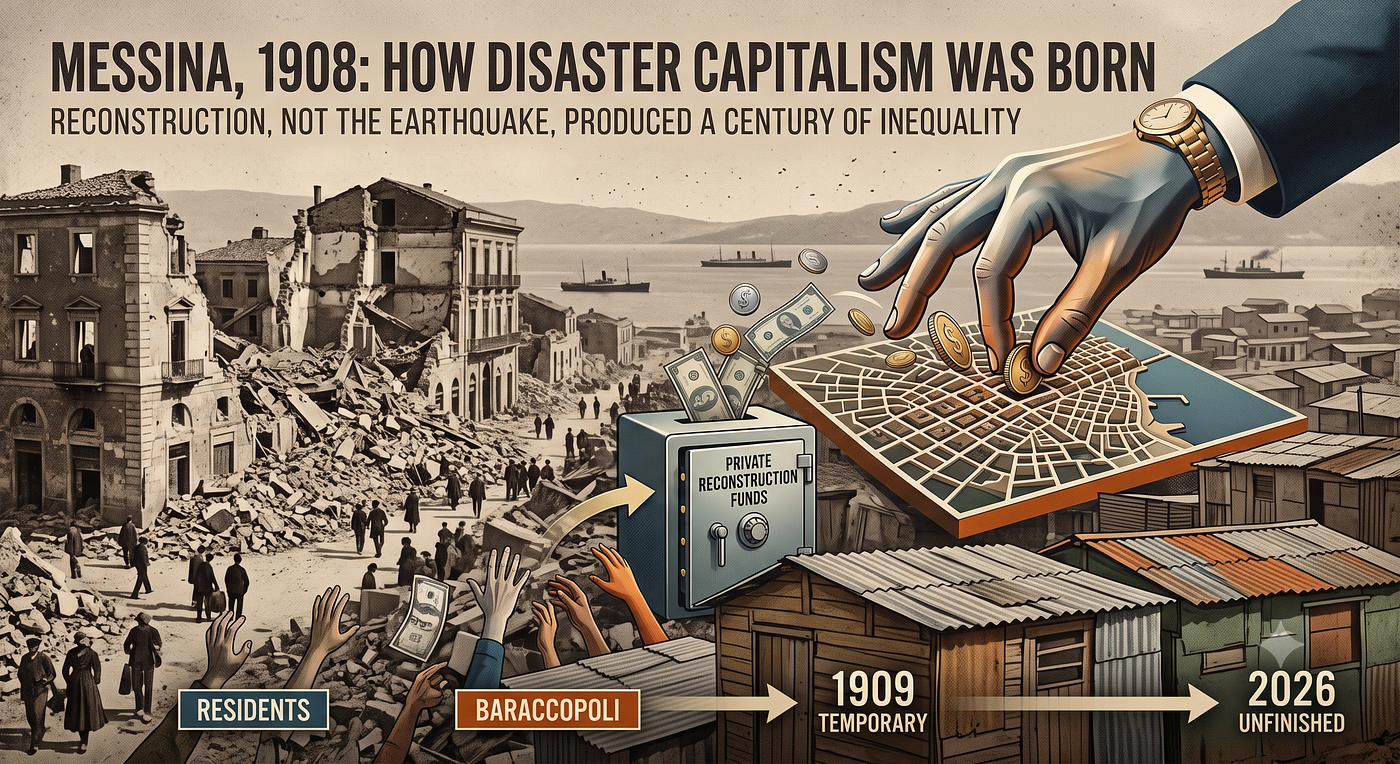
Created by Gemini
At 5:20 a.m. on December 28, 1908, the ground beneath the Strait of Messina moved for 37 seconds and killed as many as 120,000 people. That is the number most textbooks remember. What they rarely explain is why a magnitude-7.1 earthquake — strong, but not unusually so by global standards — produced Europe’s deadliest natural disaster on record, and why its social wounds took more than a century, and 100 million euros of emergency legislation, to even begin closing.
Disaster Begins Before the Ground Shakes
Early in my career, while serving as a principal research fellow at NIED, Japan’s National Research Institute for Earth Science and Disaster Resilience, I organized public, open study sessions in which outside experts and I walked general audiences through disaster case studies from around the world. What struck me, case after case, was not the hazard itself but a recurring characteristic underneath it: the death toll and the shape of recovery were already being decided long before the ground ever moved. That observation has anchored my research ever since, and it is the lens through which Messina still repays study, more than a century on.
Disaster begins before the disaster, not after it. Messina is one of the clearest historical illustrations of that principle. The hazard was severe, but the death toll — at least 75,000 in Messina and its suburbs, roughly 25,000 more around Reggio Calabria — was produced by decades of unregulated urban growth, unreinforced masonry, and a state that had never written a seismic building code for one of the Mediterranean’s most active straits. This article revisits Messina not for the earthquake, but for what came after: a reconstruction that a growing body of Italian sociology now analyzes through the lens of “disaster capitalism,” the pattern by which catastrophe becomes an opportunity to redistribute land, labor, and profit upward. The rebuilding produced Italy’s first national seismic code — and informal settlements, the baraccopoli, that the state did not legislate to eliminate until 2021, and still hasn’t finished dismantling.
A Disaster Foretold: Vulnerability Built Before the Ground Ever Shook
The Strait of Messina sits astride the Eurasian and African plate boundary, and its seismic history — including a catastrophic 1783 earthquake — was well documented long before 1908. Yet neither the Kingdom of Italy nor local municipalities had implemented building codes or restrained the dense, unplanned urban growth filling Messina’s historic core. Buildings were heavy, unreinforced masonry — river pebbles and fieldstone bound with degradable mortar — topped with rigid vaulted roofs never designed to flex under lateral force.
This physical vulnerability sat on a deeper structural one. Sicily and Calabria were at the center of the Questione Meridionale, the Southern Question — a fiscal and structural asymmetry between an industrializing North and an agrarian South. Messina’s citrus economy was already declining, and emigration rates had climbed to among the highest in Italy. Local governance was marked by the clientelism that historian and University of Messina professor Gaetano Salvemini spent his career attacking, accusing Prime Minister Giovanni Giolitti of exploiting Southern poverty to secure political dominance.
None of this caused the earthquake. All of it determined how many people it would kill and what would happen to survivors.
“The astronomical death toll was not a function of tectonic violence alone — it was the direct result of decades of unregulated urbanization and an absent seismic building code.”
Thirty-Seven Seconds, and the Collapse of Civic Order
At least 91 percent of Messina’s structures were destroyed or made irreparable. Reggio Calabria’s historic center was almost entirely erased. Roughly ten minutes later, a tsunami — its cause still debated among seismologists, variously attributed to coseismic seafloor displacement, a submarine landslide off Giardini Naxos, or both — sent waves as high as 12 meters into the coastline, drowning survivors who had fled to what they assumed was safety. The wave reached as far as Malta two hours later.
Governance collapsed with the buildings. Most officials and police were among the dead; prisons emptied; looting followed within hours. The state’s response prioritized order over rescue: martial law was declared, and General Francesco Mazza barred civilians from digging through rubble for their own families — some were shot for trying. Among those digging for days, in vain, was Salvemini, who lost his wife, his sister, and all five of his children, and later described eleven years of family happiness destroyed within two minutes. It redirected his career toward a lifelong campaign against Italian authoritarianism.
International relief arrived with unprecedented speed for 1908 — Russian sailors earning the local title “angels who came from the sea,” the British Mediterranean fleet, and two American battleships diverted from the globe-circling “Great White Fleet.” None of that speed, however, translated into an equitable reconstruction.
The Demographic Paradox That Should Not Have Happened
Conventional economic reasoning predicts that total destruction of housing and livelihoods, at the historical peak of the Age of Mass Migration with open borders and cheap transatlantic passage, should have triggered a surge in emigration. Economic historians Yannay Spitzer, Gaspare Tortorici, and Ariell Zimran tested this directly and found the opposite: no large overall effect. Emigration rose only modestly, and only where agricultural day laborers — who had no land tying them to place — made up a larger share of the workforce. Elsewhere, the destruction of household savings and property appears to have trapped rather than displaced people: catastrophic loss tightened liquidity constraints so severely that leaving became less possible, not more. The poorest were left entirely dependent on a reconstruction process with little intention of serving them equitably.
The Shock Doctrine Arrives: Reconstruction as Extraction
This is where Messina becomes most instructive. Sociologists Domenica Farinella and Pietro Saitta argue against treating the earthquake as the sole origin of the city’s modern troubles; instead, it was an accelerant, giving political and corporate actors an opening to reshape the city’s land and economy in ways already trending before 1908 — but that peacetime politics could never have executed so quickly.
Three mechanisms defined this asymmetrical recovery:
-
Forced expropriation — the state redrew Messina’s urban grid for seismic safety, transferring valuable land from displaced families to the state and large developers.
-
Exclusionary financing — a consortium of pre-disaster property owners restricted reconstruction loans to those who had held formal titles before the earthquake, locking the renting working class out of the recovery economy.
-
Corporate infiltration — contracts bypassed local artisans for capitalized Northern cooperatives and real-estate firms, shifting the profits of rebuilding northward.
The reconstruction also gave organized crime its first major foothold in public infrastructure. According to anti-mafia magistrate Nicola Gratteri and historian Antonio Nicaso, the ‘ndrangheta and Sicilian Mafia — until then focused on rural extortion — recognized the scale of the roughly 100 million lire Parliament allocated, and moved aggressively into municipal contracting: a pivotal step toward the entrepreneurial, infrastructure-embedded organized crime of later decades.
The Baraccopoli: When “Temporary” Becomes a Century
The clearest physical legacy was the baraccopoli — wooden emergency huts built on expropriated land immediately after the earthquake. Because formal reconstruction was slow and financially inaccessible to the poor under the new lending rules, these “temporary” shelters hardened into permanent, unregulated settlements — Fondo Fucile, Fondo Saccà, Rione Taormina, Maregrosso — extended over the decades with sheet metal, cinderblock, and asbestos roofing. An address there became, itself, a source of labor-market discrimination for generations.
It took the COVID-19 pandemic and the plain impossibility of social distancing among roughly 2,300 families still living there in 2021 to force the state’s hand. Legge 76/2021 authorized 100 million euros, appointed a Special Government Commissioner, and mandated demolition, asbestos remediation, and rehousing. As of mid-2026, several hundred families have been relocated, but well over a thousand remain. Rome extended the commissioner’s powers again in December 2025, through 2026, with a government target of finally clearing every settlement by 2028 — a full 120 years after the earthquake that produced them.
“Messina’s century-long baraccopoli problem is what happens when ‘Build Back Better’ is applied selectively: better for those with land titles, worse, indefinitely, for those without.”
Disaster Recovery Has No Closing Date
Messina’s 1909 building code — Royal Decree 193 — was genuinely transformative: height limits, solid foundations, lightweight roofs, early reinforced concrete. It is rightly regarded as Italy’s first comprehensive seismic code, and it worked, within the formal city it was written to protect. Its failure was one of scope, not engineering: it never reached the baraccopoli it inadvertently helped create — precisely the gap the Sendai Framework for Disaster Risk Reduction was later written to close, warning that risk-reduction measures aimed only at hazard exposure simply relocate vulnerability rather than eliminating it.
The 1908 earthquake killed on a scale unmatched in modern European history, but its most durable legacy is the century of asymmetrical reconstruction that followed: expropriation, exclusionary lending, and organized-crime capture of public funds, redirecting recovery resources toward those positioned to profit from catastrophe rather than those who needed them. The poorest were not freed to seek opportunity elsewhere; many were frozen in place, dependent on a state whose reconstruction machinery was never built with their interests in mind. Messina’s still-unfinished baraccopoli clearance is the clearest proof that disaster recovery is not an event with a closing date — it is a governance process that stays open and unjust for generations unless someone is held accountable for finishing it. The question worth asking of any reconstruction today is not only how fast homes go up, but who is left out of the financing, the contracts, and the land titles while they do.
Note Every effort has been made to ensure the accuracy of the information presented in this article. However, if you notice any factual errors or inaccuracies, please contact me. Your feedback and cooperation would be greatly appreciated.
메타데이터
- post_id
- b8aa53a5c77a
- slug
- messina-1908-how-disaster-capitalism-was-born-in-the-ruins-of-europes-deadliest-earthquake-b8aa53a5c77a
- url
- https://medium.com/@tadashi.nakasu/messina-1908-how-disaster-capitalism-was-born-in-the-ruins-of-europes-deadliest-earthquake-b8aa53a5c77a
- canonical_url
- https://medium.com/@tadashi.nakasu/messina-1908-how-disaster-capitalism-was-born-in-the-ruins-of-europes-deadliest-earthquake-b8aa53a5c77a
- author_url
- https://medium.com/@tadashi.nakasu
- status
- ok
- fetched_at
- 2026-07-23 10:24:43



