I Almost Quit Turo After My First Damage Claim — Here’s the Math Nobody Explained Up Front
Guest damage, a $500 recovery cap, and a $2,750 damage responsibility taught me that “more earnings per trip” and “actually profitable” are…
I Almost Quit Turo After My First Damage Claim — Here’s the Math Nobody Explained Up Front
Guest damage, a $500 recovery cap, and a $2,750 damage responsibility taught me that “more earnings per trip” and “actually profitable” are not the same thing.
Three months in as a Turo host, I hit my first real damage claim. Repairs came in around $1,500. I’m on the 90% earnings plan (Turo now calls it More earnings), so my damage responsibility is $2,750 per incident.
The guest had standard protection on the trip. Turo recovered $500 from the guest side. I’m on the hook for roughly $1,000 after that — not because Turo “scammed” me, but because of how the plan, the guest’s coverage, and the repair bill interact.
I almost quit that week. Not from drama — from math.
This post is what I wish I’d read before I picked a plan based on “I want to keep more per trip.”
What happened (short version)
A guest damaged the car during a trip. I filed a claim, documented everything, and went through Turo’s resolution flow.
Rough numbers:
Line item | Amount
Repair estimate | ~$1,500
Recovered from guest (standard protection) | $500
My out-of-pocket (approx.) | ~$1,000
My plan’s damage responsibility ceiling | $2,750
I chose the 90% plan because higher earnings per booking looked better on paper. On paper is not the same as three months of real trips + one bad incident.
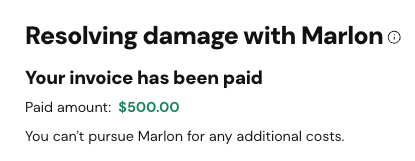
Turo’s resolution screen showing the guest-side payment ($500) and that I can’t pursue the guest for additional costs beyond what Turo collected.
Three host earnings plans in 2026 (US)
As of January 7, 2026, Turo simplified US host plans to three options. The tradeoff is always the same: higher trip share → higher damage responsibility.
Plan (2026 name) | Host share (typical) | Damage responsibility
More peace of mind | 70% | $250
Balanced | 80% | $1,500
More earnings | 90% | $2,750
Official source: Turo Help — Earnings plans in detail (US hosts) and Vehicle protection overview.

Higher earnings share usually means higher out-of-pocket exposure per damage incident (US plans, 2026)
Important: Host share can vary by market and how far in advance a guest books (dynamic pricing in some cities). Damage responsibility thresholds above are the standard US figures Turo publishes for trips booked on or after January 7, 2026.
The math a Reddit host explained better than I did
After I posted about this on Reddit, another host broke it down in a way that finally clicked — especially for economy cars with a lower monthly gross.
Their example (economy car ~$800/month before the plan):
- On the 90% plan, Turo’s take is roughly $80/month
- On the 70% plan, Turo’s take is roughly $240/month
- Difference: about $160/month in Turo’s favor on the lower plan
But the damage responsibility gap between 90% and 70% is $2,500 ($2,750 − $250).
So you need roughly:
$2,500 ÷ $160 ≈ 15–16 months with no deductible-worthy incident
…before the 90% plan actually leaves you ahead on plan economics alone.

For lower-earning cars, one incident can erase more than a year of “extra” 90% plan income
That doesn’t mean 90% is wrong. It means 90% is a bet that you won’t eat a deductible-sized event often — and that your car earns enough per month for the spread to matter.
For a higher-end car (~$2,000/month in their example), the monthly spread between plans might be ~$400. Break-even drops to roughly 7 months without a major incident. At that earnings level, 90% can make sense — if you actually have cash reserves when something breaks.
Guest protection vs host plan (why $500 showed up)
Hosts often conflate two different things:
- Your earnings plan → sets your damage responsibility ceiling with Turo
- Guest protection level on the trip → caps what Turo can collect from the guest for certain costs
My guest had standard protection. Turo’s resolution reflected a $500 guest-side payment. The screen explicitly said I couldn’t pursue the guest for additional costs beyond that process.
That’s not a surprise if you read the fine print — but it feels different when you’re staring at a repair quote.
Visual you can add (optional): Screenshot from Turo guest protection or your trip details page showing the guest’s plan tier at booking time.
What three months of hosting actually looked like for me
I’m not a fleet operator. One car, still learning.
When I stacked:
- depreciation / loan or opportunity cost
- insurance outside Turo (if any)
- cleaning, time, delivery hassle
- a slow stretch (June felt soft)
- and ~$1,000 out of pocket on this claim
…I wasn’t sure the car was net profitable yet. Maybe break-even on a good month. Losing on a bad one.
That’s the part that made me want to quit — not the claim process itself.

flat overcast light on black paint — hard to read in search, guests scroll past

same tesla, same spot basically — just better light and timing. this is what actually gets the open
Hosts don’t need fancy accounting on day one — but you do need something more honest than the Turo app’s green numbers.
What I’d tell a new host now
1. Pick your plan based on reserves, not ego. If one $1,000–$2,750 hit would wreck your month, the 90% plan is probably the wrong flex.
2. Run the break-even months math before you list. Use your realistic monthly gross, not your best week.
3. Document like you’re going to court. Pickup and dropoff photos, interior, mileage, fuel, any smell or damage. Claims are easier to file than to win economically.
4. One incident can erase months of “I kept 10% more.” That’s not Turo being evil. That’s the product structure.
5. Slow season = fix listing basics. While demand is soft, I spent more time on photos (lighting, recognizable locations, hero framing) because clicks matter more when fewer people are searching. Different problem than insurance — but still revenue.
Am I quitting?
Not yet. But I’m not adding a second car until I rerun the numbers on 70% vs 90% with real trailing data — not YouTube optimism.
If you’re going through the same thing: you’re not alone, and you’re not necessarily “bad at Turo.” You might just be learning risk math expensively.
Questions I’m still asking other hosts:
- Did you move down from 90% after your first claim?
- For a single economy car, what plan are you actually on?
- How do you track true profit — not just trip payout?
Drop a comment if you’ve got a cleaner spreadsheet than I do.
Official Turo references
- Earnings plans — In detail (US hosts)
- Vehicle protection / earnings plans overview
- Insurance & protection at Turo
- How damage claims work (Help Center — search “damage”)
About the author
I’m a Turo host in Florida, sharing what I’m learning the expensive way — claims, photos, slow months, and the gap between “trip payout” and actual profit.
I also built Shoturo, a small tool for cleaning up listing photos (background and lighting on real car photos). It didn’t fix my damage claim, but it helped my listing look more bookable during a soft month.
메타데이터
- post_id
- b8b993884e86
- slug
- i-almost-quit-turo-after-my-first-damage-claim-heres-the-math-nobody-explained-up-front-b8b993884e86
- url
- https://medium.com/@jcjimenezglez/i-almost-quit-turo-after-my-first-damage-claim-heres-the-math-nobody-explained-up-front-b8b993884e86
- canonical_url
- https://medium.com/@jcjimenezglez/i-almost-quit-turo-after-my-first-damage-claim-heres-the-math-nobody-explained-up-front-b8b993884e86
- author_url
- https://medium.com/@jcjimenezglez
- status
- ok
- fetched_at
- 2026-07-10 06:10:56