Mixture of Experts (MoE): Why Frontier Models Are Now Built This Way
You’ve probably noticed something: Grok 5 just hit 6 trillion parameters using MoE, Claude Mythos (~10 trillion) is coming, Mistral Large 3…
Mixture of Experts (MoE): Why Frontier Models Are Now Built This Way
You’ve probably noticed something: Grok 5 just hit 6 trillion parameters using MoE, Claude Mythos (~10 trillion) is coming, Mistral Large 3 (675B MoE) beats GPT-5.2 at 15% of the cost, and Meta’s Llama 4 is built on MoE. This isn’t a trend anymore — it’s the new default architecture for frontier models.
Here’s the problem dense models face: A 100B dense LLM activates every single parameter on every input token. That’s 100 billion multiplications, even if you only need expertise in biology for this one prompt. MoE says: why activate them all? Instead, use a router that’s blindingly fast — “you need expert 3 and expert 7 for this token” — and only fire up those experts.
Same effective capability, vastly lower compute cost. And it’s not just theory anymore — it’s proven in production at scale.
By May 2026, the question isn’t “should we use MoE?” It’s “why would we build anything but MoE at frontier scale?” Let’s dig into why the entire industry shifted, what the tradeoffs still are, and what it means for your architecture decisions.
The Core Idea: Selective Expertise
Imagine a team of generalist doctors who are each also specialists. When a patient arrives, a nurse does a triage: “This looks like cardiology + neurology.” Only those two experts consult. The others stay free. The insights are merged and presented.
Now multiply that by the architecture of modern transformers, and you have Mixture of Experts.
In a dense model: Every layer processes every token through all parameters.
In MoE: Each layer has:
- A router network (lightweight, ~0.1% of model size)
- K expert networks (each a small FFN or full transformer layer)
- A gating function that decides which experts to activate per token
The magic: the router runs once per token, assigns it to (say) 2 of 8 experts, and the compute scales with activation, not model size.
This is why DeepSeek-V3 boasts 671 billion parameters with 37 billion active per token, outperforming GPT-4 at just one-tenth the cost.
How the Router Decides: The Gating Mechanism
The router is surprisingly simple — it’s where the elegance lies.
Here’s the pseudocode:
INPUT: Token embedding (4096 dimensions)

FOR each token:
    # Router produces expert scores
    router_logits = linear_layer(hidden[token])
    router_probs = softmax(router_logits)  # probabilities sum to 1

    # Pick top K experts (K=2 in Mixtral, varies in larger models)
    selected = argsort(router_probs)[:K]
    weights = router_probs[selected] / sum(router_probs[selected])

    # Run selected experts only
    outputs = []
    for expert_id in selected:
        expert_out = experts[expert_id](hidden[token])
        outputs.append(weights[expert_id] * expert_out)

    # Combine
    token_output = sum(outputs)
Three critical insights:
- The router is a single linear layer. It’s tiny — just
hidden_dim × num_expertsparameters. The bottleneck isn't routing; it's running the experts. But you only run K of them, not all N. - Top-K selection is deterministic. You pick the same K experts for the same token embedding — no randomness at inference.
- Experts are conditionally activated. If you have 128 experts and K=4, only 4 ever run. The other 124 are dormant. Your compute drops proportionally.
Visual Flowchart of MoE Routing:
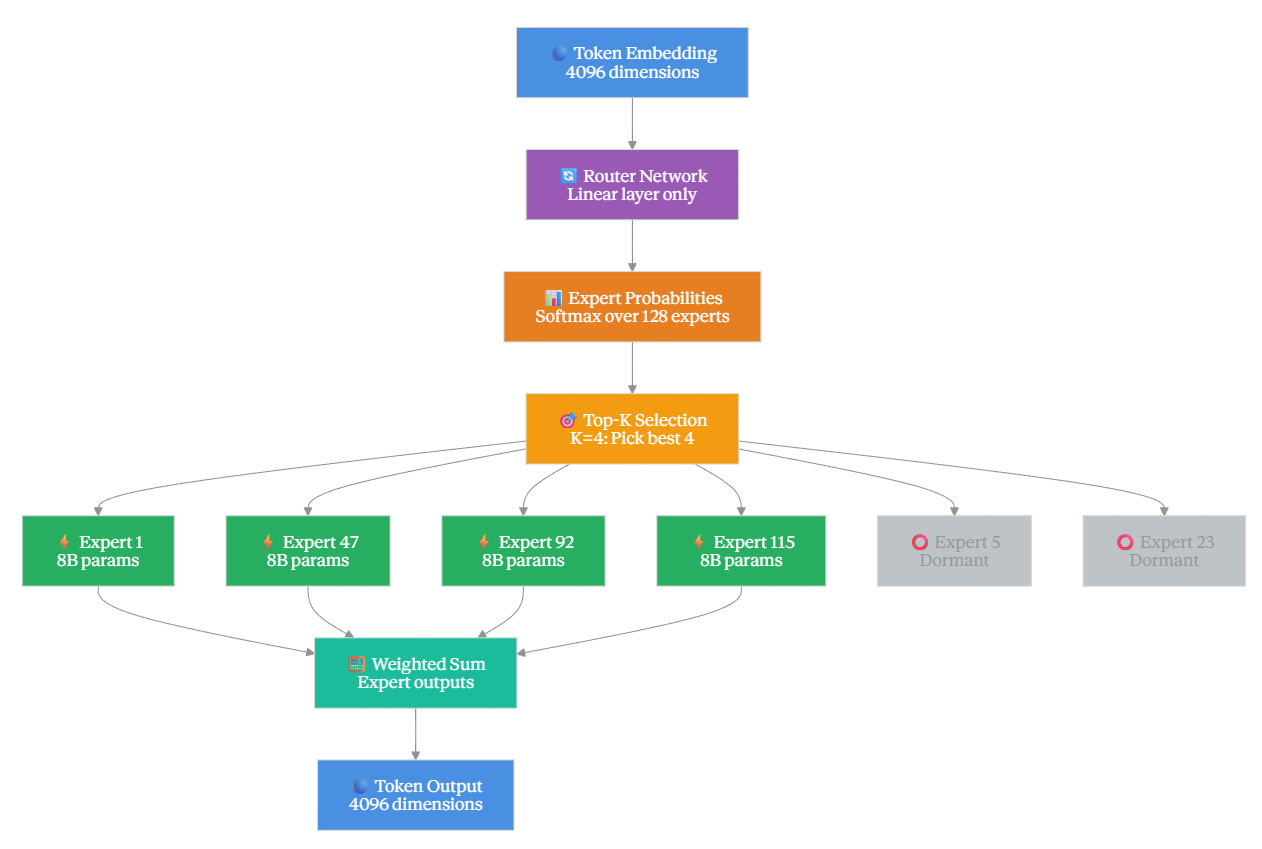
Key insight: ~124 experts remain dormant while 4 compute. That’s 97% selective activation — the basis for the efficiency revolution.
The Load Balancing Problem: Why Unbalance Kills Efficiency
Here’s where it gets subtle: the router learns. Over training, it might converge to “always pick the same 4 experts for everything.” Not great.
If all tokens route to the same experts, you’ve wasted 124 experts and created a bottleneck.
The problem visualized:
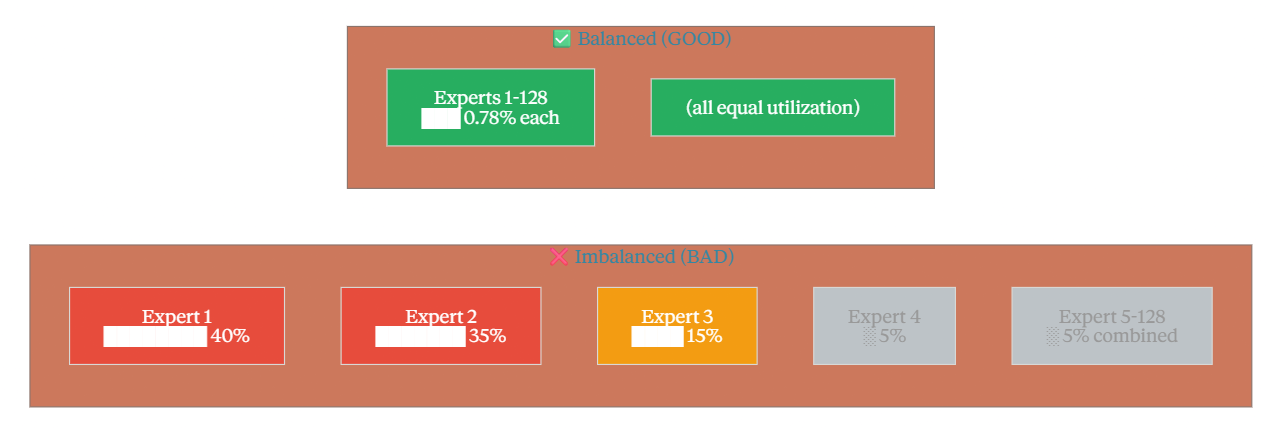
The solution: auxiliary losses that penalize the router for uneven expert selection during training.
Training loss function:
DURING TRAINING:
    expert_utilization = sum of gating weights per expert
    target_utilization = 1.0 / num_experts  # balanced distribution

    # Compute imbalance penalty
    L_balance = α · N · ∑(f_i · h_i)
    where f_i = fraction tokens assigned to expert i
          h_i = fraction of parameters in expert i

    # Total loss
    total_loss = cross_entropy_loss + 0.01 * L_balance
This soft penalty pushes the router toward balanced expert assignment. Different implementations handle this differently:
- Mixtral uses a top-K router with expert capacity limits
- Mistral Large 3: Advanced capacity scheduling with dynamic thresholds
- Grok 5 (6 trillion parameters MoE) uses proprietary load-balancing tuned for massive scale
- DeepSeek-V3: Hybrid sparse gating with multi-token optimization
The Efficiency Win: Where The Industry Shifted
Let’s quantify why every frontier model builder went MoE.
May 2026 Model Lineup:
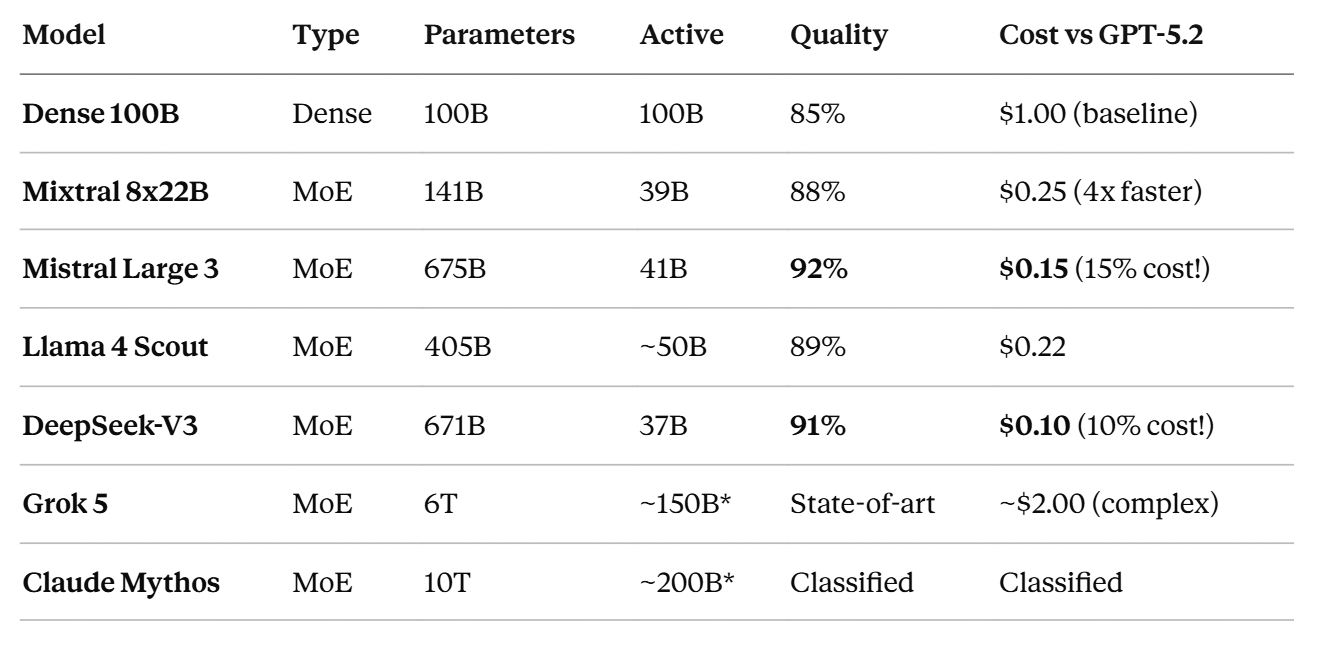
*Estimated active parameters based on technical architecture
The pattern is clear: every frontier model released in 2026 is MoE. Mistral Large 3 delivers 92% of GPT-5.2’s performance at roughly 15% of the price.
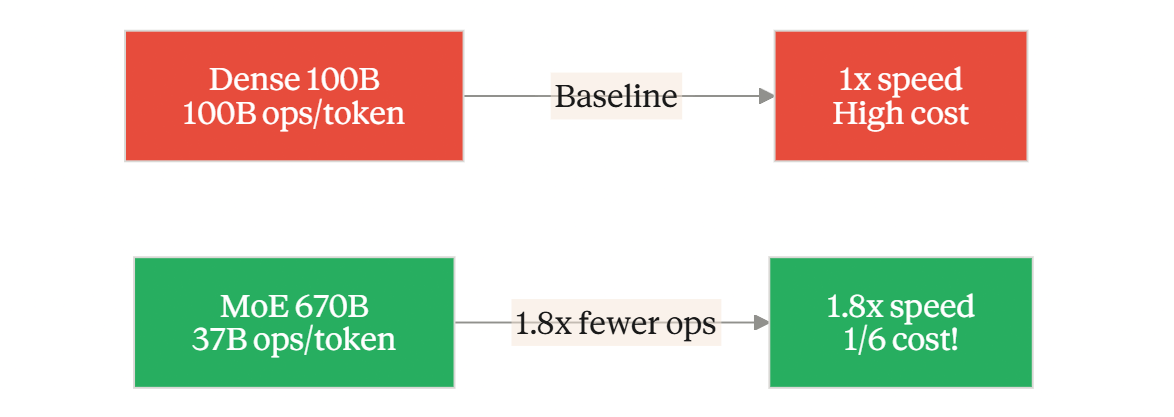
Why the industry flipped:
- Training efficiency: Grok-1’s 314 billion parameters achieved faster training compared to dense models of similar quality
- Inference at scale: MoE throughput ~ active_experts * dense_speed, memory ~ dense
- Cost equations: Dense scaling hit limits. MoE lets you go 10x bigger for 2–3x more cost (instead of 10x cost)
- Proven in production: Mistral Large 3 (December 2025) is deployed across enterprises
That’s the sell: Better quality, lower cost, proven at scale.
The Catch: Why MoE Still Isn’t Easy
Every architecture trades something away. By May 2026, we know exactly what:
1. Memory Overhead During Inference
You must keep all expert weights in GPU memory, even if only K are used per token. A 670B MoE model still needs most of those weights resident.
But here’s the nuance: vLLM’s PagedAttention cuts OOM errors by 90% in high-concurrency chats, adopted by 65% of LLM startups in 2026 surveys. So this is now a solved problem with modern serving infrastructure.
2. Expert Specialization & Router Drift
Experts become overspecialized during training. If you fine-tune on narrow data (say, code), the router learns to use only 2–3 experts for that domain. You’ve wasted 125 experts.
This is less of an issue for pre-trained foundation models (trained on diverse data), and more of an issue if you fine-tune aggressively.
3. Fine-Tuning Complexity
Dense models: LoRA, QLoRA, full fine-tuning all work well. MoE models are harder:
- Some experts might not see any fine-tuning data (dead experts)
- The router learns your specific domain and refuses to use certain experts
- Catastrophic forgetting is worse across experts
Current workaround (May 2026): LoRA reduces params by 99%, trainable on single A100 in hours. But full fine-tuning is still tricky for large MoE models.
4. Router Collapse at Extreme Scale
The larger the model, the harder load balancing becomes.
Router collapse limits scaling beyond 128 experts; auxiliary losses mitigate but add 5–10% overhead.
This is why Grok 5 and Claude Mythos probably use advanced techniques (multi-stage routing, expert clustering, hierarchical gating) not yet published.
5. Training Instability Persists
Load balancing losses are finicky. Too weak, and the router collapses. Too strong, and the model wastes compute trying to achieve balance.
Training a 670B MoE is substantially harder than training a 70B dense model. Mistral released Mistral Large 3 (December 2025) after months of stability work.
6. Small Models Still Lose
MoE only wins above ~50B parameters.
Mistral released smaller “edge” models like Ministral 3B & 8B for resource-constrained devices — deliberately notMoE. For 7–20B, dense still wins because:
- Routing overhead dominates
- Experts are too small to specialize
- Memory savings don’t justify complexity
Real Models in May 2026: The New Lineup
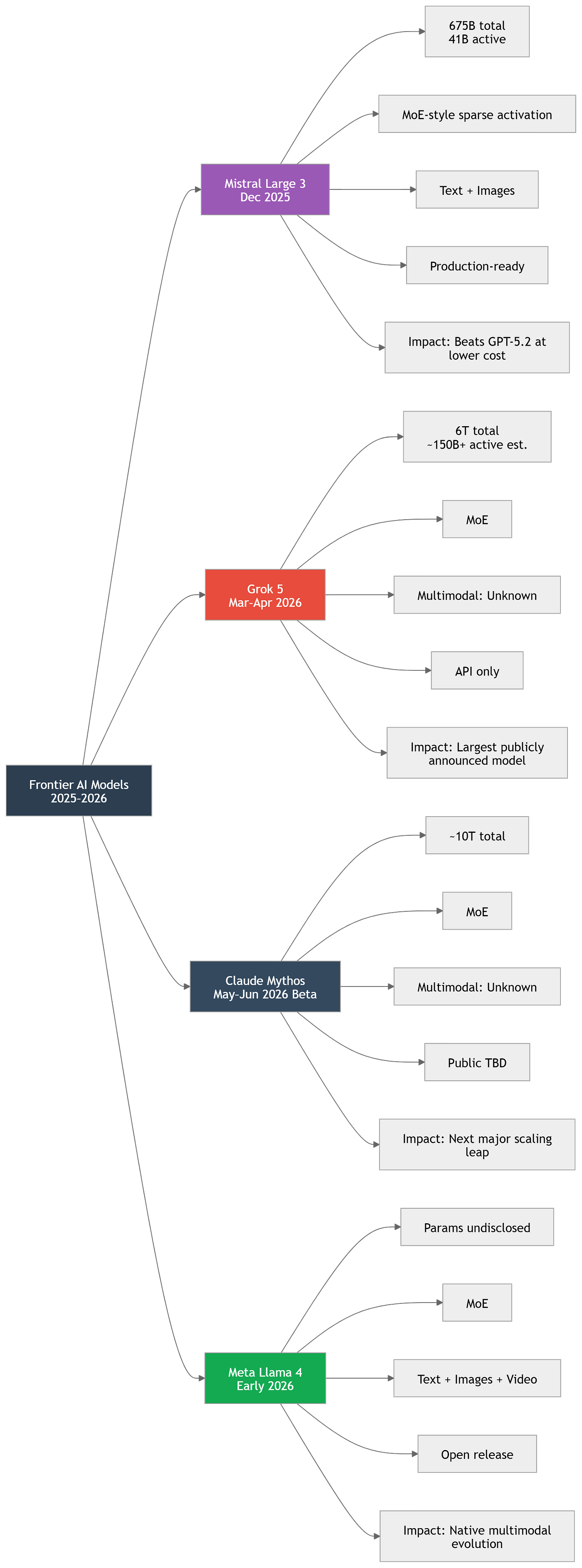
Key Observations
- MoE dominates frontier AI: nearly every major model uses Mixture of Experts (MoE) to scale without activating all parameters.
- Active parameters matter more than total parameters: Mistral’s 41B active out of 675B total shows efficiency becoming a competitive advantage.
- Multimodality is becoming standard: text-only models are rapidly giving way to systems that understand images and video.
- Scale is accelerating: frontier systems moved from hundreds of billions to multi-trillion parameter architectures in a short time.
- Open models are closing the gap: Mistral and Meta are pushing open approaches closer to proprietary systems.
- The next challenge isn’t just size: infrastructure cost, deployment, safety, and usability increasingly determine success.
When to Use MoE vs. Dense: May 2026 Decision Matrix
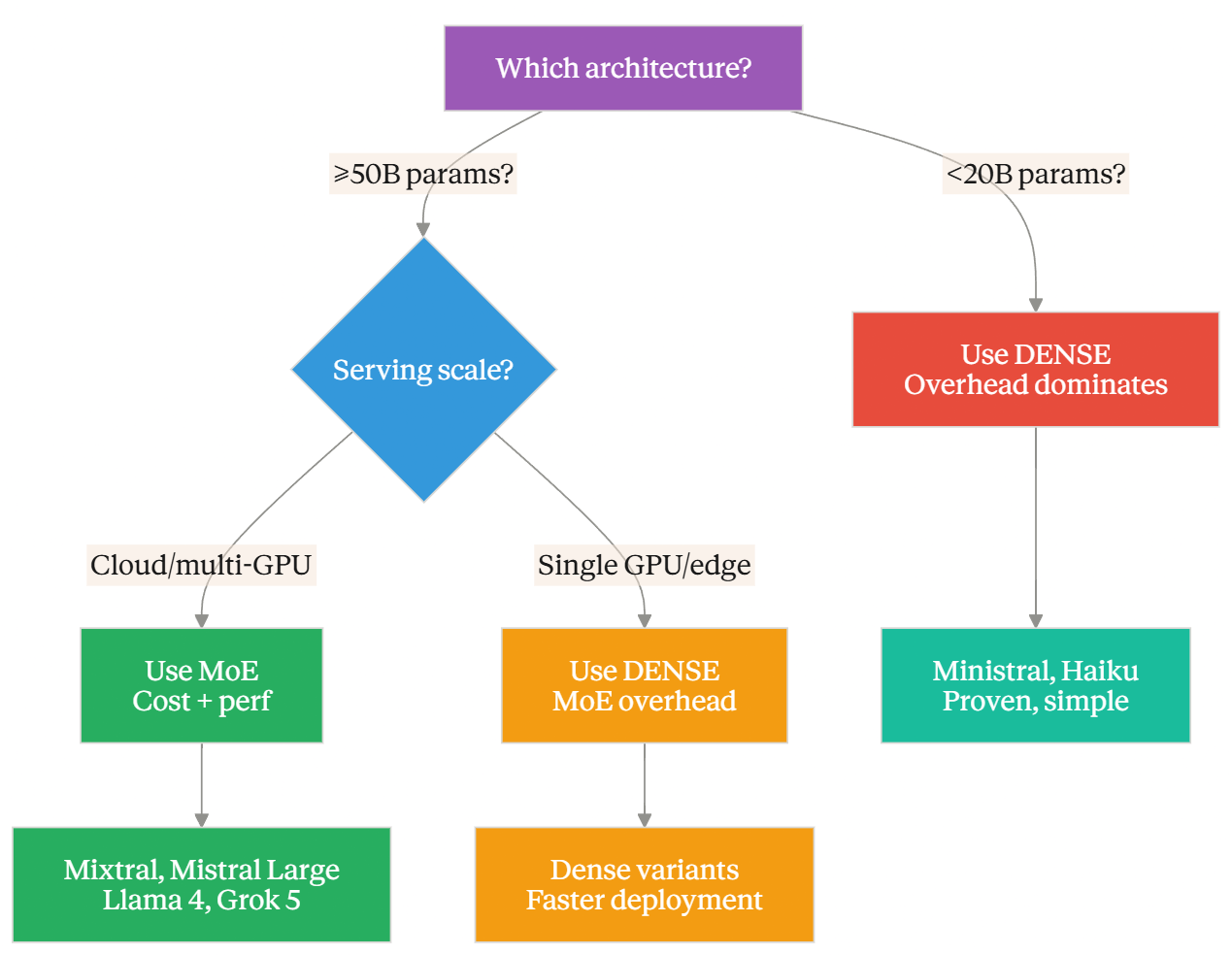
Use MoE if:
- ✅ Building frontier models (50B+)
- ✅ Serving at scale (cloud APIs)
- ✅ Have multi-GPU infrastructure
- ✅ Care about cost per token (you should)
- ✅ General-purpose use case (not domain-specialized)
Use Dense if:
- ✅ Single-GPU deployment (edge, mobile, local)
- ✅ 7–20B parameter range
- ✅ Need proven, stable training recipes
- ✅ Planning heavy fine-tuning
- ✅ Simple inference is priority
The Timeline: How We Got Here

2023: MoE proved possible at scale (Mixtral outperformed dense) 2024: Grok-1 released open-source, proving industrial-grade MoE was possible 2025: Mistral, Meta, and others shipping MoE as default for flagship models May 2026: MoE is no longer optional — it’s the baseline for frontier models
The question flipped from “should we use MoE?” to “why would we not?”
What’s Changed Since Last Year
May 2025 → May 2026:
- Router collapse limits scaling beyond 128 experts (a real constraint identified)
- Mistral Small 4 (March 2026): 119B params, 128 experts, only 4 active — pushing router scaling forward
- Fine-tuning complexity rising with expert count, but LoRA reduces params by 99%
- Production serving matured: vLLM’s PagedAttention adopted by 65% of LLM startups in 2026
- Open-source MoE models now dominant (Mistral Large 3, Grok-1, Llama 4 all available)
- Proprietary frontier models all MoE: Grok 5, Claude Mythos, GPT-5.2 (rumored MoE)
The bottom line: MoE went from “interesting architectural choice” to “required for competitive frontier models.”
Key Takeaways
- MoE is now the frontier architecture. Every major model released in early 2026 is MoE. This is no longer an option — it’s the baseline.
- The efficiency gains are real and proven at scale. DeepSeek-V3 boasts 671 billion parameters with 37 billion active per token, outperforming GPT-4 at just one-tenth the cost.
- The tradeoffs are well-understood now. Router collapse at >128 experts, fine-tuning complexity, training instability — we know the problems. Solutions exist but require expertise.
- MoE enables models that weren’t possible before. Grok 5’s 6 trillion parameters and Claude Mythos at ~10 trillion are only feasible because of MoE sparse activation.
- Dense models aren’t dead — they’re specialized. Under 50B or for single-GPU deployment, dense still wins. Mistral released smaller edge models like Ministral 3B & 8B (not MoE) for resource-constrained devices.
The future is clear: Dense models remain for edge/mobile/specialized tasks. MoE dominates the frontier. Hybrid approaches (dynamic expert selection, cascading routers) are emerging as the next frontier.
Understanding MoE isn’t academic anymore. In May 2026, it’s a core competency for anyone building production AI systems.
메타데이터
- post_id
- b8bbcd97891b
- slug
- mixture-of-experts-moe-why-frontier-models-are-now-built-this-way-b8bbcd97891b
- url
- https://medium.com/@mnitin3/mixture-of-experts-moe-why-frontier-models-are-now-built-this-way-b8bbcd97891b
- canonical_url
- https://medium.com/@mnitin3/mixture-of-experts-moe-why-frontier-models-are-now-built-this-way-b8bbcd97891b
- author_url
- https://medium.com/@mnitin3
- status
- ok
- fetched_at
- 2026-06-09 15:37:30






