We Ran an Experiment to Prove a Classic Marketing Theory. It Didn’t Go the Way We Thought.
“30% off” and “$10.50 off” are the exact same discount. So why does one of them feel like a better deal?
We Ran an Experiment to Prove a Classic Marketing Theory. It Didn’t Go the Way We Thought.
“30% off” and “$10.50 off” are the exact same discount. So why does one of them feel like a better deal?
An experiment conducted by Alina Hota, Erin Rand and Manoranjith

Every marketer knows the drill. You’re running a sale. You have a choice: do you write “30% off” or do you write “$10.50 off”? The conventional wisdom says it depends on your brand. If you’re luxury, go with the percentage. It feels softer, more sophisticated, less desperate. If you’re a value brand, go with the dollar amount. It’s concrete. Tangible. Customers can feel it in their wallet.
This idea shows up in pricing psychology papers, marketing textbooks, and a lot of brand strategy decks. The theory is tidy and intuitive. But is it actually true?
We decided to test it.
The Setup

The question we started with: does the type of discount framing (percentage-off vs. dollar-off) interact with brand positioning (luxury vs. value) to drive purchase intent?
In plain terms: does saying “30% off” work better for a luxury brand, and does saying “$10.50 off” work better for a value brand?
We ran a 2x2 experiment across two product categories: makeup and fragrance. For makeup, we used Colourpop (value) and Urban Decay (luxury). For fragrance, we used Zara (value) and Versace (luxury). Across both categories, the dollar amount of the discount was held equal so we were genuinely just testing the frame, not the size of the savings.
Participants were shown one makeup ad and one fragrance ad, each independently randomized to one of four conditions: luxury with percent-off, luxury with dollar-off, value with percent-off, or value with dollar-off. They then rated their purchase intent on a 7-point scale, along with their perception of how well the discount fit the brand’s image.

Survey Design
We built custom ads for all four conditions in each category, kept the visual design consistent within each brand, and randomized assignment through Google Forms using unique alphanumeric stimulus codes. Each ad got its own code (think MUCOPO for Makeup, Colourpop, Percent-off) so every single response could be traced back to its exact condition. Each person saw two ads, but the conditions were independently assigned.
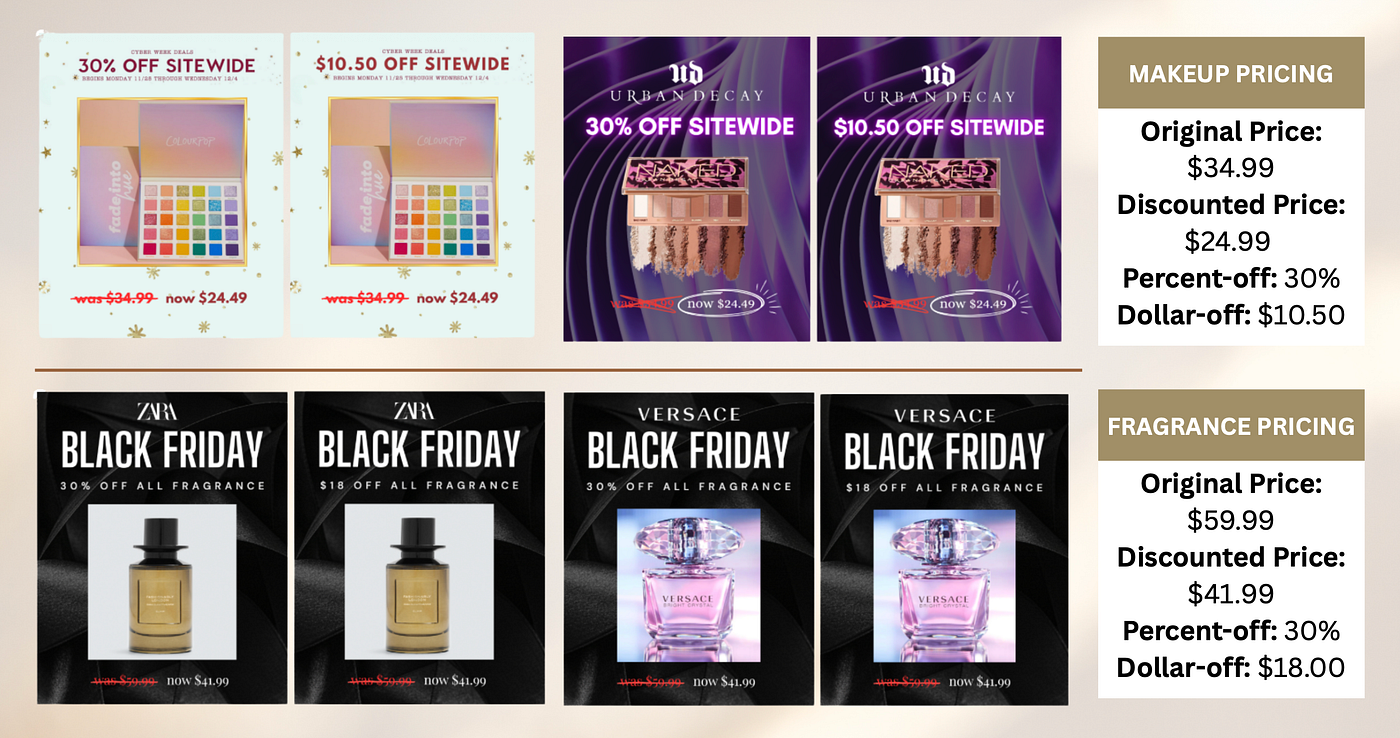
The four makeup/fragrance conditions participants saw, identical final price, different framing
The hypothesis we were testing: luxury brands benefit from percent-off framing, and value brands benefit from dollar-off framing. If hypothesis testing confirmed our prediction, the graph would show a clean crossover interaction. Plot purchase intent on the Y axis, discount type (dollar vs. percent) on the X axis, and draw a separate line for each brand tier. The value brand line should start high on dollar-off and slope downward toward percent-off. The luxury brand line should start low on dollar-off and slope upward toward percent-off. The two lines cross in the middle. That’s the pattern the theory predicts.
What the Data Actually Said
For makeup, the crossover never happened.
What we expected” vs. “What we found:


Value (ColourPop): $ off= 3.07, % off= 1.87 ; Luxury (Urban Decay): $ off= 4.20, % off= 3.13 (Takeaway: Dollar-off boosted purchase intent more than percent-off, with luxury rated higher than value across both frames)
Instead, dollar-off produced higher purchase intent than percent-off for both brands. Colourpop (value) scored 3.07 with dollar-off versus 1.87 with percent-off. Urban Decay (luxury) scored 4.20 with dollar-off versus 3.13 with percent-off. The slopes ran parallel, both tilting downward from dollar to percent. The luxury brand just sat higher overall, not because percent-off lifted it, but because people were already more willing to buy Urban Decay products regardless of how the discount was framed.
The factorial regression found no statistically significant interaction (p = 0.87). Not even close. Brand type (p = 0.06) and discount framing (p = 0.047) also didn’t clear the significance threshold we set at α = 0.01. The mediation model, testing whether perceived discount suitability explained any of the relationship, came back flat too.
The perfume study told a slightly different story, directionally.

Value (ColourPop): $ off = 2.27, % off = 2.87 ; Luxury (Urban Decay): $ off = 3.12, % off = 3.23 (Takeway: Percent-off improved purchase intent for both brands, for Value brands more than Luxury brands (counter-intuitive))
For Versace and Zara, percent-off actually produced slightly higher purchase intent than dollar-off for both brands. Zara went from 2.27 (dollar-off) to 2.87 (percent-off). Versace went from 3.12 to 3.23. But again, there was no crossover, and again, none of these differences were statistically significant (all p > 0.20).
So two product categories. Two different descriptive patterns. One shared conclusion: there is no reliable evidence that the type of discount framing interacts with brand tier to change purchase intent.
Why This Is Worth Paying Attention To
Null results get a bad reputation. Nobody puts “we found nothing” in a headline. But in measurement and experimentation work, a well-designed null result is genuinely informative, sometimes more so than a positive finding.
Here, the null matters because the alternative hypothesis is so widely accepted. The idea that percent-off framing is a better fit for luxury brands is treated as settled wisdom in a lot of marketing circles. We went in fully expecting to confirm it. We had the theory, we had the mechanism (perceived discount suitability as a mediator), and we had a clean design. The data just didn’t cooperate.
One interpretation: consumers, at least in these product categories, aren’t doing the brand-congruence calculation we assumed. They’re not thinking “does this discount type match the identity of this brand.” They’re probably just thinking about whether they want the product and whether it feels like a good deal. Dollar-off may feel more concrete across the board, regardless of what brand is attached to it. That would explain the parallel slopes in the makeup data.
Another interpretation: framing effects are context-sensitive in ways that a controlled experiment irons out. In the real world, shoppers see a brand’s full environment. The website, the packaging, the price anchor, the reviews, the friends who own the same product. Stripping all that away and showing someone a single ad in a Google Form might not produce the same psychology that plays out in an actual purchase decision.
What This Means If You Work in Growth, Marketing, or Measurement
A few practical takeaways:
Don’t trust the theory on its own. “Percent-off for luxury, dollar-off for value” is a plausible hypothesis, not an established rule. If your team is making discount framing decisions based on this assumption, it’s worth running an actual test in your context before locking it in as strategy.
Small samples make interaction effects hard to find. We had around 60 participants per product category. Interaction effects in 2x2 designs require considerably more power than main effects. If the true interaction exists but is small, we would not have detected it here. This is a limitation worth naming plainly: absence of evidence is not the same as evidence of absence.
Category and context probably matter more than we gave credit for. The makeup and perfume results pointed in opposite directions descriptively. That’s a hint that product category is doing something. A replicated study with more categories, larger samples, and more realistic purchase environments could surface patterns that this design couldn’t.
Perceived discount suitability was not a useful mediator here. This was maybe the most interesting secondary finding. Even when participants thought the discount type suited the brand’s image (or didn’t), it didn’t move purchase intent in any predictable direction. Brand congruence, in this case at least, was not the mechanism. That challenges some of the theoretical scaffolding that underlies the original hypothesis.
The Bigger Picture
There’s a lot of pricing and framing psychology research that generates clean, theoretically satisfying results in lab settings and then struggles to replicate in the messy real world. This experiment sits somewhere in that tension. The theory we tested is grounded in solid consumer psychology literature. The logic behind it is sound. But “the logic is sound” and “the effect is real and actionable” are different claims.
If you’re a data scientist working on pricing, a product analyst thinking through promotion strategy, or someone who designs experiments for a living, the uncomfortable truth this surfaces is that a lot of the best practices we treat as settled are actually hypotheses that haven’t been adequately stress-tested.
The cleanest experiment we could run, with real brands, equal discounts, randomized assignment, and a clean mediation model, couldn’t find the interaction. That doesn’t mean the interaction doesn’t exist. It means we should hold the claim more lightly and test more carefully before building strategy on top of it.
The study tested participants across two product categories: eyeshadow palettes (Colourpop vs. Urban Decay) and fragrances (Zara vs. Versace). A 30% / dollar-equivalent discount was held constant across conditions. Purchase intent and perceived discount suitability were measured on 7-point Likert scales. Analysis used factorial linear regression following Baron and Kenny’s mediation framework.
메타데이터
- post_id
- b8e05d942e05
- slug
- we-ran-an-experiment-to-prove-a-classic-marketing-theory-it-didnt-go-the-way-we-thought-b8e05d942e05
- url
- https://medium.com/@alinahota2026/we-ran-an-experiment-to-prove-a-classic-marketing-theory-it-didnt-go-the-way-we-thought-b8e05d942e05
- canonical_url
- https://medium.com/@alinahota2026/we-ran-an-experiment-to-prove-a-classic-marketing-theory-it-didnt-go-the-way-we-thought-b8e05d942e05
- author_url
- https://medium.com/@alinahota2026
- status
- ok
- fetched_at
- 2026-06-09 15:37:30




