Token Allowances Are a UX Risk: What Builders Should Explain Before Users Click Approve
A practical guide for token teams on approval screens, spender addresses, revocation paths, and documentation that helps users make…
Token Allowances Are a UX Risk: What Builders Should Explain Before Users Click Approve
A practical guide for token teams on approval screens, spender addresses, revocation paths, and documentation that helps users make informed wallet decisions.
Most token teams think about the moment a user buys, claims, stakes, or swaps a token. Fewer teams think carefully about the step that often happens immediately before it: the wallet approval.
That approval screen can look routine. A wallet asks the user to allow a contract or spender address to move tokens on their behalf. The user sees a button, a number, maybe a token symbol, maybe a contract address, and a prompt to approve. For experienced DeFi users, this is familiar. For newer community members, it can be confusing. For builders, it is a product and communication risk.
Token allowances are not automatically bad. They are a normal part of many ERC-20-style interactions and are relevant across multiple EVM networks. They allow smart contracts to perform actions the user requested, such as swapping tokens, adding liquidity, staking, claiming, or interacting with a dApp. The problem is not that allowances exist. The problem is that users often do not understand what they are approving, who can spend, how much can be spent, and how they can revoke access later.
If a launch team wants a healthier user experience, allowances should not be treated as invisible technical plumbing. They should be explained before the approval screen becomes the community’s first support issue.
What an allowance actually means
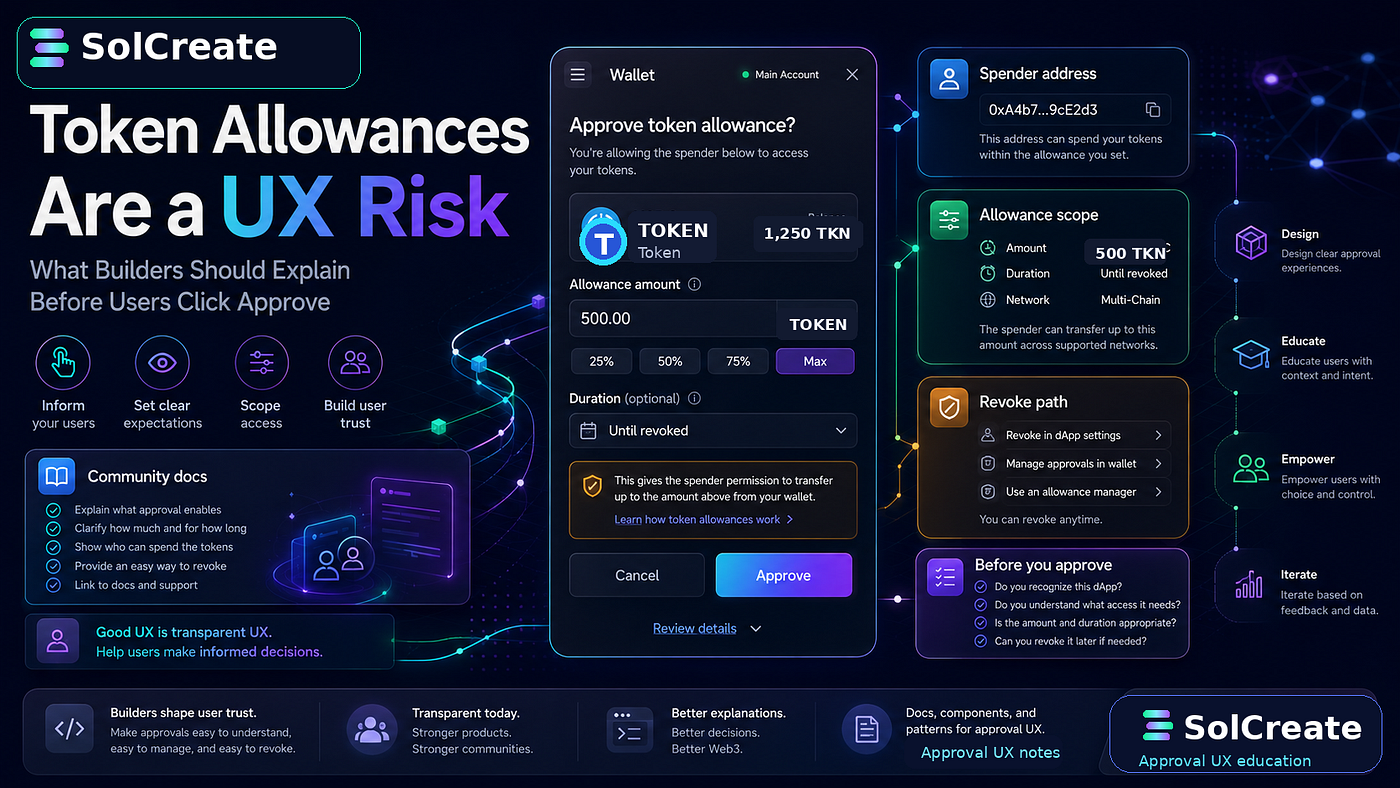
In simple terms, an allowance is permission. A token holder grants another address, usually a smart contract, permission to spend a certain amount of a specific token from the holder’s wallet.
That permission has three parts: the token contract, the spender address, and the allowance amount. The allowance can be limited or large, which can behave like unlimited approval.
A user may click approve because they want to complete a useful action. But the approval itself is not the same as the action. It is a permission step that happens before the action. That distinction matters because users may approve and then fail to complete the next transaction, switch networks, close the app, or misunderstand what remains active afterward.
Good documentation makes this separation clear. “Approval lets the contract access up to this amount” is more accurate than “click approve to continue.” Builders should describe the approval as a permission, not as a harmless loading step.
Why unlimited approvals make people nervous
Many dApps request high or unlimited allowances because it reduces friction for future interactions. Users do not need to approve every single action again. That can be convenient, especially for frequent trading or repeated contract interactions.
But unlimited approvals also create anxiety. A user may not know whether the spender address is controlled by the project, a router, a staking contract, a liquidity tool, or something else. They may not know whether that approval can be abused if a contract is compromised. They may not know how to revoke it.
A token team does not need to scare users, but it should not hide the trade-off either. If unlimited approval is required, explain why. If a limited approval works, consider making that the default. If both are possible, explain the difference in plain language.
A useful pattern is to frame approvals as scope decisions. Limited allowance means approving only the amount needed for this interaction. Higher allowance may reduce repeated approval prompts, but users should understand the spender address and know how to revoke later. This gives users a mental model instead of leaving them to interpret a technical wallet prompt alone.
The spender address deserves context
One of the most confusing parts of an approval screen is the spender address. To a user, it may look like a random string. To the builder, it may be an obvious router, vault, claim contract, vesting contract, multisender, or staking module.
Do not assume the community knows that context.
If your token launch includes a claim page, staking page, liquidity tool, or other contract interaction, publish a simple “known addresses” note. It should include the contract name, network, purpose, and explorer link. Keep it concise. The goal is not to turn every user into an auditor. The goal is to help them recognize whether the approval prompt matches the official flow.
For example, a claim contract can be described as the address used to distribute launch allocations. A staking contract can be described as the address used for voluntary staking interactions. A router or liquidity contract can be described as the address involved in swaps or liquidity actions. If an address changes, update the note and explain why. Silent contract changes create avoidable suspicion, especially during the first days after launch.
Revocation should be part of the user journey
Many users only learn about revoking allowances after something goes wrong or after someone in the community tells them to check an approval manager. That is too late.
A better approach is to include revocation guidance in launch documentation from the beginning. Explain that users can review token permissions in their wallet or through reputable allowance-management tools. Avoid giving a false sense of safety, but make the path discoverable.
Good revocation guidance answers four questions: where users can review approvals, which network they should check, how they can identify the spender address, and what happens after they revoke permission. The last point is important. Revoking permission may require the user to approve again next time they interact with the dApp. That is normal. If users understand this, they are less likely to treat every new approval request as a mystery.
Approval UX is also community support
A launch team’s support burden often comes from moments where users feel uncertain. Allowances create exactly that kind of moment. People may ask whether an approval is appropriate, whether the amount is correct, whether the address is official, or whether they can cancel.
Instead of answering the same questions repeatedly in Telegram or Discord, prepare a short approval FAQ. It can explain why the app asks for approval before the main transaction, what token the approval applies to, what spender address is involved, whether the allowance is limited or open-ended, how to revoke it later, and what users should do if the wallet prompt looks different from the official guide.
This kind of documentation does not guarantee safety, and it should not claim to. It simply reduces confusion and helps users make better decisions.
How builders can design better approval flows
A better approval flow starts before the wallet opens.
Use a pre-approval explanation in the app interface. It should say what the user is about to approve and why. Keep it short, but specific. “Approve staking contract to use up to 500 TOKEN” is clearer than “Approve.”
Prefer limited allowances where practical. If unlimited approval is used, explain the convenience trade-off. Link to official contract references so users can compare the wallet prompt with your documentation. Give users a clear cancel path, and make revocation instructions easy to find.
Teams using no-code or low-code launch tools should still own this communication. SolCreate can support token creation and related launch tooling, but the community-facing explanation still needs to match the project’s actual flow, addresses, and decisions.
What buyers and community members should watch for
From the user side, approvals deserve a pause. Before clicking approve, users should check whether the token, network, spender address, and allowance amount match what they intended to do.
A few practical questions help: do I recognize the app asking for this permission, does the spender address match the project’s official documentation, is the allowance amount reasonable for the action, can I revoke it later, and am I on the correct network and website?
None of these checks proves that an interaction is risk-free. They simply make the decision more informed.
The takeaway
Token allowances are a normal part of many crypto interactions, but they are also a UX risk when they are unexplained. Builders should treat approval screens as part of the product experience, not as a technical interruption between the user and the real action.
Clear spender-address notes, limited-scope explanations, revocation guidance, and honest approval copy can prevent confusion before it becomes fear. The strongest token communities are not built by hiding complexity. They are built by making important decisions easier to understand.
메타데이터
- post_id
- b8e324a0807a
- slug
- token-allowances-are-a-ux-risk-what-builders-should-explain-before-users-click-approve-b8e324a0807a
- url
- https://medium.com/@SolCreateApp/token-allowances-are-a-ux-risk-what-builders-should-explain-before-users-click-approve-b8e324a0807a
- canonical_url
- https://medium.com/@SolCreateApp/token-allowances-are-a-ux-risk-what-builders-should-explain-before-users-click-approve-b8e324a0807a
- author_url
- https://medium.com/@SolCreateApp
- status
- ok
- fetched_at
- 2026-06-09 15:37:30