Can we send RMAN backups from a SPARC-based Oracle database to a Zero Data Loss Recovery Appliance…
RMAN backups from a SPARC-based Oracle Database can be sent to a Zero Data Loss Recovery Appliance while simultaneously streaming Real-Time…
Can we send RMAN backups from a SPARC-based Oracle database to a Zero Data Loss Recovery Appliance (ZDLRA) while simultaneously using Real-Time Redo transport to that ZDLRA?
RMAN backups from a SPARC-based Oracle Database can be sent to a Zero Data Loss Recovery Appliance while simultaneously streaming Real-Time Redo to the same appliance, but RMAN compression and RMAN encryption must be disabled and encryption should be provided by database-level TDE instead of RMAN, because encrypted/compressed RMAN backupsets are not ingested into ZDLRA’s incremental‑forever/virtual‑full pipeline unless the specialized space‑efficient encrypted backup feature is explicitly used and supported in the environment. In this scenario, relying on TDE preserves ZDLRA’s block‑aware deduplication and virtual full capabilities while Real‑Time Redo reduces RPO to zero or sub‑second in normal operation.
Problem statement
The deployment objective is to co-exist two protection workflows from a SPARC-based Oracle Database: uncompressed RMAN backups over SBT to ZDLRA and Real‑Time Redo transport from memory to ZDLRA for near‑zero data loss, while avoiding any backup formatting that disrupts ZDLRA’s deduplication and virtual‑full ingestion path. The critical constraint is to avoid RMAN compression/encryption because those formats either are not ingested into the virtual‑full lineage or materially break deduplication unless the environment uses ZDLRA’s space‑efficient encrypted backups, which is out of scope in the stated scenario.
Real‑Time Redo fundamentals
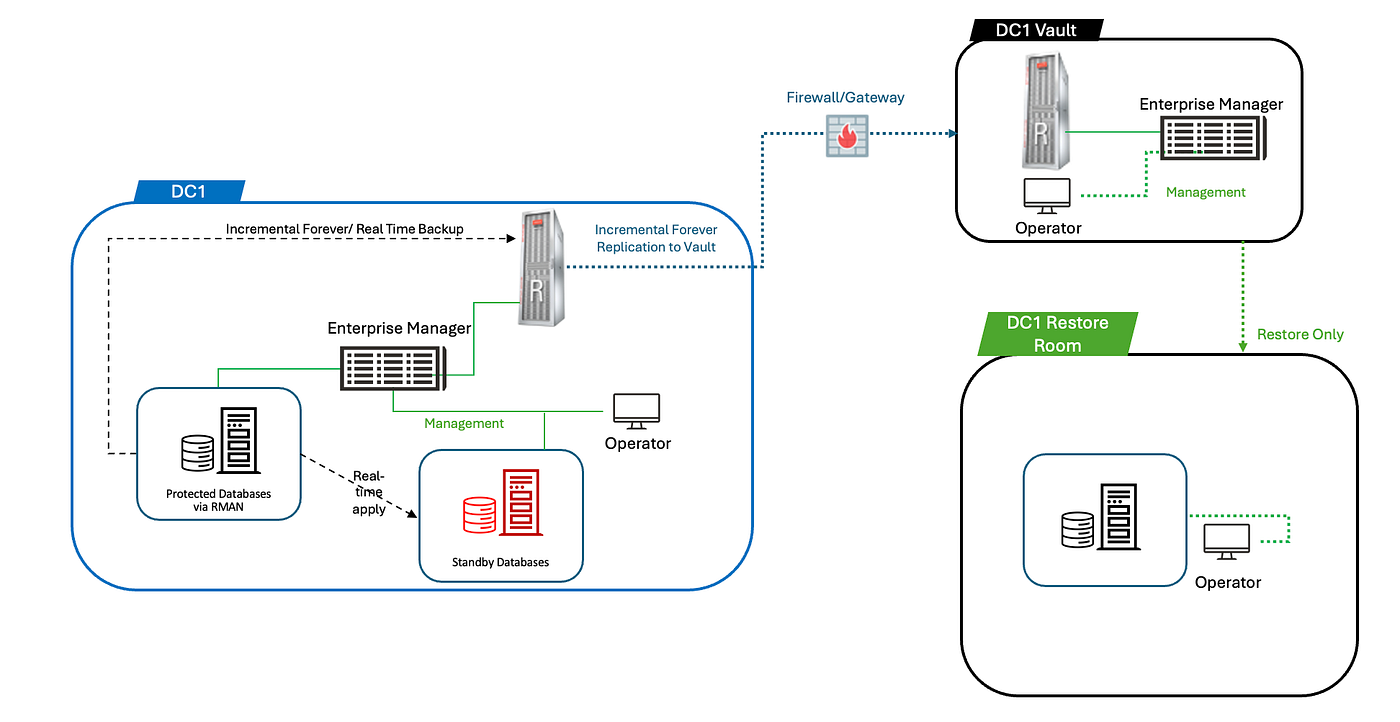
Real‑Time Redo Transport makes ZDLRA a remote asynchronous redo destination, accepting redo directly from the database memory, validating it, and staging it until each log switch, when ZDLRA assembles compressed archived redo log backups that are recorded in the RA catalog and are usable by RMAN RECOVER, enabling RPO of zero to sub‑second in typical conditions. If the protected database crashes, ZDLRA closes the incoming stream as a partial archived log and later automatically reconciles gaps when the complete archived log is available and shipped, preserving the recovery window goal.
Incremental‑forever and virtual fulls
ZDLRA’s recommended strategy is incremental‑forever: a single initial level 0 followed by periodic level 1 cumulative incrementals, from which the appliance constructs on‑demand virtual level 0 backups without requiring periodic fulls, thereby shrinking backup windows and offloading consolidation to the appliance. During restore, the appliance reifies the appropriate virtual full and RMAN then applies the needed archived/real‑time redo to reach the requested point‑in‑time, integrating smoothly with Real‑Time Redo for minimal data loss.
Why not RMAN compression/encryption here
Encrypted or compressed RMAN backupsets are not ingested into ZDLRA’s virtual‑full lineage and therefore should be avoided for backups targeting ZDLRA, as Oracle explicitly recommends avoiding RMAN backup encryption for Recovery Appliance backups to preserve ingestion, deduplication, and incremental‑forever behavior. RMAN encryption and many compression modes modify headers and payloads in ways that defeat ZDLRA’s block‑aware deduplication and virtual‑full construction unless using the specialized “space‑efficient encrypted backups” path, which is not supported in this scenario per the stated constraint.
Role of TDE
Database‑level Transparent Data Encryption protects data-at-rest while leaving block headers interpretable for ZDLRA’s block‑aware ingest, so the appliance can still validate, index, and deduplicate changed blocks across incrementals to build virtual fulls even though data portions are encrypted. TDE is also a recommended control in ZDLRA security reference architectures for database protection and ransomware resiliency, fitting cleanly with Real‑Time Redo and incremental‑forever without breaking ZDLRA’s dedupe engine.
Platform note: SPARC compatibility
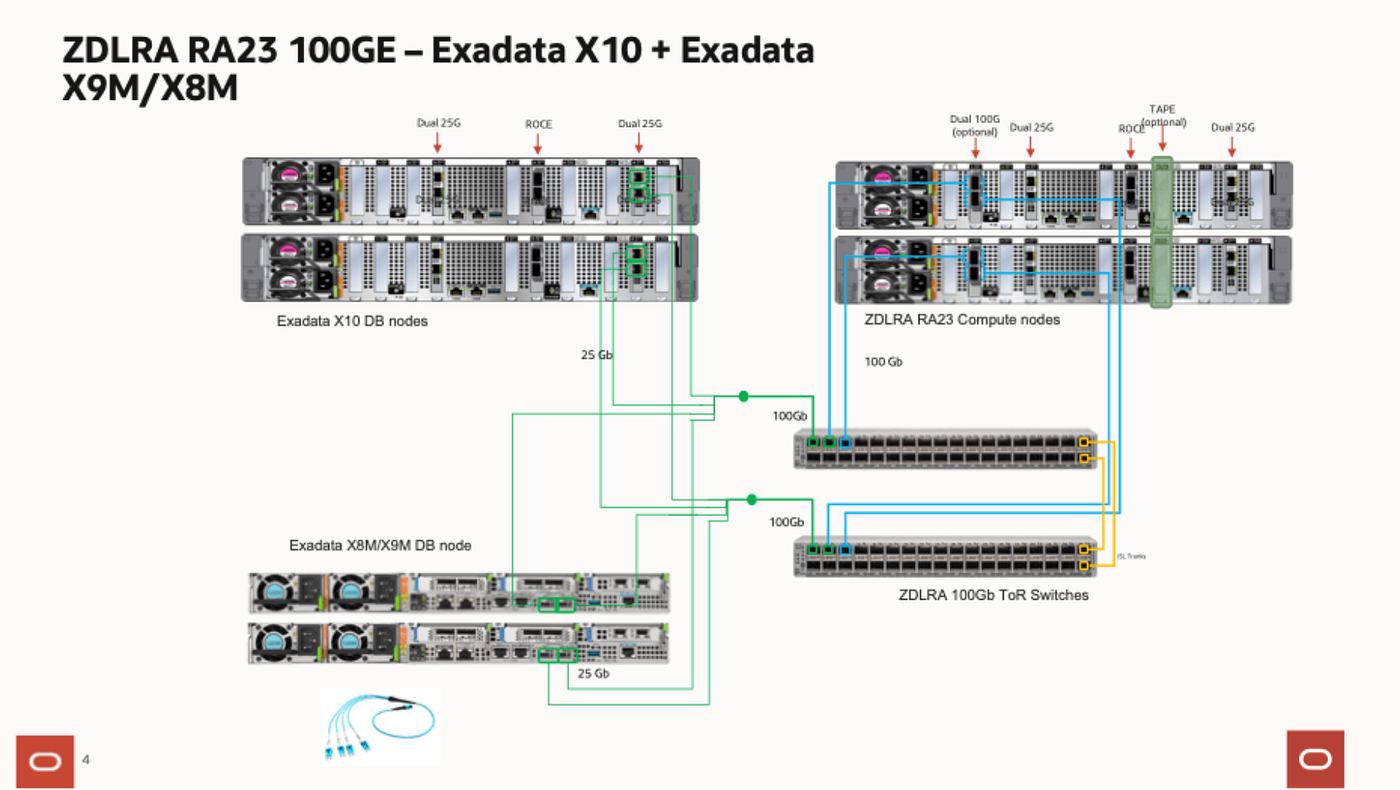
ZDLRA integration is over the standard RMAN SBT interface using the Recovery Appliance backup module (libra.so) installed in each Oracle home, which is database‑ and network‑centric rather than tied to a specific underlying storage format, allowing protected databases on supported Oracle platforms, including SPARC, to participate equally in RA ingestion and cataloging. Current guides document backup‑module deployment in each Oracle home and version support spanning multiple Oracle Database releases, independent of CPU architecture, which accommodates SPARC deployments as long as database and network prerequisites are met.
Configuration blueprint
- Real‑Time Redo: configure a VPC user on the appliance, set redo_transport_user to that VPC at the database, and define LOG_ARCHIVE_DEST_n to the ZDLRA ingest service (ASYNC/NOAFFIRM as per policy), which registers the appliance as an archive destination for real‑time streaming and automatic archived log creation and cataloging by ZDLRA.
- SBT channels to ZDLRA: install the RA backup module (libra.so), create an Oracle wallet with the VPC credentials, and configure/allocate RMAN SBT channels with PARMS SBT_LIBRARY=…/libra.so and ENV=(RA_WALLET=…,credential_alias=…) to send level 0 and level 1 incrementals, SPFILE, controlfile, and any necessary archived logs to ZDLRA.
- Disable RMAN compression/encryption: do not enable CONFIGURE COMPRESSION or SET ENCRYPTION for ZDLRA‑bound jobs; rely on TDE for encryption so ZDLRA can ingest, deduplicate, and virtualize backups correctly according to incremental‑forever lineage.
Example snippets
The following sequence illustrates standard SBT channel allocation to ZDLRA with a wallet‑based credential and an incremental‑forever cadence, aligned with ZDLRA’s block‑aware ingest (preceding narrative governs security and support boundaries).
run
{
  allocate channel sbt1 device type sbt_type
    format '%d_%U'
    parms="SBT_LIBRARY=/u01/app/oracle/product/19.0.0.0/dbhome/lib/libra.so,
           ENV=(RA_WALLET='location=file:/u01/app/oracle/product/19.0.0.0/dbhome/network/admin/server_wallet
           credential_alias=ra_alias')";
  allocate channel sbt2 device type sbt_type
    format '%d_%U'
    parms="SBT_LIBRARY=/u01/app/oracle/product/19.0.0.0/dbhome/lib/libra.so,
           ENV=(RA_WALLET='location=file:/u01/app/oracle/product/19.0.0.0/dbhome/network/admin/server_wallet
           credential_alias=ra_alias')";
  backup cumulative incremental level 1
    filesperset 1
    section size 64g
    database
    plus archivelog not backed up;
  release channel sbt1;
  release channel sbt2;
}
A minimal Real‑Time Redo enabling pattern uses a VPC user and an additional archive destination targeting the RA ingest service; versions and network policy may dictate broker‑based or parameter‑based variants.
ALTER SYSTEM SET redo_transport_user='VPC_RA' SCOPE=BOTH SID='*';

ALTER SYSTEM SET log_archive_config='DG_CONFIG=(db_unique_name_source, db_unique_name_zdlra)' SCOPE=BOTH SID='*';

ALTER SYSTEM SET log_archive_dest_3='SERVICE="ra-ingest-scan:1521/RA_SVC" ASYNC NOAFFIRM DB_UNIQUE_NAME="db_unique_name_zdlra" VALID_FOR=(ONLINE_LOGFILE,ALL_ROLES)' SCOPE=BOTH SID='*';

ALTER SYSTEM SET log_archive_dest_state_3=ENABLE SCOPE=BOTH SID='*';
Operational behaviors and monitoring
With Real‑Time Redo enabled, ZDLRA continuously validates and stages redo; on each log switch it creates archived redo backups and updates the RA catalog, which RMAN uses seamlessly during RECOVER to roll forward restored datafiles to the required SCN/time. Administrators monitor status via the RA catalog/Enterprise Manager and verify redo ingestion and backup lineage compliance with recovery window goals, while RA background tasks validate backups on disk and across replication if used, removing the need for routine manual VALIDATEs for ingest verification.
Security and compliance posture
For regulated retention, ZDLRA offers immutability and compliance controls, retention windows, compliance holds, catalog governance, and tape/cloud archival orchestration, supported by policy enforcement and role separation, which can be combined with TDE to protect data contents while preserving block‑aware ingest. In ransomware‑resilient designs, ZDLRA is positioned as a transactional‑aware, immutable backup layer with real‑time protection and optional cyber‑vault replication, further reducing blast radius and ensuring clean, validated recovery points at scale.
Practical guidance
- Do use uncompressed RMAN backupsets to ZDLRA with TDE enabled in the database so ZDLRA can index blocks and virtualize fulls across incrementals while backups remain effectively encrypted by the database.
- Don’t enable RMAN backup encryption or compression for ZDLRA‑bound backups unless the environment is explicitly configured for ZDLRA’s space‑efficient encrypted backups feature, because otherwise those backupsets are not ingested into the virtual‑full lineage and defeat deduplication.
- Validate the redo transport user, RA wallet, SBT library placement per Oracle homes, and connectivity to the RA ingest service; these are database‑ and network‑level steps and apply uniformly to SPARC and non‑SPARC platforms.
메타데이터
- post_id
- b934bf4e1b42
- slug
- can-we-send-rman-backups-from-a-sparc-based-oracle-database-to-a-zero-data-loss-recovery-appliance-b934bf4e1b42
- url
- https://medium.com/@arsalandehghanis/can-we-send-rman-backups-from-a-sparc-based-oracle-database-to-a-zero-data-loss-recovery-appliance-b934bf4e1b42
- canonical_url
- https://medium.com/@arsalandehghanis/can-we-send-rman-backups-from-a-sparc-based-oracle-database-to-a-zero-data-loss-recovery-appliance-b934bf4e1b42
- author_url
- https://medium.com/@arsalandehghanis
- status
- ok
- fetched_at
- 2026-07-17 16:16:29