Decentralized Identity Is Pushing Authentication Beyond Password Culture
For decades, passwords have controlled the internet.
Decentralized Identity Is Pushing Authentication Beyond Password Culture

For decades, passwords have controlled the internet.
Every platform, every app, every account, and almost every digital interaction has depended on a simple combination of characters that users were expected to remember, protect, and constantly reset. What once felt practical has now become one of the weakest links in modern digital security.
The digital world has evolved rapidly, but authentication systems have struggled to keep up.
Today, **decentralized identity** is emerging as one of the strongest alternatives to traditional password culture and it is changing how trust, privacy, and access work online.
The conversation is no longer just about logging in securely.
It is about giving users greater ownership over identity while reducing the growing risks tied to centralized authentication systems.
Passwords Were Never Built for Today’s Internet
When passwords first became common, the internet was far smaller and far less connected.
Users managed only a handful of accounts. Data breaches were less frequent. Cybercriminals had fewer tools and less automation.
That environment no longer exists.
Modern users interact with hundreds of digital services across banking platforms, healthcare systems, educational portals, enterprise applications, government services, and social ecosystems. The result is massive password fatigue.
People reuse passwords, create weak credentials, or depend entirely on password managers just to survive modern digital complexity.
At the same time, cyberattacks have become more advanced.
Credential stuffing, phishing, synthetic identity fraud, and database leaks continue exposing the weaknesses of centralized authentication models. Even multi-factor authentication, while valuable, often adds friction without solving the deeper structural problem.
The issue is not simply weak passwords.
The issue is that digital identity itself has become fragmented and overly dependent on centralized control.
What Makes Decentralized Identity Different
Decentralized identity changes the ownership model of authentication.
Instead of platforms fully controlling user identity records, decentralized systems allow individuals to hold and manage their own verifiable credentials securely.
This creates a completely different trust architecture.
Users no longer need to repeatedly hand over sensitive personal data to every platform they interact with. Instead, they can share only the exact information required for verification while maintaining greater control over privacy.
For example:
- A user can prove age eligibility without revealing a full birthdate
- A graduate can verify a degree instantly without manual transcript processing
- An employee can authenticate certifications without emailing documents repeatedly
- Citizens can access digital services using trusted identity frameworks without endless paperwork
This approach dramatically reduces unnecessary data exposure while improving verification efficiency.
Authentication Is Becoming Verifiable Instead of Memorized
Traditional authentication relies heavily on memory.
Passwords require users to remember static credentials that can be stolen, leaked, guessed, or reused. Decentralized identity shifts authentication toward verifiable trust instead.
In decentralized ecosystems, identity credentials can be cryptographically validated without relying on centralized password databases.
That means authentication becomes:
- More secure
- More privacy-focused
- More resistant to phishing attacks
- Easier to verify across platforms
- Less dependent on repetitive manual onboarding
Instead of asking users to continuously prove who they are through passwords, systems begin validating trusted credentials directly.
This changes authentication from a repetitive task into a seamless verification process.
Blockchain Is Strengthening Trust Infrastructure
Blockchain technology plays a major role in enabling decentralized identity ecosystems.
Blockchain-backed verification frameworks create tamper-resistant trust layers capable of validating credentials securely and transparently. These systems make it significantly harder to manipulate records or create fraudulent identity claims.
More importantly, **blockchain** allows verification to happen without requiring centralized institutions to act as the sole gatekeepers of trust.
This creates stronger interoperability across ecosystems while improving transparency and auditability.
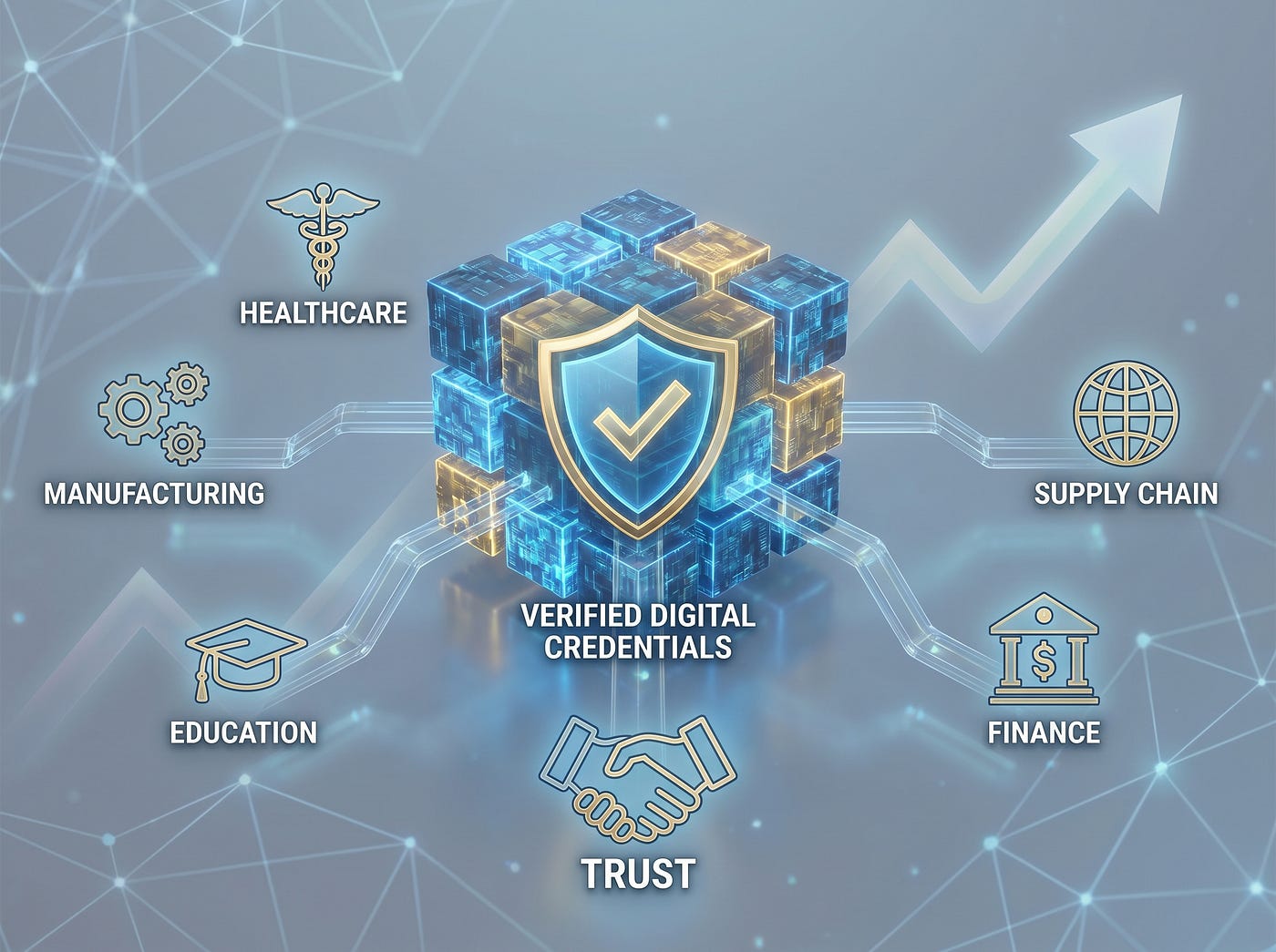
As organizations continue moving toward digital-first operations, blockchain identity verification is becoming increasingly valuable across:
- Education technology
- Financial services
- Enterprise security
- Government infrastructure
- Healthcare systems
- Workforce credentialing platforms
The focus is shifting from storing identity data everywhere to verifying trusted claims intelligently.
Privacy Is Becoming a Core Requirement
One reason decentralized identity is gaining momentum is the growing global concern around data privacy.
Traditional identity systems often collect far more information than necessary. Users regularly surrender sensitive personal data simply to access services that require only minimal verification.
This creates enormous privacy and security risks.
Decentralized identity frameworks support selective disclosure, allowing users to reveal only what is needed for a specific interaction.
That means organizations can still verify trust without accumulating excessive personal data.
As privacy regulations evolve and public awareness increases, this model aligns more naturally with the future direction of digital ecosystems.
Passwordless Does Not Mean Trustless
There is a common misconception that removing passwords somehow weakens security.
In reality, decentralized identity systems often strengthen trust because verification relies on cryptographic proof instead of easily compromised credentials.
The goal is not to eliminate security layers.
The goal is to create authentication systems that are both secure and human-friendly.
Password culture has forced users into increasingly complex behaviors that still fail to fully protect digital ecosystems. Decentralized identity offers a path toward authentication models designed for modern digital realities rather than outdated internet assumptions.
The Future of Authentication Will Be Identity-Centric
The next phase of digital transformation will likely move far beyond passwords altogether.
Authentication is evolving toward ecosystems where trusted credentials, verifiable identity frameworks, blockchain verification, and user-controlled data become foundational infrastructure.
Organizations adopting decentralized identity models today are preparing for a future where trust must move faster, operate more securely, and protect privacy more intelligently.
The internet is gradually transitioning from credential memorization to credential verification.
And that transition may become one of the most important digital infrastructure shifts of this decade.
Looking to build secure decentralized identity systems, **verifiable credential platforms**, or blockchain-powered authentication infrastructure?
Explore modern digital trust solutions with **EveryCRED** and discover how decentralized identity can transform secure digital access for enterprises, institutions, and governments.
메타데이터
- post_id
- b94c68cbe3e8
- slug
- decentralized-identity-is-pushing-authentication-beyond-password-culture-b94c68cbe3e8
- url
- https://medium.com/@everycred9/decentralized-identity-is-pushing-authentication-beyond-password-culture-b94c68cbe3e8
- canonical_url
- https://medium.com/@everycred9/decentralized-identity-is-pushing-authentication-beyond-password-culture-b94c68cbe3e8
- author_url
- https://medium.com/@everycred9
- status
- ok
- fetched_at
- 2026-06-09 15:37:30