Trust Is The Original Compound Asset
We talk about compounding like it only happens in spreadsheets. A number goes in, interest accrues, that interest earns interest, and…
Trust Is The Original Compound Asset
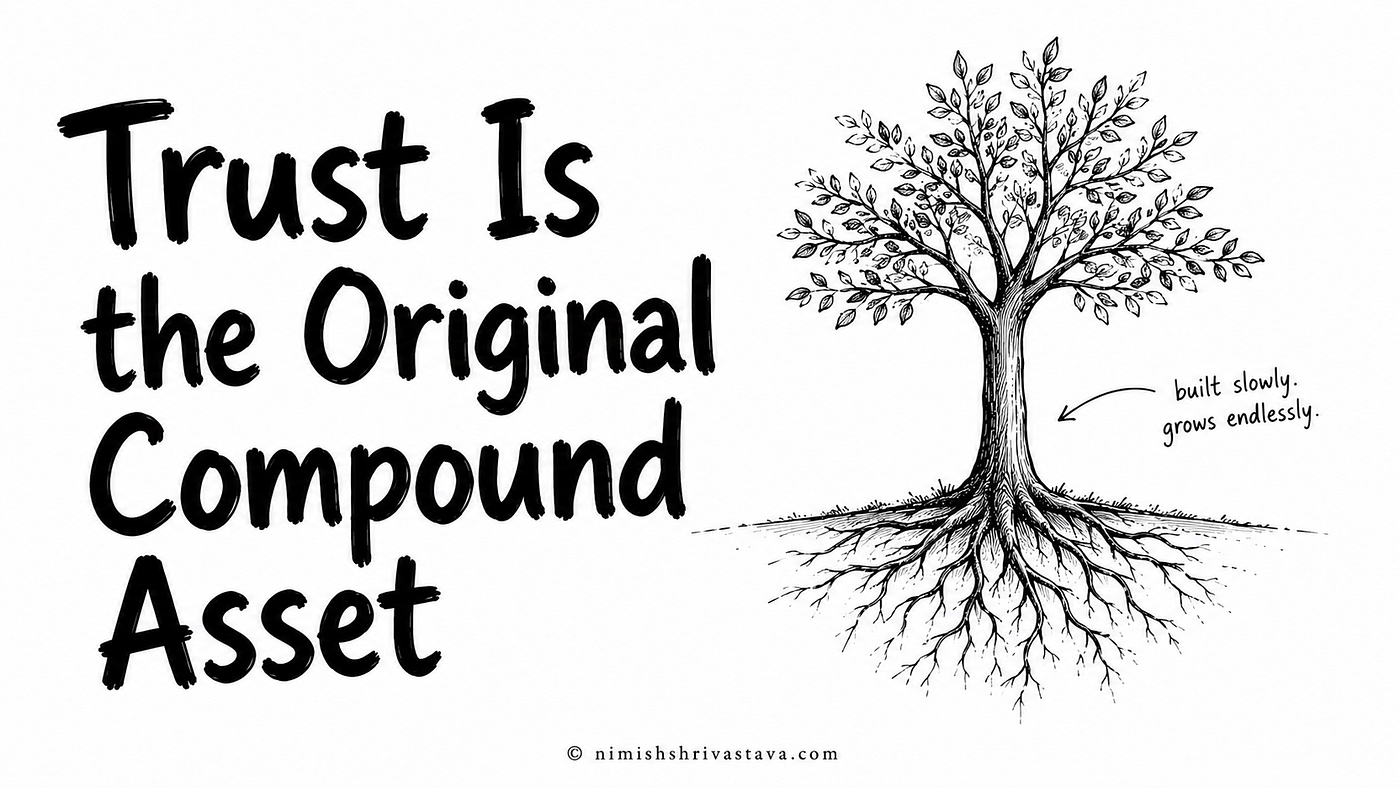
We talk about compounding like it only happens in spreadsheets. A number goes in, interest accrues, that interest earns interest, and eventually — given enough time — the curve bends upward in a way that seems almost unfair. But the most powerful compounding in business has nothing to do with money. It compounds in the minds of the people who watch how you behave over time. Kunal Shah built CRED for 11 years. He started with $1M of his own capital and one question: “Why can’t trust be rewarded?” Yesterday, he stepped back as CEO. Meta invested $900M in the company. He is now heading to lead WhatsApp globally. Most people are focused on the deal. I keep thinking about the 11 years before it.
The deposit nobody sees
When you invest in equities, every rupee you put in is visible. You can track it. It shows up on a screen. When you invest in trust, nothing shows up anywhere. There’s no dashboard. No confirmation message. No percentage gain. But it compounds exactly the same way. Every time Kunal ran an ESOP buyback — putting real money in employees’ pockets when he didn’t have to — that was a deposit. Every time CRED held its ground under regulatory pressure. Every time the platform delivered what it promised and then a little more. Every public decision that said “we optimise for the long run, not the quarter.” Those were quiet deposits into something that couldn’t be measured. Until the day it could. By the time Meta came in with $900M, that wasn’t a leap of faith. That was the interest on 11 years of compounded trust. The kind that takes decades to build and can’t be faked even for a season.
Why most builders don’t get here
Most founders want the outcome. Very few are willing to live inside the timeline. They want the $900M round without the years of skepticism. They want the team that believes in the mission without the years of demonstrating they mean what they say. They want the legacy without the compounding. But compounding has no shortcut. It responds only to time and consistency. The early years of any business are called the “hard years” — not because they’re operationally more complex than later stages, but because you’re building compound interest on very little principal. You’re depositing trust when the audience is tiny and the validation is absent. That period, invisible to everyone else, is when the real foundation is being poured.
Judgment is a compound asset too
There’s something else that accumulated for Kunal Shah over those 11 years that never appears in a funding announcement. Judgment. The ability to know when to exit FreeCharge. When to launch CRED into a skeptical market. When to raise $900M and from whom. When to step back and hand the keys to someone you trust. None of those decisions came from data alone. They came from 11 years of accumulated choices — good ones and bad ones — slowly becoming something richer than information. Earned intuition. Pattern recognition forged under pressure. Judgment doesn’t arrive in a flash of insight. It compounds. And it’s probably the scarcest, most valuable asset any founder carries.
What this means for how you invest
If you invest in publicly listed companies, the Kunal Shah story contains a framework worth keeping. The businesses that deliver outsized returns over decades are almost always the ones where trust, judgment, and compounding culture exist at the top. Not just capital allocation skill. Not just product innovation. But a founder or leadership team that treats reputation, team, and relationships as compound assets — and makes decisions accordingly. You can often sense this in how a company treats its smallest stakeholders. How they speak when things go wrong. Whether they make the decision that’s right for a decade even when it’s uncomfortable for a quarter. That’s the signal most spreadsheets can’t capture.
His next chapter
Kunal Shah is now going to lead WhatsApp — a platform with over 3 billion users globally. Some people see this as leaving the startup world. I see it as a compounding curve entering a new phase. A new principal. A new asset. A new 10-year journey beginning. What doesn’t change is the character. The curiosity. The long-term conviction. The bias toward building trust over extracting transactions. That’s not a strategy. It’s who he became over 11 years of consistent deposits. And that, more than anything, is what compounding really means. When the interest finally shows up — in the form of a $900M deal, a WhatsApp role, a Zuckerberg post welcoming you to the team — it looks sudden to everyone watching. But you know exactly how long it took.
Nimish Shrivastava Author of “Compounding Secrets” | Singer | Co-founder of The Banyan Tee Follow my work at nimishshrivastava.com
메타데이터
- post_id
- b9557b4e65ec
- slug
- trust-is-the-original-compound-asset-b9557b4e65ec
- url
- https://blog.startupstash.com/trust-is-the-original-compound-asset-b9557b4e65ec
- canonical_url
- https://blog.startupstash.com/trust-is-the-original-compound-asset-b9557b4e65ec
- author_url
- https://medium.com/@i.nimish.shrivastava
- status
- ok
- fetched_at
- 2026-07-09 03:40:04