Why Are Researchers moving to Leiden community?
Network data contains more than simple connections. Hidden within it are underlying structural patterns. In research collaboration…
Why Are Researchers moving to Leiden community?
Network data contains more than simple connections. Hidden within it are underlying structural patterns. In research collaboration networks, scholars often cluster around specific research topics. On social media, users with similar interests tend to connect more frequently with one another.
In network analysis, these densely connected groups of nodes are called communities. Community detection helps reveal group structures within a network and can be used to understand various phenomena, such as collaboration patterns among individuals, institutions, or countries, the formation of research fields, or clusters of related concepts in text data. Traditionally, methods such as Girvan–Newman community detection and the Louvain method have been widely used.
However, since the Leiden algorithm was introduced by Traag, Waltman, and van Eck in 2019, it has increasingly been adopted in recent network analysis research.
Why are many studies now choosing the Leiden method over earlier approaches? This article briefly introduces the key characteristics of the Leiden algorithm, how it differs from previous methods, and how it is used in practice.
1. Limitations of Previous methods
The Leiden community was developed as an improvement over the Louvain community detection method.
The Louvain method identifies communities by repeatedly asking a simple question: If a node moves to another community, does the overall community structure improve?
The quality of the partition is evaluated using modularity, a metric that measures how well a network is divided into communities. Modularity increases when there are many connections within communities and relatively few connections between them. The Louvain algorithm therefore forms communities by maximizing modularity.
However, because Louvain improves modularity by moving nodes one at a time between communities, it can produce a structural problem: nodes within the same community may not actually be directly connected.(Disconnected community)
Consider the following example network.
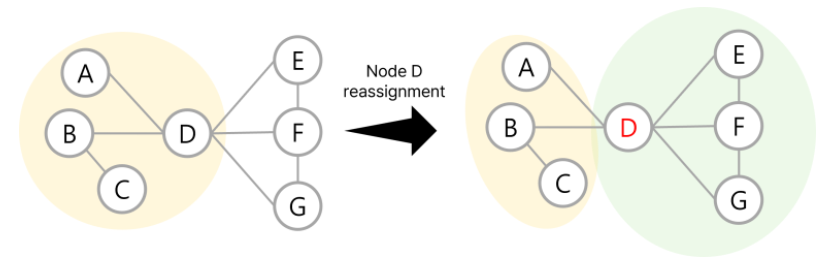
Louvain Community
Initially, as shown in the left figure, nodes A, B, C, and D are grouped into the same community based on their connection structure. Later, suppose node D moves to another community because doing so increases the overall modularity. The final result becomes two communities: ABC and DEFG.
In this situation, A and B remain in the same community, but the node D, which previously connected them, has moved to another community. As a result, A and B are no longer directly connected.
In other words, if the goal of community detection is to identify groups of closely connected nodes, the Louvain method may produce communities where nodes are only connected indirectly through nodes outside the community, rather than being internally connected.
2. What Makes the Leiden Community Different?
The Leiden algorithm improves on earlier approaches by adding a refinement phase.
- First, as in the Louvain algorithm, nodes are moved between communities to check whether the modularity score increases.
- Next, Leiden introduces an additional step that reexamines the internal structure of each community. In this refinement phase, the algorithm checks whether nodes within a community are actually well connected. Nodes with weak or no internal connections are split off into separate communities. In other words, incorrectly merged communities are reorganized internally.
- Finally, each community is collapsed into a single node, and the algorithm searches again for community structures at a higher level.

Leiden Community
As a result, the Leiden algorithm produces more stable community structures and ensures that all detected communities remain internally connected.

3. Key Research Applications
3.1 Research Trend / Bibliometric Analysis
The Leiden algorithm has become a standard tool in science mapping, where large scale citation networks are analyzed to visualize the structure of academic research.
One large study analyzed 104 million publications and 1.4 billion citation links collected from databases such as Dimensions, Web of Science, and Scopus. The study divided global research into research clusters (RCs) while maintaining clusters of manageable size, typically consisting of several hundred papers. At the same time, it was able to identify detailed subtopics within rapidly growing fields such as artificial intelligence (AI) and machine learning (ML). (Rahkovsky, I., Toney, A., Boyack, K. W., Klavans, R., & Murdick, D. A. (2021). AI research funding portfolios and extreme growth. Frontiers in Research Metrics and Analytics, 6, 630124. https://doi.org/10.3389/frma.2021.630124)
Another prominent example comes from CWTS at Leiden University, which developed the Leiden algorithm. In collaboration with Clarivate, they analyze citation networks from the Web of Science database and publish annual research topic clusters known as Citation Topics. (https://incites.zendesk.com/hc/en-gb/articles/22514077746961-Citation-Topics)

Clarivate Citation Topic (https://clarivate.com/academia-government/blog/introducing-citation-topics/)
More recent research has also used community detection on word co-occurrence networks instead of traditional topic modeling. These studies show that the Leiden algorithm is effective for identifying topic structures and even hierarchical topic patterns in large text datasets. (Austin, E., Makwana, S., Trabelsi, A., Largeron, C., & Zaïane, O. R. (2024). Uncovering flat and hierarchical topics by community discovery on word co-occurrence network. Data Science and Engineering, 9, 41–61. https://doi.org/10.1007/s41019-023-00239-2)
3.2 Social Science
In social science research, the Leiden algorithm is widely used to analyze public opinion dynamics, political polarization, and influencer detection in social media networks.
For example, one study examined the Twitter (X) interaction network during the early stage of the 2022 Russia–Ukraine war. The researchers compared communities detected by the Louvain and Leiden algorithms and then applied topic modeling within each community to analyze how discourse evolved over time.
- (A case study comparing Twitter communities detected by the Louvain and Leiden algorithms during the 2022 war in Ukraine. (2024). ResearchGate. https://www.researchgate.net/publication/380539356_A_Case_Study_Comparing_Twitter_Communities_Detected_by_the_Louvain_and_Leiden_Algorithms_During_the_2022_War_in_Ukraine))*
Another study analyzed YouTube viewer engagement networks based on interactions such as likes, dislikes, and subscriptions. By applying the Leiden algorithm to this weighted network, researchers were able to identify viewer communities and improve both marketing strategies and content recommendation systems. (Rahman, M., & Setiawan, A. (2023). Clustering of YouTube viewer data based on preferences using Leiden algorithm. International Journal of Information and Data Science (IJIDS). https://journals.adaresearch.or.id/ijids/article/download/45/47)
3.3 Other Applications
The flexibility of the Leiden algorithm has led to applications across many different fields.
- In cybersecurity, researchers have used graph based analysis of threat intelligence extracted from APT (Advanced Persistent Threat) reports to detect relationships between attack groups and uncover emerging threat communities. (A framework for developing strategic cyber threat intelligence from advanced persistent threat analysis reports using graph-based algorithms. (2024). ResearchGate. Retrieved March 12, 2026, from https://www.researchgate.net/publication/382412915_A_Framework_for_Developing_Strategic_Cyber_Threat_Intelligence_from_Advanced_Persistent_Threat_Analysis_Reports_Using_Graph-Based_Algorithms)
- In neuroscience, studies analyzing zebrafish brain structures have applied the Leiden algorithm to neural networks reconstructed from electron microscopy and optical imaging data. This approach revealed the hierarchical modular organization of neural systems. (A method for extracting an approximated connectome from libraries of single anatomically co-registered cell reconstructions, K.K.H. Manjunatha, M. Bruzzone, G. Nicoletti, S. Suweis, M. dal MaschiobioRxiv 2023.05.21.541471; doi: https://doi.org/10.1101/2023.05.21.541471)
Although network data may appear to be just a collection of connections, it actually contains underlying structures through which people, information, technology, and influence flow.
Understanding these structures requires more than simply grouping nodes. It requires methods that can reliably identify densely connected communities within complex networks.
The Leiden algorithm was developed to meet this need, providing a more reliable way to detect meaningful community structures in complex network data.
NetMiner | CYRAM Network Science · Social Network Analysis · Graph Analytics https://www.netminer.com
메타데이터
- post_id
- b95a0f0eb04a
- slug
- why-are-researchers-moving-from-louvain-to-leiden-b95a0f0eb04a
- url
- https://medium.com/@netminer/why-are-researchers-moving-from-louvain-to-leiden-b95a0f0eb04a
- canonical_url
- https://medium.com/@netminer/why-are-researchers-moving-from-louvain-to-leiden-b95a0f0eb04a
- author_url
- https://medium.com/@netminer
- status
- ok
- fetched_at
- 2026-06-20 20:29:01