China: A New Two-Man Tank With Active Protection
But where’s the AI?
Armoured Warfare
China: A New Two-Man Tank With Active Protection
But where’s the AI?
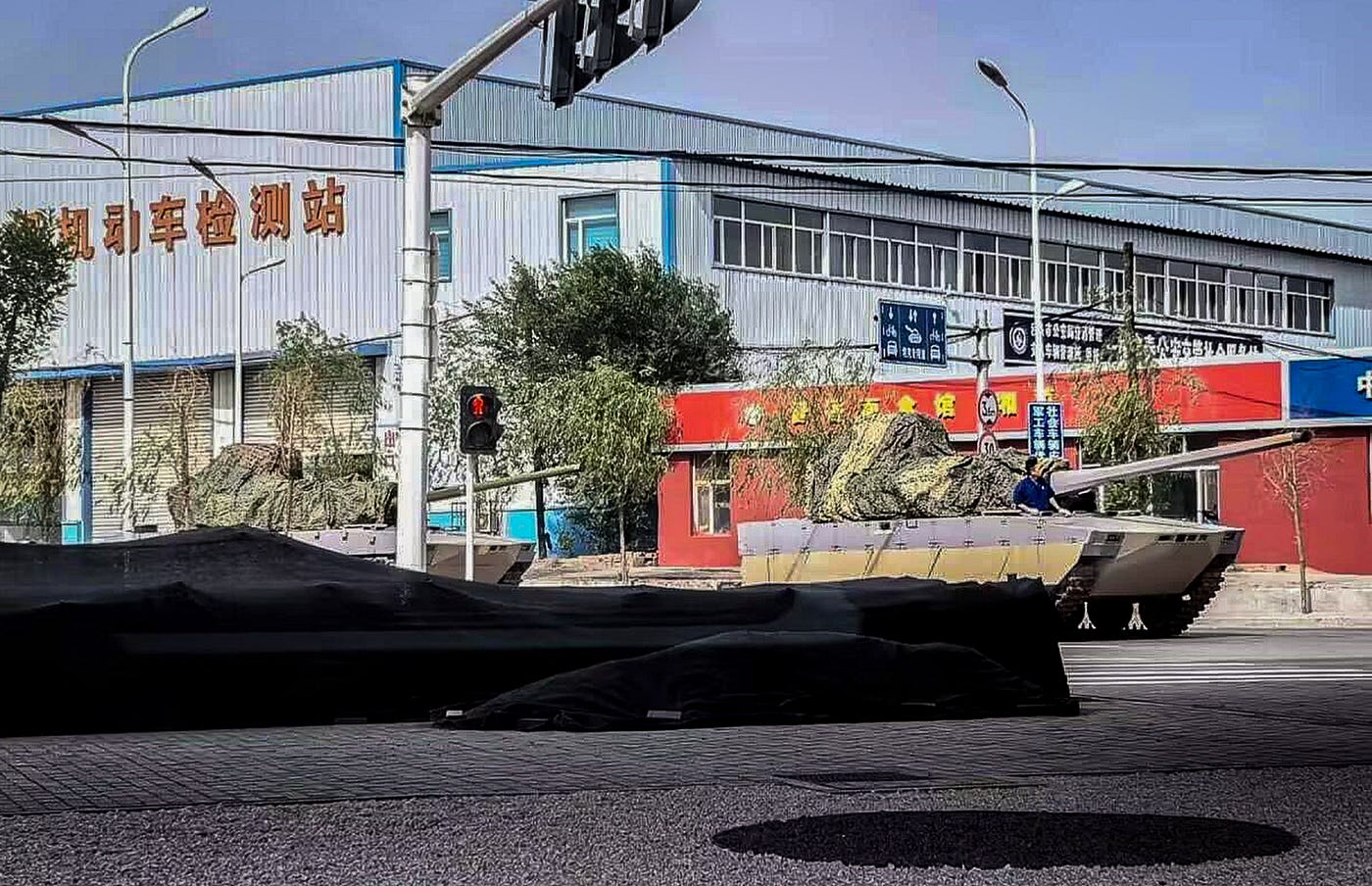
Images such as this one, circulating on Chinese social media, have drawn comments on China’s tank technology and what might be in store. Photo: Weibo/飞扬军事铁背心
Traditional heavily armoured tanks have struggled to survive in the Ukraine war. Anti-tank guided missiles have proven their worth, but drones have been the big winner. First person view (FPV) drones can be precisely targeted by their operators, usually aiming for engine vents or the gap between the turret and the hull. And the tendency for tanks crews to leave hatches open has been an invitation for drones to drop grenades or mortar shells right into the tank. Or even fly right in — click image for video:

Cheap drones costing a few hundred dollars can destroy a heavily armed tank worth millions of dollars. In response Russia has developed new approaches to anti-drone defence.
Most tanks today are third-generation designs but fourth-generation tanks are being developed as armoured warfare evolves. Threat profiles are changing with drones and missiles driving the development pressure.
The Russian T-14 Armata, unveiled in 2015 was recognised as one of the world’s first fourth-generation tanks and was equipped with an advanced active protection system.

Russian T-14 Armata tank. Source: By Vitaly V. Kuzmin — http://vitalykuzmin.net/?q=node/654, CC BY-SA 4.0,
An article in defense publication The National Interest in 2016 said that the Afghanit active protection system on the tank was able to intercept depleted uranium-core armor-piercing fin-stabilized discarding sabot cannon shells, a type of ammunition used to attack modern armored vehicles. — Newsweek
The tank was briefly deployed in Ukraine and then withdrawn, for reasons unknown.
Now we are starting to see reports about a new Chinese tank design.
New Chinese tank
Recently, images circulating on Chinese social media suggest the country been developing a futuristic battle tank with active defences against missile and drone attacks.
My first impression was that the tank appears to be ‘simple’, although we cannot see what is under the netting.
The new tank seems to be lightweight in design and have a two-person crew.
Its integrated defence system could preemptively detect and neutralise incoming missiles, significantly reducing the risk of destruction by conventional anti-tank missiles and high-explosive anti-tank rounds.
Moreover, its attack system — which integrates drones and weapon stations — suggests a shift away from traditional tank-on-tank combat to a wider warfare approach. — South China Morning Post
Assessments by Chinese milbloggers suggest that China’s new tank has an unmanned turret, a 105mm smoothbore gun and a stealth gun barrel, with potential future upgrades to electrothermal-chemical technology. However, several versions of the tanks have been seen with differing main armament sizes.

“The new tank also possesses multi-platform autonomous cooperative capabilities, significantly enhancing its offensive potential. The tank could enable coordinated strikes with unmanned drones and vehicles over beyond-visual-range air-to-ground engagements,” lyman2003 said in a Weibo post (SCMP quote).
The tank has a six-pair track system for mobility and may feature autonomous driving equipped with laser radar. Its exterior appears unpainted, with a grey upper body and yellow lower half.
“Through active disruption and interception technologies, the overall protective performance of the tank is enhanced, improving battlefield survivability by 2.7 times,” the International Top-Level Forum on Engineering Science and Technology Development Strategy-Space Aviation Marine was told.
China’s fourth-generation tank appears to be shifting away from traditional armor-piercing engagements and towards system-oriented warfare supported by information technology, featuring active interference, active interception, and multidimensional protective measures. — InterestingEngineering
Questions posed
Well, we’ve read the salesy stuff, but did you notice that there was not a single mention of ‘AI’. That’s quite striking when it seems you can’t even bake a cake these days without AI being involved. The use of AI in these tanks is either a big secret or it’s not in the recipe.
Yes, autonomous cooperative capabilities were mentioned, and that is usually taken to imply some sort of AI. But I’m still wondering why they need a crew at all if that is the case. Maybe it’s like the self-driving Tesla cars. I note that one report says it has a crew toilet.
The other point of note is that countries are still steaming ahead with 4th generation tank development but are they really confident that they understand the emergent — and developing — drone threat?
It seems to me that adding in active defence such as lasers just adds cost and complexity when the real battle against drones should be fought by reducing complexity and building cheaply with effective ECM (which I acknowledge is technically an active defence). They are a big number in any modern defence budget. Wikipedia estimates the 2022 cost of a T-14 to be U$5–7.1 million.
It’s a surely a game of numbers.
Simplify and multiply.
China has plenty of people and their political system places very little value on the individual, so putting crews in tanks is not a problem — it’s building tanks in sufficient quantity and quality that’s surely the problem in modern warfare.
Does a tank really need to have crew in this day and age?
메타데이터
- post_id
- b9643eaaff01
- slug
- china-a-new-two-man-tank-with-active-protection-b9643eaaff01
- url
- https://medium.com/the-dock-on-the-bay/china-a-new-two-man-tank-with-active-protection-b9643eaaff01
- canonical_url
- https://medium.com/the-dock-on-the-bay/china-a-new-two-man-tank-with-active-protection-b9643eaaff01
- author_url
- https://medium.com/@james-marinero
- status
- ok
- fetched_at
- 2026-08-01 21:44:42