Object 2: Achilles slays Penthesilea Amphora
This vase, created by Exekias between c.540 to 530 BCE, is an amphora, which is characterised by its two opposing handles, its tapered…
Object 2: Achilles slays Penthesilea Amphora
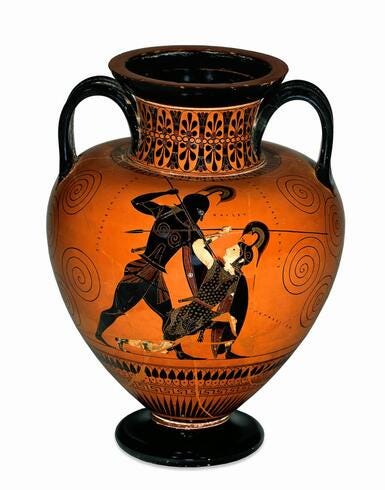
Exekias, “Amphora”, c. 540 BC -530 BCE, black-figure pottery, 41 x 29 cm, British Museum, London.
This vase, created by Exekias between c.540 to 530 BCE, is an amphora, which is characterised by its two opposing handles, its tapered base, and its narrow neck. Amphorae were used for the transport and storage of liquids and dry goods. They were typically purposed for storing wine and were often used in symposiums, an activity where aristocratic Athenian males would have intellectual debates while drinking. The contents of the amphora would be poured into a krater, where the wine would be diluted with water, to be served to guests.
This vase is black-figure pottery, which refers to when the pottery itself remains red, but the figures on the pottery are black. The black-figure technique was created in Corinth around 700 BCE. The pottery is created when clay is mixed with water to remove impurities, and is then wedged and moulded on a potter’s wheel. After it dried, it could be burnished (smoothened). Black slip would be applied to create figures and designs, and these figures could be further detailed by making incisions in the black slip, allowing the original red colour from the pottery to peek through. When the pottery design was completed, it was placed through a three-step firing process.
The scene on the amphora depicts the moment that Achilles and Penthesilea encountered each other on the battlefield in Troy, leading to Achilles piercing Penthesilea’s throat with his spear. Achilles became a hero fighting for the Greeks in the Trojan war. Penthesilea was the daughter of the god of war Ares and Otrera, and became queen of the Amazons after her sister Hippolyta was killed by Heracles. In her grief, she chose to fight against the Greeks in the Trojan war. When the bodies were collected from the battlefield, Achilles removed Penthesilea’s helmet and was taken aback by her beauty, beginning to mourn her. He returned her body to the Trojans so that they could bury her, and when he was mocked by the Greek soldier Thersites for falling in love with her, Achilles punched and killed him. Though the origin of the mythological story is derived from Homer’s Iliad, the inclusion of Penthesilea’s fight against Achilles was later created by Arctinus of Miletus in his Aethiopis.
The difference in the physical form and stance between Achilles and Penthesilea serves to reinforce Achilles’ dominance. His large figure looms over Penthesilea, forcing her body to contort in an unnatural position where her leg is turning away from him, but her chest is twisted to face him. The difference therefore emphasises how Achilles has subjugated her. While their bodies form a parallel line, with Penthesilea below him, their spears form a cross, showing that Penthesilea is still fighting against him and has not attempted to retreat. This is further emphasised through the mirroring of their bent right arms.
The imagery on the vase may show foundational Athenian attitudes to being autochthonous, and the ethnocentric identity they formed that deemed the Persians and all other non-Greeks as Barbarians, perceiving them as culturally and ethnically inferior. As the Amazons in mythology belonged to no Greek city-state, they were therefore not viewed as Greek. In turn, they began to be perceived as Barbarians. Though this ethnocentric identity was primarily conceived through the Persian War, prior imagery like this may signal to early conceptions of oppositional identities, and of Athenian superiority.
메타데이터
- post_id
- b965aaa4f2f3
- slug
- object-2-achilles-slays-penthesilea-amphora-b965aaa4f2f3
- url
- https://medium.com/@alexandra.salmon01/object-2-achilles-slays-penthesilea-amphora-b965aaa4f2f3
- canonical_url
- https://medium.com/@alexandra.salmon01/object-2-achilles-slays-penthesilea-amphora-b965aaa4f2f3
- author_url
- https://medium.com/@alexandra.salmon01
- status
- ok
- fetched_at
- 2026-06-24 11:06:28