I Compared Toolyzo and Originality.ai Using the Same 5 Writing Samples
AI detectors are becoming part of everyday workflows for publishers, students, marketers, and businesses.
I Compared Toolyzo and Originality.ai Using the Same 5 Writing Samples
AI detectors are becoming part of everyday workflows for publishers, students, marketers, and businesses.
But one question keeps coming up:
Can you trust a single AI detector?
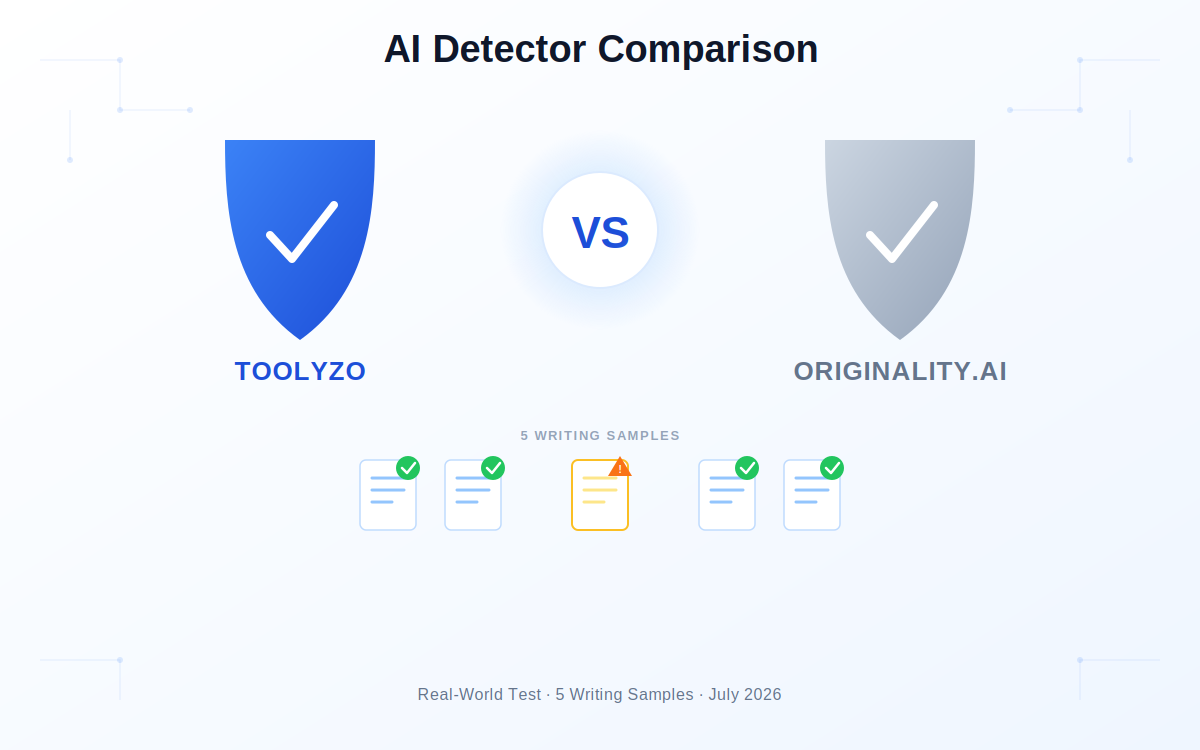
To explore that question, I compared Toolyzo and Originality.ai using exactly the same five writing samples under identical conditions.
The goal wasn’t to declare a winner.
It was to understand how two popular detectors behave when presented with different kinds of content.
The Test
Every sample was scanned under the same conditions.
The dataset included:
- Pure AI-generated text
- Pure human-written text
- Human-edited AI content
- Very casual human writing
- Technical AI-generated writing
What I Found
Some results were remarkably consistent.
Both tools confidently identified obvious AI-generated content.
However, one result stood out.
A human-written sample that I personally authored received a 99% AI score from Originality.ai during my test, while Toolyzo leaned toward human.
That doesn’t automatically make one detector “right” or “wrong.”
Instead, it highlights something many developers and content creators have noticed:
AI detection is probabilistic — not absolute.
Different systems rely on different signals, thresholds, and models, which means disagreement between detectors is completely possible.
The Biggest Lesson
Rather than asking:
“Which detector is perfect?”
A better question is:
“How consistent is a detector across different types of writing?”
Even a small five-sample experiment showed that detector behavior changes depending on writing style and context.
That’s why I believe AI detection scores should be treated as signals, not unquestionable proof.
Read the Full Comparison
The complete article includes:
- Full methodology
- Exact sample texts
- Raw detector scores
- Feature comparison
- False-positive observations
- Limitations of the experiment
Read it here:
**https://toolyzo.com/blog/originality-ai-review-vs-toolyzo**
If you’ve tested multiple AI detectors yourself, I’d be interested to know whether you’ve seen similar inconsistencies.
메타데이터
- post_id
- b975a9b1f13b
- slug
- i-compared-toolyzo-and-originality-ai-using-the-same-5-writing-samples-b975a9b1f13b
- url
- https://medium.com/@jigarvaaru86/i-compared-toolyzo-and-originality-ai-using-the-same-5-writing-samples-b975a9b1f13b
- canonical_url
- https://medium.com/@jigarvaaru86/i-compared-toolyzo-and-originality-ai-using-the-same-5-writing-samples-b975a9b1f13b
- author_url
- https://medium.com/@jigarvaaru86
- status
- ok
- fetched_at
- 2026-07-25 20:14:21




