What helps, or could help, us to care across time?
Part 4— Burrowing deeper into Stories of Place composting
What helps, or could help, us to care across time?
This is a deeper layer of learning behind **Stories of Place 2024–2025 Composting #3 | Co-creators as earthworms**, so this post will make much more sense if you start there. Our glossary might also help.


Making Human Limpet
Hands wove in and out of the cardboard structure, paper rustling with haphazard taping and slotting, hastily forming Human Limpet. A muffled voice from within Human Limpet called out: “How might this challenge, integrate, or adapt pre-existing notions about the world?”¹ We laughed as we realised we had fallen into our human habit of acting fast within a human set deadline. Helen asked, “Why would it be reasonable to think we could make a Limpet in a couple of hours?!” Our Limpet kith grow their shells slowly over time: between 0.005 to 2.6 mm/month, faster in summer, on exposed shores or if they’re small in a less populated area, and slower in winter or on sheltered shores.² I wondered, “What happens if we have a material that builds over time… and each Stories of Place session we added a layer…”, to which Helen’s eyes rounded with Limpet excitement (as they often do), “… perhaps that’s what we should do! Why don’t we do that then? Just add bits each time? So just accept that it’s going to take us weeks and weeks…”³ Our mollusc-minded thinking returned us to a concept Bill introduced at the beginning of the year: chronodiversity. Different parts of the ecosystem experience time differently. For example, Insects’ nervous systems enable them to experience and react to time quicker than humans. Limpets experience time through tidal and light-dark rhythms,⁴ whereas Trees experience and react to time more slowly through gradual environmental changes. Paul experienced chronodiversity when exploring Dudley High Street as Mycelium, sensing changes of “an aging of environment, a slow reclaiming by nature”: moss growing on roofs, the patina patchwork of stone repairs on Top Church, stalactites growing from concrete overhangs, and Buddleia hiding amongst scaffolding in anticipation of eating into the masonry and pushing brickwork outwards.⁵ We have realised interacting with, embodying and learning from our more-than-human kith invite different perspectives around time.

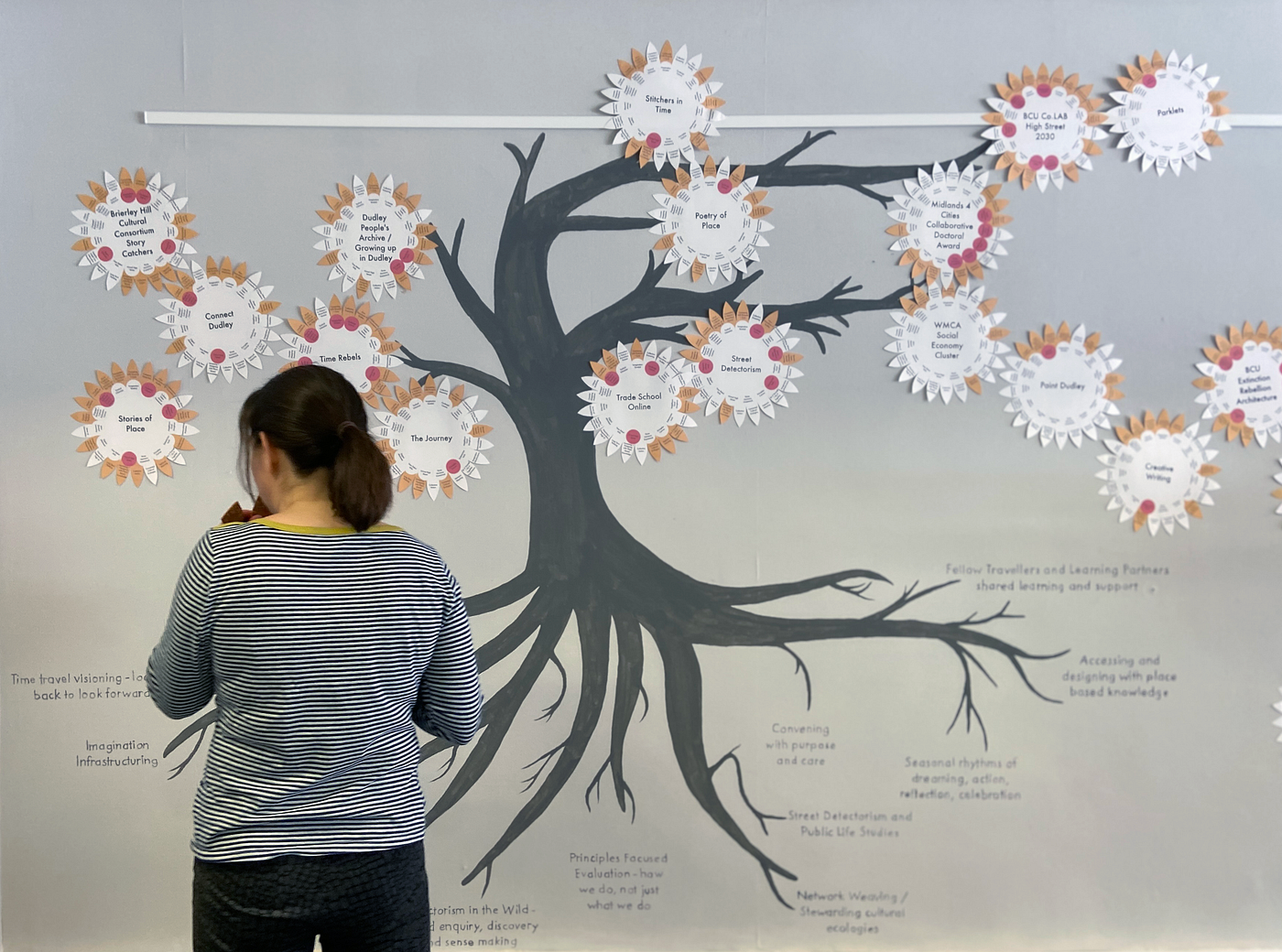
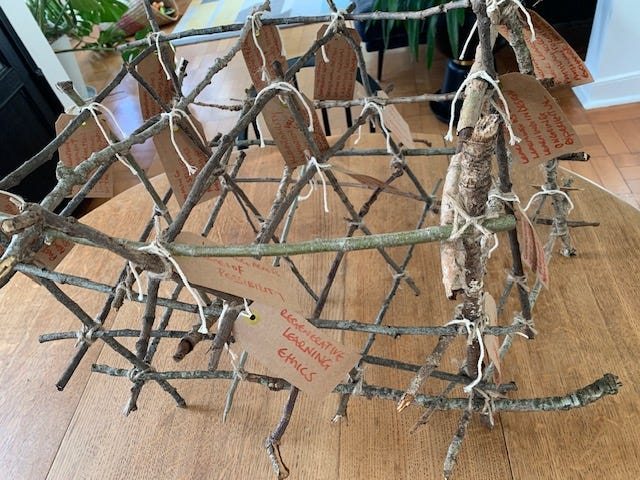
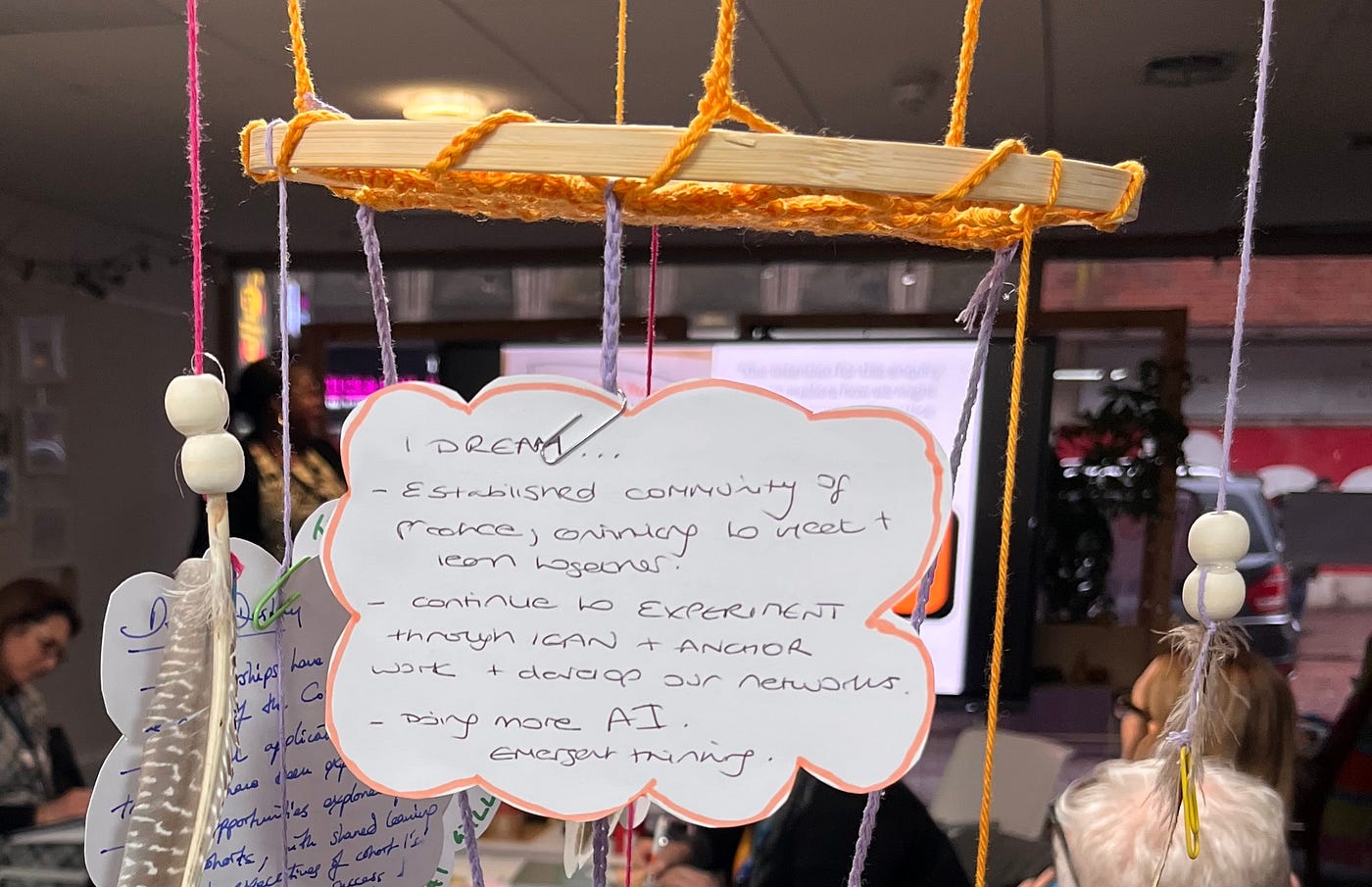
The Stories of Place archive and gatherings emerged from the Andean concept of time, seeing the past, present and future swirling together in pool. This framing invited rituals of care and stewardship of knowledge, ideas, experiences and artifacts from across time, so they could be archived, celebrated, connected, interacted with, critically thought about, combined, prototyped and evolved over long periods of time by multiple co-creators. How we steward idea seeds has evolved over the years: from an experiment digital database to bringing them to life in our gatherings through diagramming and visualising their connections. Jo wanted to understand the idea seeds by how they are connected “to tell a more cumulative, relational, dynamic and bigger story of possibility.”⁶ By November, we were using lessons learnt from making Human Limpet to create a Limpet-inspired mobile hanging and connected idea seeds. This physical manifestation of our archive sits alongside our co-design of the digital archive which will make these connections more accessible. As the convener of Stories of Place, I hold the knowledge and privilege of where the information and tools behind each seed lie, and I hold the responsibility of connecting emerging ideas with co-creators not present. I want to shift idea seed stewardship into the commons so anyone can discover, adapt and connect with these ideas and tool. Together with community technologists, Common Knowledge, we are co-creating a living 100-year digital archive called Dudley Time Portal with Stories of Place and Dudley People’s School for Climate Justice co-creators.


Prototypes of the Dudley Time Portal Archive by Common Knowledge
However, it isn’t enough to see technology as a sole solution to knowledge stewardship. The digital archive will not replace the need for a relational culture of care and connection. In our gatherings, I now have a ritual of sprinkling idea seeds around the space for others to find and grow. Idea seed sowing led to Helen finding a way to invite their Human Limpet practice onto the High Street by evolving April’s idea seed for the travelling film screening structure. By September, our cardboard Human Limpet appeared. By October, Dudley Council staff members and students from the Architectural Association School of Architecture were sitting inside Human Limpet, reflecting on their changing perspectives of space and safety. By April 2025, outside of Stories of Place, Helen and Bill were hosting ‘Limpets Alive in Dudley’ performance, inviting people “to inhabit 3 human-sized limpets and experience live sound and projected images that take us into a more-than-human watery world.”⁷
“Re-referring to the [seeds of ideas] is a long-term way of working… you keep those little records of ideas… and then we keep going back to them and reworking them and adding to them… combining and recombining… which is an interesting process that extends the life of something, by continually recombining it into something else.” — Helen Garbett, October 2024
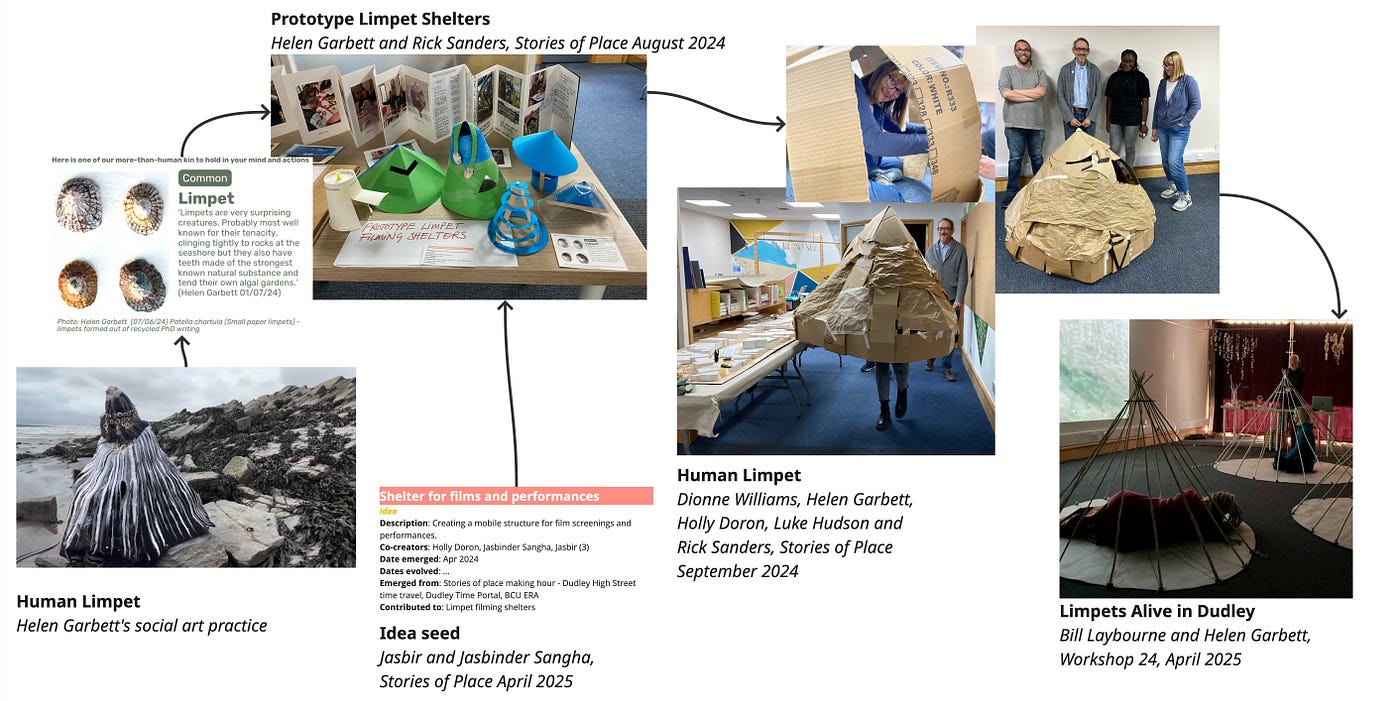
Human Limpet process
This evolution of long-term care and making reminded Rebekah of energy in life: “nothing is created and nothing dies, it just changes.”⁸ Perhaps this ritual of knowledge stewardship is a signal of an emerging regenerative cycle.
Our Stories of Place gatherings connect and deepen knowledges, such as around systems thinking and climate crises, with prompts for reflections around care. Dena was drawn to systems diagrams exploring cycles of waste in Dudley. Clasping the question prompt card “How might this express of practice care?”, Dena’s attention was caught by ‘derelict buildings’ listed under examples of waste. They had never thought of buildings as waste before which made them wonder if we have become desensitised to waste. Dena reflected on waste as a wilful and deliberate act, as a demonstration of an incapability of caring. Sharing these reflections with other co-creators invited collective reflections on care and connection with derelict buildings and led to imaginings of them being brought back to life with play, artist residencies and youth takeovers as a way to make climate concerns more accessible.⁹ A ritual with interacting with, critically thinking about, learning with and adding to is an act of collective care of ecological and system knowledges.

Learning patterns:
- Rituals with more-than-human kith help us to expand our perceptions of time and long-term thinking.
- Stewarding knowledges and ideas can be a practice of relational long-term making and care.
- Ecological and wider systems lenses can invite reflections and imaginings around care.
These help us to shift us away from linear, short-term and individualistic thinking that might limit how we think about the world and what futures we can imagine. This also can help us to avoid action that is disconnected from place-based knowledges, perceives Nature and future generations as a resource to be extracted from, or prioritises productivity or efficiency through short-term solutions that might lead to harm.

Design questions these patterns reveal for how Stories of Place might evolve this year:
- How might we embody chronodiversity / different scales of time?
- How might we shift reflections of care towards practices of care?
- How might Stories of Place connect ecological and systems knowledges across Dudley People’s School for Climate Justice?
- How might place stewardship show up in Stories of Place?
- How do we distribute power in accessing, stewarding and evolving place-based knowledges?
- How might we understand place-based knowledges and idea seeds by how they connect?
- How might we invite experimentation and long-term making as a regenerative cycle?
- How might we combine technological and social rituals with stewarding and connecting knowledges?

Intentions for Stories of Place this year:
- Embody different scales of time through seasonal ways of being, long-term making and momentary sensory experiences.
- Experiment with and share tools that invite practices of care.
- Integrate knowledges from Dudley People’s School for Climate Justice into the Dudley Time Portal and kith pool, gifting back interactions between them.
- Experiment with rituals of making with idea seeds (*we’re now doing this!)*
- Continue co-designing the digital Dudley Time Portal with Common Knowledge.
- Experiment with expressing and stewarding physical and social connections of knowledges.

Wisdom we might draw from:
- Place stewardship — Ekho Collective’s project One Mile Stretch invited people to regularly walk, litter pick and observe Nature along a mile of canal in Brierley Hill, as a form of evolving place stewardship.
- Sharing knowledge — Chimpanzees share knowledge by sharing tools. Slime molds “can learn and share what they learn with other slime molds by joining together for a time”.
- Digital archiving — Multitudes’ project Black Digital Archiving explored how community-based archives of Black history might “provide a springboard for further investigation, discussion and collaboration necessary to enact future change.”
- Experiencing time with Nature — Bill and Helen spent 24 hours inhabiting Alder Coppice, an ancient wet woodland in Sedgley, creating woodland sound music, experiencing the dawn chorus and Fern shadow drawing beneath a naturally dyed shelter.


Helen Garbett and Bill Laybourne, Workshop 24 in Alder Coppice
- Question from CreaTures Framework, 2022
- Blackmore, 1969; Boaventura et al., 2003; Hill, 2008; Jenkins and Hartnoll, 2001
- Helen Garbett and Holly Doron, September 2024
- Helen Garbett, a welcome Limpet-based writing distraction Whatsapp exchange, May 2025
- Paul Burns, April 2024
- Jo Orchard-Webb, October 2024
- Helen Garbett and Bill Laybourne’s invitation for ‘Limpets Alive in Dudley’
- Rebekah Warmington, October 2024
- Abby Staniland, Dena Khan, DKB, Jan Norton, Laura Jane Round, Nat WB and Paul Burns, July 2024
Stories of Place Co-creators
Abby Staniland (Earthworm / Orkney Vole) grew up in Dudley, worked at the zoo and is now a budding landscape architect, bringing their connective imagination and visualisation talents. With other design students, Abby gifted dreams of local folk swapping waste plastic for Dudley pounds to mould into pop-up modular community tables for people to exchange goods, collaborate, create and learn together.
Alex Lui (Limpet)
Andy Edwards (Limpet)
Bill Laybourne (Sludge Worm) is full of fascinating facts and provocations, bringing laughter and inspiring disorder. Bill‘s sound-based social art practice led to co-creators noise making with more-than-human sounds of the High Street.
Caz Emery (Ginger) has a reputation for creating something out of nothing and getting stuff done, with curiosities around craft, nature and food. They are often found cooking plant-based meals on the campfire feeding and nurturing the Ekho Collective community.
Deb McDonald (Ant) is a network weaver, bringing knowledges and curiosities from Ekho Collective, and is particularly curious about how people can collectively engage with creativity, culture and heritage to co-create resilient communities.
Dena Khan (Bumblebee / Shark / Swift) brings an imagination that centres young people and how they can shape and renew places through creativity, connecting with multiple generations. They are curious about buildings being perceived as waste, and how we can bring life to them again through care and connection.
Dionne Williams (African Migrant Butterfly / Limpet / Mycelium / Northern Pool Frog / Red Squirrel) is a deep thinker and doer drawn to creativity and experimentation. Dionne has a gift for nurturing welcoming, safe and generous spaces, currently exploring how East African values might invite conversations and creativity that bring us closer to Nature-connected values in Dudley.
DKB (Dragonfly / Ginger) is curious about sharing sustainable farming and growing knowledges between different places across the world to help build hopeful resilience within the Earth crisis. This curiosity is rooted in their captivating childhood memories of running through their farm pausing to eat fresh mangos.
Erica Williams (Buddleia / Ginger) is a walking encyclopaedia of Black Country history, whose Storylines blog is rich with research connecting family history with wider systemic issues. Erica has a wonderful ability to connect ideas to inspiration from places across the world and knowledges gained from her background in teaching and training business communication, particularly in the marketing communications industry.
Helen Garbett (Little Whirlpool Ramshorn Snail / Limpet / Orkney Vole / Sludge Worm) always brings a contagious curiosity rooted in their social art practice exploring human entanglement with Limpets. Helen has a magical ability to shift us from imagining to making, inspiring us with their creations between our gatherings, and, of course, spark collective fascination in all things Limpet.
Holly Doron’s (Chiffchaff / Earthworm / Fountain Water / Great Diving Beetle / Limpet / Moth) favourite moments are watching people spark with others over a thought or idea so they try to create the conditions for this to happen while listening, note-taking and connecting learning and curiosities.
Jack Williams (Water Strider) brings their wildlife conservation knowledges from Dudley Zoo and is curious about what zoos might look in the future as spaces for community, nature connectedness and wellbeing.
Jan Norton (Hazel Dormouse / Peacock Butterfly / Robin / Zitting Cisticola) brings their creativity, stories with Nature, smiles and stunning skills and ideas with fabrics and stitching. Jan is a convenor of Stitchers in Time who research and create beautiful pieces connecting textiles, fabrics, stitching and other media with Nature, place, stories with heritage and futures.
Jasbinder Sangha (Puddle)
Jasbir (Water Strider)
Jhora Sangha (Pigeon)
Jo Orchard-Webb (Gorse / Hawthorn / Hedgehog / Mycelium) joins virtually from the Dorset seaside, bringing Nature perspectives and curiosities from Eric-the-dog walks along with their deep care for Dudley. Jo has a talent for absorbing and connecting everybody’s ideas with wider ecosystems and knowledge networks.
Laura Jane Round (Hammerhead Shark)
Laura Onions (Limpet) has an inspiring ability to get stuck in with making, gifting their creativity and curiosity to other co-creators. Laura’s art practice is rooted in printmaking and how this can take on new forms out and about with Nature across the Black Country.
Lorna Prescott (Barn Owl / Great Diving Beetle / Hedgehog / Nettle / Red Fox / Swift) brings years of lessons from doing in Dudley alongside deep thinking around systemic issues behind our everyday interactions. Lorna is full of curiosity and wonder around anything more-than-human and deep time.
Luke Hudson (Dragonfly / Great Mouse-Eared Bat / Limpet) brings their fascination and knowledges around green living, Nature and psychology, alongside their curiosity and laughter, diving into and co-evolving whatever unexpected activities co-creators are dreaming up.
Miriam Atikpo always brings deep reflections with critical thinking rooted in a stunning abundance of cultures and languages. If she’s not with us, it’s because she’s busy spreading care in the NHS.
Nat WB (Bumble Bee, Hedgehog, Little Egret)
Natalie Marsh (Snail)
Nichaela Reid (Bumble Bee)
Paul Burns (Hawthorn / Mycelium) brings invigorating perspectives and prose as a creative writer with a fascination in more-than-human folklore. Paul is generous in sharing photos and videos of their local wildlife in between gatherings and always has interesting Dudley memories to share.
Rachael Othala (Fountain Water / Great Diving Beetle) always arrives full of Dudley energy and curiosity, inspiring other co-creators with their creativity through making and poetry. They are curious about how the LBGTQIA+ community and allies can explore art together.
Rebekah Warmington (Badger / Bear / Buddleia / Ladybird) brings her gifts in creative making and thinking, with an extraordinary ability to weave deep reflections in the moment. Rebekah generously shares her experience in learning with and from Nature and Indigenous knowledges. She is also deeply inspired by play, and how experiential learning can enhance and guide the connections we make in our journeys of exploration and discovery.
Rick Sanders (Beaver / Limpet) brings their do-it-together spirit, gifting inspiration from their practice in poetry and breathing creativity into upcycling furniture and textiles.
This research is funded by the Arts and Humanities Research Council through Midlands4Cities. It is entangled with my work at CoLab Dudley funded by The National Lottery Community Fund’s Climate Action Fund and Joseph Rowntree Foundation as part of a network of Pathfinder organisations reimagining and redesigning the world we want to live in to achieve deep, transformative change.
메타데이터
- post_id
- b97705c0f7f0
- slug
- what-helps-or-could-help-us-to-care-across-time-b97705c0f7f0
- url
- https://medium.com/colab-dudley/what-helps-or-could-help-us-to-care-across-time-b97705c0f7f0
- canonical_url
- https://medium.com/colab-dudley/what-helps-or-could-help-us-to-care-across-time-b97705c0f7f0
- author_url
- https://medium.com/@hollyrosedoron
- status
- ok
- fetched_at
- 2026-07-19 06:24:50