How Organizations Can Move from AI Experimentation to Enterprise Adoption
Why do most organizations fail to scale their artificial intelligence initiatives despite widespread individual usage of generative tools…
How Organizations Can Move from AI Experimentation to Enterprise Adoption

Why do most organizations fail to scale their artificial intelligence initiatives despite widespread individual usage of generative tools? The answer lies in a lack of operational adaptability and a failure to build the foundational infrastructure necessary for organization-wide AI adoption.
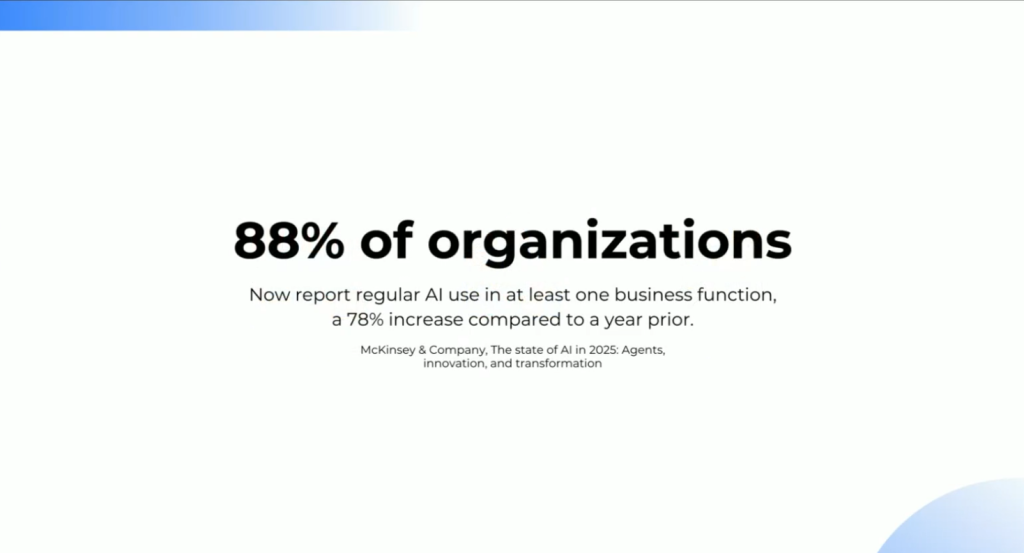
While many businesses have experimented with pilots, two-thirds remain stuck in the experimentation phase because they have not redesigned workflows to account for AI capabilities or established shared knowledge systems.
Bridging the Gap in Enterprise AI Implementation
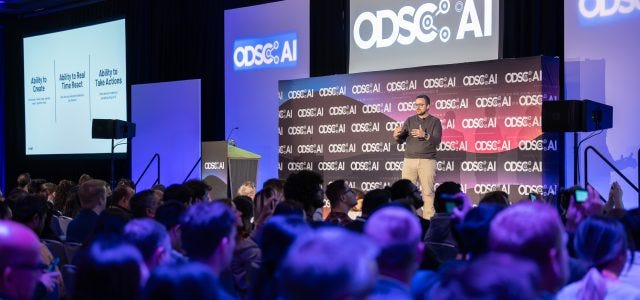
At ODSC AI East 2026, Ivan Lourenço Gomes, AI consultant and lead instructor at Daweb Schools, shared a practical framework for moving beyond isolated AI experiments and toward organization-wide adoption. His session focused on the operational foundations companies need to turn generative AI from a personal productivity tool into a scalable business capability.
His framework for organization-wide AI adoption moves through three distinct layers: the AI starter pack, no-code agents, and custom-engineered tools. According to Gomes, the responsibility for this transition rests on everyone within the hierarchy.
Business owners must foster a culture, leaders must guide their teams toward better use of tools, and employees have the unique opportunity to stand out as drivers of change within their departments. By focusing on practical foundations rather than just the technology itself, organizations can move past isolated usage and toward compound, scalable results.

Layer One: The AI Starter Pack
The first step toward mature organization-wide AI adoption involves moving beyond individual “pro” subscriptions toward collaborative systems. Gomes emphasizes that individual use without shared knowledge fails to deliver the long-term gains businesses need. The “AI Starter Pack” consists of three essential pillars: a shared knowledge base, reusable instructions, and systematic testing.
Establishing a Shared Knowledge Base
A shared knowledge base ensures that AI responses remain grounded in accurate, company-specific information. Rather than pasting data manually into prompts, teams should collaborate on live documents — such as Google Docs or internal wikis — that detail policies, product information, and service guidelines.

This collaborative maintenance prevents information silos and ensures the AI remains an accurate reflection of current operations.
Utilizing Reusable Instructions and Gems
To maintain consistency, teams should utilize “Gems” or custom GPTs, which are sets of predefined instructions and knowledge files. For example, a customer service team can build a Gem that automatically formats replies with the correct tone, salutations, and specific data pulled from the shared knowledge base.
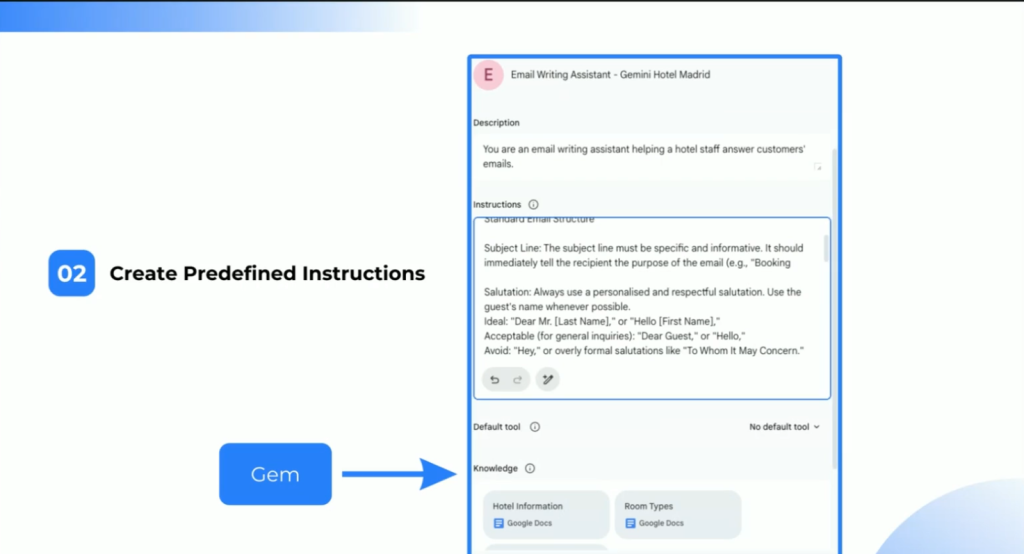
Sharing these tools across the team ensures that every member benefits from proven methods and historical successes.
The Role of Systematic Testing
The final component of the starter pack is iterative, systematic testing. Gomes suggests that teams use simple worksheets to log AI responses to real or simulated inquiries, identifying where the model misses details or over-explains. This feedback loop allows for the continuous refinement of instructions and data, turning AI adoption into an evolving process rather than a one-time setup.
Layer Two: Scaling with No-Code Agents
Once a team masters shared knowledge and instructions, the next logical progression is the deployment of proactive AI agents. Unlike a standard chat interface that waits for user input, an agent is proactive; it can monitor schedules, watch folders, and trigger actions based on external events.
Gomes highlights the difference between output and orchestration. While a Gem might generate a draft for a human to review, an agent can orchestrate entire workflows — creating files, scheduling meetings, and communicating with other agents. By using no-code platforms like Zapier, N8N, or Make.com, organizations can automate complex consulting or sales workflows.

A practical application of this involves a “Customer Intelligence Team” of agents. In this model:
- A research agent monitors new appointments and performs deep research on potential clients.
- A briefing agent takes that research to write a meeting preparation brief for the consultant.
- A follow-up agent summarizes the transcribed meeting notes and drafts proposals or next steps.
By delegating repetitive research and administrative tasks to these agents, human professionals can focus on high-value interactions that require trust and emotional intelligence.
Layer Three: Custom-Engineered AI Solutions
For organizations ready to invest IT effort into specific solutions, the third layer involves building custom internal tools. This approach combines engineering capabilities with AI models to solve highly specific business problems that off-the-shelf tools cannot address.

Gomes advocates for a tech stack using Firebase and React, which allows developers to securely manage authentication, databases, and API calls to models like Gemini. This engineering-first approach enables features like image recognition, document understanding, and large-scale data processing.
For instance, one of Gomes’s clients developed a translation tool that connects to the DeepL API to manage content across 24 languages, drastically reducing the $5,000 monthly cost of human translation while maintaining consistency through custom glossaries.
Other successful projects include automated invoice processing that saves ten hours of work per week and image archives that classify thousands of product photos using AI taxonomies.
Overcoming the AI Effort and Benefit Curve
Successful organization-wide AI adoption is not instantaneous; it requires navigating what Gomes calls the “AI effort and benefit curve.” While AI can eventually allow one person to do the work of ten, a significant amount of upfront effort is required in the form of interviewing stakeholders, gathering data, and rigorous testing. Most organizations fail because they stall during this intensive preparatory phase.
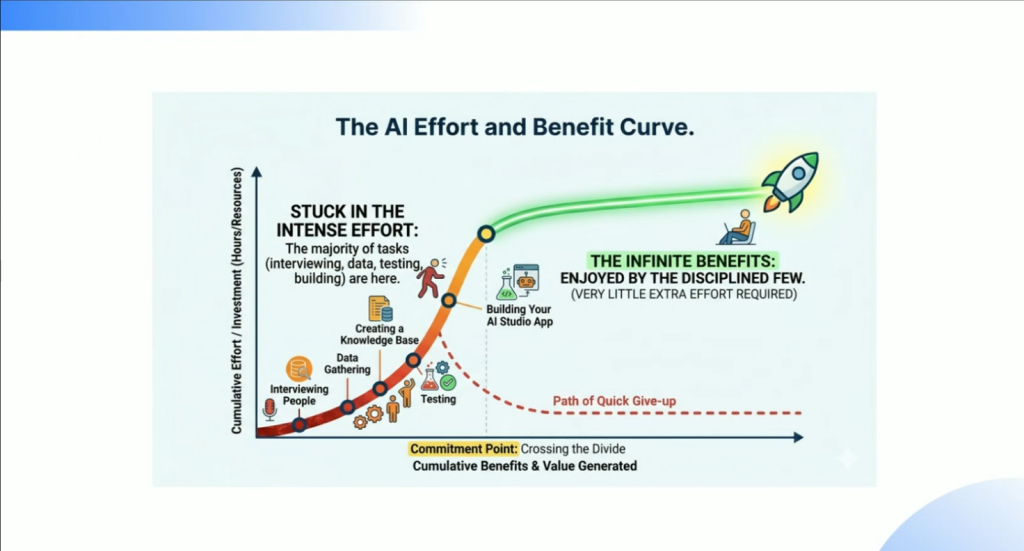
To achieve sustainable results, leadership must approach AI with intention and discipline. This means moving beyond “AI for the sake of AI” and instead sitting down with teams to identify their most time-consuming pain points.
By building tailored solutions — whether through simple shared Gems or complex custom applications — businesses can finally bridge the gap between experimentation and enterprise-scale efficiency.
The AI revolution is only beginning, and the organizations that prioritize these foundational tactics today will be the ones leading their industries tomorrow. For teams ready to move from experimentation to execution, ODSC AI West 2026 offers an opportunity to learn from practitioners, engineers, and AI leaders working across LLMs, machine learning, generative AI, and real-world AI deployment.
Join the data and AI community in San Francisco and explore how to build AI systems that deliver measurable impact.
메타데이터
- post_id
- b9819cfa6549
- slug
- how-organizations-can-move-from-ai-experimentation-to-enterprise-adoption-b9819cfa6549
- url
- https://medium.com/@odsc/how-organizations-can-move-from-ai-experimentation-to-enterprise-adoption-b9819cfa6549
- canonical_url
- https://medium.com/@odsc/how-organizations-can-move-from-ai-experimentation-to-enterprise-adoption-b9819cfa6549
- author_url
- https://medium.com/@odsc
- status
- ok
- fetched_at
- 2026-06-09 19:06:51