The Good Eye: On ballet, images, and symbolic connections
“A ballet is a picture, or rather a series of pictures connected one with the other by the plot.” — Jean-Georges Noverre (1727–1810)
The Good Eye: On ballet, images, and symbolic connections
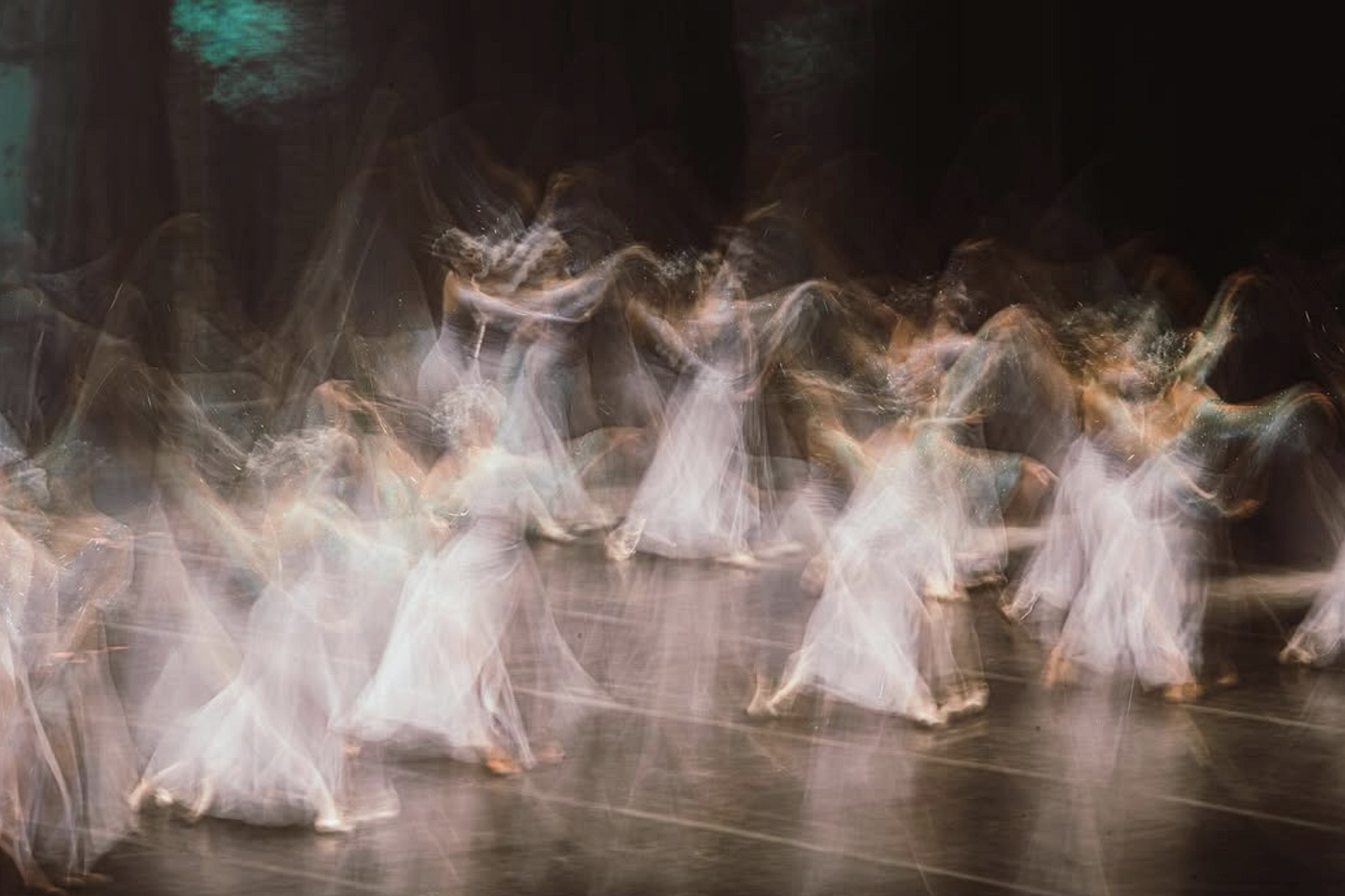
‘Forest Song’ with Lapidare school, photo by Carol Lancelloti, Joinville Dance Festival, 2025.
“A ballet is a picture, or rather a series of pictures connected one with the other by the plot.” — Jean-Georges Noverre (1727–1810)
I see visual connections — all the time. My mind does this almost instinctively, even without prior intention. And before I realize it, I find myself immersed in a constellation of mental associations and visual references. This essay reflects on how I perceive ballet as a form of moving image, and on how my training in visual culture has shaped the way I instinctively connect what I see on stage to broader symbolic and visual traditions.
These connections do not exist only in theory — they run directly through my practice as a dance photographer. I am particularly drawn to excavating these links and the hidden meanings they carry within my own work. Sometimes this happens while I am photographing; other times, during post-production, or even when I revisit my images after some time has passed. This process, which often begins intuitively, materialized very clearly in a specific experience: an image I captured in 2025 during the Joinville Dance Festival, held annually in Santa Catarina, Brazil.
On stage, the Lapidare school was presenting the repertoire Forest Song, and I decided to experiment with a slower shutter speed, as I sometimes do. When I finished the image in post-production, two paintings immediately came to mind: The Awakening of a Poet (1899), by Gabriel Ferrier, and Le Willi (1906), by Bartolomeo Giuliano (a theme intimately connected to ballet through the beloved repertoire Giselle). Making these visual associations was not intentional or conscious at the moment I “blurred” the image. I also did not know this repertoire in detail, and my initial intention was simply to work with the textures and luminous qualities of the beautiful costumes. Yet, through my visual interpretation at that moment, and through a later, more reflective intention during the editing process, I was able to access deeper layers of meaning than I had originally captured.
Forest Song is, in fact, a ballet that explores themes of nature and the world of forest spirits. Inspired by an acclaimed Ukrainian play by the poet Lesya Ukrainka, it stands as a tribute to Ukraine. I did not know this when I created the image. Still, I felt compelled to “blur” it — to evoke the ethereal and these spirits.
Here, I am offering a purely visual and simple example, born out of a technical experiment with my camera — even if it inevitably carries traces of my style and intentions as a photographer. Yet, it was not a conscious decision. And still, there they are: the mysterious female souls that inhabit moonlit forests, about whom every culture has told so many stories. The image moved me, and it was also warmly received when I published it. I believe this is because it evokes curiosity, mystery, and a connection to ancestral themes — much like other similar images that seem to reside in some distant layer of our collective memory. And if something so profound can emerge from a simple visual experiment, imagine what might happen if we chose to look at an entire repertoire with attentive eyes. With “good eyes.”
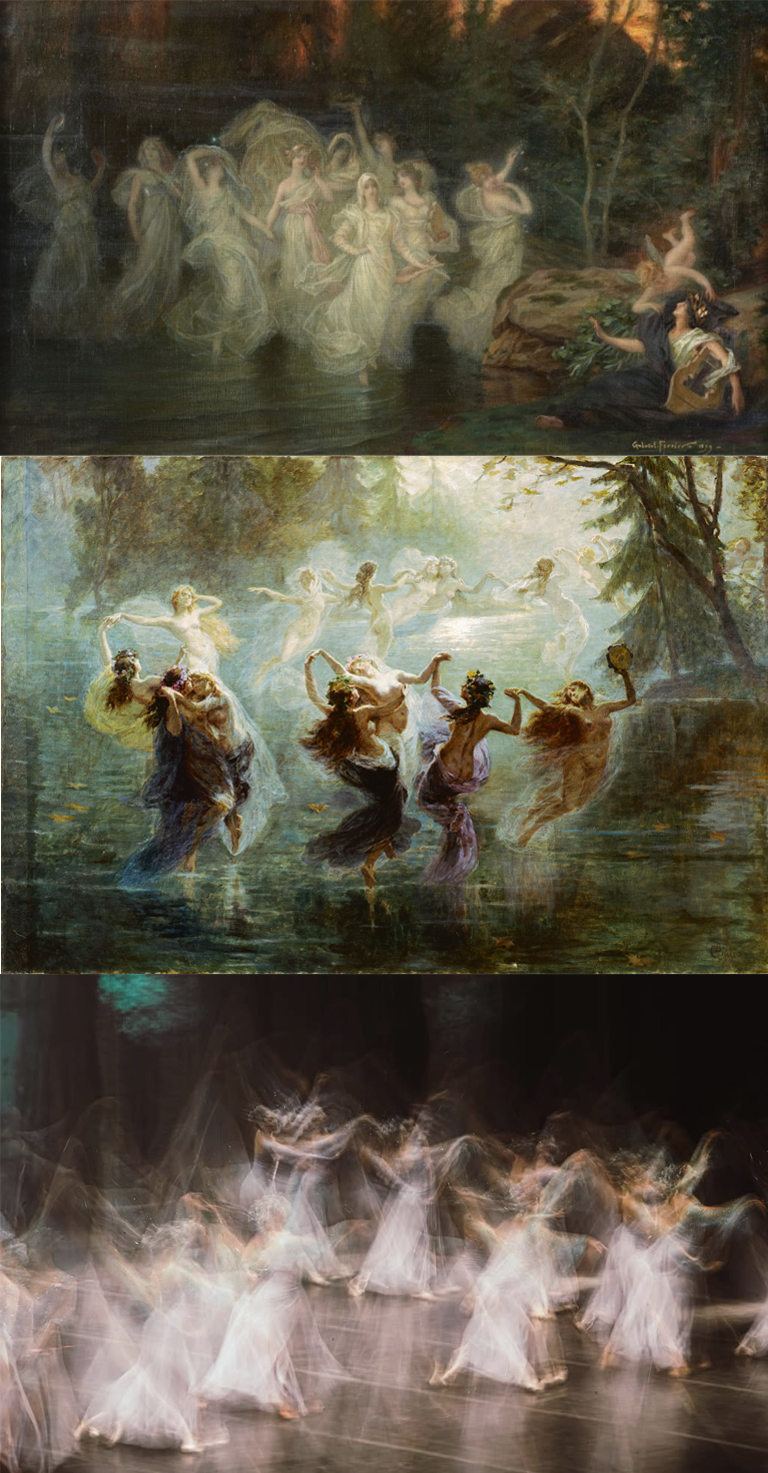
“The Awakening of the Poet”, 1899, by Gabriel Ferrier; “Le Villi”, 1906, by Bartolomeo Giuliano; Forest Song with Lapidare school, photo by Carol Lancelloti, 2025.
This way of perceiving the world — through images that speak to one another — found a theoretical foundation during my Master’s studies at IADE — Universidade Europeia, in Lisbon, where I was introduced to the work of Aby Warburg (1866–1929). Warburg is widely known as the founder of iconology. A German art historian and cultural theorist, he revolutionized the field of visual culture by investigating how symbols and images from the classical world survived and transformed over time, particularly during the Renaissance.
His approach involved a deeper analysis of the artwork from within, rather than solely through its historical context. Warburg regarded the image as the very center of cultural investigation and transmission. His most emblematic project, the Bilderatlas Mnemosyne, which unfortunately remained unfinished, consists of a series of panels in which images are arranged so as to reveal how ancient gestures, symbols, and myths reappear in visual expressions across different periods (Sherman, 2023). He conceived the atlas as a visual narrative of art history, structured exclusively through images, in which the juxtaposition of approximately 900 figures distributed across 79 panels would allow historical knowledge to emerge without the support of a verbal discourse (Almeida, 2015). It is worth noting that Mnemosyne is the name of the goddess of memory in Greek mythology — a Titaness whose very designation derives from the Greek word for “remembrance” or “memory,” and who, in classical tradition, represents the source of the preservation and transmission of knowledge and the arts. These attributes resonate symbolically with the very proposal of Warburg’s Bilderatlas. Warburg believed that images could be connected to one another, communicating across time, and that their symbols and compositions contained vast layers of information. It was precisely this idea that gave me a strong sense of recognition, for I have always built my authorial, academic and creative projects upon this kind of image-based and symbolic crossing. In fact, I believe that all artists do this, if we stop to think about it — though not always consciously or intentionally.
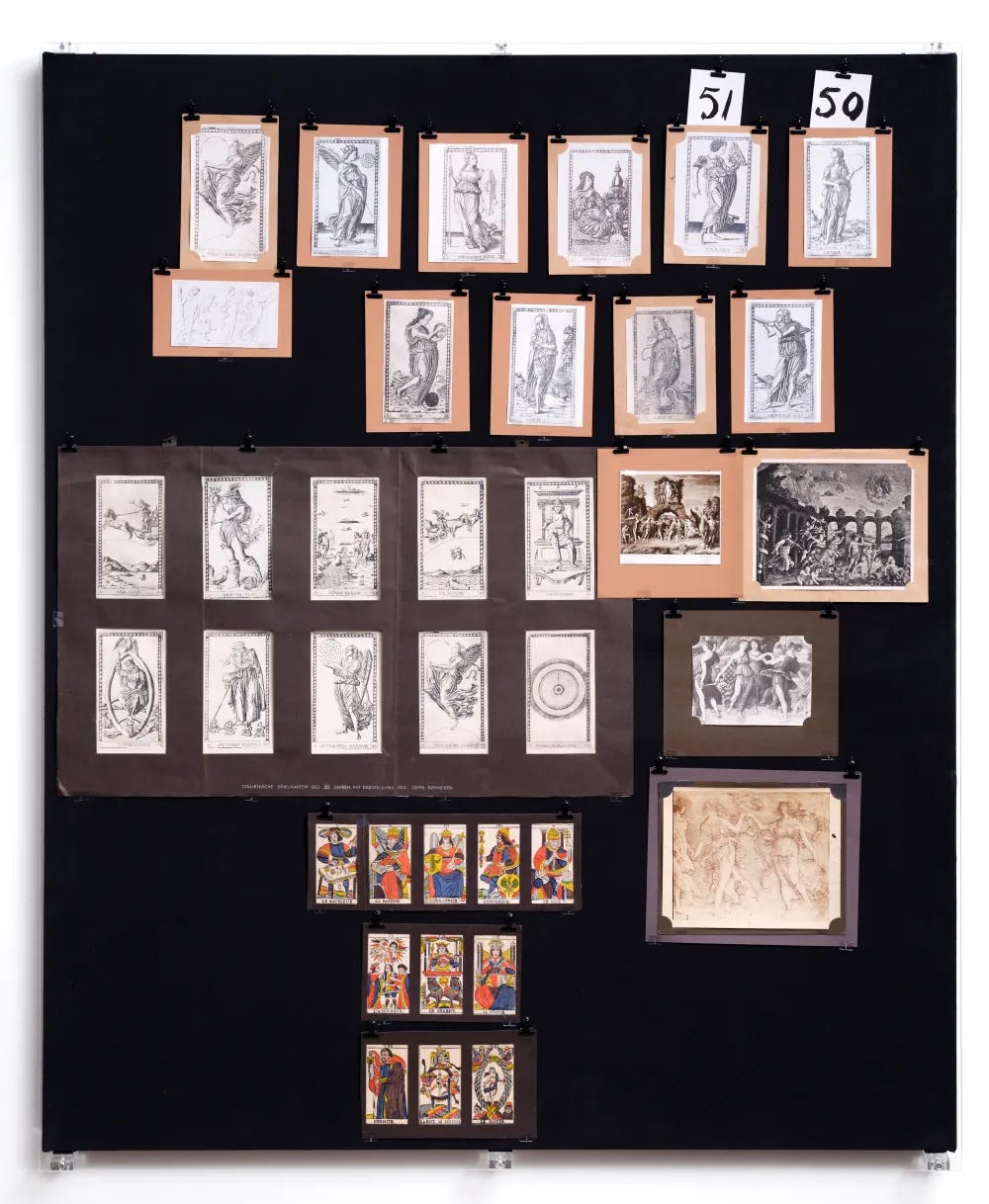
Panel 50–51, Aby Warburg’s Bilderatlas Mnemosyne. Photo by Stephen White & Co.
As we begin to engage with archetypes, symbols, the collective unconscious, and visual culture, everything becomes clearer, and our way of seeing artworks and artistic expressions begins to shift. It was within this context that I encountered, in Gillian Rose, a methodology that gave a name to something I had already been doing intuitively.
The title of this essay refers to one of the visual methodologies proposed by Gillian Rose (2001), which I employed in my Master’s dissertation, entitled Revealing Feminine Archetypes — Women in Tarot as Visual Culture. Starting from a central image — in the case of my dissertation, a tarot card — and among the other methodologies articulated by Rose, The Good Eye was used specifically to draw a parallel with another image that shared a similar color palette, as well as comparable uses of perspective and formal balance. But The Good Eye is only the beginning.
In my experience as a spectator and as a photographer, my mind almost automatically begins to analyze an artwork the moment I come into contact with it — including a ballet from the classical repertoire. This analysis unfolds from the whole, encompassing every visual element of a ballet: sets, lighting, textures, tonalities, costumes, and even choreography. Yet, although my visual reading may at first appear iconographic — that is, grounded in figures, graphic elements, and colors — it becomes impossible not to move toward iconological connections when I begin to perceive how these visual elements reflect broader symbolic and cultural manifestations. This way of reading finds a direct parallel in the stages of analysis proposed by Erwin Panofsky (1892–1968).
According to Panofsky (1989), an influential German art historian — shaped by Warburg’s thinking and fundamental to the study of Western art in the twentieth century — images are part of a culture and express an entire worldview. In his research, he developed three stages of visual analysis:
-
Pre-iconographical analysis: in which we observe style, forms, and colors — in other words, how something is being represented;
-
Iconographical analysis: here, the desire is to understand why. At this stage, we analyze allegories, symbols, artistic motifs, and the theme of the work (the story being told). A decomposition of elements takes place;
-
Iconological analysis: here, we examine the intrinsic meaning of a work — its values and philosophies, as well as its cultural, religious, and philosophical contexts. In other words, this is where interpretation reaches a deeper level (Panofsky, 2012).
As we can see, within Panofsky’s methodology, iconological reading corresponds to the deepest level of interpretation, oriented toward identifying the cultural content implicit in images. For this content to be understood, it becomes necessary to articulate it with different fields of knowledge, relating the work to a broader cultural system. From this perspective, the historical, symbolic, and contextual elements that surround an artistic object take on greater relevance than the object’s materiality itself (Almeida, 2015).
When I observe dance through these layers of reading, something becomes evident: everything begins, first and foremost, with the image. By understanding dance as a visual manifestation — that is, as a moving image — we expand our relationship with it and our capacity for interpretation, establishing deeper connections from what we see on stage. A world opens up, and classical repertoire ballet reveals itself as a powerful archive of universal references.
I believe, therefore, that in classical ballet — and especially in the classical repertoire — the possibilities for parallels with works of art, symbols, the collective unconscious, and visual culture are vast, even when they are not necessarily intentional. Ballet, understood as image, offers countless possibilities for the application of visual methodologies and analytical approaches, regardless of which one we choose to begin with. And perhaps this is what I have been seeking throughout this essay: to argue that ballet can be read as a moving image, and that through visual analysis we can establish symbolic parallels between what we see on stage and other images within visual culture — often unintentionally, yet profoundly and meaningfully.
- ***Carol Lancelloti *is a dance photographer, communicator and visual researcher who holds a Master’s degree in Design and Visual Culture (IADE — Universidade Europeia) and has loved using dashes in her writing since before ChatGPT.
_ References:
Almeida, D. S. de. (2015). A interpretação de imagem na História da Arte: questões de método. Ícone — Revista Brasileira de História da Arte, 1(1), 80–91. *https://seer.ufrgs.br/index.php/icone/article/view/48596*
Growcott, A. (2025, 25 de fevereiro). The Forest Song: A history of ballet in Ukraine. Substack. https://amygrowcott.substack.com/p/ukrainian-ballet-the-forest-song
Homans, J. (2011). Apollo’s angels: A history of ballet. Random House Trade Paperbacks.
Mnemosyne. (n.d.). In Wikipedia. Recuperado de https://en.wikipedia.org/wiki/Mnemosyne
Panofsky, E. (1989). O significado nas artes visuais. Editorial Presença. (Coleção Dimensões Série Especial).
Rose, G. (2016). Visual methodologies: An introduction to researching with visual materials (4ª ed.). SAGE Publications.
Sherman, B. (2023, July 5). Tarot: Origins and afterlives — A conversation with the Director and Co-Curator Bill Sherman. Warburg Institute. https://warburg.sas.ac.uk/blog/tarot-origins-afterlives-a-conversation-director-and-co-curator-bill-sherman
메타데이터
- post_id
- b985ee2076d2
- slug
- the-good-eye-on-ballet-images-and-symbolic-connections-b985ee2076d2
- url
- https://medium.com/@c.lancelloti/the-good-eye-on-ballet-images-and-symbolic-connections-b985ee2076d2
- canonical_url
- https://medium.com/@c.lancelloti/the-good-eye-on-ballet-images-and-symbolic-connections-b985ee2076d2
- author_url
- https://medium.com/@c.lancelloti
- status
- ok
- fetched_at
- 2026-06-09 15:37:30