Youth and Systems: Understanding and Shaping the Future of Biodiversity in ASEAN
The ASEAN is home to over 224 million youth and an increasing population that plays an increasingly vital role in shaping biodiversity…
Youth and Systems: Understanding and Shaping the Future of Biodiversity in ASEAN
Indonesian delegates at Convention on Biological Diversity COP16 in Cali, Colombia. Credit: Nadia Putri
The ASEAN is home to over 224 million youth and an increasing population that plays an increasingly vital role in shaping biodiversity policies and conservation efforts. With the region home to some of the world’s most diverse ecosystems, youth have emerged as key actors in addressing biodiversity loss. From grassroots conservation initiatives to high-level policy engagements, youth-led movements in ASEAN have been instrumental in pushing for more inclusive and ambitious biodiversity governance.
The sixteenth meeting of the Conference of the Parties to the Convention on Biological Diversity (CBD COP16), held in Cali, Colombia, from October 21 to November 1, 2024 was a great space to showcase the effort and role that young people has. The ASEAN Centre for Biodiversity (ACB) through their youth program, ASEAN Youth Biodiversity Programme (AYBP), is put a spotlight on the participation of ASEAN youth at COP16.
To ensuring that youth representatives could engage meaningfully at the conference, ACB is established an agreement with the Hanns Seidel Stiftung (HSS) to strengthen youth engagement in biodiversity governance. This model of collaboration between intergovernmental organizations and development partners provides a strong example of how institutions can empower youth to contribute to high-level environmental policymaking. By investing in youth participation, organizations not only foster the next generation of biodiversity champions, but also create a more inclusive and representative decision-making process.
One of the significant contributions of youth towards biodiversity conservation has been documented though a collaborative efforts to map youth contributions called “Documenting ASEAN Youth Contributions to Global Goals”. This project was a collaboration between the ASEAN Youth Biodiversity Programme of the ASEAN Centre for Biodiversity with Global Youth Biodiversity Network (GYBN) Southeast Asia, with support from the Hanns Seidel Stiftung (HSS) and the KfW Development Bank. The study, also called the “mapping project”, aimed to document youth-led initiatives that contribute to achieving KMGBF targets.
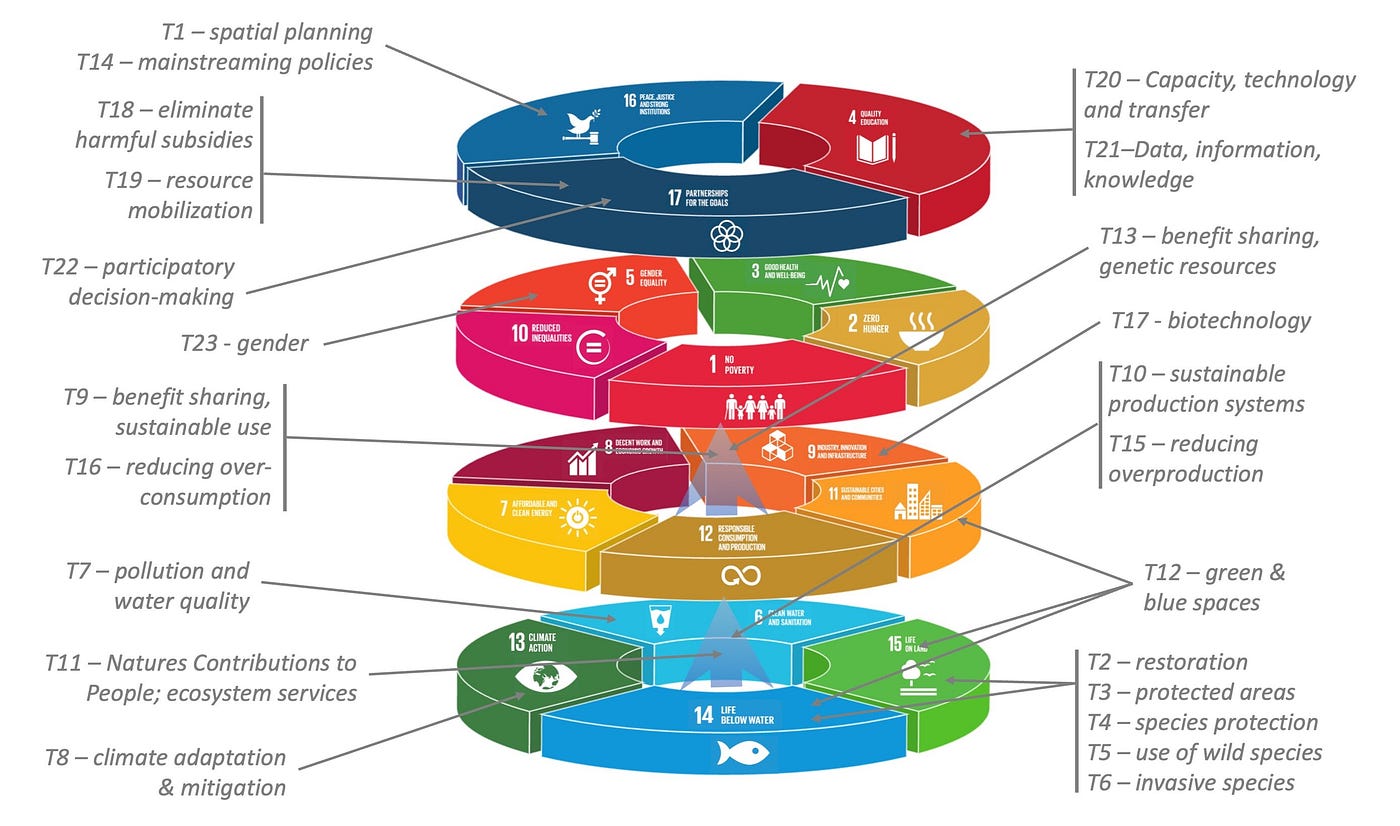
The 23 targets of Kunming-Montreal Global Biodiversity Framework (KMGBF) across the Sustainable Development Goals. Credit: Future Earth
Based on the response from 344 respondents, this project identified 379 biodiversity-related projects in 10 ASEAN Member States, showcasing the impact at local and regional levels. Notably, all 379 projects were found to be aligned with KMGBF targets, highlighting the significant role of youth in driving the efforts of biodiversity conservation. These findings also emphasized the importance of integrating youth efforts, especially in biodiversity policymaking, to ensure inclusivity, effectiveness, and sustainability.
Nadia Putri Rachma, Indonesian delegate, presenting the documentation of ASEAN youth contributions to global goals on CBD COP16, Cali, Colombia. Credit: Nadia Putri
Nadia Putri Rachma, the regional chapter coordinator of GYBN Southeast Asia and ASEAN Youth Biodiversity Leader (AYBL) who led the regional coordination for the mapping project, added:
“This mapping process is essential because it highlights and prioritises youth contributions, which are often overlooked. Since the Kunming-Montreal Global Biodiversity Framework was first adopted in 2022, this study is the first of its kind. ASEAN is currently setting an example for youth globally by demonstrating how similar initiatives can be replicated worldwide. I am so grateful for ten amazing young people who are working as their countries’ representatives who have been involved in this project. It helps them to understand the youth movement in their country and it helps me to get a sense of how ASEAN youth are doing.”
A Snapshot of Indonesia at CBD COP16
Indonesia, a biodiversity hotspot hosting some of the world’s richest ecosystems, brought significant priorities to COP16. Among these important agendas, Indonesia main focus were advocating for enhanced resource mobilization to support biodiversity efforts, emphasizing the importance of Article 8(j) to safeguard the knowledge and rights of Indigenous Peoples and Local Communities (IPLCs), and contributing to the development of a robust monitoring framework to track global biodiversity targets.
During the last day of the COP16, Indonesia finally agreed to the formation of the Subsidiary Body on Article 8(j), expressing a strong commitment to support the recognition and integral contribution of the IPLCs in all documents developed under the CBD.
Beyond formal negotiations, Indonesia’s delegations are actively engaged with youth at COP16, especially with several Indonesian youth delegates, representing the Global Youth Biodiversity Network (GYBN) Indonesia and Southeast Asia. These relationship build shown by the presence and participated in bilateral discussions, consultations, and side events with policymakers, emphasizing the need for stronger youth inclusion in biodiversity decision-making.
The Indonesian delegation also met with youth representatives to discuss how their grassroots conservation initiatives and policy recommendations could align with national biodiversity strategies, demonstrating a commitment to bridging intergenerational dialogues.
As the Chapter Co-coordinator of GYBN Indonesia, Nadia said:
“I have known our national focal points since we established the Indonesia chapter in 2020. It is a great opportunity to reconnect and discuss the importance of youth in a bigger space such as COP16. Young people often face the same challenges in conservation, and having a strong support from our national focal point is crucial in keeping us engaged and motivated.”
The Role of Youth in Indonesia’s Biodiversity Agenda
Youth are increasingly recognized as vital stakeholders in conservation and policy, particularly in a country like Indonesia, where over half the population is under 30. Their ability to blend traditional ecological knowledge with modern technology and innovation makes them uniquely positioned to tackle biodiversity challenges.
As Indonesia strives to achieve its Indonesia 2045 Vision — a blueprint for a prosperous, inclusive, and sustainable nation — the alignment with biodiversity goals is clear. Protecting ecosystems, promoting sustainable development, and ensuring resource equity are all critical components of this long-term vision, and youth will play a central role in realizing these objectives.
Within this landscape, the role of Indonesian delegates at COP16 was crucial, particularly in amplifying youth participation. During the ASEAN side event at COP16, Nadia represented Young Biodiversity Leaders and the Regional and National Chapter Co-coordinator for both GYBN Southeast Asia and Indonesia, presented the findings and recommendations of the mapping project.
The mapping project was a critical tool to bridge gaps between local actions and national policy priorities. It documented the diverse activities of youth networks, such as raising awareness about biodiversity issues, supporting the protection of Indigenous knowledge, and facilitating grassroots conservation efforts. This initiative involved youth consultants from each ASEAN country in identifying how young people are actively shaping national biodiversity strategies, such as their National Biodiversity Strategic and Action Plan (NBSAP) and aligning them with international frameworks like the KMGBF.
This project provided critical insights into how young people contribute to biodiversity conservation by identifying gaps and opportunities, it highlights that youth-led projects within ASEAN are aligned to the KMGBF and it offered policymakers concrete recommendations on strengthening youth involvement in implementing the framework.
Furthermore, it outlined how youth organizations like GYBN Indonesia and youth programs like the AYBP align their initiatives with broader biodiversity goals, such as resource mobilization and Article 8(j) describes what this is about. These insights informed decision-makers and inspired other youth delegates and organizations to adopt similar documentation practices.
A significant impact of the mapping project was it gave a new — but often overlooked — perceptions than young people has been doing diverse spectrum of projects to protect their biodiversity. Nadia was able to presented the result and recommendation of the mapping to many relevant stakeholders, including the Indonesian National Focal Points (NFPs) and other ASEAN delegates.
By showcasing tangible evidence of youth contributions, the delegates fostered trust and credibility, demonstrating that young people can be active partners in biodiversity governance. This effort resonated with other youth organizations, encouraging them to prioritize structured and documented approaches to advocacy and project outcomes.
Despite its success, the mapping project also revealed the challenges of documenting and tracking youth-led activities effectively.
Many youth initiatives lack the resources or capacity for systematic monitoring and reporting, which limits their visibility and potential impact.
Reflecting on this, the youth delegates recognized the need for better tools and training to enhance their capacity for policy engagement. Moving forward, they aim to refine the mapping process, ensure consistent follow-up, and use the insights gained to advocate for more inclusive and accessible governance frameworks.
Leveraging COP16 Outcomes for Indonesia’s Biodiversity Goals
Nadia’s experience as a youth delegate at COP16 highlighted the paradox of biodiversity negotiations — while all parties share the goal of protecting nature, discussions often feel ego-driven rather than communal. Observing the negotiations was overwhelming as she grappled with the contradictions within the system.
According to Nadia:
“It should feel communal because biodiversity is inherently communal. Every country has good intentions: safeguarding its natural resources and ensuring the well-being of its people. Everyone’s agenda seems to come from a good place. We all recognize the system’s complexity, its brokenness and corruption. The system is very humane. We know we need new approaches to fix it, yet we still enable the broken system. This leads me to wonder: Who are we truly advocating for? Are we fully present and conscious in making decisions meant to benefit humanity — and if so, which humans?”
Amid these reflections, Nadia found hope in Indonesian beliefs such as Gotong Royong (communal collaboration), which emerged as a guiding principle for youth solidarity. This collective spirit was evident in their collaborative presentations and mutual support, which amplified the impact of their advocacy. By connecting biodiversity goals to the Indonesia 2045 Vision, they aim to inspire a new generation of leaders committed to sustainability and equity.
Nadia, GYBN Southeast Asia Co-coordinator, presenting regional report on ASEAN event at CBD COP16. Credit: Nadia Putri
The reflections from COP16 highlight the significant strides made by Indonesian youth in biodiversity governance, yet they also underscore the need for continued growth. Through collaborative initiatives like the mapping project, fostering trust with stakeholders, and embracing inclusive cultural values, these young leaders are paving the way for a future where biodiversity thrives alongside human development. Their journey at COP16 serves as a powerful reminder of the transformative potential of youth in shaping a sustainable and equitable world.
Get to know Nadia!
Nadia Putri Rachma Persada, Southeast Asia Regional Co-coordinator of the Global Youth Biodiversity Network and BEKAL Pemimpin Alumni Liaison Officer in United in Diversity.
Nadia Putri Rachma Persada, Co-coordinator of GYBN Southeast Asia and GYBN Indonesia
Over the past eight years, she has been working on engaging different stakeholders and her specialty is in developing meaningful and transformative change within communitites and structures. Her toolkit includes specialised trainings to invoke change through approaches such as systems thinking, iceberg models, and Theory U (which is an ongoing concept that is still being developed with Massachusetts Institute of Technology). These tools facilitate a multistakeholder and holistic engagements that are proven to have sustained results in the Southeast Asia (SEA) regional context.
Her efforts have contributed towards environmental development in over ten countries, including leading and representing studies on SEA youth environmental engagements in the Conference of Parties (COP16) in Colombia, and facilitating trainings during the International Youth Conference on Biodiversity (IYCB) in Japan.
DISCLAIMER: The views and opinions expressed in this article are those of the author and are not intended to represent the official position or opinion of the ACB, KfW, the ASEAN Member States, or the ASEAN Secretariat.
Reviewed by Cita Ramadhanti
메타데이터
- post_id
- b991b5a6fb22
- slug
- youth-and-systems-understanding-and-shaping-the-future-of-biodiversity-in-asean-b991b5a6fb22
- url
- https://medium.com/@gybn-id/youth-and-systems-understanding-and-shaping-the-future-of-biodiversity-in-asean-b991b5a6fb22
- canonical_url
- https://medium.com/@gybn-id/youth-and-systems-understanding-and-shaping-the-future-of-biodiversity-in-asean-b991b5a6fb22
- author_url
- https://medium.com/@gybn-id
- status
- ok
- fetched_at
- 2026-07-20 19:09:02