Understanding K-Nearest Neighbors (KNN):My Beginner-Friendly Explanation
Today I learned how the K-Nearest Neighbors (KNN) algorithm works, and this is my simple explanation of it from a beginner’s perspective…
Understanding K-Nearest Neighbors (KNN):My Beginner-Friendly Explanation
Today I learned how the K-Nearest Neighbors (KNN) algorithm works, and this is my simple explanation of it from a beginner’s perspective. KNN is one of the easiest machine learning algorithms to understand because it makes predictions purely based on distance — basically, “who is closest to the test point.”
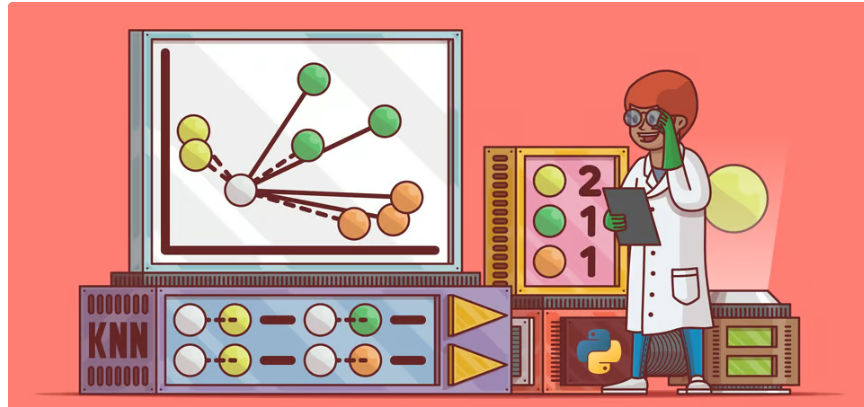
Let me walk you through everything I learned step by step.
What Is KNN?
KNN (K-Nearest Neighbors) is a supervised machine learning algorithm used mainly for:
- Classification (predicting a category)
- Regression (predicting numbers)
The idea is simple:
👉 When you give a new data point, KNN looks at the K closest points in the training set. 👉 It checks their labels. 👉 The most common label becomes the prediction.
No training phase. No model training. Just distance + neighbors + voting.
That’s why KNN is sometimes called a lazy learning algorithm.

Step 1: Importing Required Libraries

IMPORTING LIBRARY FILES
- NumPy → for numerical calculations
- Counter → to count votes from neighbors
This is all I needed to build KNN .

Step 2: Creating the Distance Function

This function calculates the Euclidean Distance (straight-line distance). I learned that “nearest” simply means:
✔ The smallest distance ✔ The closest point
Step 3: Writing the KNN Prediction Function

Here’s what happens:
✔ Find distance: Loop through all training points and calculate how far each one is from the test point.
✔ Sort : Sort all points so the closest ones come first.
✔ Select top K neighbors : Pick the first K labels — these belong to the nearest neighbors.
✔ Voting: Whichever label appears the most wins.
This gives the final prediction.
Step 4: Preparing Data

Here:
- The first three points belong to class A
- The last two belong to class B
- I want to predict the label for
[4,5]
Step 5: Final Prediction

OUTPUT: A
The three nearest neighbors of
[4,5]all belong to Class A, so KNN predicts A.
This is exactly how KNN works.
Conclusion :
Learning KNN gave me a clear idea of how distance-based machine learning works. The algorithm is incredibly easy to understand:
- Pick a value for K
- Find the closest K neighbors
- Let them vote
- That becomes the prediction
메타데이터
- post_id
- b9bb3ec26858
- slug
- understanding-k-nearest-neighbors-knn-my-beginner-friendly-explanation-b9bb3ec26858
- url
- https://medium.com/@6606775/understanding-k-nearest-neighbors-knn-my-beginner-friendly-explanation-b9bb3ec26858
- canonical_url
- https://medium.com/@6606775/understanding-k-nearest-neighbors-knn-my-beginner-friendly-explanation-b9bb3ec26858
- author_url
- https://medium.com/@6606775
- status
- ok
- fetched_at
- 2026-06-12 18:14:10