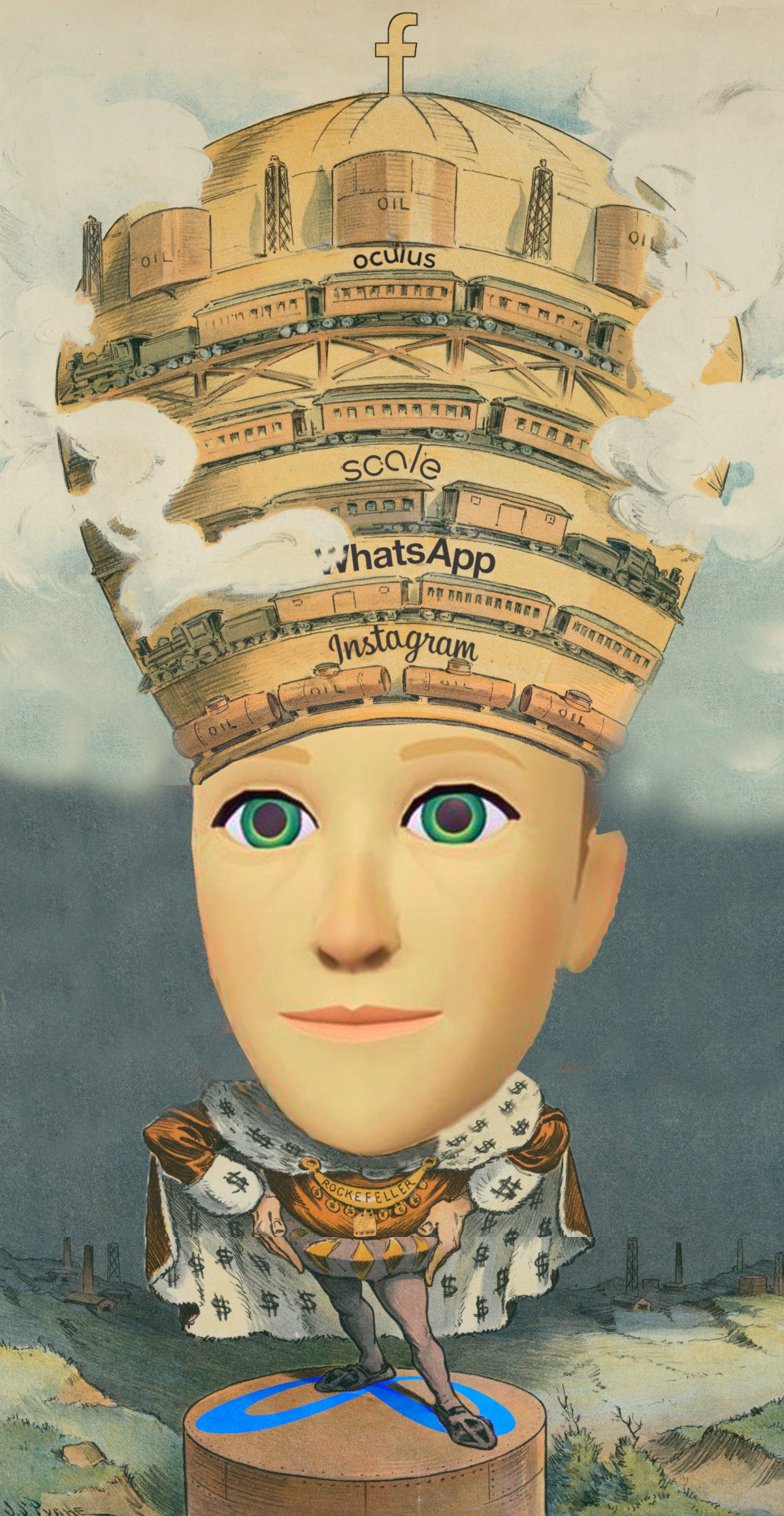
Demonopolizing the Internet with Interoperability
How to shift power away from big tech and back to communities and individuals
Demonopolizing the Internet with Interoperability
How to shift power away from big tech and back to communities and individuals

The Communications of the Association for Computing Machinery has just published my editorial, “Competitive Compatibility: Let’s Fix the Internet, Not the Tech Giants,” explaining how interoperability was once an engine for competition and user empowerment — and how that ended.
https://cacm.acm.org/magazines/2021/10/255710-competitive-compatibility/fulltext
As the title suggests, regulators are fed up with Big Tech’s abuses, but they’re not sure what to do about it. One approach is to “fix the companies” — like forcing Facebook to fight “disinformation” or making Google filter all user content for suspected copyright violations.
The problem with this approach is that it’s not clear whether the tech companies can solve these problems (for example, no copyright filter can distinguish between permitted uses like parody or commentary and infringing ones).
A rule that requires Big Tech to throw everything at unsolvable problems will make the cost of entry into the tech sector so expensive that Big Tech will get to rule unchallenged, forever. And the problems still won’t get solved.
There’s another approach, though — rather than fixing tech companies, we can fix the internet. We can empower communities and individuals to escape monopoly platforms, through interoperability.
If you don’t like how FB moderates its platform, interop would let you leave — and still stay connected to the family, community and customers you leave behind.
My article sets out a taxonomy of interoperability:
- Cooperative: When you interoperate through an API or a standard (like web browsers and servers)
- Indifferent: When a company takes no steps to help or block interop (like when you plug a USB adapter into a car lighter)
- Adversarial: Interop against the wishes of the interoper-ee, overcoming whatever defenses they put up to prevent interop. This has a long and honorable tradition — Apple reverse-engineering Microsoft Office for Iwork, say.
That adversarial interoperability (we call it “competitive compatibility” or comcom at EFF) is the stick to standardization’s carrot.
https://www.eff.org/deeplinks/2019/10/adversarial-interoperability
Dominant companies may not like having third parties plug into their stuff to give their customers more freedom, but if it is going to happen, they’d much prefer a managed system of standards to techno-guerrilla warfare with reverse-engineers, botmasters and scrapers.
Unfortunately, the rise of monopoly tech platforms has concentrated power in the hands of a small number of execs whose companies have near-infinite cash to spend on lobbying against adversarial interoperability.
https://www.eff.org/deeplinks/2021/08/starve-beast-monopoly-power-and-political-corruption
The Big Tech cartel’s members all owe their existence to comcom, but like the pirate who becomes an admiral, they are all committed to preventing upstarts from doing unto them as they did unto others when they were new on the scene.
The problem with Big Tech isn’t just that they’re wildly imperfect — it’s that they’re wildly imperfect and they’ve rigged the system to make it painful for you to go somewhere better. Interop lowers the “switching costs” that hold you hostage.
https://www.eff.org/deeplinks/2021/08/facebooks-secret-war-switching-costs
Fixing the tech companies won’t work. The problem isn’t just that Mark Zuckerberg is unfit to be the unelected, perpetual lifestyle czar of 3 billion people — it’s that no one should have that job.
That’s why, in addition to all the antitrust remedies that trustbusters have wielded against abusive monopolists for more than a century, we need modern tools — like interoperability. Bills like the ACCESS Act will get us part of the way:
https://www.eff.org/deeplinks/2021/06/new-access-act-good-start-heres-how-make-sure-it-delivers
But it’s not enough to mandate that Big Tech open up its interfaces — we also have to empower users and the toolsmiths who serve them to connect to dominant platforms in the ways that serve users, not corporate shareholders.
https://www.eff.org/wp/interoperability-and-privacy
Cory Doctorow (craphound.com) is a science fiction author, activist, and blogger. He has a podcast, a newsletter, a Twitter feed, a Mastodon feed, and a Tumblr feed. He was born in Canada, became a British citizen and now lives in Burbank, California. His latest nonfiction book is How to Destroy Surveillance Capitalism. His latest novel for adults is Attack Surface. His latest short story collection is Radicalized. His latest picture book is Poesy the Monster Slayer. His latest YA novel is Pirate Cinema. His latest graphic novel is In Real Life. His forthcoming books include The Shakedown (with Rebecca Giblin), a book about artistic labor market and excessive buyer power; Red Team Blues, a noir thriller about cryptocurrency, corruption and money-laundering (Tor, 2023); and The Lost Cause, a utopian post-GND novel about truth and reconciliation with white nationalist militias (Tor, 2023).
메타데이터
- post_id
- b9be6b851238
- slug
- demonopolizing-the-internet-with-interoperability-b9be6b851238
- url
- https://onezero.medium.com/demonopolizing-the-internet-with-interoperability-b9be6b851238
- canonical_url
- https://onezero.medium.com/demonopolizing-the-internet-with-interoperability-b9be6b851238
- author_url
- https://medium.com/@doctorow
- status
- ok
- fetched_at
- 2026-07-27 23:39:06