Why Salesforce’s Data-Driven Model Is a Smarter Choice for Campaign Influence Attribution
In the world of B2B marketing and sales, understanding how campaigns influence opportunities is essential for optimizing strategy and…
Why Salesforce’s Data-Driven Model Is a Smarter Choice for Campaign Influence Attribution
In the world of B2B marketing and sales, understanding how campaigns influence opportunities is essential for optimizing strategy and proving ROI. Salesforce offers multiple attribution models to help businesses track this influence — but not all models are created equal. The Data-Driven Model stands out for its ability to associate campaign engagement more comprehensively and automatically, especially in organizations where contact-to-opportunity associations are inconsistent.
🔁 Traditional Attribution Models: Depend on Contact Roles
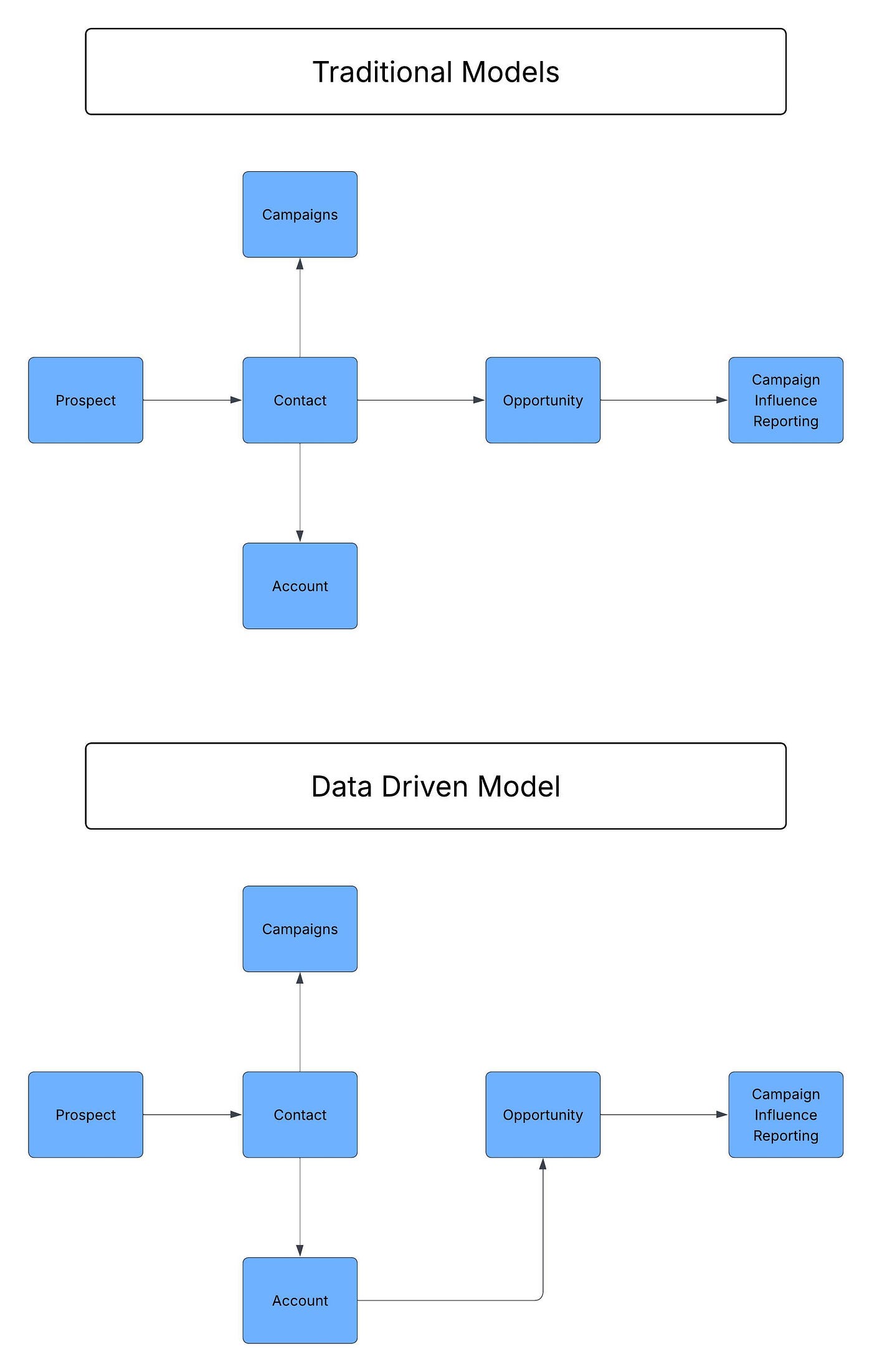
Salesforce’s traditional attribution models — First-Touch, Last-Touch, and Even Distribution — rely heavily on manual association of contact roles to opportunities. These models work by:
- Assigning influence based on the first or last campaign a contact engaged with.
- Distributing influence evenly across all campaigns a contact interacted with.
However, these models only function correctly if the contact is explicitly linked to the opportunity via a Contact Role. This means that if your team forgets to assign contact roles — or does so inconsistently — your attribution data will be incomplete or misleading.
🔍 Data-Driven Model: Uses Account-Level Contact Engagement
The Data-Driven Model takes a more intelligent and automated approach. Instead of relying solely on contact roles, it:
- Analyzes engagement from all contacts associated with the account tied to the opportunity.
- Automatically attributes influence based on actual engagement behavior, even if the contact was not manually linked to the opportunity.
This is especially valuable in organizations where contacts are routinely associated with accounts, but not always with individual opportunities — a common scenario in many B2B environments.
✅ When to Use Which Model

🧠 Why the Data-Driven Model Is More Efficient
In real-world CRM usage, many organizations struggle with maintaining perfect data hygiene. Contact roles are often overlooked or inconsistently applied. The Data-Driven Model compensates for this by leveraging account-level relationships, ensuring that valuable engagement data isn’t lost just because a contact wasn’t manually linked to an opportunity.
This makes the Data-Driven Model not only more accurate but also more scalable and resilient in dynamic sales environments.
📌 Conclusion
While traditional attribution models can be effective in well-disciplined CRM environments, the Data-Driven Model offers a more flexible and intelligent solution. By automatically associating campaign influence based on account-level contact engagement, it ensures that your marketing efforts are accurately reflected in your pipeline — even when contact role data is incomplete.
메타데이터
- post_id
- b9c1a47e27f3
- slug
- why-salesforces-data-driven-model-is-a-smarter-choice-for-campaign-influence-attribution-b9c1a47e27f3
- url
- https://medium.com/@louischinnam/why-salesforces-data-driven-model-is-a-smarter-choice-for-campaign-influence-attribution-b9c1a47e27f3
- canonical_url
- https://medium.com/@louischinnam/why-salesforces-data-driven-model-is-a-smarter-choice-for-campaign-influence-attribution-b9c1a47e27f3
- author_url
- https://medium.com/@louischinnam
- status
- ok
- fetched_at
- 2026-07-19 17:05:15



