Becoming bioregional
Bioregioning is the essential journey of this time.
Becoming bioregional
Bioregioning is the essential journey of this time.
For people who live in the same place where they grew up, it might be easier. And easier still if their ancestors lived in that same place and knew anything about living in relationship to that place. And if that place still has a sense of place, you’re off to a great start.
Unfortunately, many places have lost any sense place over the last century. The environment has been degraded. Farms and forests have turned into strip malls and suburbs. Traditional ecological knowledge has been wiped out.
“There is no there, there,” wrote Gertrude Stein about returning to her old home of Oakland, California decades after she grew up on a 10-acre farm in rural East Oakland. She wasn’t insulting the place, as people often think, but rather expressing solastalgia — a nostalgia or homesickness for a place that has changed over time, often due to environmental degradation.
For those who are like me, living on a different continent from my ancestors and on a different coast from where I grew up, and from a lineage of people who were continually persecuted and forced to move, the journey towards bioregionalism may be harder.
The good news is you can start the journey right where you are, right now, and there are many pathways in. It may start with an awareness of the local flora and fauna — the different native plants that grow at different times of year. It may begin with understanding the watershed that you live in. It may be part of a growing interest in the traditional people of the land where you live. Maybe you’re into growing food and come across permaculture and social permaculture. It could be forest bathing that opened the door for you!
Perhaps you’re on a spiritual quest for something real and deep. You’ve realized the limits of ungrounded personal growth. You want to be something more than a consumer on Planet Earth. Maybe you’re sick of social media and want to connect to real people in you’re community.
Or it could be that you’re looking for a bright spot amidst a feeling of hopelessness about the metacrisis we are experiencing around the world.
This is a call to spend less time on your screen with people and robots in faraway places and more time with real people in offline ways.
Bioregionalism is the pathway towards becoming a place-based person like all our ancestors once were. As described on BioFi, it’s a socio-political and ecological philosophy that argues for the organization of human societies based on natural ecological or biocultural regions, or “bioregions,” which is the natural, regenerative pattern of how humans live on Earth.
As Isabel Carlisle said an episode of The Great Simplification podcast titled The Future is Local: Bioregioning 101, “We were born out of the web of life on Earth, and bioregionalism is about coming back into a deeper recognition of that truth and living in harmony in reciprocity with all of the plants and animals and insects and water and rocks in the places where we live and that we are tasked with stewarding as humans on this planet.”
Naturally, Indigenous wisdom is some of the best information we have about how to live bioregionally, in a way that’s rooted in systems, patterns, and principles, and relationship to place. Bioregionalism is about have a sense of identity that’s rooted in a place.
Some people might have this based on where or how they grew up. I never felt that connected to where I grew up. I left at 17 and never looked back. It wasn’t until I moved to rural Southern Oregon that I really understood what it was like to live in a place. It’s more than feeling connected to nature or enjoying the local trails. It’s about feeling a sense of responsibility to that place — a place that scales from individual to family to neighborhood to community to ecoregion to the whole Planet and includes the more-than-human world. Being bioregional includes understanding and partaking in the topocosm, the world order of a particular place.

But the trails sure are great
Topocosm is one of my favorite words. I first came across it in a book on ritual while living in a cabin in the wilderness with a huge bookshelf full of books on herbalism, indigenous history, spirituality, and nature connection.
As Dolores LaChapelle, one of the early voice of deep ecology, writes, “The topocosm is the entire complex of any given locality conceived as a living organism — not just the human community but the total community — the plants, animals and soils of the place. The topocosm is not only the actual and present living community but also that continuous entity of which the present community is but the current manifestation.” There is a coherent narrative, already in existence or waiting to emerge, for each bioregion.
So how do you become bioregional? Gary Snyder said in most succinctly:
“Find your place on the planet. Dig in, and take responsibility from there,” he wrote. This quote has become a mantra for me over the past half decade.
It’s taken years and many deaths of outdated versions of myself as well as major life transformations for me to get to where I am on my own journey of becoming bioregional. And who knows how much further I have to go. Probably it continues until death, when your body is fully returned back to the Earth.
The place to begin this journey is the place you physically live, even if it doesn’t totally feel like your place. That part will sort itself out. The process of becoming bioregional is like any journey where there is a death of some part of you that no longer serves and a call towards something beyond that you may not yet understand.
It’s a personal and collective journey. It requires reorienting to your place and learning about it. For example: Where does your water come from? Can you name five native edible plants in your area? How long is the growing season where you live? Can you point north? (These questions were inspired by Daniel Christian Wahl’s article Bioregionalism — Living with a Sense of Place at the Appropriate Scale for Self-reliance, more here, but my permaculture teachers gave us a similar quiz).
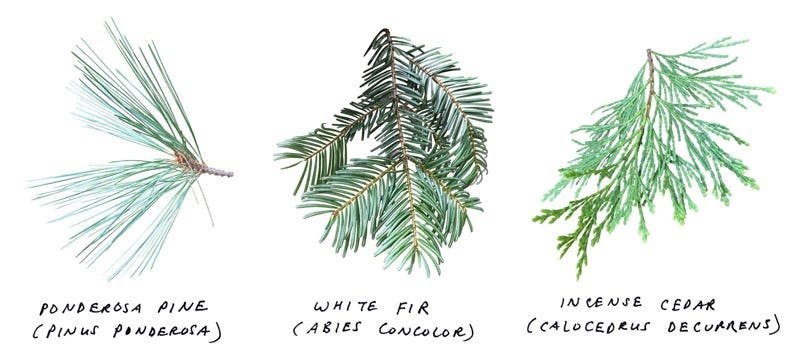
Images by Jenny Odell from her trip to the Cascade Siskiyou National Monument, where I lived for three years
But you can only get so far on your own. Eventually you need to find other people where you live and find local projects to get involved with (or start). Collaboration in creating and investing in local regenerative economic projects is a huge part of this process.
Since moving to Southern Oregon, I’ve only ever worked remotely — for tech companies and branding agencies that had less than nothing to do with the place I live. I’m hoping to change that now. I will write more about this shift soon.
I had my first in-person meeting ever in my town the week that Trump got inaugurated for a new nonprofit. For an icebreaker, we shared about what gave us hope during hard times. A few of us all shared that turning our work, efforts, and activism more local helped us feel better.
What I love about bioregionalism is that it makes sense. It’s a term for something I’ve been feeling for a long time. It’s an antidote to remote, impersonal work and too much time on the Internet. And it’s a pathway forward through these times which can feel daunting and overwhelming.
There is so much potential in this area and I’m looking forward to learning, connecting, living, and working more bioregionally.
I hope you’ll join me on this journey home.
메타데이터
- post_id
- b9dbbb07ff26
- slug
- becoming-bioregional-b9dbbb07ff26
- url
- https://medium.com/@juliaplevin/becoming-bioregional-b9dbbb07ff26
- canonical_url
- https://medium.com/@juliaplevin/becoming-bioregional-b9dbbb07ff26
- author_url
- https://medium.com/@juliaplevin
- status
- ok
- fetched_at
- 2026-07-13 18:04:26