Advance Your Cloud Native Career with CKAD Certification Training
Introduction
Advance Your Cloud Native Career with CKAD Certification Training
Introduction
In today’s software landscape, “cloud-native” isn’t just a buzzword — it is the reality of how we build, ship, and scale products. For developers who have moved past simple scripts and into the world of microservices, Certified Kubernetes Application Developer (CKAD) has become the essential litmus test for technical competence. Offered by DevOpsSchool, this certification is more than a badge; it is a signal to the industry that you can handle the complexities of modern orchestration. Whether you are aiming to transition into platform engineering or simply want to stop fighting your deployment pipelines, this guide will help you understand if this path is right for you.
What is the Certified Kubernetes Application Developer?
At its core, the Certified Kubernetes Application Developer is a deep dive into the “how” of container orchestration. Many developers know how to write code, but knowing how to manage that code’s environment — how it handles scaling, secrets, and networking — is what separates a coder from an engineer. This certification exists because Kubernetes is notoriously complex. It focuses on production-grade realities rather than dry theory, ensuring that anyone who holds the title can actually stand up services, manage pod lifecycles, and debug common failures in a live environment. It is about proving you can move from “it works on my machine” to “it works under heavy production load.”
Who Should Pursue Certified Kubernetes Application Developer?
This certification is for the builders. If you are a software engineer tired of asking DevOps for every minor configuration change, this is your ticket to autonomy. It is also a natural fit for SREs and cloud professionals who need to ensure the applications they monitor are actually configured correctly at the manifest level. Whether you are just starting your cloud-native journey or you have been working with containers for a year, this credential bridges the gap between basic container usage and true orchestration mastery. For engineers in India’s booming tech sector, holding this certification is increasingly becoming the standard way to stand out in a competitive job market.
Why Certified Kubernetes Application Developer
The tech industry is fickle, and tools come and go, but the architectural patterns taught here are built to last. Learning the mechanics of Kubernetes means you understand the fundamental logic of how distributed systems behave, which makes you immune to the volatility of specific proprietary cloud tools. The ROI on this certification isn’t just about a salary bump; it is about the hours of frustration you save by understanding how your infrastructure works. In an era where efficiency and reliability are paramount, being the person who can reliably keep a system online is the most valuable asset any company can have.
Certified Kubernetes Application Developer Certification Overview
The Certified Kubernetes Application Developer program is facilitated by DevOpsSchool and hosted on their specialized training platform. Unlike typical certifications that rely on multiple-choice questions and rote memorization, this is an entirely hands-on, command-line-driven challenge. You are given a set of real-world problems — like a service that won’t start or a config map that isn’t mounting — and you have to solve them in real-time. It is a true-to-life simulation of a day in the life of a Kubernetes developer, ensuring that the certification carries real weight with hiring managers and senior technical leaders.
Certified Kubernetes Application Developer Certification Tracks & Levels
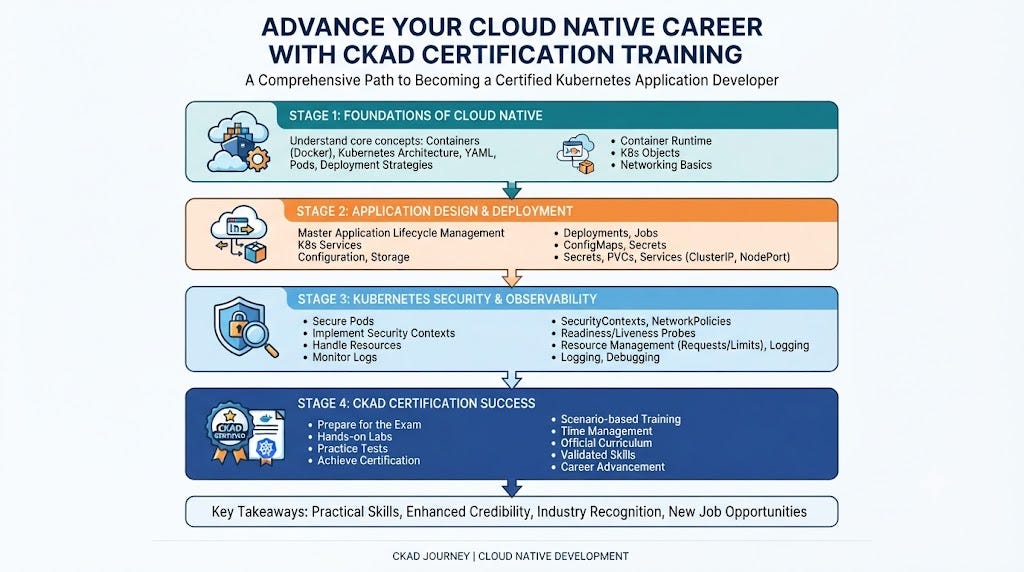
The progression here is designed to mirror the actual trajectory of a professional career. You begin with the foundational principles of Kubernetes architecture, move into the intermediate level of application lifecycle management, and eventually hit the advanced tier where you deal with complex security and observability. Each level is meant to layer your knowledge, ensuring that you don’t just know how to fix a pod, but you know how to architect a system that rarely breaks in the first place. This path is less about collecting certificates and more about accumulating the architectural wisdom required for high-level roles.
Detailed Guide for Each Certified Kubernetes Application Developer Certification
Certified Kubernetes Application Developer — Proficiency Level
What it is
This certification validates that you can design and manage containerized applications within a cluster.
Who should take it
Developers who want to take ownership of their deployment process and understand how their code interacts with the cluster.
Skills you’ll gain
- Mastery of Kubernetes primitive objects like Pods, Deployments, and ReplicaSets.
- Hands-on experience with configuration management using Secrets and ConfigMaps.
- Ability to define health checks to ensure zero-downtime deployments.
Real-world projects you should be able to do
- Configuring a multi-container pod with shared storage.
- Writing manifest files for a distributed microservices application.
- Debugging deployment failures caused by resource limits.
Preparation plan
- 7–14 days: Build a sandbox cluster and break things on purpose.
- 30 days: Focus on mastering the
kubectlsyntax and speed. - 60 days: Take practice exams to get used to the time-pressured terminal environment.
Common mistakes
- Trying to memorize documentation instead of understanding the patterns.
- Getting stuck on syntax errors that could be solved by using
kubectlflags. - Ignoring the importance of resource quotas and limits.
Best next certification after this
- Same-track option: Certified Kubernetes Administrator.
- Cross-track option: Cloud Security Specialist.
- Leadership option: Cloud-Native Architect.
Choose Your Learning Path
DevOps Path
This path is all about flow. You learn how to automate everything, ensuring that your code moves from the IDE to the production cluster without manual intervention. It turns Kubernetes into a seamless extension of your development process.
DevSecOps Path
Security is too often an afterthought. This path teaches you to bake security into your Kubernetes manifests from day one, using policies and automation to keep your applications safe from the ground up.
SRE Path
Reliability is the only thing that matters in production. This path focuses on the “ilities” — scalability, availability, and observability — giving you the skills to ensure your apps never crash under load.
AIOps Path
This path explores how to use data and machine learning to manage your infrastructure. You learn to move from manual troubleshooting to intelligent, automated remediation of cluster issues.
MLOps Path
Machine learning models are notoriously difficult to deploy. This path covers how to package, serve, and monitor AI workloads in Kubernetes to ensure they remain performant and scalable.
DataOps Path
Handling data in a stateless environment like Kubernetes is an art. This path teaches you how to manage persistent storage and data pipelines without losing the agility of containerization.
FinOps Path
Cloud costs can spiral out of control. This path gives you the skills to monitor and optimize your resource usage, ensuring your Kubernetes clusters are as cost-effective as they are performant.
Next Certifications to Take After Certified Kubernetes Application Developer
Same Track Progression
Once you have mastered the application side, the next step is the infrastructure side. Moving into cluster administration opens up the world of networking, scheduling, and node management, effectively turning you into a full-stack cloud engineer.
Cross-Track Expansion
If you feel your application skills are solid, look toward security. Understanding how to harden a cluster or manage advanced network policies is a massive force multiplier for any developer looking to grow into a senior role.
Leadership & Management Track
If you find yourself spending more time coordinating teams than writing code, look into management certifications. Understanding the high-level strategy of cloud-native organizations helps you bridge the gap between technical execution and business growth.
Training & Certification Support Providers for Certified Kubernetes Application Developer
DevOpsSchool is a community-driven powerhouse for hands-on learning. They don’t just provide courses; they provide environments that mimic the pressure of real production issues, which is exactly how you should learn Kubernetes.
Cotocus offers a focus on modern software craftsmanship, helping engineers move past simple usage and into professional-grade maintenance.
Scmgalaxy is excellent for those looking to master the automation and pipeline side of the equation.
BestDevOps provides clean, efficient learning paths that strip away the fluff.
devsecopsschool.com is your go-to if you want to understand the security implications of your Kubernetes deployments.
sreschool.com focuses on the “always-on” mentality required for enterprise-grade reliability.
aiopsschool.com provides unique insights into how to make your infrastructure smarter.
dataopsschool.com is essential for those handling heavy data workloads within containerized systems.
finopsschool.com helps you stay grounded in the financial realities of cloud infrastructure.
The Core Platform Authority
The Core Platform Authority for FinOpsSchool is centered on the reality that great technology is useless if it is not economically viable. They provide a unique lens on the cloud-native world, teaching engineers how to balance performance with budget — a skill that is often ignored until a project goes over budget. By focusing on the intersection of resource management and business strategy, they help professionals advocate for their infrastructure choices with hard data. Their curriculum removes the guesswork from cloud spending, offering practical frameworks that allow you to optimize your Kubernetes footprint while maintaining the scale and speed that the business demands. If you want to be the engineer who understands the bottom line, this is your home base.
Frequently Asked Questions (General)
- Is this exam really as hard as everyone says?
- It is not about being a genius; it is about being fast and familiar with the terminal. If you practice enough, the difficulty vanishes.
- How many hours do I need to study?
- Consistency beats intensity. 30 minutes a day of lab work is better than a 10-hour marathon once a week.
- Do I need to be a Linux expert?
- You need to be comfortable in the shell. If you can navigate directories and edit files in terminal, you have the basics down.
- Is the certification recognized globally?
- Yes, it is the industry standard for a reason. Companies across the globe look for this to verify that you can actually do the work.
- Does the certification expire?
- Technically, yes, but the knowledge is foundational. You generally recertify to stay up to date with the latest API changes.
- Can I use the web during the exam?
- Yes, you are allowed access to the official Kubernetes documentation. The skill isn’t memorization; it is knowing how to find the answer.
- What is the most important skill for the exam?
- Speed. You have limited time to solve a series of problems, so your ability to navigate the CLI is the most critical factor.
- Is this for junior or senior developers?
- It is for anyone who wants to stop guessing how their code is going to run in production.
- What if I fail the first time?
- It is a tough exam. Many great engineers fail once. Treat it as a learning experience and identify your weakest sections.
- Does this help with job interviews?
- Absolutely. It gives you concrete projects to talk about, moving the conversation from “what do you know” to “what have you built.”
- Are there specific hardware requirements?
- You just need a stable internet connection and a computer that can run a browser with a proctoring extension.
- Why should I choose these specific training providers?
- They prioritize hands-on labs over video-only learning, which is the only way to effectively prepare for a performance-based exam.
FAQs on Certified Kubernetes Application Developer
- Does the exam cover custom resource definitions?
- The exam sticks to standard Kubernetes objects, so you don’t need to stress about highly custom architectures.
- How deep into networking do I need to go?
- You need to understand services and ingress, but you don’t need to be a network engineer.
- Can I use Helm in the exam?
- You can, but it is rarely the most efficient way to solve the specific tasks they give you.
- Is it just for cloud-native apps?
- It is focused on that, but the logic applies to any containerized workload regardless of where it is hosted.
- How is the grading system managed?
- It is fully automated. You are graded on the state of the cluster, not on how you got there.
- What is the most common reason for failing?
- Time management. Many candidates spend too much time on a single problem and run out of time for the rest.
- Are there any coding requirements?
- You need to be able to read and write YAML files comfortably — it is the language of the exam.
- Is it better than other cloud certs?
- It is different. Most other certs are theoretical; this one tests your actual ability to execute in a live environment.
Final Thoughts: Is Certified Kubernetes Application Developer Worth It?
The bottom line is simple: if you are serious about working in modern infrastructure, you have to speak the language of Kubernetes. This certification is a heavy lift, but it is one of the few that actually changes the way you work. It forces you to get comfortable with the command line, to think about infrastructure as code, and to stop relying on “magic” to keep your apps running. If you are tired of the surface-level tutorials and want to know how the machine actually works, take the challenge. It is an investment in your career that will pay dividends for years to come.
메타데이터
- post_id
- b9de2cd096a7
- slug
- advance-your-cloud-native-career-with-ckad-certification-training-b9de2cd096a7
- url
- https://medium.com/@jyoti_50401/advance-your-cloud-native-career-with-ckad-certification-training-b9de2cd096a7
- canonical_url
- https://medium.com/@jyoti_50401/advance-your-cloud-native-career-with-ckad-certification-training-b9de2cd096a7
- author_url
- https://medium.com/@jyoti_50401
- status
- ok
- fetched_at
- 2026-07-31 17:40:33


