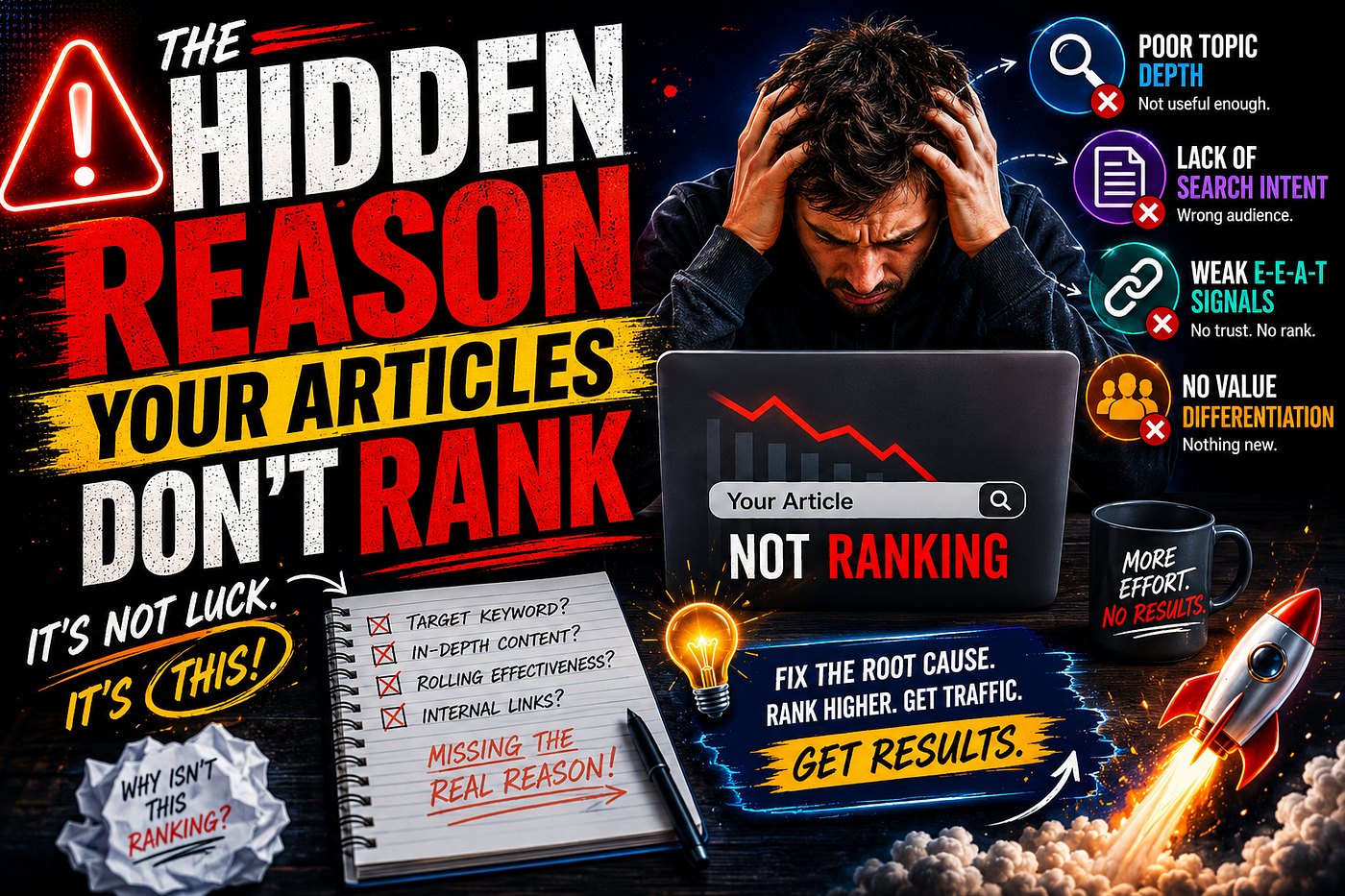
The Hidden Reason Your Articles Don’t Rank
A year ago, I thought I had figured out blogging.
The Hidden Reason Your Articles Don’t Rank
A year ago, I thought I had figured out blogging.
I was publishing articles consistently, targeting keywords, and following every SEO checklist I could find online.
Yet something frustrating kept happening. My articles weren’t ranking. Some posts would briefly appear on Google and then disappear. Others never got any visibility at all.
At first, I blamed competition. Then I blamed Google’s algorithm. Eventually, I discovered the real problem.
It wasn’t my keywords.
It wasn’t backlinks.
It wasn’t even technical SEO.
The hidden reason my articles weren’t ranking was much simpler:
I was writing content for search engines instead of people.
The SEO Trap Most Writers Fall Into
Many bloggers believe SEO is about inserting keywords in the right places.
So they focus on :
- Titles
- Headings
- Meta descriptions
- Keyword density
I did the same thing. My articles looked optimized. But they didn’t feel useful.
Google has become incredibly good at understanding whether content genuinely helps readers. Ranking today is less about optimization and more about solving problems.
Information Is Everywhere
Think about it.
Thousands of articles are published every day covering the same topics. Most of them repeat identical advice.
The internet doesn’t need another article that says the same thing as everyone else.
Google rewards content that adds:
- Real value
- First-hand experience
- Unique perspectives
- Practical solutions
That’s where many articles fail. They provide information, but they don’t provide insight.
Experience Creates Authority
One day, I rewrote an article that wasn’t performing.
Instead of explaining SEO theory, I shared
- A real mistake I had made
- The lesson I learned
- Practical examples
- Personal observations
A few weeks later, the article started gaining traffic.
That experience changed how I approached content creation. People connect with stories.
Search engines increasingly recognize content backed by real-world experience.
Search Intent Matters More Than Keywords
One mistake many bloggers make is targeting keywords without understanding why people search for them.
For example:
- “SEO tips” → Often searched by people looking for quick advice.
- “How to rank a new website” → Usually searched by people wanting a detailed solution.
The keyword might be similar. The intent is completely different.
When your content matches search intent, rankings become much easier to achieve.
Depth Beats Length
For years, bloggers believed longer articles automatically ranked higher. That’s no longer true.
A focused 800-word article that answers a question completely can outperform a 3,000-word article filled with unnecessary information.
Readers don’t want:
- More words
- More fluff
- More repetition
They want:
- Clear answers
- Actionable advice
- Fast solutions
Every section of your article should help the reader move closer to a solution.
The Importance of Content Updates
Many bloggers publish articles and never revisit them. I used to do that too. But search trends change. Industries evolve. New information appears constantly.
Updating older articles can:
- Improve rankings
- Increase traffic
- Boost relevance
- Enhance user experience
Fresh content signals relevance to both readers and search engines.
What Google Really Wants
Google’s goal is surprisingly simple.
It wants to deliver the most helpful answer to a user’s question.
If your article genuinely helps someone:
- Solve a problem
- Understand a concept
- Learn a new skill
- Make a better decision
You’re already moving in the right direction.
Key Takeaways
- Write for people first, search engines second.
- Focus on solving problems, not stuffing keywords.
- Share real experiences and unique insights.
- Match content with search intent.
- Prioritize depth and clarity over article length.
- Update older content regularly.
- Aim to be the most helpful answer available.
SEO is no longer about tricking algorithms.
It’s about serving people better than anyone else.
메타데이터
- post_id
- b9ecdfd09c21
- slug
- the-hidden-reason-your-articles-dont-rank-b9ecdfd09c21
- url
- https://medium.com/@mana_s/the-hidden-reason-your-articles-dont-rank-b9ecdfd09c21
- canonical_url
- https://medium.com/@mana_s/the-hidden-reason-your-articles-dont-rank-b9ecdfd09c21
- author_url
- https://medium.com/@mana_s
- status
- ok
- fetched_at
- 2026-06-11 15:16:29