GEO Is the Strategy Every CEO Must Understand
Discover why GEO is replacing SEO and why every CEO must understand generative engine visibility to stay competitive in the AI-driven…
GEO Is the Strategy Every CEO Must Understand
Discover why GEO is replacing SEO and why every CEO must understand generative engine visibility to stay competitive in the AI-driven market.
The shift from traditional SEO to Generative Engine Optimization (GEO) marks one of the most significant transitions in digital strategy since the rise of search itself. Instead of ranking webpages on Google, brands now compete for visibility inside AI-generated answers produced by engines like ChatGPT, Gemini, Claude, and Perplexity. This is no longer a search-driven internet — it’s a generation-driven internet, where information is synthesized, contextualized, and returned instantly without the user ever clicking a link.
For CEOs and founders, this shift isn’t just tactical — it’s existential. The companies that adapt to GEO will own authority in the AI era. Those that don’t will become invisible.
Why Generative Engines Change the Rules of Visibility
**Generative AI engines** don’t rely on traditional keywords or backlinks. They operate on probabilistic reasoning, semantic relationships, and entity-level understanding. Instead of indexing pages, they learn from patterns and interpret context, combining content from millions of sources to produce a single, authoritative answer.
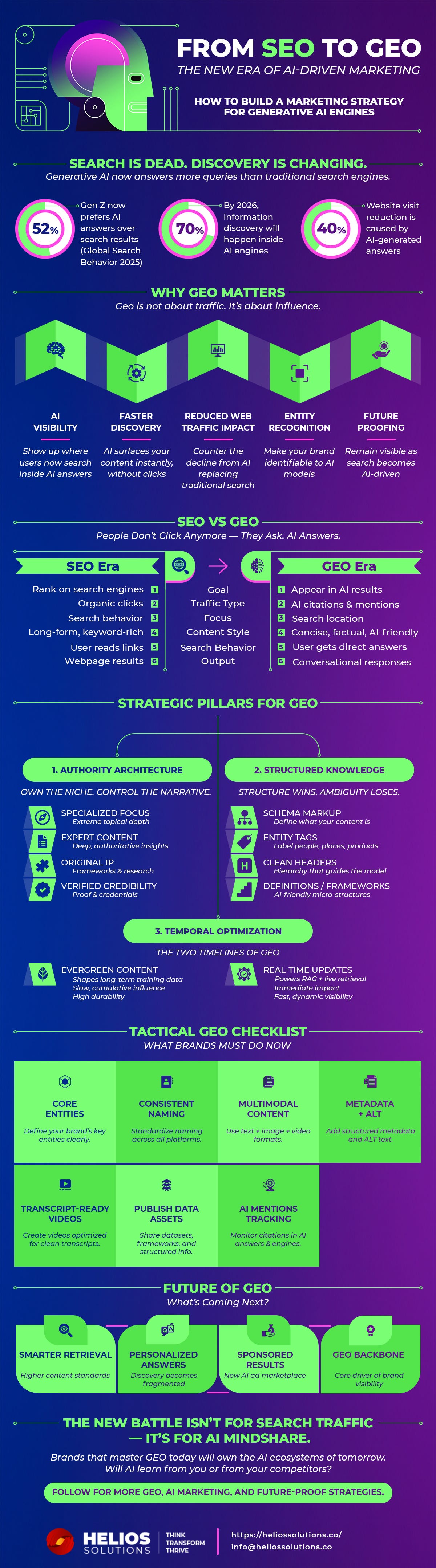
This means brands no longer compete for “rankings” — they compete for inclusion. AI engines decide which brands to cite, surface, or reference based on credibility, clarity, and domain authority at a machine-readable level. In GEO, visibility is defined not by search traffic but by how often AI models trust your content enough to weave it into their responses.
The New Pillars of GEO Strategy
Building GEO visibility begins with **understanding how LLMs interpret information**. Generative engines privilege structured, factual, trustworthy content that reinforces semantic meaning across sources. Traditional blogs stuffed with keywords won’t matter. Instead, what matters is entity strength — your brand’s fingerprint in the data ecosystem.
GEO requires content to be AI-trainable, meaning it must be built in formats that engines can extract, summarize, and contextualize easily. This shifts the focus from search optimization to knowledge optimization. Brands must architect their digital presence like a knowledge graph, reinforcing expertise through consistent language, verifiable claims, and cross-linked insights.
As models increasingly rely on **retrieval-augmented generation (RAG)**, companies that offer high-quality, first-party knowledge stand to gain a structural advantage. AI engines reward brands that contribute expert-level explanations, datasets, research papers, and semantic outputs that can be retrieved confidently.
How Companies Can Begin Implementing GEO Today
The transition from SEO to GEO begins with reframing content creation around clarity, context, and machine readability. Instead of publishing for humans and hoping search engines notice, leaders must publish for humans and models simultaneously. This includes shaping content into formats that engines love to cite: concise definitions, authoritative insights, direct explanations, and high-value thought leadership.
Companies should audit their existing content to identify gaps in semantic authority — places where their expertise is not represented clearly or consistently across the web. From there, they can rebuild content into deeper, AI-friendly formats such as long-form explainers, structured Q&A clusters, strategic insights, detailed methodologies, and transparent breakdowns.
Another powerful step is investing in brand evidence — publishing datasets, case studies, frameworks, and research-backed content. Generative engines cite sources that demonstrate expertise, not opinions. Building this foundation helps establish trust signals inside LLM ecosystems.
Finally, leaders must think in terms of retrieval clarity. AI engines rely on embeddings, vectors, and semantic proximity. The clearer your narrative and terminology, the easier it becomes for models to associate your brand with an expertise domain.
The Future: Generation Visibility Will Replace Search Visibility
As the world moves from search queries to conversational interactions, GEO will rapidly become the dominant strategy for brand visibility. Instead of fighting for page-one rankings, businesses will strive to become a trusted, authoritative voice inside AI-generated answers.
The advantage will go to companies that shift early, build semantic authority, and ensure their content becomes part of the knowledge fabric that generative engines rely on. GEO is not a trend — it is the new competitive frontier of the AI economy.
For CEOs and founders, the question is no longer “How do we rank?” but “How do we become the source AI trusts?”
메타데이터
- post_id
- b9fbd2007d8d
- slug
- geo-is-the-strategy-every-ceo-must-understand-b9fbd2007d8d
- url
- https://medium.com/@smiteshmakwana/geo-is-the-strategy-every-ceo-must-understand-b9fbd2007d8d
- canonical_url
- https://medium.com/@smiteshmakwana/geo-is-the-strategy-every-ceo-must-understand-b9fbd2007d8d
- author_url
- https://medium.com/@smiteshmakwana
- status
- ok
- fetched_at
- 2026-08-03 03:13:11