I built a database of banned books. What emerged was a pattern
A while ago, I started building something that felt relatively contained: a database of banned books. The idea itself was straightforward —…
I built a database of banned books. What emerged was a pattern
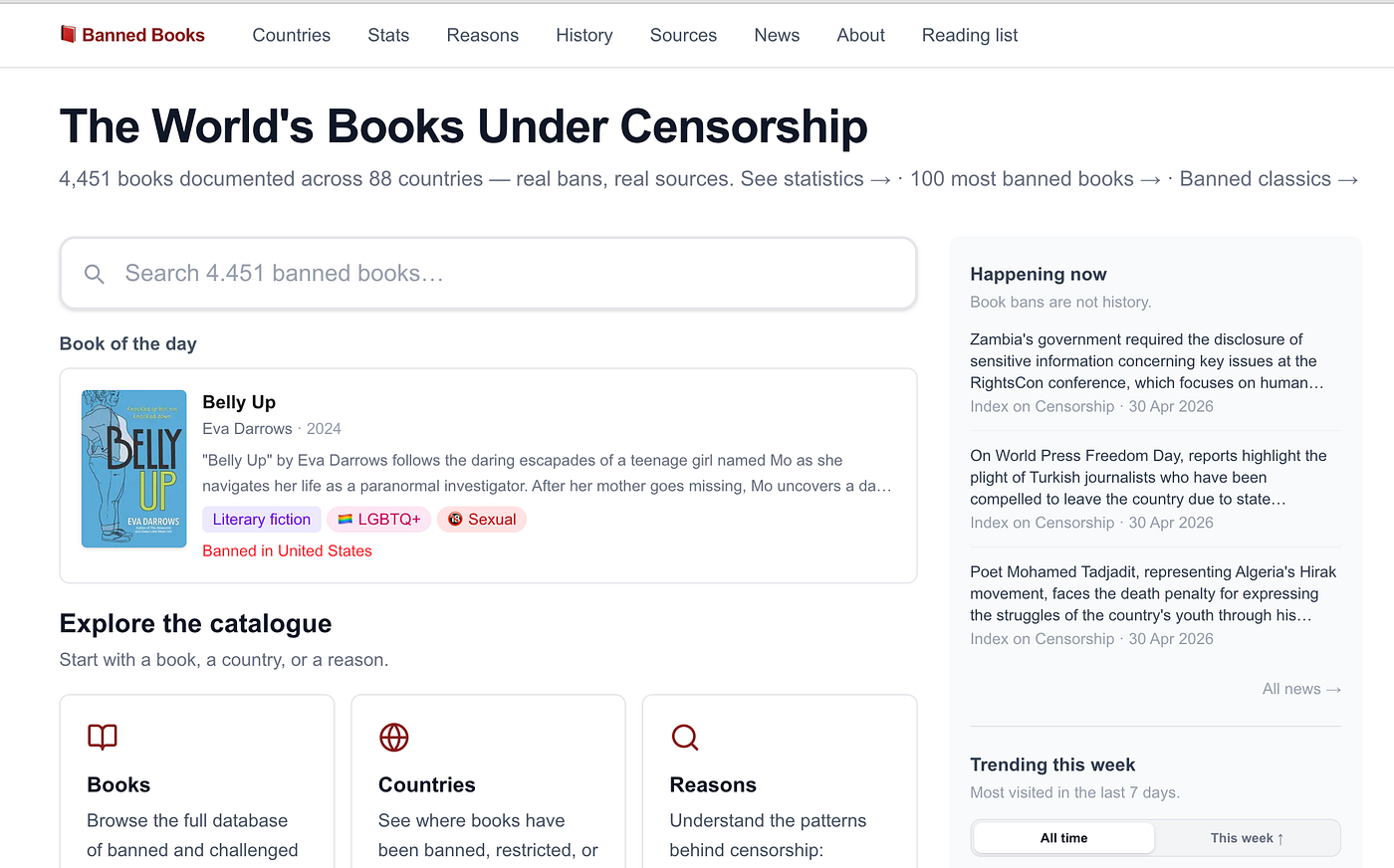
A while ago, I started building something that felt relatively contained: a database of banned books. The idea itself was straightforward — collect titles, add context, structure the data, and make it searchable. Something useful, perhaps niche, and honestly not intended to grow into much more than a well-organized side project.
It didn’t stay small for long.
The dataset now contains over 4,500 books, spread across dozens of countries and time periods, and what surprised me most is not just the scale, but the consistency in what emerges when you start looking at it as a whole rather than as individual cases.
What the data reveals when you stop looking at single cases
At first glance, book bans tend to feel like isolated events. A controversial title removed from a school here, a government restriction somewhere else, a debate that briefly flares up and then disappears again.
But once you start aggregating that data and looking at it structurally, something shifts.
You begin to see repetition, not in the books themselves, but in the reasoning behind them. Across very different countries and contexts, similar themes keep returning: political control, religious pressure, discomfort around sexuality and identity, or broader attempts to shape and control narratives.
What makes this particularly interesting is that these patterns rarely present themselves through large, visible actions. More often, they emerge through smaller, seemingly reasonable decisions — books being removed from curricula, not stocked by libraries, or quietly disappearing from distribution channels. Each decision on its own can be justified. Together, they start to form a direction.
Why I built banned-books.org
I didn’t start this project with a clear mission or a strong point to prove. It began more as an exploration — trying to understand how widespread book bans actually are and whether the common narrative that “this mainly happens elsewhere” holds up when you start collecting data across regions.
At the same time, there was a growing sense of discomfort. Not tied to one specific event, but to a broader shift in how we talk about knowledge, education, and access to information. There seems to be increasing acceptance of the idea that some information might need to be restricted, framed as protection, responsibility, or simply common sense.
Individually, those arguments can be reasonable. But when you start seeing them appear across different contexts, they begin to align in a way that is hard to ignore.
Building this database became a way to make that alignment visible.
From a list to something more structural
What started as a collection of titles quickly evolved into something more layered. Each entry connects multiple dimensions: where a book was restricted, when it happened, who initiated it, what kind of action was taken, and — crucially — why.
That structure allows you to move beyond anecdotes and start exploring relationships between events.
You can follow a single book across countries and see how its reception changes. You can look at a specific country and identify patterns over time. Or you can focus on reasons and see which themes are consistently targeted, regardless of geography.
At that point, it stops being just a list and becomes a way to understand how and why restrictions on knowledge take shape.
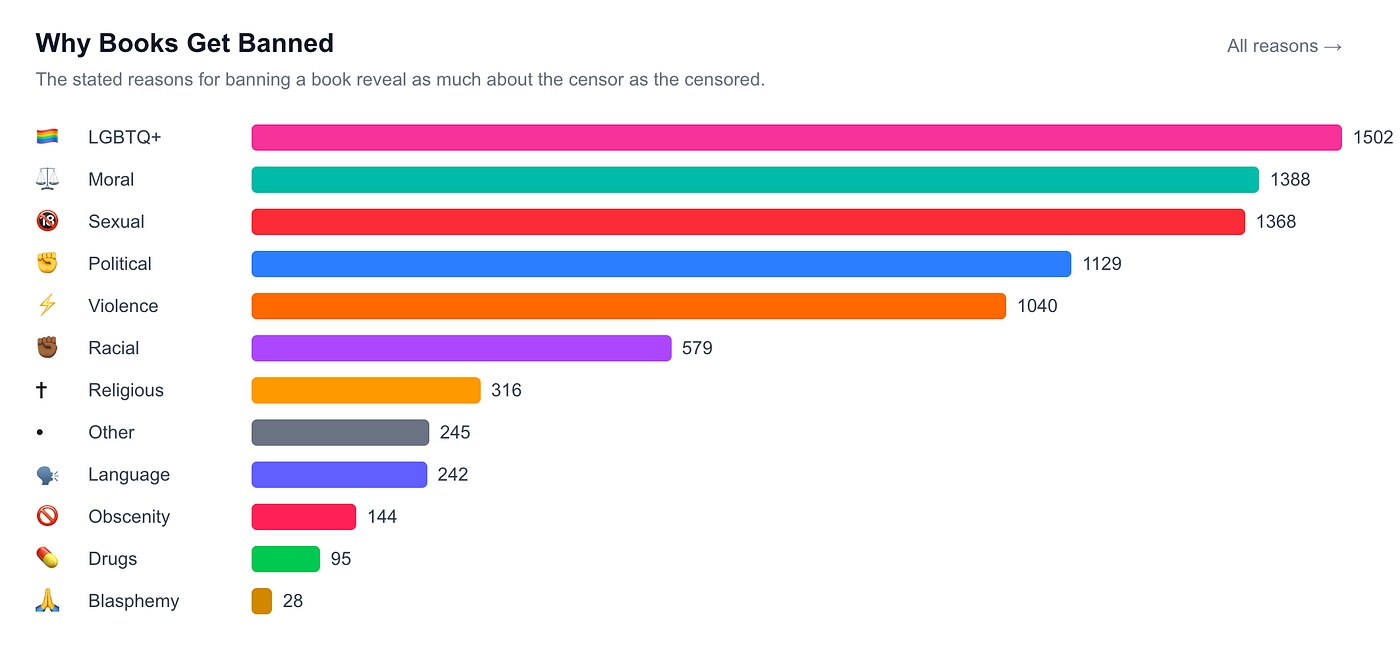
Ban reasons. (screenshot from banned-books.org)
Why this matters more than it seems
Banning books is rarely about a single title. It is about defining boundaries — what is acceptable to read, discuss, or even be exposed to. And those boundaries almost never shift overnight.
They move gradually, through a series of decisions that each seem reasonable in isolation, but collectively reshape access to knowledge.
What makes the current moment particularly interesting is not just that bans exist, but that the conversation around restricting information has become more normalized. We are increasingly comfortable debating which knowledge should be limited, and under what conditions, rather than questioning the premise itself.
This creates a tension that is often described as the Paradox of Tolerance — the idea that a society that is fully open and tolerant may eventually enable forces that seek to limit that openness.
There are no simple answers here. Some forms of content clearly cross boundaries, and discussions about responsibility and protection are necessary. But the line between protecting and restricting is not fixed, and once it starts shifting, it tends to do so gradually and unevenly.
The uncomfortable realization
One of the more striking insights from this project is how often these patterns appear in places we typically consider stable and free.
Not just in authoritarian contexts, but within democracies, school systems, and local communities. Sometimes driven by policy, sometimes by social pressure, and sometimes by more subtle forms of risk avoidance.
That makes the issue harder to distance from. It is not something that only happens “somewhere else,” but something that emerges in different forms across many environments, including those that define themselves by openness.
What this project actually does
What this project does, at its core, is make something visible that is usually scattered, fragmented, and therefore easy to ignore. Once you start connecting the dots across countries, contexts, and motivations, it becomes much harder to treat these cases as isolated incidents or exceptions. They begin to form a structure, a direction even, and that shift — from incident to pattern — is exactly why I keep building.
Because without that perspective, it is almost impossible to have a meaningful conversation about what is actually happening.
Where this leaves us
I don’t think a database like this solves the problem. It doesn’t prevent bans, and it doesn’t resolve the underlying tension between openness and restriction. What it does offer is clarity.
And that matters, because once patterns become visible, they are harder to ignore, harder to simplify, and harder to dismiss as isolated cases.
For me, that is enough reason to keep working on it.
If you want to explore it yourself
Take a look at banned-books.org and explore the data from different angles. Not necessarily to agree or disagree, but to see how the patterns emerge when you step back from individual cases.
Chances are, it will raise more questions than answers.
And that is exactly where it becomes interesting.
메타데이터
- post_id
- ba0b279570e8
- slug
- i-built-a-database-of-banned-books-what-emerged-was-a-pattern-ba0b279570e8
- url
- https://medium.com/@LudoRaedts/i-built-a-database-of-banned-books-what-emerged-was-a-pattern-ba0b279570e8
- canonical_url
- https://medium.com/@LudoRaedts/i-built-a-database-of-banned-books-what-emerged-was-a-pattern-ba0b279570e8
- author_url
- https://medium.com/@LudoRaedts
- status
- ok
- fetched_at
- 2026-06-26 21:52:29