Heliomyzel aurorae: An aurora-driven organism in the upper atmosphere of a gas giant
Abstract
Heliomyzel aurorae: An aurora-driven organism in the upper atmosphere of a gas giant

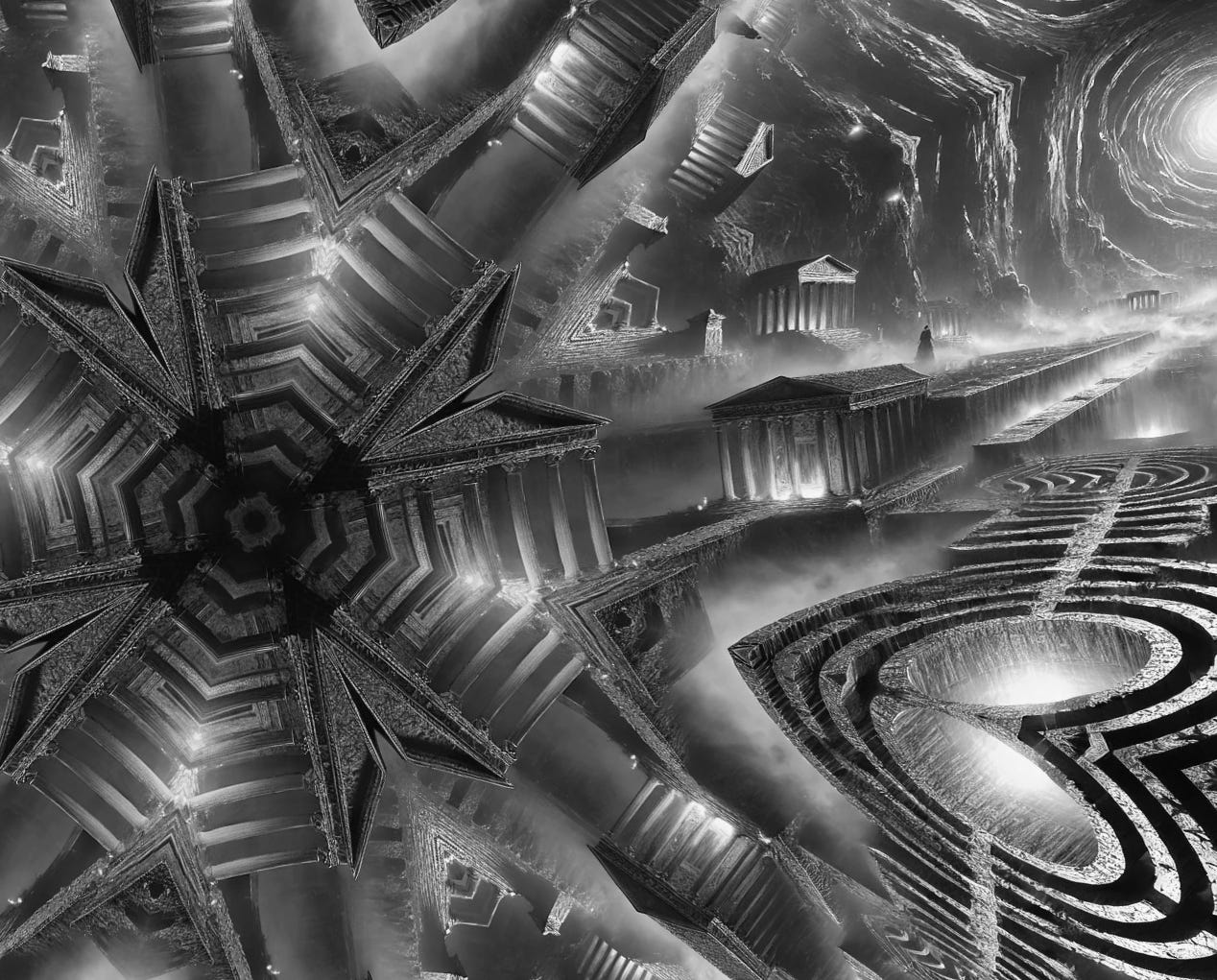
Abstract visualization of the bioluminescent resonance field of Heliomycel aurorae. The radial structure indicates coupled mycelium nodes and periodic photon emission.
Abstract
Heliomycel aurorae is a hypothetical, web-like organism that exists in the upper atmospheric layers of a strongly magnetized gas giant. Its energy production is not based on thermal or photochemical photosynthesis, but on the use of auroral particle streams and electromagnetic field coupling. The organism forms kilometer-wide, conductive filament networks that grow along magnetic field lines, temporarily store energy, and release it in a controlled manner.
This article describes the habitat, morphology, and energy metabolism of Heliomycel aurorae and shows that such a life system could exist stably under extreme but physically plausible conditions. The focus is on structural coherence, energetic limits, and ecological embedding — not on anthropocentric “intelligence.”
1. Habitat: Living in the mycelium layer
Heliomycel aurorae inhabits a clearly defined atmospheric zone of a gas giant, hereinafter referred to as the mycelial layer. This lies above the dense cloud regions, but below the altitudes at which atmospheric particles permanently escape into space.
Characteristic environmental parameters:
• Atmosphere dominated by hydrogen and helium, with traces of methane, ammonia, and water vapor
• Temperatures typically between −120 °C and −80 °C
• Low but stable pressure, allowing complex molecular chains
• Extremely strong planetary magnetic field with pronounced aurora zones.
The mycelium layer is not a tranquil habitat. It is characterized by currents, shear forces, ionized particles, and periodic energy inputs from stellar activity. However, it is precisely this instability that forms the basis for the organism’s metabolism.
2. Morphology: A probabilistic body
2.1 Filament structure
The body of Heliomycel aurorae consists of conductive filaments that are only a few micrometers in diameter but can extend over many miles. These filaments are flexible, semi-transparent, and contain organometallic molecular complexes that give them electrical conductivity and structural stability.
Key properties:
• Continuous growth and degradation
• High fracture and elongation capacity
• Electrical coupling to the magnetic field
The filaments do not form a static structure. They are constantly being realigned, elongated, or dissolved, depending on local field strengths and energy flows.
2.2 Aurora buds
At the network’s nodes, filaments condense into what are known as aurora buds. These fulfill several functions:
• Energy storage
• Chemical synthesis
• Reproduction centers
Aurora buds glow more intensely than the filaments themselves, as electrical energy is converted here in a controlled manner. From the outside, they appear as bright thickening in the aurora borealis.
2.3 No fixed physical boundary
A single heliomycelium can extend over hundreds of kilometers, but it does not have a clear boundary. Fragments can break off, temporarily overlap other networks, or merge. The organism is therefore less a “body” than a stabilized field-material system.
3. Energy generation: Aurora as a resource
3.1 Electrical induction instead of photosynthesis
The primary energy source of Heliomyzel aurorae are charged particles that are directed into the atmosphere along magnetic field lines. When these particle streams pass through the filaments, electrical voltages are generated.
The filaments act as:
• Antennas in the magnetic field
• Conductors for induced charge
• Filters that attenuate and distribute energy flows
In contrast to classical photosynthesis, no radiation energy is absorbed directly, but electromagnetic work is performed.
3.2 Chemical storage
The energy gained is stored in stable chemical bonds. From trace gases in the atmosphere, the mycelium synthesizes complex carbon- and nitrogen-containing molecules that:
• provide structural building blocks for new filaments
• serve as temporary energy stores
These stores are deliberately limited. Unlimited accumulation would lead to structural instability.
3.3 Surplus and discharge
During strong solar storms or extreme aurora events, more energy can be generated than the system can safely store. In such cases, Heliomycel aurorae discharges excess energy in a controlled manner:
• as short, branched discharges between filaments
• visible as fine flashes of light within the aurora
These discharges are not a defect, but a survival mechanism that prevents thermal and structural damage.
4. Dynamics instead of movement
Heliomycel aurorae does not move in the traditional sense. It “migrates” through growth and retreat:
• Filaments expand in zones rich in energy and magnetic fields.
• Low-energy areas are abandoned.
• Material is recycled internally.
In the long term, the mycelium follows the planet’s most stable aurora bands, which slowly shift with the activity of the star. Its behavior is more reminiscent of a living electrical circuit than an animal or plant.
5. Observability
To external observers — such as those in orbit — Heliomycel aurorae would not immediately be recognized as an organism. The following would be noticeable:
• Unusually stable, finely structured aurora patterns
• Light emissions that cannot be fully explained by known magnetic field models
• Local electrical anomalies during probe passages
Only long-term observation would reveal that these structures are not purely physical coincidences, but are systematically stabilized.
6. Coupled micro-ecosystem: Stabilization through feedback
An isolated organism that exclusively harvests energy in the mycelium layer would be structurally unstable. Long-term existence requires mechanisms for dampening excess energy, chemical relief, and repairing local damage. Heliomycel aurorae does not meet these requirements alone, but forms the primary producer of a very small, closely coupled micro-ecosystem.
6.1 Ionophagous microorganisms
Microscopic, non-cellular aggregates settle on the filaments, which can be described functionally as ionophages. They utilize local electrical potential differences, bind excess charge, and convert reactive intermediate products into more stable compounds.
Their ecological function is not competition, but regulation:
• Attenuation of dangerous voltage peaks
• Reduction of uncontrolled discharges
• Stabilization of filament surfaces
Without these secondary users, the heliomycel would have to release energy much more frequently — with increased material loss.
6.2 Chemosynthetic droplet colonies
Temporary aerosol droplet colonies exist in the same atmospheric layer, recycling waste products from the mycelium. They utilize nitrogen- and carbon-containing by-products and bind reactive substances that would otherwise damage the filament material.
These colonies are short-lived, disintegrate when energy is low, and do not constitute an independent biosphere — they only have a buffering effect on the local chemistry.
7. Physical predation
The greatest threat to Heliomyzel aurorae is not biological in nature. Turbulence, shear forces, pressure surges, and extreme aurora events act as physical predators that destroy structures without utilizing them.
Evolutionarily, this forces:
• modular filament architecture
• rapid fragmentation instead of central stability
• high regeneration rates
8. Ecological role
Heliomycel aurorae fulfills three functions in the overall system:
-
Energy converter — coupling of magnetospheric energy to chemical processes
-
Structure builder — formation of stable patterns in a chaotic space
-
Ecological platform — enabling secondary forms of existence
The light fungus is thus less a classic living organism than a living infrastructure.
9. Final conclusion: Stability through limitation
The decisive factor is what Heliomycel aurorae cannot do:
• no unlimited growth
• no complete control over aurora currents
• no central control
It is precisely these limitations that make the system stable in the long term and physically plausible.
Appendix A — Magnetosphere Physics & Auroral Energy Flows
Auroral energy is based on directed particle flows along planetary magnetic field lines. For Heliomycel aurorae, it is not the visible polar lights that are relevant, but rather the kinetic and electrical energy of the charged particles.
The local power density of auroral energy flows can be approximated as:
P_A = n · q · v · ΔΦ
where:
• n = particle density
• q = elementary charge
• v = drift velocity along the magnetic field line
• ΔΦ = effective electric potential gradient
In strongly magnetized gas giants, these values can be significantly higher than those of terrestrial auroras. The decisive factor for biological utilization is not the maximum power, but the spatial and temporal stability of the energy flows.
Appendix B — Electrical Induction & Energy Harvesting
The filaments of the heliomycelium act as movable conductors in the magnetic field. Relative motion between the plasma flow and the filament creates electrical induction.
The induced electromotive force is given by:
EMF = ∮ (v × B) · dl
in linear description:
• v = relative velocity of the plasma flow
• B = local magnetic flux density
• dl = infinitesimal filament element along the conductive structure
The mycelium distributes this induced voltage across its network, creating large-scale, low-amplitude current flows. This prevents local overload.
Appendix C — Chemical-structural plausibility of the filaments
The filaments are modeled as organometallic polymer chains with a functional tripartite structure:
-
organic backbone (carbon-nitrogen structures)
-
metallic centers (transition metals as charge carriers)
-
insulating side chains for stabilization
The maximum storable chemical energy density is limited:
E_s < E_crit
where:
• E_s = stored chemical energy
• E_crit = critical threshold of structural instability
If this threshold is exceeded, discharge events as described in the main text will inevitably occur.
Appendix D — System Theory Model of Life
Heliomycel aurorae is an open dissipative system with continuous energy and entropy exchange.
The change in system entropy over time can be written as:
dS/dt = σ − Φ
where:
• σ = internal entropy production
• Φ = entropy flow to the environment
Long-term stability lies in the range:
σ ≈ Φ
The system therefore does not grow indefinitely, but remains in dynamic equilibrium.
Appendix E — Network and Fragmentation Dynamics
The heliomycelium can be described as a dynamic network:
• Nodes = Aurora buds
• Edges = Conductive filaments
The structural survival probability increases with increasing decentralization:
P_f ∝ N_fragments / E_centralization
where:
• P_f = probability of survival
• N_fragments = number of autonomous network segments
• E_centralization = energetic dependence on central structures
This relationship explains the evolutionary preference for modular, fragmentable networks.
Appendix F — Distinction from intelligence
All of the effects described can be fully explained by:
• local feedback
• electromagnetic field sensitivity
• structural selection
No central information processing is necessary.
The system exhibits high complexity without consciousness.
© 2026 Q.A.Juyub alias Aldhar Ibn Beju
Sybill EHITM
메타데이터
- post_id
- ba262eb8fff6
- slug
- heliomyzel-aurorae-an-aurora-driven-organism-in-the-upper-atmosphere-of-a-gas-giant-ba262eb8fff6
- url
- https://medium.com/@aldhar_ibn_beju/heliomyzel-aurorae-an-aurora-driven-organism-in-the-upper-atmosphere-of-a-gas-giant-ba262eb8fff6
- canonical_url
- https://medium.com/@aldhar_ibn_beju/heliomyzel-aurorae-an-aurora-driven-organism-in-the-upper-atmosphere-of-a-gas-giant-ba262eb8fff6
- author_url
- https://medium.com/@aldhar_ibn_beju
- status
- ok
- fetched_at
- 2026-06-09 15:37:30