7 Strategic Steps to Plan a Successful RWA Token Development Project
Real-world asset tokenization has moved beyond small technical trials and entered serious discussions among banks, investment managers…
7 Strategic Steps to Plan a Successful RWA Token Development Project
Real-world asset tokenization has moved beyond small technical trials and entered serious discussions among banks, investment managers, property firms, commodity businesses, regulators, and financial technology companies. The concept involves representing legal or economic rights connected to an asset through digital tokens recorded on a distributed ledger. Depending on the structure, a token may represent ownership, a debt claim, income rights, fund units, beneficial interests, collateral rights, or access to a contractual payment.
The attraction is easy to understand. Real estate, private credit, infrastructure, commodities, intellectual property, investment funds, and other assets often involve slow settlement, fragmented records, high entry amounts, and several intermediaries. A carefully designed token arrangement may reduce reconciliation work, support fractional participation, improve record accuracy, and connect asset transfers with payments through programmable rules.
Interest from established financial institutions also continues to rise. Boston Consulting Group reported in 2024 that tokenized funds could reach more than $600 billion in assets under management by 2030. A later BCG assessment projected that tokenized real-world assets could reach $14 trillion by 2030 and $55 trillion by 2035. Such forecasts should not be treated as guaranteed outcomes, but they indicate how seriously the financial sector is studying the field.
Yet an RWA token project cannot succeed through software alone. The token must correspond to enforceable rights, accurate asset records, lawful distribution, dependable custody, suitable governance, and practical market demand. A technically sound token may still fail when the underlying asset is poorly documented, the issuing entity lacks authority, the investor audience is misunderstood, or secondary trading cannot operate lawfully.
The following seven-step planning method addresses the commercial, legal, operational, and technical decisions that deserve the greatest attention before significant development spending begins.
1. Define the Asset, Rights, and Commercial Purpose
Every RWA project should begin with the asset and the economic arrangement, not with a blockchain network or token standard. Project teams often start by discussing smart contracts, wallets, transaction fees, or token supply before deciding precisely what the token holder will own. That sequence creates avoidable legal and commercial confusion.
The first question is not, “What token should we issue?” It is, “What legally recognised right will a buyer receive?”
A token connected to a commercial property may represent direct title, shares in a company that owns the property, units in a trust, a debt instrument secured against the property, or contractual rights to rental income. These structures may appear similar to an investor, but their tax treatment, insolvency position, voting rights, transfer rules, licensing requirements, and risk profile can differ considerably.
The asset itself must also be suitable for digital representation. A viable asset usually has identifiable ownership, reliable valuation methods, documented cash flows or utility, manageable transfer restrictions, and records that can be independently verified. Assets subject to active litigation, uncertain title, severe valuation disputes, or frequent physical deterioration are far more difficult to represent responsibly.
Methods for defining the project foundation
- Prepare an asset dossier containing ownership documents, valuation reports, insurance details, liens, cash-flow history, maintenance obligations, and pending disputes.
- Write a rights matrix showing voting rights, income rights, redemption terms, liquidation priority, information access, and transfer restrictions.
- Identify the business problem in measurable terms, such as lowering the minimum investment from $100,000 to $5,000, reducing settlement from several days to one day, or widening distribution to qualified investors in additional regions.
- Test whether tokenization solves a genuine problem better than an ordinary database, fund structure, or digital registry.
The project should also state who benefits. An issuer may want access to a broader investor base. Investors may want smaller investment amounts, quicker settlement, or improved portfolio diversification. Asset managers may value more automated administration. These interests do not always align. For example, investors may want frequent redemption, while the issuer may hold an illiquid property that cannot be sold quickly.
The Bank for International Settlements describes tokenization as recording claims on real or financial assets on programmable platforms. It also notes that such arrangements can combine information, rules, and asset transfer within the same environment. This combination has practical value only when the represented claim is accurately defined outside the ledger.
A useful planning output at this stage is a one-page economic description written without technical terminology. It should explain the asset, the issuing entity, the investor’s rights, the source of returns, the major risks, and the intended exit route. When legal, finance, sales, and engineering teams interpret that document differently, the project is not ready to proceed.
2. Establish the Legal and Regulatory Structure
The legal structure determines whether the token represents an enforceable interest or merely a digital entry with uncertain meaning. Distributed ledger records cannot replace property law, securities law, contract law, insolvency rules, tax obligations, or licensing duties.
Regulatory classification depends on substance rather than branding. Calling a token a “utility token,” “digital certificate,” or “membership unit” will not prevent it from being treated as a security when purchasers contribute money with an expectation of financial return. In the United States, the Securities and Exchange Commission has repeatedly stated that tokenized securities remain securities. A different recordkeeping method does not alter the legal nature of the underlying instrument.
The project team must review every jurisdiction connected to issuance, marketing, investor residence, asset location, custody, trading, and payment processing. A token may be lawful to issue in one country but restricted from public promotion in another. Real estate projects may also face local land-registration rules that do not recognise blockchain transfers as legal title transfers.
Many projects use a special-purpose vehicle, commonly called an SPV, to hold the asset. Investors then purchase tokens representing shares, notes, fund units, or beneficial interests connected to that entity. This arrangement can separate the asset from the operating company and define investor rights through corporate documents. However, an SPV is not a universal answer. It brings accounting, governance, filing, tax, administration, and insolvency considerations of its own.
Methods for regulatory planning
- Obtain a written classification opinion for the proposed token in each planned market.
- Map every regulated activity, including issuance, placement, brokerage, exchange operation, custody, fund management, payment handling, and investor solicitation.
- Select an issuance route, such as private placement, qualified-investor offering, regulated crowdfunding, public securities registration, or fund distribution.
- Document know-your-customer, anti-money-laundering, sanctions-screening, investor-eligibility, and transaction-monitoring procedures.
- Decide which records hold legal authority when an on-chain record conflicts with a company register, transfer-agent record, land registry, or custodian ledger.
The legal documents should address events that software cannot settle by itself. These include death, divorce, bankruptcy, court orders, stolen credentials, disputed transfers, lost wallets, asset seizure, regulatory intervention, and mistakes made by authorised operators.
Jurisdiction selection should not become a search for the place with the fewest rules. Weak oversight may discourage institutional investors, banking partners, insurers, and reputable exchanges. A jurisdiction with defined digital-asset laws, functioning courts, recognised ownership structures, and experienced service providers may be more valuable than one offering low incorporation costs.
Legal analysis should continue throughout the project. Token features often change during design, and those changes may alter the regulatory position. Adding profit sharing, voting rights, collateral use, redemption promises, or public trading can materially affect classification.
3. Design the Token Economics and Investor Proposition

Token economics in an RWA project concerns the relationship between the token supply, the underlying asset, investor returns, fees, liquidity, governance, and redemption. It should not be confused with speculative incentive models commonly found in crypto projects.
The token supply must correspond to an understandable unit of value. Suppose an SPV owns a property valued at $20 million and issues 200,000 tokens. Each token may initially correspond to a $100 economic interest before fees, liabilities, reserves, and transaction costs. That calculation is only meaningful when the valuation basis and investor entitlements are stated accurately.
Project planners must also determine how income moves from the asset to token holders. Rental income, bond interest, royalties, commodity-sale proceeds, or loan repayments may first enter a bank account controlled by the issuer, trustee, servicer, or paying agent. The project then needs a documented process for calculating expenses, reserves, taxes, management fees, and investor distributions.
A token does not create liquidity merely because it can move between wallet addresses. Genuine liquidity requires willing buyers and sellers, lawful trading venues, dependable market information, suitable custody, sufficient market participation, and practical settlement methods. A token representing an illiquid warehouse or private loan may remain illiquid after issuance.
This point deserves particular attention because liquidity promises can create unrealistic investor expectations. The World Economic Forum’s 2025 report on asset tokenization notes that market adoption depends on matters such as interoperability, legal certainty, suitable settlement assets, and institutional participation. Technology represents only one part of the market structure.
Methods for economic design
- Prepare financial models for base, optimistic, and adverse conditions.
- State all issuer, management, custody, legal, trading, redemption, and servicing fees.
- Define distribution frequency and explain how payment amounts are calculated.
- Set valuation procedures for both regularly traded and infrequently valued assets.
- Decide whether tokens can be redeemed, under what conditions, at what price, and from which source of funds.
- Analyse concentration limits, lock-up periods, voting thresholds, and related-party transactions.
- Conduct investor interviews before finalising supply, minimum purchase amount, and holding period.
A property token, for instance, may distribute net rental income quarterly. Yet rental receipts can decline because of vacancy, repairs, taxes, insurance costs, or tenant default. The investor proposition should explain these factors in ordinary financial language rather than presenting an estimated yield without context.
Governance rights also require careful treatment. Allowing token holders to vote on every maintenance decision may be impractical. Giving the issuer unrestricted authority may create conflicts of interest. A balanced arrangement may reserve investor votes for major events, such as asset sale, refinancing, changes in management fees, related-party transactions, or amendments to investor rights.
Good token economics remain understandable when separated from promotional language. A prospective buyer should be able to identify what produces the return, what may reduce it, how fees are charged, when funds may be inaccessible, and what happens if the issuer fails.
4. Choose the Ledger, Token Standard, and System Architecture
Technology selection should follow the commercial and legal decisions. The chosen network must support the project’s transaction rules, privacy needs, security model, expected activity, custody arrangements, reporting duties, and operating budget.
A public network may offer wider wallet compatibility, a larger developer community, and easier integration with digital-asset services. A permissioned network may offer greater control over participation and data access. Hybrid arrangements may record token transfers on a shared ledger while keeping personal data, legal documents, and detailed asset information in controlled off-chain systems.
No single network suits every asset. A high-value private credit instrument issued to 30 institutional investors has different requirements from a fractional property product offered to thousands of eligible retail participants.
Project teams should evaluate transaction finality, network reliability, validator concentration, historical outages, upgrade procedures, fee volatility, privacy features, developer support, custody support, and long-term maintenance prospects. They should also consider whether the network might change its rules in a manner that conflicts with legal or operational obligations.
The token standard must support more than transfers. Regulated assets often require wallet allowlists, investor-category checks, holding limits, jurisdiction restrictions, lock-up periods, forced transfers, transaction pauses, token recovery, and supply controls. These functions must be governed carefully because administrative powers can also create security and abuse risks.
Methods for architecture selection
- Create a requirements matrix comparing candidate networks against legal, operational, security, privacy, and cost criteria.
- Run a prototype that covers issuance, investor onboarding, transfer, income distribution, wallet loss, suspension, and redemption.
- Define what information remains on-chain and what remains in controlled databases.
- Plan integrations with identity providers, custodians, banks, payment services, transfer agents, valuation sources, and reporting systems.
- Document fallback procedures for network congestion, oracle failure, contract suspension, or service-provider outage.
Personal information should rarely be written directly to an immutable public ledger. Identity records, addresses, tax details, and compliance files are better held in protected systems, with the ledger recording only references, permissions, or verification status where appropriate.
Interoperability also matters. Investors may expect tokens to work with several custodians, wallets, trading venues, or collateral systems. Yet unrestricted compatibility can conflict with compliance controls. The design must decide which integrations are commercially useful and legally permissible rather than pursuing connection for its own sake.
The system architecture should also identify the authoritative record. Some projects treat the blockchain ledger as the official ownership register. Others treat it as a transaction layer that synchronises with a transfer-agent or corporate registry. The choice must match legal documentation and operational practice.
5. Plan Custody, Compliance, Security, and Asset Verification
RWA token projects contain two connected security problems. The digital token must be protected against theft, contract errors, and unauthorised issuance, while the underlying asset must be protected against fraud, loss, double pledging, damage, or improper disposal.
Custody arrangements vary by investor type. Retail participants may use hosted wallets with account recovery. Institutions may require regulated custodians, segregated accounts, multi-person approval, insurance, and detailed reporting. Self-custody gives users direct control, but lost private keys and compromised devices can create serious legal and operational difficulties.
The project needs procedures for wallet recovery, succession, court orders, sanctions actions, account freezing, and mistaken transfers. These are not peripheral matters. They affect whether the token arrangement can function under real legal and personal circumstances.
Smart-contract audits are also necessary, although an audit should not be treated as a permanent certificate of safety. Contracts may behave differently after upgrades, external integrations, configuration changes, or network changes. Security work should include code review, penetration testing, access-control review, infrastructure testing, dependency analysis, incident exercises, and continuous monitoring.
Asset verification is equally important. A token representing gold requires evidence that the metal exists, has the stated purity, remains in approved storage, is insured, and has not been pledged elsewhere. A property token requires title checks, valuation updates, insurance, occupancy information, and reports on material damage. A private credit token requires loan documentation, repayment records, borrower monitoring, and collateral status.
The BIS has warned that tokenization introduces familiar financial risks in new forms, including operational failures, liquidity mismatches, governance weaknesses, and links between ledger-based systems and traditional finance.
Methods for risk control
- Use independent asset verification at issuance and at scheduled intervals.
- Separate asset custody, token administration, valuation, and payment duties where practical.
- Apply multi-signature or multi-party approval for minting, pausing, upgrading, and treasury movements.
- Audit smart contracts before launch and after material changes.
- Maintain an incident-response plan covering compromised wallets, incorrect issuance, data leakage, network failure, and asset fraud.
- Publish periodic asset, liability, reserve, and distribution reports appropriate to the product.
Proof-of-reserve reports can add useful information, but they have limits. A report showing that an asset exists does not automatically prove that investors have first-ranking rights over it. The project also needs proof of ownership, lien checks, liability records, and legal analysis of investor claims.
6. Organise Development, Testing, and Service-Provider Coordination
RWA projects cross several professional fields. Lawyers, engineers, compliance officers, accountants, asset managers, custodians, banking partners, auditors, transfer agents, and marketing teams may all participate. Weak coordination between these groups is one of the most common causes of delay.
A project plan should divide work into commercial, legal, technical, compliance, operational, and distribution tracks. Each decision should have an owner, approval authority, deadline, and dependency list. For example, smart-contract coding should not finalise transfer restrictions until legal counsel has confirmed investor categories and jurisdiction rules.
The first release should cover the complete asset lifecycle rather than only token minting. A convincing demonstration must show onboarding, identity checks, payment receipt, issuance, transfer review, income distribution, reporting, corporate actions, recovery, and redemption or asset sale.
Testing should include unusual and adverse scenarios. What happens when an investor changes residence? Can a deceased holder’s tokens be transferred to an estate? What happens when a payment is reversed after tokens are issued? Can an administrator accidentally mint above the authorised supply? What happens when a sanctioned wallet attempts a transfer?
Methods for project execution
- Divide delivery into discovery, legal structuring, prototype, controlled pilot, production release, and post-launch review.
- Maintain a decision register recording who approved each material business, legal, and technical choice.
- Use test cases derived from real investor and asset events rather than only software functions.
- Run reconciliation tests between blockchain records, bank payments, custodian records, and legal ownership registers.
- Conduct a limited pilot with a small investor group before wider distribution.
- Set acceptance criteria for compliance performance, transaction accuracy, recovery procedures, reporting, and service-provider response.
Vendor selection deserves careful scrutiny. A provider may offer token issuance software but lack regulated custody, transfer-agent support, banking access, or experience with the chosen asset. Contract terms should address data ownership, system access, subcontractors, security obligations, exit assistance, intellectual property, service interruptions, and regulatory cooperation.
The project should avoid dependence on a single vendor where replacement would be nearly impossible. Source-code access, data-export rights, documented interfaces, and operational manuals can reduce that risk.
7. Prepare Distribution, Market Operations, and Long-Term Governance

Issuing tokens is the beginning of the operating period, not the end of the project. Investors need information, payments, tax documents, support, valuation updates, corporate-action notices, and practical exit arrangements. Regulators may require ongoing filings, transaction records, suspicious-activity reporting, investor communications, and financial statements.
Distribution planning should begin early because the target market influences nearly every other decision. Institutional investors may require regulated custody, legal opinions, audited financials, standard identifiers, and integration with existing portfolio systems. Retail investors may need simpler onboarding, lower purchase amounts, educational material, and account-recovery support.
Marketing material must accurately describe the asset and avoid implying guaranteed returns or automatic liquidity. Claims about blockchain should not distract from ordinary investment risks such as tenant default, borrower failure, commodity price changes, interest-rate movements, maintenance costs, or management conflicts.
Secondary trading should be arranged only where lawful and commercially realistic. The project may use a regulated digital securities venue, periodic auctions, bulletin-board matching, issuer-managed redemption windows, or private bilateral transfers subject to approval. Each method has different effects on price formation, investor access, and compliance workload.
Long-term governance must also cover contract upgrades, changes in service providers, asset refinancing, emergency suspension, legal disputes, and eventual closure. An asset may be sold years after issuance, and token holders must know how sale proceeds will be calculated and distributed.
Methods for post-launch management
- Prepare an annual calendar for valuations, audits, investor reports, distributions, tax documents, and regulatory filings.
- Set service standards for onboarding, transfer reviews, wallet recovery, complaints, and payment inquiries.
- Monitor holder concentration, trading activity, failed transactions, unusual wallet behaviour, and liquidity conditions.
- Review the legal and technical structure after regulatory changes or major product amendments.
- Define procedures for asset sale, token cancellation, final distribution, and project closure.
- Maintain a governance committee with representation from asset management, compliance, technology, finance, and investor relations.
A successful RWA product should be judged through business and operational measures rather than token issuance volume alone. Relevant measures may include capital raised, investor retention, distribution accuracy, settlement time, compliance exceptions, administrative cost per investor, trading activity, reconciliation differences, and complaint resolution.
Conclusion
Planning an RWA token development project requires far more than deploying a smart contract and attaching it to an asset description. The project must connect digital records with enforceable legal rights, dependable asset custody, accurate financial administration, suitable investor access, and disciplined governance.
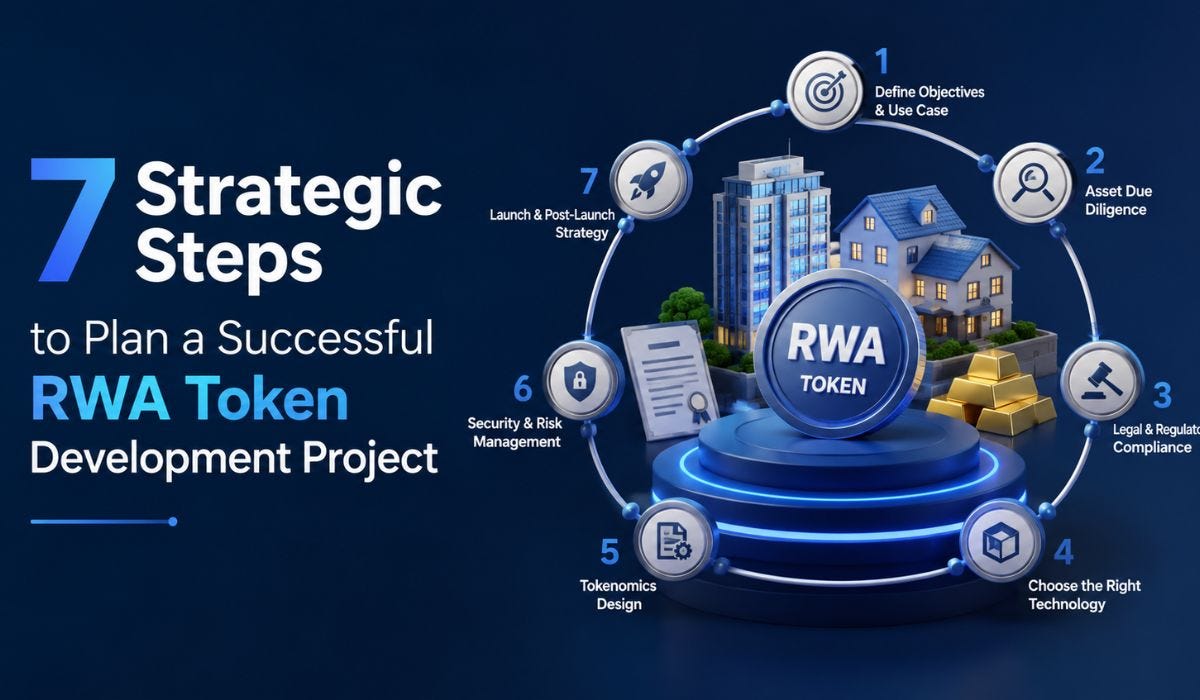
The seven steps form a practical sequence. First, define the asset and investor rights. Second, establish the legal and regulatory structure. Third, design the economics and investment proposition. Fourth, select the ledger and system architecture. Fifth, organise custody, compliance, verification, and security. Sixth, coordinate development and testing across all participants. Seventh, prepare distribution and long-term operation.
The most credible projects begin with a real financial or operational problem and use tokenization only where it offers a practical improvement. They avoid exaggerated liquidity promises, vague ownership claims, and technology-first planning. They also recognise that a distributed ledger can record and execute instructions, but it cannot independently verify legal title, inspect a warehouse, collect rent, value a loan portfolio, or resolve a court dispute.
RWA tokenization may support broader participation, quicker settlement, more programmable administration, and improved coordination between parties. The outcome, however, depends on the quality of the entire arrangement surrounding the token. When asset records, legal documents, investor protections, technical controls, and operating procedures work together, tokenization can become a useful financial infrastructure rather than a short-lived digital experiment.
메타데이터
- post_id
- ba4ce47e7124
- slug
- 7-strategic-steps-to-plan-a-successful-rwa-token-development-project-ba4ce47e7124
- url
- https://medium.com/readers-club/7-strategic-steps-to-plan-a-successful-rwa-token-development-project-ba4ce47e7124
- canonical_url
- https://medium.com/readers-club/7-strategic-steps-to-plan-a-successful-rwa-token-development-project-ba4ce47e7124
- author_url
- https://medium.com/@kevingeller
- status
- ok
- fetched_at
- 2026-07-18 05:23:42