Is it worth switching to the new Heltec WiFi LoRa 32 V4 board?
If you are interested in LoRa (“long range”) development boards from the ESP32 family, you will certainly have heard that the Chinese…
Is it worth switching to the new Heltec WiFi LoRa 32 V4 board?
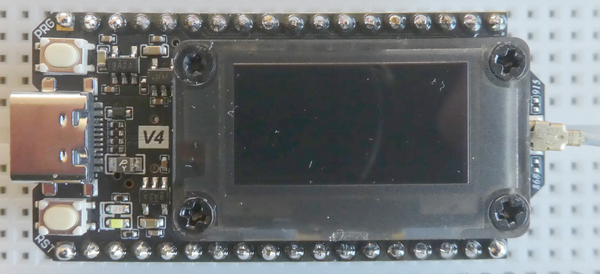
If you are interested in LoRa (“long range”) development boards from the ESP32 family, you will certainly have heard that the Chinese company Heltec Automation presented a further development of the Heltec WiFi LoRa 32 series last year. In this article, I will examine the advertising claims and, through some comparisons, find out if the new board is really better.
A note on this: I purchased and paid for all Heltec modules myself, and there is currently no connection to the company Heltec Automation.
According to the advertising claims, the **Heltec WiFi LoRa 32 V4** board offers a number of advantages compared to its predecessor, the “V3” version:
- More transmission power, now up to 28+1 dBm
- Maximum Receive Sensitivity: -137 dBm
- 16 MB external flash memory and 2 MB PSRAM
- Low-power consumption of less than 20μA
- Added SH1.25–8Pin GNSS interface
- Added SH1.25–2P solar panel interface
- Optimized lithium battery management
- OLED: SSD1315 (0.96 inch, 128*64 resolution)
Development environment
To create a reproducible environment, I am not using the ESP32 boards provided by Heltec but rather the “standard” ESP32 boards from Arduino/Espressif:
- Arduino IDE Version 2.3.6 (Windows)
- Arduino-ESP32 boards version 3.3.5 (https://github.com/espressif/arduino-esp32) that is based on Espressif ESP32 version 5.5.1
All sketches were written not with the RadioLib library but with the **SX12xx library from Stuart Projects. I do this for the simple reason that there is absolutely no information on the “correct” setup for the Heltec V2 models—the SX12xx library, on the other hand, works well with the Semtech LoRa chip types SX127x and SX126**x.
LoRa frequency, transmission power, spreading factor, and bandwidth
Since I am located in Germany (Europe), I must adhere to the technical regulations applicable in Europe. Besides the 433 MHz frequency band (not part of the test), I am permitted to transmit in the 863 to 870 MHz band. The maximum transmission power is set at 14 dBm (25 mW). I must not exceed a duty cycle of 1% (0.1% in certain bands). However, there is one minimal exception: in the frequency range of 869.40 to 869.65 MHz, I am allowed to use a much higher transmit power of up to +27 dBm (500 mW). I use a total of 4 different transmission powers: 0, 7, 14, and 21 dBm.
Therefore, I set a frequency of 869,500 MHz for my tests with a bandwidth of 125 kHz.
To thoroughly test the transmission and reception qualities, I use a total of three different spreading factors: 7, 10, and 12.
To ensure that channel usage remains manageable despite intensive testing, I will send 2 data packets per test, from which I will later calculate an average. I have set each data packet to be as small as possible, namely only 9 bytes long:
        Nr of Total
Nr Type bytes bytes Content
01 uint8_t  1    1  Id of transmission device
02 uint8_t  1    2  Device type *1)
03 uint8_t  1    3  Type of transmission *2) see below
04 uint8_t  1    4  TX-Power *3) see below
05 uint8_t  1    5  Spreading Factor (7...12)
06 uint32_t 4    9  Transmission counter (1) | other data (2) *4)
07 uint8_t  1   10  static footer (0xFD)
------------------------
Total            9 bytes
Test setup for my comparisons
I have included the following Heltec LoRa boards in the comparison:
- Heltec WiFi LoRa 32 V4 (the newest one) (“V4”)
- Heltec WiFi LoRa 32 V3 (the predecessor model) (“V3”)
- Heltec WiFi LoRa 32 V2 (outphased, but still on sale and in use by many hobbyists) (“V2”)
- Heltec Wireless Stick V3 (“WS3”)
- Heltec Wireless Stick Lite V3 (“WSL3”)
- Heltec Vision Master T190 (“VMT190”)
Test scenarios
I have no laboratory equipment available to measure scientifically validated results in a “clinical” environment. Instead, I have set up a test setup that is as realistic as possible and closely resembles a real-life environment in my home. Since I live in an urban area, I cannot perform tests that can measure over a possible large distance—there is no “line of sight” more than 100 meters.
Scenario 1
My first test scenario takes place entirely within my apartment, and I send my test packet from a second Heltec V2 to the test group. I will output the number and strength of the received packets (RSSI) and the signal-to-noise ratio (SNR) after 2 packets for each transmission power and spreading factor combination that have been sent. For the next two complete tests, I used a Heltec V3 and the brand-new Heltec V4 for transmission.
Scenario 2
For the second test, I chose a different setup for the devices: one device is in the basement in the laundry room on top of the washing machine, and the other device is 3 floors higher in the living room. There are concrete walls and floors between the two devices, so this is a real stress test: can I establish a connection between the two devices?
For this reason, I am working this time with a fixed transmit power (21 dBm) and Spreading Factor (SF7). It is a classic “ping-pong” software: a device transmits the received strength (RSSI) and quality of a packet (SNR) it has received. Now the second device is responding itself with the strength and quality it has received the data.
        Nr of Total
Nr Type bytes bytes Content
01 uint8_t  1    1  Id of transmission device
02 uint8_t  1    2  Received transmission Id *1)
03 int16_t  2    4  Received transmission RSSI
04 int8_t   1    5  Received transmission SNR
05 uint32_t 4    9  Transmission counter
06 uint8_t  1   10  static footer (0xF3)
------------------------
Total           10 bytes
The device in the basement is a Heltec Wireless Stick Lite V3, powered by a battery. In my living room, I’m using three modern devices: a Heltec WiFi LoRa 32 V3, the most recent Heltec WiFi LoRa 32 V4 board, and a Heltec Wireless Stick V3 device.
Test results
Scenario 1
When I analyzed the results, I was quite surprised. I started with the Heltec WiFi LoRa 32 V2, which is the “oldest” device in the test. Although the distance to be bridged within the apartment was around 10 meters, I got comparatively poor reception values, regardless of which device was the transmitter. Even more surprising was the fact that a significantly higher transmission power didn’t produce any measurable improvement in the results. For this reason, I did not include the “V2” device in scenario 2:

The second surprise was that the brand-new “V4” model delivered the worst measurement results.
The use of the Heltec WiFi LoRa 32 V3 development board significantly changed the measurement results. Now, the new “V4” version stands out from the rest of the test field—it is by far the most powerful transmitter.

Let’s now look at the reception performance of the Heltec V4. The “V4” version also scores very well in this area. Of all the devices in the test field, it achieves by far the best reception values:

In my scenario 1 there is a clear winner: the Heltec WiFi LoRa 32 V4 is by far the most powerful device.
Scenario 2
For my second scenario, I reduced the number of devices tested and discontinued using the Heltec V2. I also didn’t rotate the devices but instead used them as follows.
For the device used in the basement, I consistently use the Heltec Wireless Stick Lite V3, which does not have a built-in display but doesn’t need one due to the test situation.
In my living space, I use the Heltec Wireless Stick V3, the Heltec V3, and the Heltec V4 development board one after the other.
With a single test setup, I get 4 values, but I can disregard the two signal/noise ratios (“SNR”) because the values are very similar.
The transmission and reception performance confirms the previously known results. The Heltec Wireless Stick V3 board achieves a good transmission power of -70 dBm through concrete walls and floors and receives the signal from the basement at -72 dBm. The values for the Heltec WiFi LoRa 32 V3 board are slightly worse: the transmit power is -75 dBm and the receive power is -77 dBm.
The performance figures for the Heltec WiFi LoRa 32 V4 clearly demonstrate the impact of the additional transmit and receive amplifier. The transmit power reaches a top value of -62 dBm, and the receive power of -59 dBm also puts the V4 in first place.
Overall rating of my tests
The test results speak for themselves: the Heltec WiFi LoRa 32 V4 board is the most powerful LoRa development board in my small selection of devices. This new device achieves by far the best results on both the transmit and receive sides, making it highly recommendable for new projects, especially in challenging environments.
Happy coding!
메타데이터
- post_id
- ba4f64844c4a
- slug
- is-it-worth-switching-to-the-new-heltec-wifi-lora-32-v4-board-ba4f64844c4a
- url
- https://medium.com/@androidcrypto/is-it-worth-switching-to-the-new-heltec-wifi-lora-32-v4-board-ba4f64844c4a
- canonical_url
- https://medium.com/@androidcrypto/is-it-worth-switching-to-the-new-heltec-wifi-lora-32-v4-board-ba4f64844c4a
- author_url
- https://medium.com/@androidcrypto
- status
- ok
- fetched_at
- 2026-07-13 06:23:13