Norwegian Neuroscientist Founds — Typing puts our Brains to Sleep (Why you should Start Writing…
Norwegian Neuroscientist spent 20 years proving that the act of writing by hand changes the human brain in ways typing physically cannot…
Norwegian Neuroscientist Founds — Typing puts our Brains to Sleep (Why you should Start Writing with Paper and Pen)
Norwegian Neuroscientist spent 20 years proving that the act of writing by hand changes the human brain in ways typing physically cannot…
Look down at your hands resting on the keyboard. You press a key. A letter appears on the glowing screen.
You reach for another key, press it, and a second letter joins the first.
The physical sensation remains completely uniform.
The travel of the mechanical switch, the light clicks, the immediate manifestation of a perfect, pixelated character — it is a closed, perfected loop.
We have spent the last three decades optimizing this exact process for speed and efficiency. We engineered faster processors, developed frictionless cloud-syncing applications, and built entire ecosystems around the premise of capturing thoughts instantly. We won the war on friction. We successfully eliminated the physical effort of writing.
We also accidentally disabled the specific cognitive mechanism that makes human memory function.
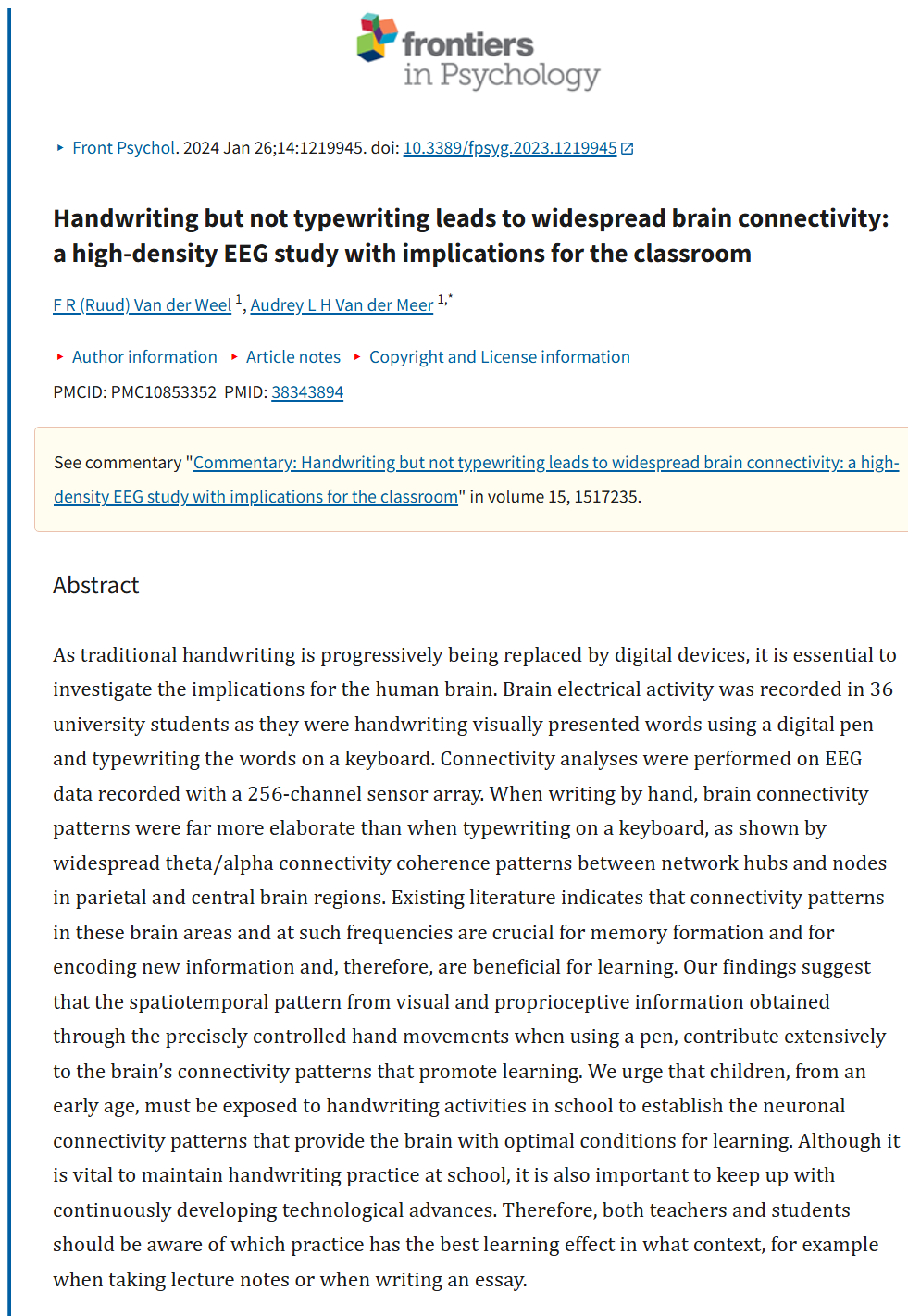
A Norwegian neuroscientist spent twenty years proving that the physical act of writing by hand alters the human brain in ways that typing cannot replicate. Her name is Audrey van der Meer. Operating out of a brain research lab in Trondheim, she recently published a conclusive paper in the 2024 edition of Frontiers in Psychology.
The data she uncovered is brutal enough that it demands an immediate reevaluation of how we structure every classroom, boardroom, and personal workspace on Earth.
256-Sensor Reality
The premise of van der Meer’s experiment was remarkably straightforward. She recruited 36 university students and equipped each with an advanced EEG cap. These caps pressed 256 individual sensors against their scalps to capture high-resolution, real-time brain activity.
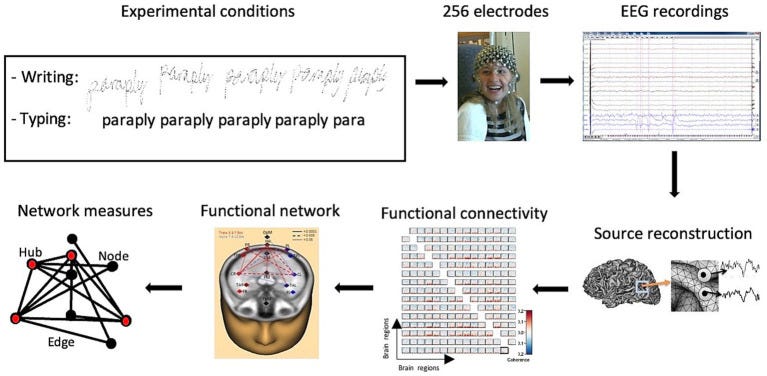
Words flashed on a screen in front of the participants one at a time. In one phase of the experiment, the students wrote the word by hand on a touchscreen using a digital stylus. In the other phase, they typed the exact same word on a keyboard. Every single neural response was recorded for the full five seconds the word occupied the screen.
Her team then directed their focus toward a highly complex metric often ignored in similar studies: neurological connectivity. They mapped how different, isolated regions of the brain communicated with one another during the task.
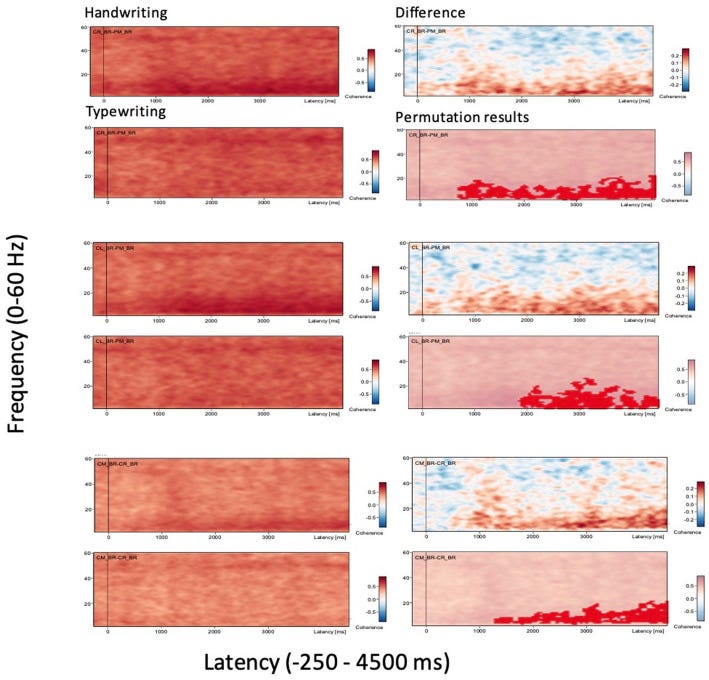
When the students wrote by hand, the brain erupted in synchronized activity.
The regions responsible for memory, sensory integration, and the encoding of new information fired together in a massive, coordinated pattern spreading across the entire cortex. The whole neurological network was awake, active, and deeply connected.
When those exact same students typed those exact same words, that massive network collapsed.
Most of the brain went entirely quiet. The rich connections between regions that had been alive and communicating seconds earlier vanished from the EEG monitors.
Same word, same brain, same person. Two entirely separate neurological events.
The Hidden Mathematics of a Pen
The root cause of this massive discrepancy lies in the physical mechanics of the action. Writing by hand requires a sequence of thousands of microscopic, highly specific movements coordinated with your eyes in real time.
Every single letter possesses a unique shape, demanding that the brain solve a slightly different spatial problem with every stroke.
Your fingers, your wrist, your visual cortex, and the specialized regions of your brain tracking physical position in space must work in absolute harmony to produce one letter, connect it to the next, and follow the line across the page.
Typing abandons this complexity completely.
Every single key on a standard keyboard demands the exact same finger motion regardless of the letter you intend to produce.
Striking the ‘A’ key feels physically identical to striking the ‘P’ key. Consequently, the brain has absolutely nothing to integrate and zero spatial problems to solve. Pressing identical keys over and over fails to stimulate the brain in any meaningful way.
Van der Meer explicitly highlighted the danger this poses to early childhood development.
Children who learn to read and write exclusively on tablets frequently struggle to distinguish between similarly shaped letters like ‘b’ and ‘d’. They lack the physical, bodily memory of what it takes to construct those specific shapes on a piece of paper. They have never felt the directionality of the curve.
Princeton Precedent
A decade before van der Meer’s neurological mapping, two researchers at Princeton University arrived at the exact same conclusion through a completely different methodology.
Pam Mueller and Daniel Oppenheimer tested 327 students across three rigorous experiments. Half of the participants took notes on laptops with the internet completely disabled. The other half took notes by hand.
Following the lectures, the researchers tested everyone on their actual comprehension of the material.
The handwriting group won by a massive margin on every single question requiring genuine conceptual understanding.
The mechanism behind their victory was hiding in plain sight within the transcripts. The students using laptops typed incredibly fast, capturing the lecture verbatim. They recorded a massive volume of content while processing absolutely none of it.
The handwriting students physically lacked the speed to transcribe a lecture in real time. This limitation forced them into an active state of triage. They had to listen intensely, evaluate the incoming information, decide what truly mattered, and synthesize the concepts into their own words on the page.
That single, physical act of filtering and synthesizing is the learning process. The keyboard bypasses the synthesis, taking the learning down with it.
Two distinct studies spanning two different countries yielded one undeniable reality: Handwriting forces the brain to work. Typing allows the brain to coast.
Thin Pipeline vs Faulty Memory
Every typed note entered your brain through a highly restricted, narrow pathway. Every project meeting, every highlighted book passage, and every brilliant idea you captured in a mobile app was processed at half depth.
A faulty memory is rarely the true culprit for forgotten information. Forgetting happens when the initial recording process fails to engage the necessary neurological pathways. Typing leaves the memory centers entirely dormant.
The ultimate solution to this modern retention crisis is the exact tool your grandparents relied on.
Pick up a pen. Write the thing down.
The slower road is the faster one.
So let me know in the comments what you are writing.
Reference & Paper Abstract: —
https://pmc.ncbi.nlm.nih.gov/articles/PMC10853352/
Norwegian Neuroscientist Founds — Typing puts our Brains to Sleep (Why you should Start Writing with Paper and Pen) © 2026 by TechX is licensed under CC BY-NC-ND 4.0
SubStack link for weekly TechX news update in your inbox for free. Coffee link to support our work 🍵 Looking for a work-from-home job in Australia in 2027 (try our app for free).
Write for TechX:
메타데이터
- post_id
- ba533ec4d063
- slug
- norwegian-neuroscientist-founds-typing-puts-our-brains-to-sleep-why-you-should-start-writing-ba533ec4d063
- url
- https://medium.com/techx-official/norwegian-neuroscientist-founds-typing-puts-our-brains-to-sleep-why-you-should-start-writing-ba533ec4d063
- canonical_url
- https://medium.com/techx-official/norwegian-neuroscientist-founds-typing-puts-our-brains-to-sleep-why-you-should-start-writing-ba533ec4d063
- author_url
- https://medium.com/@shipx
- status
- ok
- fetched_at
- 2026-06-10 08:17:25