A Practical Introduction to GraphQL Pentesting
Understanding GraphQL architecture, reconnaissance techniques, and common security vulnerabilities.
A Practical Introduction to GraphQL Pentesting
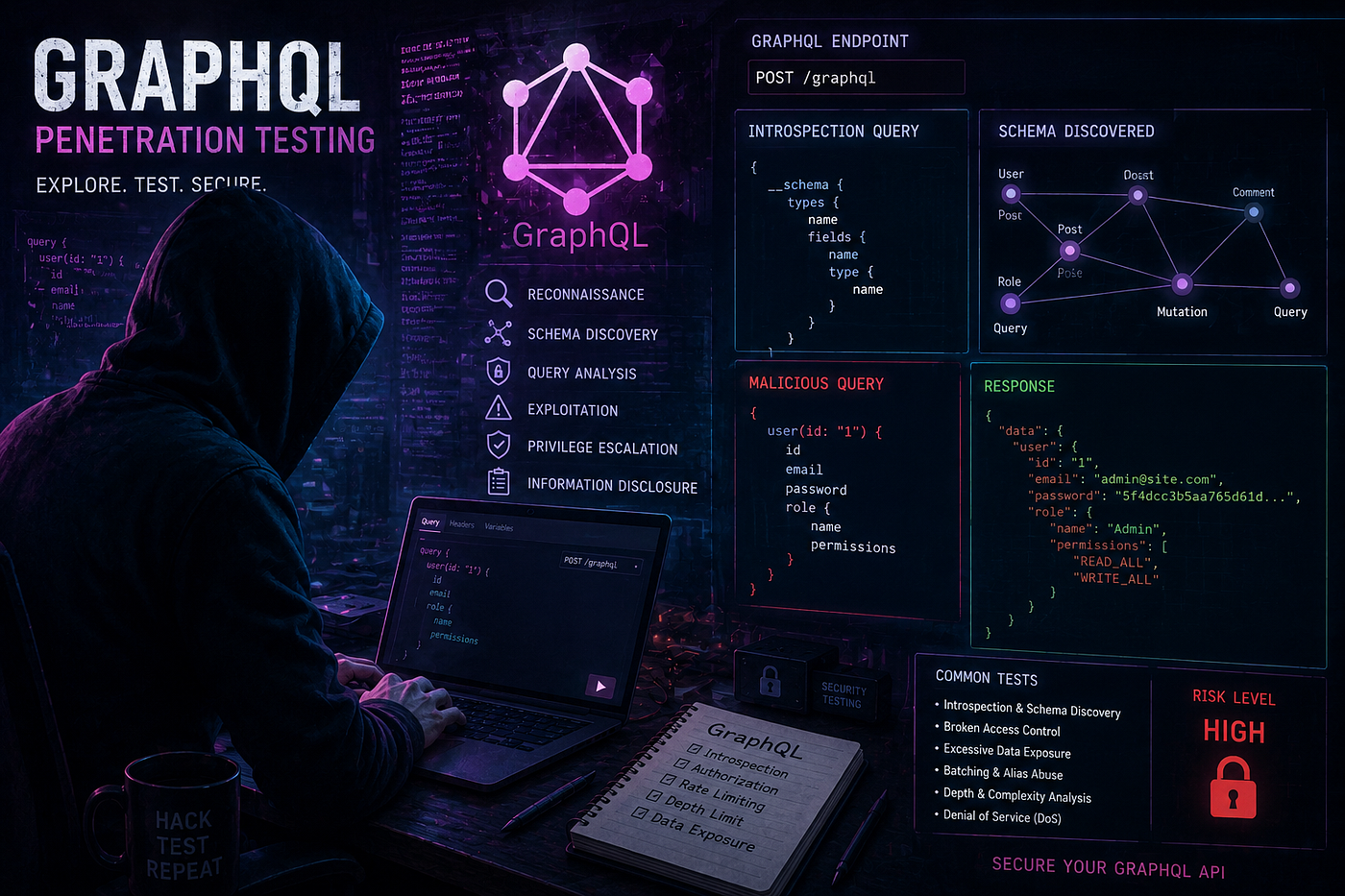
Understanding GraphQL architecture, reconnaissance techniques, and common security vulnerabilities.
Introduction
GraphQL has become one of the most popular API technologies in modern web applications. Originally developed by Facebook, GraphQL was designed to provide a more flexible and efficient alternative to traditional REST APIs.
Unlike REST, where multiple endpoints are typically exposed for different resources, GraphQL applications usually rely on a single endpoint, such as:
/graphqlClients specify exactly which data they want to retrieve, update, or subscribe to within the request body. This flexibility provides significant advantages for developers but also introduces a unique attack surface that security testers must understand.
In this article, we will explore the fundamentals of GraphQL, discuss common reconnaissance techniques, and review several security issues frequently encountered during GraphQL assessments.
Understanding GraphQL
GraphQL is built around objects and relationships.
For example, a blogging platform may contain the following objects:
- User
- Post
- Comment
Each object contains its own fields and may be related to other objects.
A User object may contain:
- username
- role
And a single user may own multiple posts, while each post may contain multiple comments.
Understanding these relationships is important because they often reveal hidden attack paths during security assessments.
The GraphQL Schema
The GraphQL Schema acts as the blueprint of the API.
It defines:
- Available object types
- Fields
- Queries
- Mutations
- Subscriptions
- Relationships between objects
For penetration testers, access to the schema can provide a detailed map of the application’s functionality.
In many ways, a GraphQL schema serves a similar purpose to API documentation in REST environments.
Core GraphQL Operations
GraphQL supports three primary operation types.
Query
Queries are used to retrieve data.
Example:
query {
  user(id: 1) {
    username
    email
  }
}
Mutation
Mutations are used to modify data.
Examples include:
- Creating records
- Updating records
- Deleting records
mutation {
  updateProfile(id: 1, email: "user@example.com") {
    id
    email
  }
}
Subscription
Subscriptions provide real-time communication between clients and servers.
Examples include:
- Notifications
- Chat applications
- Live updates
- New comments
How GraphQL Processes Requests
Before executing a request, GraphQL passes it through three stages.
1. Parse
The query is converted into an Abstract Syntax Tree (AST).
At this stage, GraphQL validates syntax and checks for parsing errors.
2. Validate
The server verifies:
- Field names
- Types
- Relationships
- Query structure
A query may be syntactically correct but still fail validation if it references invalid fields or types.
3. Execute
After validation succeeds, GraphQL executes the request through Resolvers, which interact with databases and backend services.
Understanding this process helps testers identify validation weaknesses and authorization flaws.
GraphQL Reconnaissance
The first step in any GraphQL assessment is identifying whether the application uses GraphQL.
Since GraphQL usually exposes a single endpoint, tools such as Burp Suite and Logger++ can help identify GraphQL traffic.
Common GraphQL-related endpoints include:
/graphql
/graphiql
/playground
/graphql-playground
Useful discovery techniques include:
- Fuzzing
- Default path discovery
- Google Dorking
- Wayback Machine analysis
- Nuclei templates
- GraphQL-specific wordlists
Discovering GraphiQL
GraphiQL is an interactive interface commonly used by developers for testing and debugging GraphQL APIs.
If exposed in production environments, GraphiQL may reveal:
- Available operations
- Object types
- Fields
- Documentation
For security testers, GraphiQL can significantly simplify API enumeration.
Introspection
One of the most important GraphQL features from a security perspective is Introspection.
Introspection allows users to query the API itself and retrieve information about:
- Types
- Fields
- Queries
- Mutations
- Relationships
This effectively provides a map of the application’s functionality.
Tools such as InQL can automatically extract schemas and generate queries based on the discovered structure.
It is important to note that enabled Introspection is not automatically a vulnerability. However, exposing it in production environments can greatly assist reconnaissance efforts.
GraphQL Pentesting Methodology
A practical GraphQL testing workflow may look like this:
- Identify GraphQL endpoints
- Check for exposed GraphiQL or Playground interfaces
- Test Introspection
- Extract and analyze the schema
- Enumerate available queries and mutations
- Test authorization controls
- Assess injection opportunities
- Test SSRF functionality
- Evaluate DoS risks
- Review rate-limiting controls
Following a structured methodology helps ensure that important attack surfaces are not overlooked.
Common GraphQL Security Vulnerabilities
1. Authorization Issues
Authorization flaws are among the most common GraphQL findings.
In some applications, access restrictions are correctly applied to a sensitive root query but can be bypassed through related objects and nested queries.
For example, an administrative query may be protected while another query exposes access to the same underlying data through object relationships.
These issues commonly fall into:
- Broken Object Level Authorization (BOLA)
- Broken Function Level Authorization (BFLA)
Security testers should always examine nested objects and relationships for alternative access paths.
2. Injection Vulnerabilities
GraphQL does not automatically prevent injection attacks.
User-controlled values are frequently passed through Variables and eventually reach backend systems.
Depending on the implementation, this may lead to:
- SQL Injection
- NoSQL Injection
- Command Injection
Variables should always be considered a high-value testing area.
3. Server-Side Request Forgery (SSRF)
Whenever a Query or Mutation accepts a URL as input, SSRF should be considered.
Examples include:
- Image import functionality
- External integrations
- URL previews
- Webhook creation
These features may cause the server to send requests to internal or external systems.
4. Resource-Intensive Queries
Some queries and mutations trigger expensive backend operations.
Examples include:
- Report generation
- File processing
- Search functionality
- Analytics calculations
Improperly protected operations may allow attackers to consume excessive resources.
5. Batch Query Abuse
Some GraphQL implementations support multiple operations within a single request.
If limitations are not enforced, attackers may submit large numbers of queries simultaneously, significantly increasing server workload.
6. Recursive Query Denial of Service
One of the most well-known GraphQL security issues involves recursive queries.
If object relationships are recursive, attackers may construct deeply nested requests that consume excessive:
- CPU
- Memory
- Processing time
To mitigate this risk, many GraphQL implementations enforce:
- Maximum Query Depth
- Query Complexity Limits
- DEPTH_MAX Controls
7. Query Complexity and Rate Limiting
Attackers may intentionally submit complex or deeply nested queries to exhaust server resources.
Defensive mechanisms commonly include:
- Query depth limiting
- Query complexity scoring
- Request rate limiting
- Execution time limits
These protections should always be reviewed during security assessments.
Useful Tools
Several tools can assist during GraphQL assessments:
ToolPurposeInQLSchema extraction and query generationGraphQLmapEnumeration and testingBurp SuiteTraffic interception and analysisLogger++GraphQL traffic discoveryNucleiEndpoint discoveryWayback MachineHistorical endpoint discovery
Conclusion
GraphQL provides a powerful and flexible API architecture, but it also introduces a unique attack surface that differs significantly from traditional REST applications.
Understanding schema discovery, Introspection, authorization testing, injection vectors, SSRF opportunities, and GraphQL-specific denial-of-service scenarios is essential for modern penetration testers.
As GraphQL adoption continues to grow, security professionals must adapt their methodologies to identify and assess the risks unique to GraphQL-based applications.
메타데이터
- post_id
- ba615bbf3442
- slug
- a-practical-introduction-to-graphql-pentesting-ba615bbf3442
- url
- https://medium.com/@andrewdehghan/a-practical-introduction-to-graphql-pentesting-ba615bbf3442
- canonical_url
- https://medium.com/@andrewdehghan/a-practical-introduction-to-graphql-pentesting-ba615bbf3442
- author_url
- https://medium.com/@andrewdehghan
- status
- ok
- fetched_at
- 2026-06-10 09:45:17




