Designing Feedback Loops That Fuel Continuous Improvement
Most business systems are built once, documented, and then quietly left to decay. Here’s how to keep them alive.
Designing Feedback Loops That Fuel Continuous Improvement
Most business systems are built once, documented, and then quietly left to decay. Here’s how to keep them alive.
There is a particular kind of organizational blindness that is surprisingly common. A company builds a process, writes it down, trains people on it, and then considers the work done. Months later, the process still exists in a manual somewhere. But reality has moved on without it.
New employees have quietly invented their own methods. One small change in a single role has rippled into three connected departments, and no one connected the dots. The documented system and the living system have drifted apart, and nobody noticed because no one was looking.
This is not a problem exclusive to small startups. It happens in mid-sized companies with proper HR departments. It happens in large enterprises with dedicated audit teams and formal review cycles. The documentation exists. The processes exist. But if they are not updated when real work changes, the system on paper becomes a fiction.
The question is not whether your system will drift. It will. The question is whether you have a mechanism to catch the drift before it costs you.
Why Feedback Loops Matter More Than Documentation
A system is not finished when it is documented. It becomes useful when real people use it, test it, struggle with it, and help improve it over time.
This distinction changes everything about how you should think about operations. Most businesses invest heavily in building the initial version of a process and almost nothing in maintaining it. They treat documentation as a destination rather than a starting point.
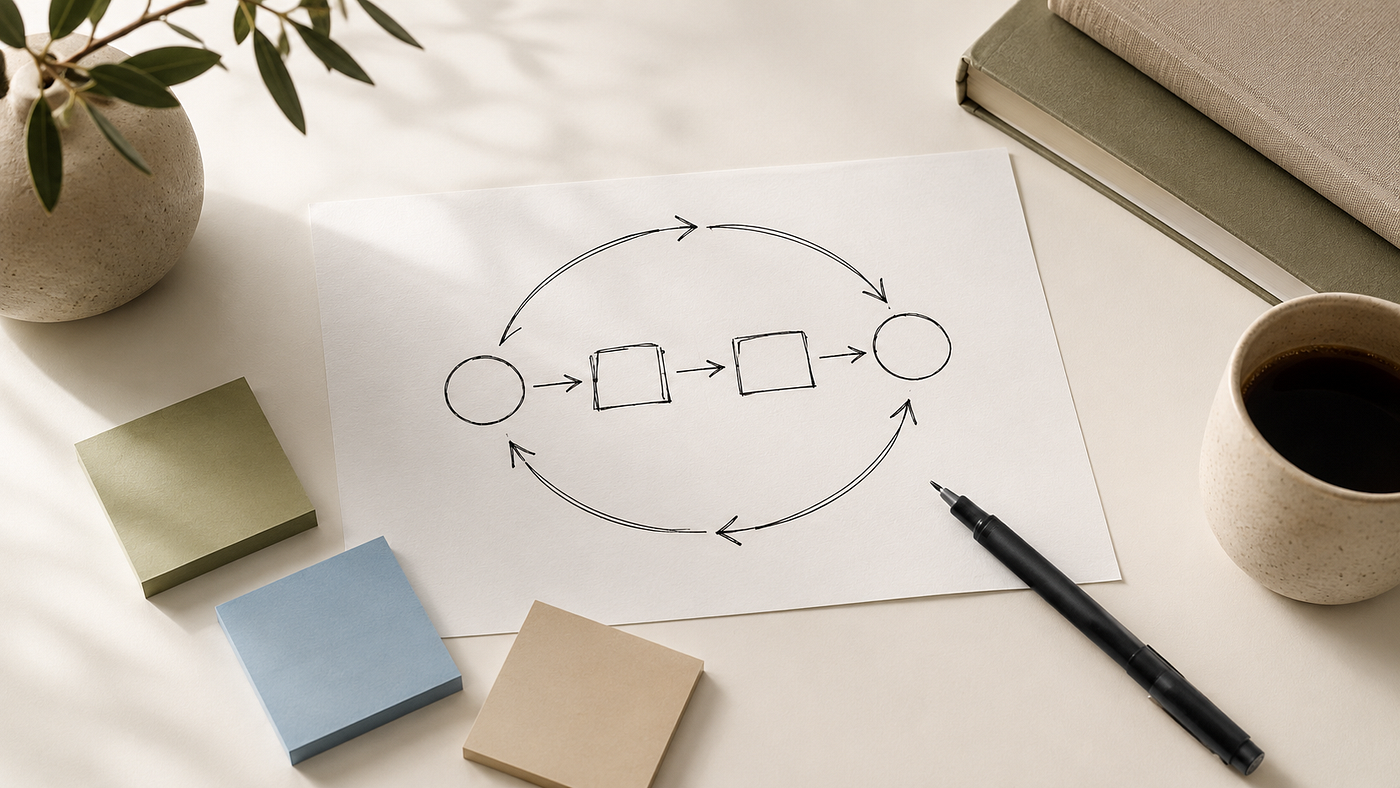
A feedback loop is the mechanism that closes this gap. For the purposes of this article, a feedback loop is a regular process that helps a business learn from reality, update its systems, and avoid repeating the same mistakes. It is not a suggestion box. It is not an annual survey. It is a structured habit of listening, interpreting, and acting.
There is also a subtler truth worth naming here: the real system is not the software, the dashboard, the form, or the written procedure. The real system includes people. People bring different habits, levels of experience, assumptions, and ways of interpreting instructions. A process that looks simple and logical from the designer’s perspective can become genuinely confusing when a real person tries to use it for the first time. The gap between the designed experience and the lived experience is where most systems fail.
The Part Most People Get Wrong: What Feedback Actually Looks Like
Before building a feedback loop, it helps to understand what feedback actually is, because most businesses are only capturing a small fraction of it.
The obvious kind is direct. Someone tells you something is confusing. A client mentions they almost gave up during onboarding. A team member flags that a step in the process no longer makes sense. This is the feedback most organizations are set up to receive, and even then, they often receive it without acting on it.
But there is a second kind of feedback that is equally important and far more commonly ignored: indirect feedback. Silence is feedback. If people view a post but do not engage, visit a page but do not take action, or find an offer but ignore it, that behavior is a signal. It may mean the message is unclear, the value is not obvious, or there is friction in the system that you cannot see from the inside.
When designing consulting intake forms, for instance, it is easy to assume a question is clear because it makes sense to the person who wrote it. But watching someone actually fill out that form tells a different story. You see where they hesitate. You see where they re-read the question twice. You see where they type an answer, delete it, and try again. That hesitation is data. It shows exactly which questions need to be simplified or rethought. No amount of internal review produces this kind of insight. Only the real moment of use does.
This is the non-obvious insight that separates businesses that improve from those that stagnate: the most useful feedback is often not what people say, but what they do.
The Feedback Loop Framework: Four Stages
A well-designed feedback loop has four distinct stages. Skipping any one of them breaks the cycle.
Stage 1: Capture
This is about creating consistent, low-friction ways to collect feedback from the right sources. The methods will vary depending on your business, but the principle is the same: make it easy for reality to reach you.
Useful capture mechanisms include:
- Short post-interaction surveys. One to three questions sent immediately after a service is delivered, a project milestone is completed, or an onboarding step is finished. Timing matters enormously here. Ask too late and people cannot remember the details. Ask in the moment and you get honest, specific responses.
- Structured retrospectives. At the end of a project, launch, or campaign, gather the team and ask three questions: What worked? What did not work? What would we change next time? This should be a calendar event, not an optional conversation.
- Behavioral observation. Look at completion rates, drop-off points, response rates, and engagement patterns. Where are people stopping? Where are they slowing down? That data is often more reliable than what people say when asked directly.
- Operator input. The people executing your processes every day often know exactly what is broken. They have usually already adapted around the problem. Build a regular channel for this input, whether that is a monthly team review, a shared document for flagging issues, or a standing ten minutes at the end of a weekly meeting.
Stage 2: Filter
Not all feedback carries the same weight, and this is where many businesses go wrong in both directions. Some ignore feedback entirely and keep running systems that are clearly not working. Others overcorrect, redesigning an entire process based on a single complaint.
A useful filter asks three questions: Who is giving this feedback? How much relevant experience do they have? And does this pattern appear across multiple sources, or is it an isolated opinion?
Feedback from an experienced operator who has run the same process for two years carries more weight than feedback from someone who encountered it once under unusual circumstances. A pattern that appears in three retrospectives, two surveys, and a handful of direct messages is telling you something. A single comment from someone who had a bad day is not.
The goal is to be genuinely open to feedback without being held hostage by it.
Stage 3: Analyze
This is the stage most businesses skip because it requires sitting still with uncomfortable information. After collecting and filtering feedback, the question is: what does this pattern actually mean?
Kaizen, the Japanese philosophy of continuous improvement, is instructive here. Its core idea is that improvement is not a project with a beginning and an end. It is a permanent, incremental practice built into how the work is done. Small and consistent beats large and occasional.
In practice, this looks like returning to a process, a template, a page, or a piece of content created three or six months ago and asking a simple question: knowing what I know now, what would I make clearer, simpler, or stronger? Often the answer is one better paragraph, one clearer question, one less confusing step, or one tighter call to action. These small improvements compound significantly over time.
Stage 4: Act and Close the Loop
This is the most important stage and the most neglected one. Feedback that is collected, filtered, and analyzed but never acted on is not a feedback loop. It is a feedback archive.
Acting on feedback means making a specific change to a specific system, documenting what was changed and why, and if relevant, communicating that change to the people who provided the feedback. That last part matters more than it seems. When people see that their input led to a visible change, they keep giving it. When they notice it disappears into silence, they stop.
Closing the loop also means treating launches, campaigns, and projects not only as performance events but as learning systems. A launch is not finished when the results come in. It is finished when the team has held a retrospective, identified the key lessons, and documented what changes will be made to the next one. That review may not happen immediately. Sometimes clarity requires a little distance. But it should always happen.

Case Study: When Feedback Exists but Action Doesn’t Follow
Consider a business owner who invests in consulting to improve their operations. They receive a detailed report. They sit in the debrief and nod. They can articulate every problem clearly because they have been living with it for years.
And then nothing changes.
This pattern is more common than most consultants admit. The feedback is there. The analysis is there. Even the action plan is there. But the behavior does not shift, because the real barrier is not information. It is discomfort. Improving the business requires updating the contract, having a difficult conversation with a partner, reworking a financial system, or letting go of a marketing approach that has never worked but feels familiar. These are not intellectual problems. They are human ones.
This is why the fourth stage of the framework, acting and closing the loop, cannot be treated as a formality. Feedback without action is not continuous improvement. It is continuous documentation of the same problems.
The businesses that genuinely improve are the ones that have built the habit of making change feel routine rather than threatening. They do this by starting small, celebrating small wins, and treating each iteration as a normal part of how they work rather than an admission of failure.
How to Apply This Today
You do not need to overhaul your entire operation to start. Pick one system, one process, or one deliverable that you suspect has drifted from reality, and run it through the four stages.
Ask yourself: when was the last time someone who was not involved in building this process gave you honest feedback about it? When was the last time you watched a real user interact with it? When was the last time you updated it based on what you learned?
If you cannot answer those questions, that is your starting point.
Run a retrospective with your team this week. Keep it to forty-five minutes. Ask what is working, what is not, and what one thing you would change. Then make that change. Document it. Tell the team you did.
That is one complete feedback loop. Build the habit of running them regularly, and your system will not decay. It will improve continuously, at whatever pace your business can sustain.
Final Thoughts
The goal of a feedback loop is not perfection. It is honesty. It is building a business that is willing to look at itself clearly, learn from what it finds, and make the small adjustments that keep it aligned with reality.
Static systems decay. They do not fail dramatically. They drift slowly until the gap between the process and the reality becomes so wide that even the people inside the business can no longer see it clearly.
A well-designed feedback loop is what keeps that gap small.
If this resonated with you, I have two resources that can help you put this into practice immediately.
The first is a free retrospective template designed for small business teams, structured around the four stages outlined above. It takes less than an hour to run and gives you a clear record of what changed and why.
The second is my Business Systems Blueprint, which walks through how to design, document, and maintain the core systems in your business so they stay current and continue to serve your growth.
And if you would like direct support in building or auditing your feedback systems, I offer consulting for small business owners who are ready to move from documentation to continuous improvement.
Reach out through saramoradi.com , I would be glad to help.
Warmly,
Business Consultant & Systemization Coach Helping small businesses grow with structure, strategy, and smart tools.
Did you find this guide helpful? Follow me on Medium for more real-world insights, free tools, and honest strategies, no fluff included.
메타데이터
- post_id
- ba7cf16190f4
- slug
- designing-feedback-loops-that-fuel-continuous-improvement-ba7cf16190f4
- url
- https://medium.com/@upskillbysarah/designing-feedback-loops-that-fuel-continuous-improvement-ba7cf16190f4
- canonical_url
- https://medium.com/@upskillbysarah/designing-feedback-loops-that-fuel-continuous-improvement-ba7cf16190f4
- author_url
- https://medium.com/@upskillbysarah
- status
- ok
- fetched_at
- 2026-06-09 15:37:30