The Vocabulary of Belonging
From Rodina to Bashertland: A Taxonomy of Homeland
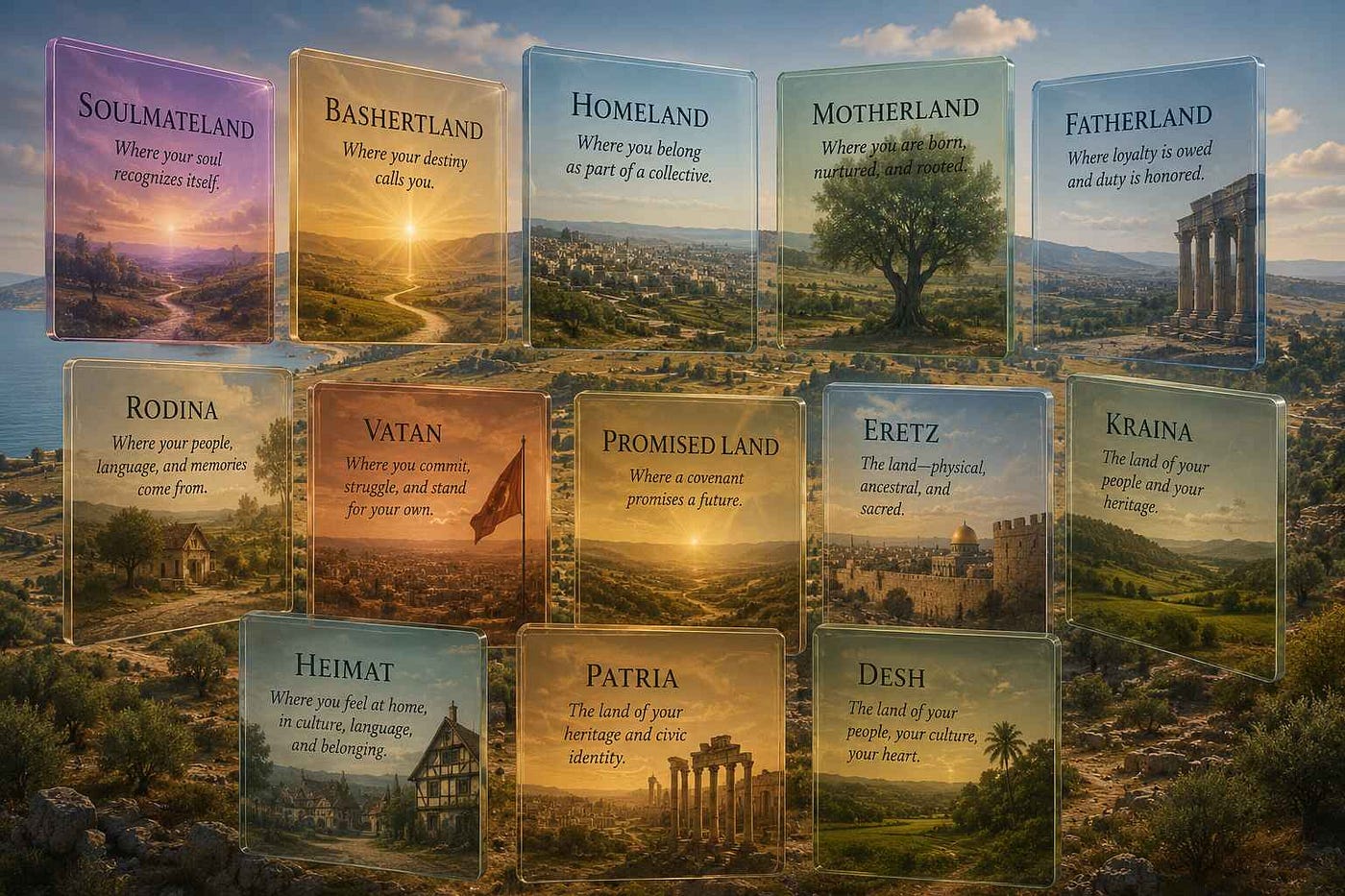
One land. Many homelands. Image © Ivan Bassov, 2026. Licensed under CC BY 4.0.
The Vocabulary of Belonging
From Rodina to Bashertland: A Taxonomy of Homeland
In my earlier piece, *Soulmateland. Bashertland*, I introduced two new terms — not as linguistic curiosities, but as necessary additions.
Because the existing vocabulary was insufficient.
We have many words for “homeland,” yet most of them flatten fundamentally different relationships into a single category. They describe where people come from, but often fail to capture why that place matters — whether by birth, by duty, by choice, or by destiny.
This essay extends that idea: mapping the full spectrum.
Not synonyms — but distinct models of belonging.
New Terms of Belonging
Soulmateland
Recognized belonging.
A Soulmateland is not given at birth. It is discovered.
It is the place where internal structure aligns with external reality — where one feels not just comfortable, but accurate.
It replaces accident with recognition.
Bashertland
Destined belonging.
From the Yiddish bashert — meant to be.
If Soulmateland is recognition, Bashertland is inevitability. It suggests that the connection was always there, waiting to be realized.
It is belonging framed not as choice, but as unfolding destiny.
The Classical Terms
Homeland
Modern, neutral, administrative.
“Homeland” is the language of institutions — immigration forms, ministries, security departments. It defines origin in a functional sense, without prescribing emotional depth.
It allows mobility. You can have one, leave it, replace it.
It is belonging reduced to coordinates.
Motherland
Emotional, nurturing, sacrificial.
The “motherland” is not chosen — it is given. It feeds, shelters, and absorbs identity into itself. In Slavic usage, especially Russian (Родина-мать), it carries a tone of suffering, endurance, and unconditional attachment.
You may criticize it — but you do not detach from it lightly.
It binds through memory and emotional debt.
Fatherland
Structured, demanding, hierarchical.
If the motherland nurtures, the fatherland commands.
Historically prominent in Germanic and some European traditions, the “fatherland” invokes duty, order, and allegiance. It is less about emotional warmth and more about responsibility and structure.
You stand for it, defend it, obey it.
Rodina (Родина — Russian)
Organic, ancestral, almost biological.
Derived from rod — birth, lineage, kin — Rodina is deeper than both motherland and fatherland. It is not just where you are from. It is what you are made of.
It cannot be replaced. At most, it can be suppressed.
Rodina is belonging as extension of ancestry.
Vatan (وطن — Turkish, Arabic, Persian)
Sacralized homeland under tension.
Common across Turkish, Arabic, and Persian usage, “vatan” emerges most powerfully in contexts of defense, struggle, and sacrifice. It is not passive belonging — it is belonging proven under pressure.
Unlike Rodina, which is inherited, Vatan is affirmed through action.
It sits somewhere between political duty and existential attachment — closer, in many ways, to Soulmateland and Bashertland than to purely administrative or biological models.
Promised Land
Teleological, covenantal, future-oriented.
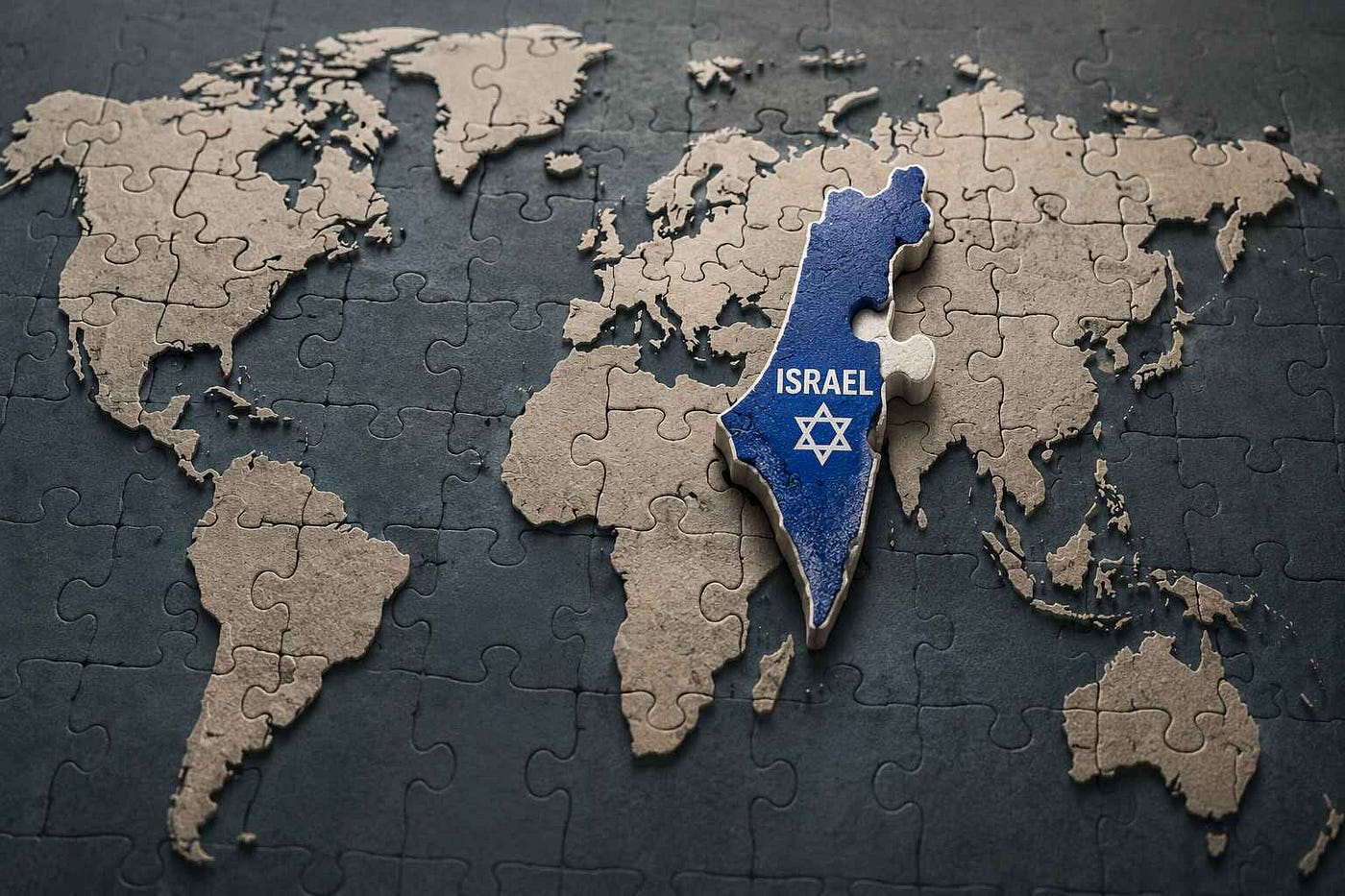
The “Promised Land” is not an abstract metaphor. It originates in the biblical narrative and refers specifically to the Land of Israel — a land defined not merely by geography, but by covenant.
It is not where you begin — but where you are meant to arrive.
Its defining feature is purpose. It transforms land into destiny.
Belonging here is not inherited or chosen — it is fulfilled.
In modern usage, the phrase is sometimes applied metaphorically to other aspirations. But this is a later dilution. The original concept is precise: a homeland defined by promise, not by accident.
Land as Identity
Eretz / Ha-aretz (Hebrew)
Meaningful land. The Land of Israel.
Eretz is not “land” in a purely physical sense. It is land embedded with identity, history, and purpose.
In Israeli usage, Ha-aretz — “the land” — functions as a direct, unambiguous reference to the Land of Israel. Not metaphorical, not descriptive, but a lived linguistic shorthand.
As in Eretz Israel, geography and meaning are inseparable.
It stands between Promised Land and Rodina — both inherited and directed, yet continuously lived as present reality.
Kraina / Ukraina (Ukrainian)
The land as this place.
In Eastern Slavic languages, krai means land, region, territory:
- рідний край (ridnyi krai) — native land
- у наших краях (u nashykh kraiakh) — in our lands
- у чужому краю (u chuzhomu kraiu) — in a foreign land
The prefix u- in Old East Slavic functions as a directional and deictic marker, indicating nearness and localization rather than distance.
Thus:
Ukraina = u-krai-na = this land, the local land, the land as it is here.
A self-sufficient name of place-as-identity.
Direct Parallel in Hebrew
A structural parallel exists in Hebrew:
- Eretz — land, country
- Ha-aretz — “the land,” the immediate, definite reference to the country
In Israeli usage, Ha-aretz functions as a direct designation of the Land of Israel, without need for further specification.
Conceptually:
Ukraina ≈ Ha-aretz
In both cases, “the land” is not abstract geography, but a self-contained identity label.
The difference is functional: in Hebrew, Ha-aretz remains a descriptive-linguistic form; in Ukrainian, it became the formal name of the state.
The “Person of the Land”
Language is precise where ideology often distorts.
In Ukrainian:
- краянин (kraianyn) — literally “a person of the land”
This mirrors:
- Hebrew: בן הארץ (ben ha-aretz) — “son of the land”
- English: “countryman”
Thus:
A Ukrainian (українець) is not an abstract citizen, but a person of this land.
Additional Dimensions of Homeland
These are not minor variations. Each adds a distinct axis.
This list is not exhaustive, but selectively representative. It highlights key linguistic models that structure how belonging is expressed across cultures
Heimat (German)
Intimate, local, lived.
Heimat is not a state. It is not even necessarily a nation.
It is the place of familiarity — the landscape of childhood, dialect, habits, and memory. It is deeply personal and often small in scale.
Closer to Motherland, but more localized and less political.
Patria (Latin / Romance languages)
Civic-ancestral synthesis.
Root of “patriotism,” patria blends lineage with civic belonging. It is both inherited and maintained through participation in a shared political structure.
Closer to Fatherland, but softened by cultural continuity.
Desh (South Asia)
Cultural-linguistic homeland.
In languages like Bengali, desh refers not just to a country, but to a shared cultural and linguistic space. One may leave the territory and still remain within the desh.
Closer to Rodina, but defined less by blood and more by culture and language.
What This Mapping Reveals
These terms are not interchangeable.
They cluster around distinct models of belonging:
- Inherited belonging (Rodina, Motherland, Desh) Belonging defined by birth, lineage, and origin.
- Structured belonging (Homeland, Fatherland, Patria, Vatan) Belonging defined by civic order, duty, and collective framework.
- Meaning-driven belonging (Promised Land, Soulmateland, Bashertland) Belonging defined by purpose, recognition, or destiny.
- Immediate land-identity (Eretz / Ha-aretz, Kraina / Ukraina) Belonging where land and identity function as direct equivalence — “the land” as a self-contained reality.
- Intimate-local belonging (Heimat) Belonging defined by lived familiarity, memory, and personal landscape within inheritance.
Final Thought
A homeland is never just a place.
It is a claim about the nature of belonging — whether you inherit it, serve it, discover it, or fulfill it.
And when people argue about land, they are rarely arguing about geography.
They are arguing about which of these meanings is real.
Often, they do so without fully articulating it. Different speakers may operate from different implicit models of belonging, while using the same word simply because their language offers no alternative. The disagreement is therefore not only political or historical, but conceptual — hidden beneath shared vocabulary.
This is precisely why a broader vocabulary matters: to make visible the different shades of homeland that are otherwise collapsed into a single term.
To name these differences is to begin seeing what was previously only felt.
—
See Also
메타데이터
- post_id
- ba8226b29d68
- slug
- the-vocabulary-of-belonging-ba8226b29d68
- url
- https://medium.com/@ibassov/the-vocabulary-of-belonging-ba8226b29d68
- canonical_url
- https://medium.com/@ibassov/the-vocabulary-of-belonging-ba8226b29d68
- author_url
- https://medium.com/@ibassov
- status
- ok
- fetched_at
- 2026-06-14 11:28:49