Empowering Developer Autonomy with DevOps Champions
Written By: Barr Vered Lesnik
Empowering Developer Autonomy with DevOps Champions
Written By: Barr Vered Lesnik

Picture this: A team struggling with bottlenecks, waiting for support on routine tasks. What if there were a way to break free and empower developers to take control?
At DV, we believe in the power of knowledge sharing. By investing in internal documentation and training, we equip developers to independently overcome roadblocks, accelerate their skill development, and drive efficiency — the key pillars of a successful team.
In this post, I will present DevOps Champions, a training program developed internally at DV that embodies these values. I’ll share how this program addressed a critical bottleneck in our processes and the value it delivered to software developers, DevOps teams and the engineering organization as a whole.
The Challenge
Our dedicated DevOps team powers the heart of DV’s operations: the software development lifecycle (SDLC), infrastructure, cloud solutions and observability. This team provides developers with the tools and processes to create robust code and applications. Over the past few years, the DevOps team has invested in building platforms that enable developers to work independently, allowing them to take their code to production in an automated and secure manner.
In a perfect world, DevOps would primarily focus on building automation, infrastructure and platforms, while developers would use these platforms to build and deploy their code. In reality, despite the independence the DevOps-built platforms provided to developers, teams still often relied on DevOps for routine tasks such as bug fixes, add-ons, operational support and pipeline issues. With significantly fewer DevOps team members than developers, this created a bottleneck. As a result, DevOps spent much of their time addressing daily support requests, which delayed developers who were waiting for assistance.
To address this challenge, Roiy Berko, our SVP of Technical Operations, brainstormed ideas with our Engineering Architects and launched the DevOps Champions program. This training aims to reduce the dependency on the DevOps team by empowering developers with the skills, knowledge, and permissions needed to manage DevOps tasks independently. But who exactly are these DevOps Champions, and what makes them so integral to this initiative?
What Is a DevOps Champion?
DevOps Champions are engineers — mostly software developers — without prior DevOps expertise but who are passionate about automation, observability and understanding the DevOps culture.
These Champions act as mediators, sharing their DevOps knowledge with their teams while also gathering feedback to share with DevOps to improve systems and processes. They contribute to greater collaboration and continuous improvement across the organization.
Through the DevOps Champions program, developers can handle tasks within DevOps systems more independently. By embedding DevOps skills directly into development teams, we have created a scalable solution that alleviates the bottleneck between DevOps and developers while giving developers greater ownership of their work. Pieter Mees, DV’s Chief Architect and SVP of Engineering, described the DevOps Champions program as: “an educational program where DevOps can be an embedded function, which essentially allows everybody to become a DevOps person, to some degree, for their own area of the business.”
Let’s take a closer look at how we brought this vision to life.
Creating the Program
Transforming knowledge into an effective learning program doesn’t happen magically — it requires a deliberate, well-designed process to transform expertise into impactful training.
Our journey began with a brainstorming session with Berko, in which we untangled what this program should look like. Turning the ideas into something practical and impactful felt like assembling a puzzle — each decision needed to fit perfectly to create a seamless learning experience. We defined the program’s outlines by raising questions that led us to clarify our mission. For example, what are the program’s goals? What do we want learners to gain from this program? Who is our target audience, and how will we select the designated champions?
This initial discussion helped us define the responsibilities of the DevOps Champions. We realized that asking managers to choose a champion for each team would help us achieve a broad cross-team reach, maximizing the value of the training. This way, the teams’ designated Champions could support and educate peers on handling DevOps tasks.
We also decided to open the program to anyone interested, even if they weren’t nominated by their managers. This decision aimed to ensure broader participation and maximize the program’s impact. When it comes to spreading DevOps wisdom, the more, the merrier!
Another key decision was to format the training as a combination of asynchronous learning, meeting-based sessions and hands-on tasks. There are various learning formats available, including asynchronous learning (videos or written documentation) and meeting-based learning (group or one-on-one meetings, live sessions, open discussions, etc.). Additionally, hands-on tasks such as labs, exercises, or quizzes allow learners to practice and showcase the knowledge they’ve gained.
As a Learning & Development Manager, I recommend combining several formats for training on vast topics. It keeps learners engaged and allows training creators to incorporate active, hands-on experimentation, ensuring that learners apply what they’ve learned rather than just passively absorbing information. Ultimately, we chose a self-paced, asynchronous program that incorporated a mix of recordings, textual documentation, labs and exercises. This combination enabled us to integrate both theoretical and hands-on content, ensuring a well-rounded learning experience that enables learners to acquire knowledge and practice implementing it.
We also included surveys at the end of each learning section to collect feedback from learners and better understand how the program could be refined.
Once we had these elements in place, the DevOps team, who are the true minds behind the program, mapped out key topics, breaking them into sections and sub-sections. They identified four main pillars that set the cornerstones of the content they later created. Each pillar represented a critical area of knowledge.
The Pillars of the DevOps Champions Program
1. SDLC Process (CI/CD and Automation)
Champions learn the lifecycle from code commit to production, mastering CI/CD pipelines and the tools used to build automation and deploy Kubernetes applications.
2. Platform Systems
This pillar focuses on the platforms that run our applications, such as Kubernetes and Kafka. Champions learn to troubleshoot issues and handle their day-to-day needs without relying on DevOps for basic tasks.
3. Secured Cloud Infrastructure
Champions dive into the Cloud infrastructure that powers our systems; training includes our primary cloud provider, GCP, and tools like Terraform. They learn how resources are managed and created using infrastructure as code, gaining both general and DV-specific insights.
4. Observability
This pillar teaches Champions to use our extensive monitoring and alerting stack to create dashboards, application metrics and alerts, ensuring they can effectively monitor and optimize their applications.
These pillars ensure that developers acquire the requisite skills and gain a holistic understanding of our systems, empowering them to work independently while enabling DevOps to focus on strategic projects.
Once the foundational pillars were defined, the next step was translating them into actionable learning materials.
From Content Creation to Launch
Once the pillars and topics were fully mapped, the DevOps team leveraged its extensive expertise in CI/CD, infrastructure, security and observability, transforming this knowledge into training content. This process wasn’t easy — turning such deep, complex knowledge into clear, digestible learning materials required breaking them down into manageable pieces while retaining their essence. The team created video recordings and text documentation, designed tailor-made exercises and incorporated labs from external learning platforms like Google Cloud Skills Boost. Watching the DevOps team embrace this challenge with such seriousness and thoughtfulness was truly inspiring!
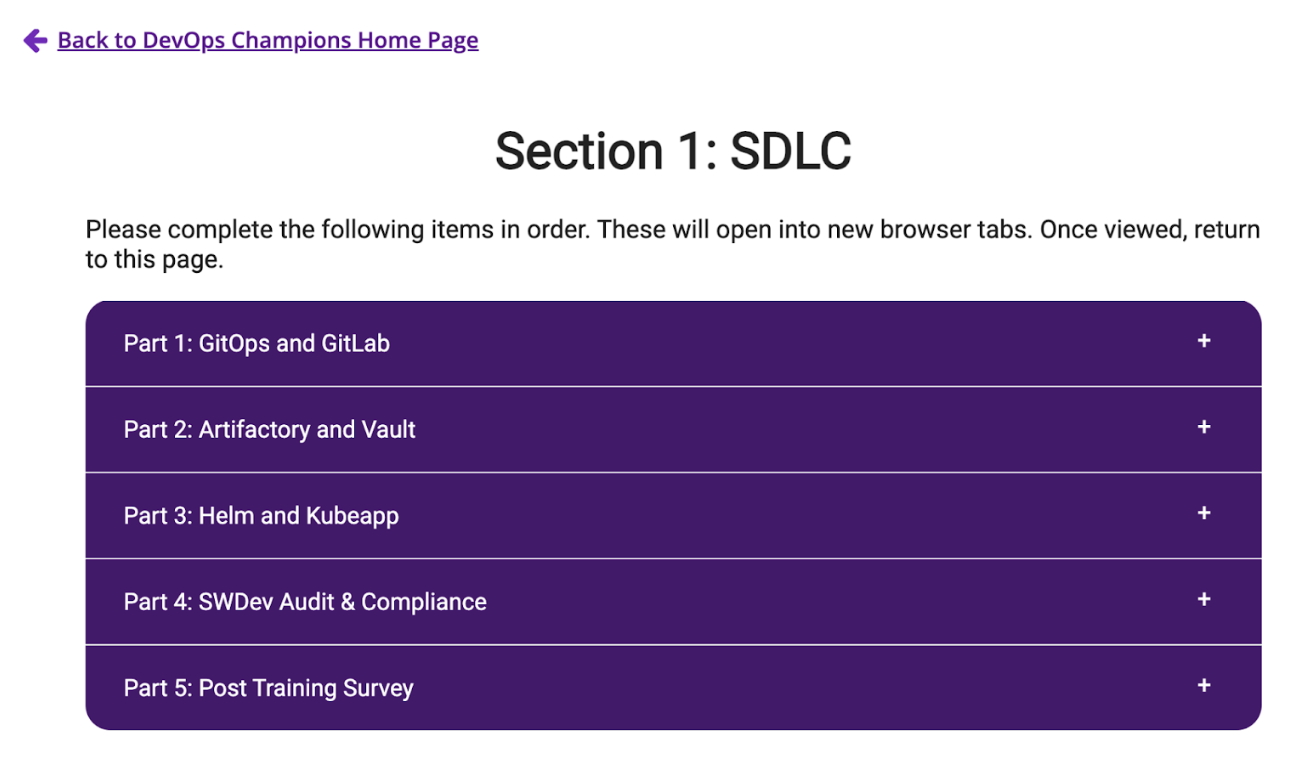
With the content ready, my team collaborated with DV’s Global Learning & Development team to integrate it into a learning management system (LMS). Each pillar was hosted on a separate page and divided into multiple sections. The content starts with high-level concepts and gradually progresses to more advanced topics to ensure a smooth learning experience. Here is an example of how we structured the SDLC pillar:
To ensure effectiveness, we ran a pilot to test the entire flow with a select group of learners who were lucky enough to receive a sneak peek before the official launch. We gathered feedback on both the content and the overall learning experience through meetings with these pilot learners and surveys. This feedback loop helped us refine the program until we were confident it met our standards and expectations.
Once the program was polished, we opened registration and worked with managers to assign DevOps Champions. The response was overwhelming — beyond the designated participants, many others wanted to get involved! This strong demand reinforced our understanding that we are tackling a real and pressing need.
The Success of the DevOps Champions Program
The DevOps Champions program has significantly transformed how our teams operate and collaborate in several aspects.
Practical Impact
Developers now handle tasks that previously required DevOps intervention, such as creating pipelines or managing Kubernetes resources. A senior engineering director shared, “We gained much-needed insight into the internals of DevOps. Having an engineer with in-depth knowledge of the system decreased the time needed to get answers; it became as simple as raising a question during daily stand-ups.” He explained that teams could configure multiple Directed Acyclic Graphs (DAGs) and improve CI/CD workflows without DevOps support. Troubleshooting Kubernetes issues also became much simpler.
One VP of Engineering highlighted how the program addressed a significant time zone dependency, particularly for teams in India that lacked a local DevOps presence. Tasks like creating service accounts, configuring Terraform, and managing Google storage buckets became faster and more reliable. Engineers could now operate asynchronously, reducing delays caused by time zone differences and minimizing reliance on approvals from remote DevOps teams. He emphasized that this shift not only saved substantial time but also allowed engineers to focus more on development rather than waiting for operational support.
As a result, bottlenecks were reduced, leading to faster workflows and shorter delivery times. For the company, this means quicker time-to-market, as developers can deploy features faster without waiting for DevOps to intervene.
Cultural Shifts
The program has fostered a deeper understanding and appreciation between development and DevOps teams. Developers have gained insight into the complexities of DevOps, understanding the “platform mindset” that prioritizes scalable solutions over immediate fixes. A VP of Engineering noted how developers who completed the program demonstrated increased ownership and a clearer understanding of infrastructure and DevOps principles.
One engineering manager highlighted how DevOps Champions helped streamline development processes to better integrate with DevOps workflows. This shift enhanced cross-team collaboration and efficiency.
Participants also noted how the program bridged skill gaps between team members, ensuring that infrastructure-related reviews and processes followed standardized conventions. This leveling of expertise resulted in more consistent workflows and greater confidence during deployments. Moreover, DevOps team members reported higher satisfaction levels, as they could focus on building long-term platforms rather than handling repetitive support requests.
Meeting Goals and Beyond
The program’s success became evident, with nearly 100% of nominated participants completing the training and earning certifications. As Berko observed, “We knew the program was working when developers not only started taking on these tasks but also kept asking for more — more permissions, more knowledge and more autonomy.”
This enthusiasm highlights how the program not only addressed immediate operational gaps but also laid the groundwork for long-term growth, positioning teams to tackle future challenges with confidence.
What the Future Holds
Knowledge is never static. As technologies evolve and new challenges arise, our work must continue adapting. Developers are increasingly seeking more opportunities to learn and contribute, and we are committed to meeting that demand by refining our educational materials and processes.
As Berko put it, “Our work doesn’t stop here. It’s about empowering teams to build, innovate and thrive, even as the landscape keeps changing.” The DevOps Champions program is more than just a solution to a bottleneck; it embodies our belief in continuous learning and collaboration.
메타데이터
- post_id
- ba8f1cf18448
- slug
- empowering-developer-autonomy-with-devops-champions-ba8f1cf18448
- url
- https://medium.com/doubleverify-engineering/empowering-developer-autonomy-with-devops-champions-ba8f1cf18448
- canonical_url
- https://medium.com/doubleverify-engineering/empowering-developer-autonomy-with-devops-champions-ba8f1cf18448
- author_url
- https://medium.com/@dv-engineering
- status
- ok
- fetched_at
- 2026-06-15 20:49:13