IHB LCL Transfer Yard
This writing is based on a post I wrote in my Facebook group. I slightly edited the language, but otherwise it’s true to the original.
sendThe ill-fated Indiana Harbor Belt Gibson LCL Freight Transfer Yard
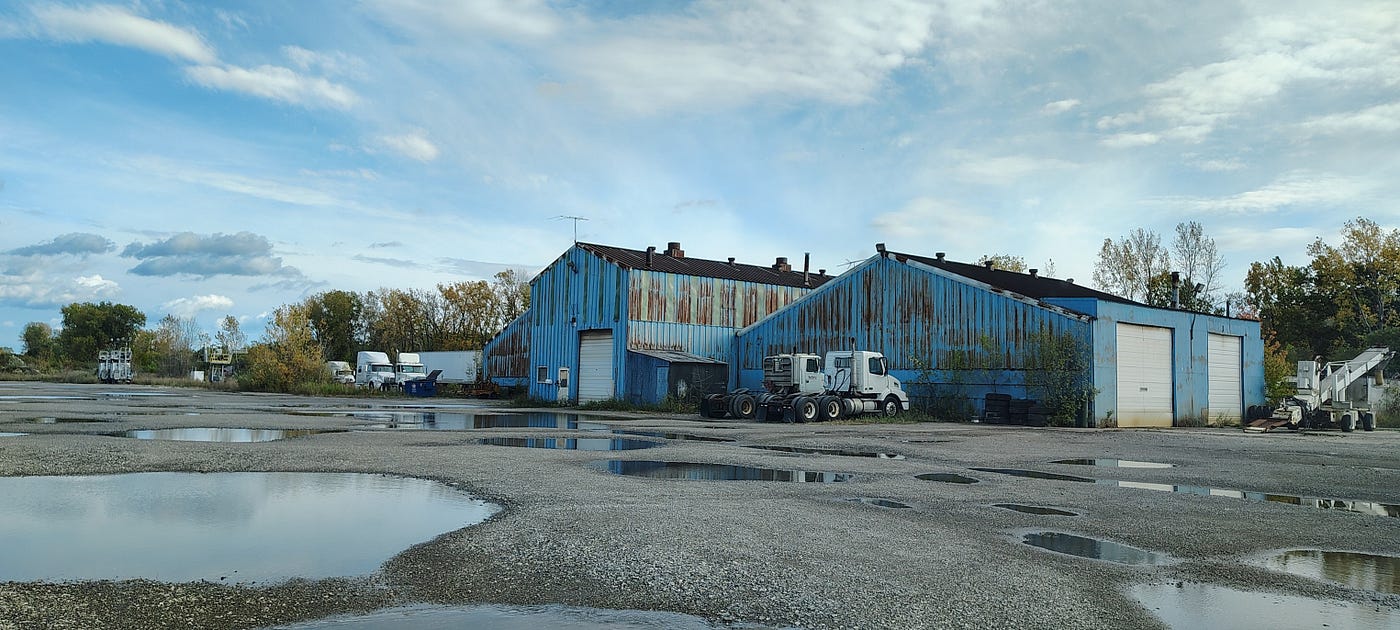
The Hill Hubble warehouses.
This place has many names. Gibson Transfer Company, Gibson Transfer Yard, the IHB LCL Transfer Yard, the NYC IHB Railroad Gibson LCL Transfer Station, and, simply, the Gibson Transfer.
This writing is based on a post I wrote in my Facebook group. I slightly edited the language, but otherwise it’s true to the original.
I got a lot of questions about the Gibson Transfer Yard, the LCL yard, so here we go.
An LCL or Less-than-Container-Load yard is a space railroads use to hold cargo for multiple customers that does not fill an entire railcar or container.
What did they do? LCL operations consisted of truck shipments and packages from shippers, as well as their deliveries to the LCL yard. At the yard, clerks consolidated clearance and shipping documentation, loading cargo into railcars until the cars were full. Each railcar carried cargo for multiple customers traveling in the same general direction. Once loaded, workers sorted and placed goods on new trains for distribution to various customers or to a single location. This was commonly seen as more cost-effective from the shipper’s perspective, as they only paid for a percentage of the volume they needed for each freight car. In other cases, shippers would share the volume cost with one or more businesses.
Railcars were spotted on designated tracks to specific destinations every day. If a LCL load arrived by train or a shipment arrived by truck, the company knew exactly where the shipment would go once it arrived at the yard.
Let’s say multiple trucks brought a shipment of barley destined for delivery to a brewery in Gary. At the LCL yard, that specific cargo would always be spotted on, say, “track 7”. There could be 13 half-filled barley cars on track 7 that could be filled with the new shipment. Or, shipments can be broken into different “spots” on “Track 7.” Say Brand X barely would be spotted on Track 7 at the 5th spot, and Brand Y would be spotted at the 12th spot on Track 7, etc. IHB would fill the cars until each was full. Once done, they would be delivered to the brewery, the empties would be brought back, and so on.
Sometimes the cars delivered would contain barley on one half of the car, and barley slated for another brewery on the other, or any variation thereof. Now replace barley with any deliverable commodity. Coal, gravel, barley, rye, ore, stone slabs, or wet goods such as milk, petroleum, water, rubber, etc. If they were local-bound, they were likely sorted in the LCL.
Sometimes, freight arriving at the central Gibson Yard would need to be unloaded into different cars at the LCL Yard. If a shipment of fish came into Gibson from, let’s say, Blue Island, and that fish is destined for the IHB freight office in Gary. This car, or associated cars, would be detached from the initial train and transferred onto a train bound for the LCL yard. Once there, the fish would be transferred to another car spotted on a designated track, and the original car would be returned to Gibson later. Once in Gary, the fish would be unloaded into a truck for distribution.
IHB was not the only laborer in the yard. By the 1940s, much of this work had been contracted to brokers. These brokers hired workers to handle specific freight in the yard on behalf of the cosigner or company. These contracted grunts would load freight into their employers' cars. IHB would have rented out spots on certain tracks for these types of workers. This freight would be transported on LCL trains from a specific location.
Sometimes the destinations were not local, but were set to be transferred to another train for further transportation east of Gary, and IHB was the bridge between. There were also situations when specific freight required the car to be in a different spot on the LCL train multiple times until the car was empty. All of this work was done on precise schedules. Time is money on the railroad. The work was hard, long, tedious, and went 24/7. This was the time when a freight yard clerk position was coveted. They were the ones keeping track of all of this movement and work, without sophisticated software and computers to aid them. Trucks would also come to the yard to pick up shipments.
In the early 1910s, IHB was the only railroad handling LCL operations. The next railroad to enter that game was the Baltimore & Ohio in July of 1912. That same year, in response to a new LCL yard opening at Clearing Yard by then Chicago Union Transfer Railway and the Chicago and Western Indiana Railroad, New York Central announced its intention to build a brand-new LCL yard for IHB near Gibson. The City of Gary had not been approached by any major railroad entity about a new interchange and LCL yards. Kirk Yard and some smaller yards in its orbit were about the extent of this business. It was so new that its population didn’t justify the cost of scraping out new rail yards within the city itself, especially for LCL business. The streetcar system was enough to handle Gary’s traffic. The new IHB LCL yard, which began construction in 1913, was expected to meet Gary’s future business needs, as it was anticipated to grow exponentially over the next decade.
By November 1913, grading was completed at the new Gibson Transfer Yard, and work began on the initial 14 miles of trackage. Numerous freight sheds were built to serve the IHB, Michigan Central, and Michigan Southern railroads. The yard had two units. A gigantic “wye” was constructed west of Kennedy Avenue, which would connect the new LCL yard with the main Gibson Yard, and provide passage for Michigan Central freights to the yard as well. They called this section “Unit 1.” Unit 2 was east of Cline Avenue, beginning just west of Ivanhoe Interlocking. By spring, construction had included 32 additional miles of tracks, more office buildings, loading platforms, a two-story boarding house, a cafeteria, and employed 230 workers.
In 1917, a large sulphuric acid fire caused by unknown means resulted in the loss of a few miles of track and three smaller platforms. This hastened an additional investment in the LCL yard. It ensured that IHB’s LCL Yard was, according to the Times, “the largest and most complete ‘less than carload’ freight transfer yard in the world.” When 1917 rolled around, the LCL yard had a 200-foot-long building with loading platforms. The building had modern electric generators and other conveniences not typically seen in other LCL yards. It wouldn’t be until 1924 that the entire yard would be completed, with an additional 30 tracks. Another fire destroyed an office building, destroying many records.
In 1958, New York Central began its new “flexi-van” truck-to-rail piggy-back service at Gibson Transfer Yard. It employed a new technique that allowed flat trailers to slide from the train car to highway wheels in about 4 minutes. When the truck reached its destination, it could slide back onto a railcar and start the process all over again. This was the first instance of this service anywhere in the United States. This service operated between Chicago and New York.
By 1960, there was too much competition with trucks and the further evolution of commercial interstate road systems. LCL freight movements fell rapidly due to trucking. IHB petitioned the Indiana Public Service Commission to discontinue LCL freight service. The petition was granted that June, and service immediately ceased. As the IHB railroaders aged, they lost their positions and subsequently began retiring in large numbers. In 1977, a railroad relocation project nearly saw the Chessie System utilize the Wabash 4th District to access the Gary & Western high line, allowing it to reach the old Gibson Transfer Yard, where it planned to repurpose the abandoned yard. However, this never materialized.
MORE PHOTOS AND INFORMATION
The following link is from Dennis DeBruler of the Industrial Scenery blog. It incorporates my original post, plus a few other comments from contributors.

This is an image from the USGS showing the LCL yard in 2002; ARUCHI000100346.

This image is from 1970, ten years after the IHB LCL service ended. The yard is not completely abandoned. The camera captured the dismantling of the yard tracks at Unit 1. USGS; ARB6830A0131261.
The following photos are cropped from a master photo provided by the USGS, 1970, picture B6830A0111194. The cropped photos are arranged in a series, from west to east, at Unit 1. Images slightly adjusted.
USGS AERIAL PHOTOGRAPHS

The above 1939 USGS photo shows the Gibson LCL Transfer Yard. Notice that Cline Ave had not been built across the yard at this time. The yellow arrows point west towards the main IHB Gibson yard (out of frame).

The same area as the previous photo, but shown 20 years later in 1951. Note the addition of the Moonlight Drive-In Theater.
Apparently, there was a restaurant at 2713 163rd Place called the LCL Gibson Transfer Restaurant. Today, that address takes you to the middle of a nearby neighborhood full of houses. Perhaps that was the owner’s address, not the restaurant's. A restaurant that was associated with the yard burned down. I haven’t been able to find its location.
UNIT 1


This is what is left of Unit 1. 1970.

Unit 1 has been greatly reduced. However, some of the buildings seen in the above photo still stand. Note the warehouses at the center-left.
The blue warehouses are used by Savage, a Trans-Flo business, which is served by the Indiana Harbor Belt. The following photos are of the abandoned yard in front of the warehouses.


The road adjacent to the railroad tracks is the Gary & Western tracks, №3–4. Across the road are what were once called the MDT (Merchant Despatch Transport) tracks. These tracks are labeled tracks 20–23, leftover track numbers from its LCL service. Again, this is Unit 1. The MDT tracks go east into the former Unit 2, where Savage’s actual transflo equipment is stored.
Merchant Despatch Transport

Looking east.
IHB dieselized in 1948. By 1950, new diesels were still arriving. In March 1950, 13 diesel locos arrived at Gibson, helping modernize the fleet. It was at this time that NYC and IHB were operating Merchants Despatch Transportation Company. Now, the early 1940s is when I first discovered printed evidence of MDT operating at Gibson Transfer. This does not mean it began in the 1940s. I’ve found obituaries of clerks who retired from MDT in the 70s after 30-40 years of service.
MDT operated at the LCL yard, as shown in the above photo. NYC owned MDT. It also owned and operated the LCL yard through IHB. With being IHB’s parent company, NYC had a large presence in the region. This control was even more evident at the LCL yard. MDT had its own refrigerated railcars, which were spotted on its own tracks. Below are a couple of pictures of MDT railcars.

From Wikipedia.

Other companies had their own refrigerated cars, Pacific Fruit Express, Fruit Growers Express, Armour, Cudahy, etc. It is unknown if any of these businesses rented space. When IHB ended LCL service in 1960, it seems, based on reading local obituaries, that MDT employees began retiring in droves throughout the 60’s. This leads me to believe that MDT severely reduced yard operations. At least one IHB locomotive operator told me he worked the MDT tracks in the 70s. Amazingly, they remained in operation until the Conrail breakup in 1998.
Here is evidence of MDT operating back in 1992. Apparently, there was a small derailment at CP Gibson in 1992.

Vincent O’Donoghue, MDT employee, 1992, The NWI Times.
UNIT 2
I’ve yet to find anything specific about Unit 2. According to all the images I’ve seen thus far, Unit 2 was the busiest, consistently filled to the brim with freight cars and waiting trucks associated with the work there. The work was grueling. Workers would sometimes die on the job, young men in their 40s just dropping dead.
![[EDIT] I originally associated this with a photo of Unit 2 of the LCL Transfer Yard. It is not; it is of the main Gibson Yard, looking east from on top of the Indianapolis Blvd bridge. Check the link below for the source.](https://miro.medium.com/v2/resize:fit:1400/1*0Ie1JQ5reWw8kX3oiJY_4w.jpeg)
[EDIT] I originally associated this with a photo of Unit 2 of the LCL Transfer Yard. It is not; it is of the main Gibson Yard, looking east from on top of the Indianapolis Blvd bridge. Check the link below for the source.
https://www.newspapers.com/article/the-times-gibson-yard-1949/185432091/
The photo below is a rare look at Unit 2, ten years after it closed for LCL service.

This is what is left of Unit 2. 1970.
In the 1930s, there were plans to upgrade nearby Cline Avenue by building a bridge over the LCL yard and the Michigan Central main line. Indiana Harbor Belt threatened to rip up the entire yard and eliminate hundreds of jobs to prevent this. Their ploy worked, and Cline Avenue wouldn’t be upgraded until the late 1950s.
The following is an announcement of the construction of Cline Avenue over the IHB LCL yard.

Engineering News-Record 1959–08–20: Vol 163 Iss 8.
Freight railroads had ignored the growth of freight trucking from the start. The following clip is from a 1930s article describing how a local trucking firm’s banker had not realized motor trucks were essentially an extension of what the freight railroads were doing. He felt that they enhanced railroad freight service.
This was the sentiment in the 30s. Yet, by the beginning of the 1960s, interstate freight trucking had all but put railroads out of business.
THE END OF LCL SERVICE/IHB Difficulties
On April 17, 1960, a fire broke out. It happened at 3300 Gibson Transfer Yard, in the middle of the yard.
In the middle of the yard, you can see the outlines of the footprints where more buildings once stood. That is 3300 LCL Rd, which is described in the article.

Then, a month after said fire, this happened. A hearing to discuss ending IHB’s LCL service occurred in May 1960.
https://www.newspapers.com/article/chicago-tribune/185300208/
I don’t know what effect the fire had on the decision to shut down. Perhaps, there was no correlation. In the above photos from the 1970s, the warehouse buildings were still standing. Why they were later demolished is unknown.
At the same time, IHB was wondering whether they would be leaving Hammond altogether. They wanted to move all operations to Blue Island, IL, where they had another major hump yard, which was openly discussed. Plans were to reduce trackage at Gibson Yard’s automatic hump facility from 14 tracks to two. It also had 29 classification tracks. Gibson Yard was under an economic assault. The question of whether it should modernize or close was very real. By the end of the decade, the railroad had somewhat recovered.
WHY DID THIS YARD SURVIVE?
In 1956, a new business was erected inside the yard.

Engineers Erling G. Opperhud and John L. O’Dell study plans of the new pipe-wraping plant.
The new firm was Hill, Hubble, and Co., a division of Universal Paint Corp. It was known in Hammond simply as Hill Hubble. This is the source of the blue warehouses I posted earlier in this write-up.
The Hill Hubble warehouses, built in 1956.
In 1960, New York Central Railroad and Indiana Harbor Belt filed to cease all LCL transfer service at the Gibson LCL Freight Transfer Yard. The application was granted that summer. However, Hill Hubble may have been a business that IHB continued to serve, helping keep the yard active for a period after LCL service stopped.
According to the above link, freight transfer and storage continued past 1960. Fred Miller started at Indiana Harbor Belt (IHB) in 1913 and transfered to LCL in 1915. He served as a general foreman until IHB discontinued LCL service in 1960. New York Central, then the majority stock owner of IHB and builder of the LCL yard itself, maintained a freight materials storehouse at the yard where Miller was a supervisor until he retired in 1962. So, though IHB was officially no longer involved in LCL freight, its parent company, NYC, still used the yard for that purpose, albeit to a severely diminished extent. What is unclear is whether NYC used its own locomotives or if IHB continued to be used for this purpose.
So, we have Hill Hubble and NYC continuing to use the yard after 1960. Very interesting stuff, I did not know. All mention of Hill Hubble disappears from my searches after 1963. In 1964, Jack Gray Transport moved into the building, but the business was still looking for clerks to work at 3200 Gibson Transfer Road until at least 1979. The business wasn’t named, so I don’t know if it was Jack Gray, Hill Hubble, or anything else.
Another element to this is the merger of the Pennsylvania Railroad and the New York Central Railroad in 1968 into the new company, Penn Central Transportation Company (PC). Prior to the 1968 merger, both roads deferred maintenance on most of their Midwest properties. So, by the time their properties were combined, prohibitively expensive physical conditions had already emerged. Penn Central attempted to diversify, venturing into non-railroad businesses such as real estate and interstate trucking. These steps did not help the company.
By 1970, PC was bankrupt, and by 1974, PC was just a joke. I assume by this time, the freight storage operation at the LCL yard went the way of the dodo. The following picture shows the LCL yard in 1970, at the beginning of the bankruptcy. PC was the parent company of IHB, having inherited it from the former New York Central Railroad.
This is what is left of Unit 1. 1970. Previously used above.
In 1976, PC’s profitable ventures and rail lines were consolidated into the new nationalized railroad, intended to improve America’s rail situation. This new company was the Consolidated Rail Corporation (Conrail). Conrail (CR) inherited IHB, just as Penn Central had from the New York Central Railroad. Conrail’s purpose was to consolidate redundant rail lines, nurture profitable lines and other nonrailroad assets, and eliminate all failed ventures. The freight service at the LCL yard may have been affected by this.
Between 1970 and 1983, the LCL yard was reduced to the state shown in the photo below. Today, the LCL yard still pretty much looks the same as it did in 1983.

In 1971, Penn Central was operating a Flexi-Flo terminal. However, this, along with Hill Hubble and Jack Gray, partially explains why freight continued to be sorted at the Gibson LCL yard (to a certain degree) even after LCL service was eliminated.
This terminal became what we know today as Savage Services. From its website, it has:
Rail Services
- 139 railcar spots
- BNSF, CN, CPKC, CSX, NS, and UP access via IHB short line
- BNSF premier transload facility
Transload Services
- Rail-to-truck, truck-to-rail service
- Liquid bulk handling
- HAZMAT capable
- Railcar steam heater
- Multiple transload racks
- Certified truck scale
Inventory Management
- Railcar storage

A view of the east end of the Gibson Transfer Yard, former Unit 2, now Savage, an transload facility.
Looking at their website, you’d think the Savage facility in Hammond would be a well-maintained, corporate behemoth. Not the case. The Savage property is janky, barely maintained, dirty, and small. Extremely small. This is probably how Savage calls itself saving some money and being able to have 49 other terminals in the nation. Good ol’ capitalism for you.
Anyway, between the freight storage ops and the Transflo business, it was Transflo or Flexi-Flo that ended up surviving.
메타데이터
- post_id
- baa9764655ff
- slug
- ihb-lcl-transfer-yard-baa9764655ff
- url
- https://medium.com/@garyrailblog/ihb-lcl-transfer-yard-baa9764655ff
- canonical_url
- https://medium.com/@garyrailblog/ihb-lcl-transfer-yard-baa9764655ff
- author_url
- https://medium.com/@garyrailblog
- status
- ok
- fetched_at
- 2026-07-15 08:22:34