The River Beneath the Bazaar: When Memory Refuses to Stay Silent
In a novel where rivers are witnesses and bazaars are archives, memory flows louder than history itself.
The River Beneath the Bazaar: When Memory Refuses to Stay Silent
In a novel where rivers are witnesses and bazaars are archives, memory flows louder than history itself.
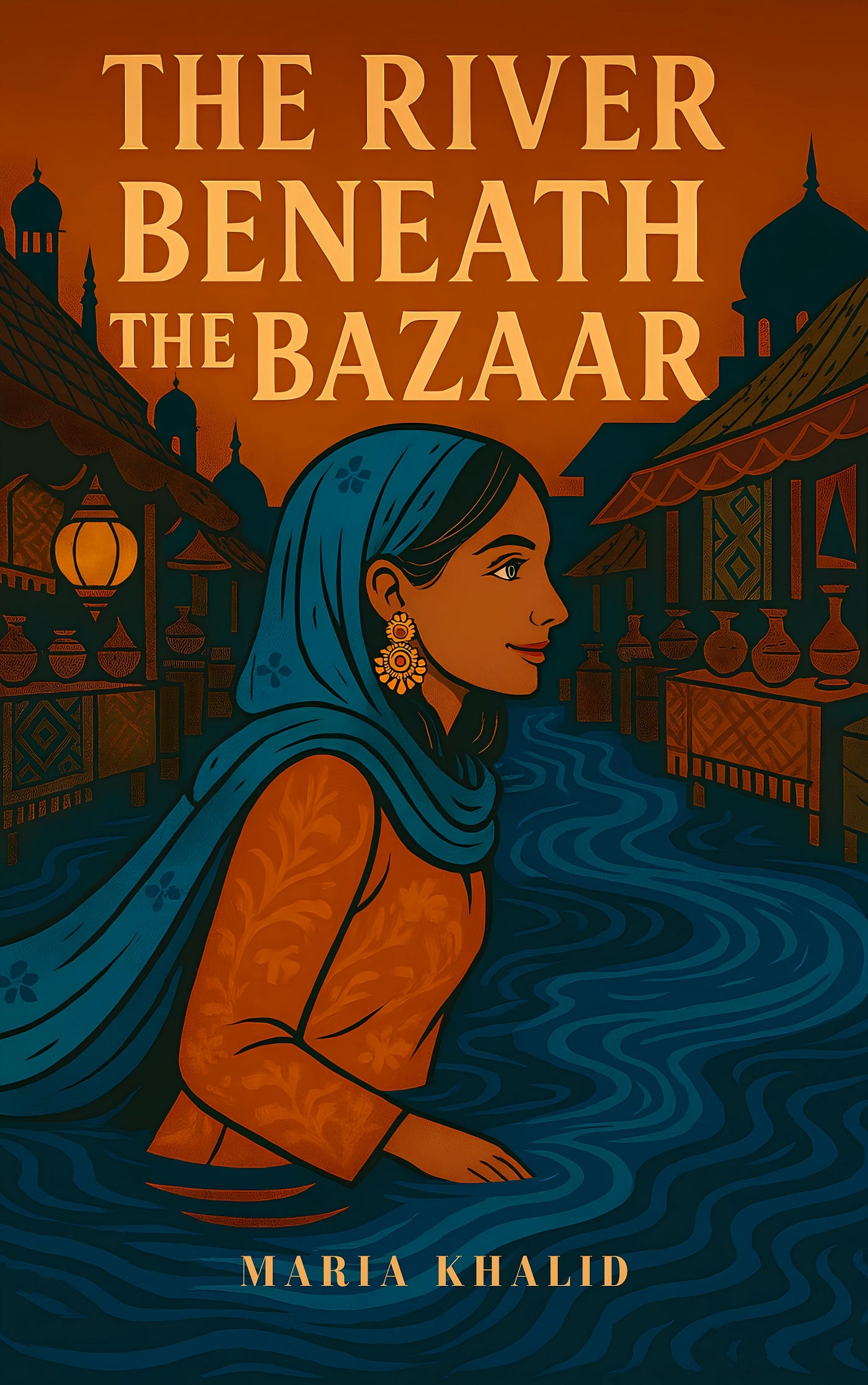
Some books can be neatly summarized. Others resist the confinement of a blurb or a single-line description. The River Beneath the Bazaar belongs to the latter. It is not merely a novel — it is an elegy, a cartography of memory, a meditation on silence, and a pilgrimage through landscapes where folklore and grief entwine. To read it is to step into a river that carries you backward and forward at once: backward into myths and inherited silences, forward into a rediscovery of self and history.
At its heart lies a simple yet haunting question: what if rivers remembered more than people do? That question saturates every page. The unnamed narrator, armed only with a hand-drawn map left by a grandmother who carried stories in her bones but rarely spoke them, journeys across Pakistan — from Lahore’s dust-filled bazaars to Sindh’s sacred shrines, from the desert winds of Balochistan to Hunza’s crystalline valleys. Yet this journey is never only geographical. The grandmother’s map charts wounds as much as routes, silences as much as towns, reminding the narrator — and us — that inheritance is not always property or name. Often, what we inherit is grief.
The novel opens with Lahore’s bazaars, rendered with the intimacy of someone who knows that a market is not just commerce but archive. “In this city,” the narrator observes, “stories are the only form of land that the poor can own.” The bazaars are thick not only with spices, incense, sweat, and dust but with history itself. Beneath every stone, every doorway, lies the weight of what has been lost. Here the grandmother’s map first begins to unfold: among stalls and alleyways where silence is inherited alongside recipes and fabrics. The bazaar is itself a kind of river, carrying memory forward while always remembering what it has already consumed.
Rivers in the work are never scenery. They are characters, living and remembering with greater fidelity than the people along their banks. The Ravi, once powerful enough to carry Aurangzeb’s ship to the Badshahi Masjid, is now little more than sewage and dust. Yet the novel insists the river remembers — the oars, the smoke of prayers, the illusion of a king who thought he had bent water to his will. The Chenab remembers Sohni, whose clay pot betrayed her as she swam across the current for love. Her cries are still audible to anyone patient enough to stand at its banks. The Indus remembers Jhulelal, saint and god, whose child-body appeared as both miracle and defiance. The desert winds of Balochistan remember Sassi, barefoot and crying for Punhun, her body erased but her voice carried in the sand. “Grief travels like rivers,” the narrator observes, “carrying not only silt, but silence.”

Here lies the novel’s deepest strength: its ability to transform folklore into geography. The tragic lovers of Punjab — Heer and Ranjha, Sohni and Mahiwal, Mirza and Sahiban, Sassi and Punhun — are not romanticized fables but cartographies of rebellion, loss, and longing, inscribed into rivers, deserts, and shrines. They shape the land as surely as water carves valleys, insisting that myths are maps of sorrow, repositories of memory that outlast borders and generations.
If the rivers are memory, the grandmother’s map is inheritance. Drawn without concern for precision, it charts not roads but hauntings, leading the narrator not only to cities and shrines but to family silences: the unspoken traumas of Partition, the griefs never given voice, the songs hummed in kitchens without translation. The map becomes the novel’s central metaphor: inheritance not as treasure but as burden. The narrator follows it across physical space, yet the true journey is inward — into what it means to belong to a land fractured by borders but held together by memory and myth. As the narrator reflects, “Some songs were written for forgetting. Not all songs wish to soothe.” Forgetting, the book suggests, is never neutral; it is often survival, leaving traces in its wake.

The novel’s landscapes are vivid enough to feel sentient. Lahore’s bazaars swarm with stories. Sindh’s shrines pulse with music and longing, where qawwals turn grief into melody. Balochistan’s deserts echo with Sassi’s footsteps, each grain of sand a repository of exile and loss. Hunza’s valleys, with their crystalline air, become thresholds where clarity appears, if only fleetingly. Dust clings like history, incense burns like memory, rivers flow like unfinished conversations. The world here is not backdrop but archive; to move through it is to read a text older than writing itself.
The prose circles and swells like currents, often looping back to images or phrases as though unwilling to let go. Reading it is less following a plot and more listening to an incantation. For readers of literary fiction, the novel offers a lyrical meditation on memory, inheritance, and loss. For those who love travel writing, it provides a pilgrimage through Pakistan’s most resonant landscapes. For anyone interested in South Asian history and post-colonial studies, it is a reminder that history lives not only in archives and state documents but in water, song, and silence. Above all, it insists that folklore is not dead; it is alive in the land, in the rivers, in the songs our elders hum when no one listens. Myths are maps, she suggests, ways of remembering rebellion when rebellion itself was silenced.
To call The River Beneath the Bazaar a novel is accurate but insufficient. It is an experience, one that lingers long after the final page. Its nostalgia is sharp, born of exile and silence, its beauty lying in its refusal to simplify grief or domesticate memory. The book does not ask for passive reading. It asks for listening — to rivers, to bazaars, to deserts, to silences. It asks readers to inherit songs without fully understanding them, to follow maps that lead not to destinations but to the spaces memory itself inhabits.
And in the end, it offers a quiet, irresistible promise: if we are patient, if we listen closely enough, sometimes the river speaks back.

The River Beneath the Bazaar is available now on Amazon.
Thank you for reading.😊
This article is published in Women Write Publication. A growing, strong community built by women for women. All thoughts are welcome.
To join this community, read these submission guidelines.
[embed]Submission Guidelines for Women Write Publication Voices unfiltered, Words unboundmedium.com
메타데이터
- post_id
- baa9c46be1dc
- slug
- the-river-beneath-the-bazaar-when-memory-refuses-to-stay-silent-baa9c46be1dc
- url
- https://medium.com/women-write/the-river-beneath-the-bazaar-when-memory-refuses-to-stay-silent-baa9c46be1dc
- canonical_url
- https://medium.com/women-write/the-river-beneath-the-bazaar-when-memory-refuses-to-stay-silent-baa9c46be1dc
- author_url
- https://medium.com/@mareeakhaled
- status
- ok
- fetched_at
- 2026-08-22 00:15:17