Claude Code vs Codex vs OpenCode: Which AI Coding Agent Is Actually The Best in 2026?
Claude Code vs Codex vs OpenCode compared on real benchmarks, pricing, and architecture. The benchmark marketing hides what the pricing…
Claude Code vs Codex vs OpenCode: Which AI Coding Agent Is Actually The Best in 2026?
Claude Code vs Codex vs OpenCode compared on real benchmarks, pricing, and architecture. The benchmark marketing hides what the pricing pages don’t say.
Quick Answer
TLDR: I went deep down the rabbit hole and ran a full-scale research breakdown comparing Claude Code, Codex, and OpenCode: benchmarks, workflows, strengths, tradeoffs, and real-world developer experience included.
Feel free to dive in, download the PDF + deliverables, and explore the results yourself.
And if you’re ready to read the full article… grab a coffee. This one goes deep ☕️
Before We Start: What Most Comparisons Get Wrong
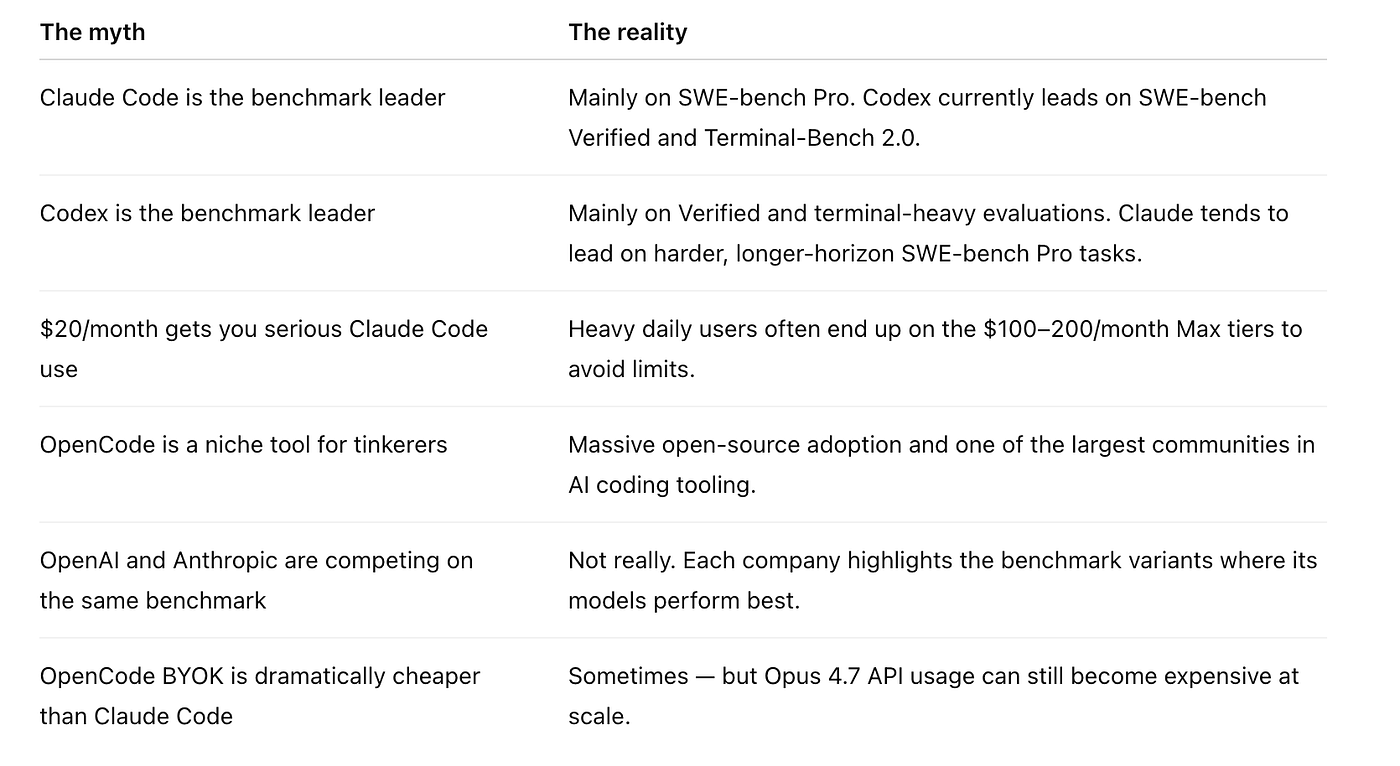
This table is the article in miniature. Everything below is the evidence behind it.
What Each Tool Actually Is
Claude Code
Claude Code is Anthropic’s agentic coder. It runs as a CLI in your terminal, inside VS Code and JetBrains via plugins, in a standalone desktop app on macOS and Windows, on the web at claude.ai/code, on iOS, and inside Slack. It reads your actual files, runs shell commands, executes tests, and makes changes to your codebase with full context of what’s around them.
It uses CLAUDE.md files for project memory. It defaults to Claude Sonnet 4.6 on Pro and Claude Opus 4.7 on Max.
What separates Claude Code from the others is ecosystem depth: 29 programmable hook events across session lifecycle, tool use, file changes, agent coordination, and MCP elicitation. Agent Teams let you run coordinated parallel sub-agents that communicate with each other and share task state. A growing Skills marketplace and plugin system means the community has built integrations for most developer tools already.
OpenAI Codex
Codex has two faces. The CLI is open-source (Apache-2.0, ~85K GitHub stars), written in Rust, installable via npm i -g @openai/codex or Homebrew. The cloud version is a fully managed service. You dispatch a task, it runs in an isolated cloud sandbox, and produces a pull request. Dispatch from ChatGPT, Slack, the macOS desktop app, or GitHub Code Review.
It runs GPT-5.5 and GPT-5.4. Project memory lives in AGENTS.md. The CLI uses OS-level sandboxing(Seatbelt on macOS), Landlock on Linux, kernel isolation, not just application-layer restrictions.
OpenCode
OpenCode is an open-source terminal AI coding agent built by the team at SST (Anomaly Innovations), the same team that built the SST serverless framework. MIT-licensed, written in Go, 75+ LLM providers. No subscription.
The growth is worth pausing on. VS Code has 185,000 GitHub stars, accumulated since Microsoft open-sourced it in November 2015. OpenCode reached 160,000+ stars in under a year. Launched June 2025, 160K by May 2026. 7.5M monthly active developers. 900+ contributors. It did this without a marketing team, a subscription product, or IDE lock-in. Developers found it and told other developers.
The architecture is a persistent client/server setup. A background server handles AI communication and session state in a local SQLite database. The frontend; terminal TUI, desktop app, or IDE extension just connects to it.
Sessions survive SSH drops and terminal disconnects: reconnect and the server is still running, mid-task. This is architecturally different from Claude Code, which exits when your terminal closes. Claude Code does have session resumption. “claude — resume” lets you pick up from a stored transcript. but it’s a restart from a saved file, not a reconnect to a live running process.
The TUI is built with Bubble Tea (Go), keyboard-driven, fast startup. Project memory lives in AGENTS.md. Two primary modes: Build (full tool access — reads, writes, runs commands) and Plan (read-only, shows the full action plan before touching anything). Available for VS Code, Cursor, and Zed via dedicated extensions, with Neovim and JetBrains support via the Agent Client Protocol (ACP).
The Benchmark Deception
This is the section most comparison articles skip.
- OpenAI publishes SWE-bench Verified: GPT-5.5 scores 88.7%.
- Anthropic publishes SWE-bench Pro: Claude Opus 4.7 scores 64.3%.
These are not the same test. Verified uses a curated, more controlled problem set. Pro uses harder, real-world multi-file problems. Both are published by the same organization (swebench.com), but they measure different things. The scores are not directly comparable.
What’s actually happening: Each company reports the variant where their model wins. When you see a press release citing “88.7% on SWE-bench,” check which variant. “88.7% on SWE-bench Verified” and “64.3% on SWE-bench Pro” are from different tests.
Treating them as the same number is exactly what the companies are hoping you’ll do.
The honest breakdown:

Claude Code vs Codex vs OpenCode
What this actually tells you:
- Codex (GPT-5.5) wins on terminal/shell work. Terminal-Bench 2.0 measures real-world agentic tasks in a shell: compiling code, setting up servers, system administration, security tasks, data science pipelines. The 13-point gap (82.7% vs 69.4%) is meaningful if this is your workflow.
- Claude Opus 4.7 wins on hard multi-file problems. SWE-bench Pro is considered more realistic than Verified. The gap here (64.3% vs 58.6%) is smaller but consistent, and it’s on the benchmark that better predicts performance on actual complex codebases.
- OpenCode is infrastructure, not a model. Its benchmark score is entirely determined by whichever model you plug in. Run Opus 4.7 through OpenCode and you get Claude Code scores. Run GPT-5.5 and you get Codex scores.
One real-world signal on adoption: As of February 2026, Claude Code was authoring roughly 4% of all public GitHub commits (~135,000/day). By March 15, 2026, it hit a single-day peak of 326,000 commits. SemiAnalysis projects Claude Code will exceed 20% of all daily commits by end of 2026.
Pricing: The Numbers They Don’t Put in the Headline

The Claude Code Pro reality: The $20/mo plan hits rate limits in a few hours of real agentic work. For long refactoring sessions, multi-agent tasks, large codebases. Most engineers doing daily professional AI-assisted coding use Max at $100/mo. Power teams run $200/mo. That’s $1,200–2,400/year per developer.
The Codex billing reality: The “included in ChatGPT Plus” framing is accurate for light use. OpenAI moved to token-based credits in April 2026, so actual cloud sandbox costs vary month to month. Dispatching async tasks on large codebases adds up in ways that are hard to forecast in advance.
The OpenCode BYOK reality: You pay your model provider directly. For Claude Sonnet 4.6 ($3/M input, $15/M output), regular professional coding work typically runs $10–30/month. For Claude Opus 4.7 ($5/M input, $25/M output) with heavy daily use, expect $30–80/month. For local models via Ollama: $0. If you already pay for ChatGPT Plus or GitHub Copilot, OpenCode can use those as providers at no additional cost.
OpenCode can also be used completely free. OpenCode’s platform currently offers several free models that require no API key and no payment:
- Big Pickle: A stealth model available free on OpenCode. Note: during its free period, collected data may be used to improve the model.
- DeepSeek V4 Flash: Currently the most popular model in OpenCode’s Go subscription, also available free for a limited time. An efficiency-optimized Mixture-of-Experts model (284B total parameters, 13B activated) built for fast inference and strong coding performance.
- Nemotron 3 Super: NVIDIA’s open hybrid MoE model (120B parameters, 12B activated) built on a Mamba-Transformer architecture, available free on OpenCode.
These free models are offered on a limited-time basis, so availability may change. Check opencode.ai for current free model offerings.
For developers who just want to try agentic coding with zero upfront cost, this is the lowest-friction entry point of any tool in this comparison.
The comparison that matters: Claude Code Max (Opus 4.7) at $100–200/month vs OpenCode BYOK with Opus 4.7 at $30–80/month. Same model. Similar quality. Lower cost. What you’re paying for with Claude Code is the Skills marketplace, 29-hook governance system, Agent Teams coordination, and first-class Anthropic integration, not the model itself.
OpenCode Go is an optional $10/month (first month $5) subscription that gives you one API key and access to a curated set of models the OpenCode team has tested for agentic coding. OpenCode Zen is a separate pay-as-you-go credits system with zero markups. Buy credits, use any Zen-curated model at cost.
UI/UX: Three Different Philosophies
Claude Code: Conversational and Deep
Claude Code behaves like a senior pair programmer. It reads between the lines on ambiguous prompts, infers intent, and asks clarifying questions when genuinely uncertain rather than guessing wrong.
The 29-hook system is the most mature automation layer of the three. Program behavior at specific lifecycle events: pre-tool-call approval, post-edit formatting, auto-test after changes, worktree lifecycle management, MCP elicitation responses. Engineers who build on top of this describe it as more like programming the agent’s behavior than configuring a tool.
Agent Teams allow coordinated parallel work: one orchestrator spawning specialized workers, passing results between them, managing dependencies and shared task state. This is different from Codex’s parallel subagents. Claude’s agents communicate with each other; Codex’s run in isolation.
Where it struggles: Claude Code is chatty. It explains reasoning, confirms steps, sometimes hesitates when it should just act. Heavy users on Pro hit rate limits faster than expected. Some users report regressions in coding reliability across certain model updates.
Codex: Async and Hands-Off
Codex is built for delegation. The premise of the cloud service: queue a task, walk away, come back to a pull request. This is a genuinely different interaction model, not an interactive loop but a job queue.
If you’re a senior engineer who wants to offload “fix this class of bug across the repo” while working on architecture, the Codex cloud service is purpose-built for that. GitHub integration is native, dispatch from Slack, receive PRs. OS-level sandboxing means the agent is kernel-isolated, not just told to behave.
The CLI covers local workflows with three safety modes (auto-approve, confirm-on-write, confirm-everything) and explicit configuration profiles suited to team governance.
Where it struggles: Codex is less suited to tight interactive loops. If you want to watch an agent reason through a problem in real time and redirect it, the async cloud service isn’t that. Users also report it occasionally falsely claiming to complete a task when it hasn’t.
OpenCode: Transparent and Flexible
OpenCode is the most transparent of the three. The TUI is keyboard-driven and fast. Plan mode is genuinely useful: before the agent touches a single file, it lays out the full intended action plan. Review it, modify it, approve or cancel.
The persistent client/server architecture means sessions survive terminal restarts. Reconnect mid-task without losing state. This matters on long agentic sessions over SSH or unreliable connections.
LSP integration gives the agent real code intelligence: diagnostics, symbol navigation, error awareness in the loop. Model switching mid-session is supported. GPT 5.5 for complex reasoning, a cheaper model for documentation, all in the same project context.
Where it struggles: OpenCode involves a bit more steps. Provider setup, API key management, model selection, overhead that Claude Code and Codex eliminate by design. The desktop app is still in beta. Documentation lags the feature set.
What Each Tool Actually Does Best
Claude Code leads on:
- Full-stack and frontend work (TypeScript, React, HTML/CSS, Python)
- Long-horizon refactoring requiring coordinated sub-agents with shared state
- Teams building automation on top of the agent (29 hooks, plugin ecosystem)
- Programmable governance: security review, format enforcement, custom approval gates
Codex leads on:
- Terminal/CLI-heavy and systems work (Python, Go, Rust, Java, C/C++)
- Async fire-and-forget task delegation with GitHub-native PR output
- Bulk parallel task execution (8 subagents, no coordination overhead)
- Security-sensitive environments requiring kernel-level sandbox isolation
OpenCode leads on:
- Cost: lowest effective cost for Claude or GPT-tier quality, or completely free with free models
- Model flexibility: any provider, any model, switch mid-session
- Privacy: no code/context storage, self-hostable, local models supported
- Transparency: Plan mode review before every file write
- Session persistence: survives disconnects without losing state
Essential Skills for Each Tool
Knowing which tool to use is one thing. Knowing how to extend it is what separates developers who get 2x productivity from those who get 10x. Each tool has a skills ecosystem worth investing in.
Claude Code Skills
Claude Code has the most mature skills ecosystem of the three. The Skills marketplace gives you installable slash commands: browser automation, code review, diagram generation, security testing, and more — that activate based on task context and compose with hooks and Agent Teams.
The 10 skills I’d recommend starting with are covered in detail here: 10 Must-Have Skills for Claude Code and Any Coding Agent in 2026
Highlights from that list: a browser-use skill that gives the agent live web interaction, a code reviewer that audits generated code before delivery, a frontend design skill that breaks Claude out of generic AI aesthetics, and a Valyu skill / CLI for quality web search and deepresearch.
Worth reading in full before you invest time in Claude Code.
Codex Skills
Codex has its own skills layer that plugs into its **AGENTS.md** system. The patterns are different from Claude’s marketplace: more workflow-oriented than UI-driven but equally powerful for the right tasks.
The 9 skills worth adding to Codex are covered here: 9 Must-Have Skills for Codex in 2026
Highlights from the list: a “create-plan” skill that forces Codex to outline its approach before touching any files (solving the “it just started writing code” problem), a “gh-fix-ci” skill that autonomously resolves failing GitHub Actions, a “gh-address-comments” skill that processes all PR review feedback in one session, a “valyu” skill and CLI for docs + web search, great for deep research as well, and a “stop-slop” skill that strips AI writing patterns from your documentation.
OpenCode Skills
The good news: most of the skills and patterns from both articles apply directly to OpenCode.
OpenCode supports MCP servers, custom agents via AGENTS.md, and rule-based configurations that mirror the workflow patterns described in the Codex skills article.
If you’re setting up OpenCode for serious work, the Codex skills article is the right starting point. The approach translate directly even when the installation method differs.
The main advantage OpenCode has here is model flexibility: you can apply these skill patterns with any provider, including the free models mentioned above, so you can build and test your skill configuration before spending API budget on a production workflow.
The Verdict
The balanced answer of “it depends on your use case” is accurate and useless.
For most developers: OpenCode with Claude Sonnet 4.6 or Opus 4.7 BYOK.
You get Claude Code-quality output at $10–80/month depending on usage and model choice, full model flexibility, privacy by default, and transparent pre-execution review. The things you give up: Skills marketplace, 29-hook governance, Agent Teams coordination, only matter if you’re actively building automation infrastructure on top of your agent. Most developers aren’t.
If you want to start for free: OpenCode with Big Pickle, DeepSeek V4 Flash, or Nemotron 3 Super costs nothing. The free models won’t match Opus 4.7 on complex multi-file work, but they’re a legitimate zero-cost starting point for exploring agentic coding before committing to API spend.
Claude Code Max is worth the premium when:
You’re building on top of the agent, not just using it. The hook system, Skills marketplace, and Agent Teams are genuinely powerful for teams that need programmatic control over AI behavior in a production codebase. Also worth it if you want the most mature ecosystem with minimal setup.
Codex wins when:
Your workflow is terminal-first and systems-heavy, you want async task delegation that produces PRs without babysitting, or you need kernel-level sandbox security as a hard requirement. If you’re already on ChatGPT Pro, it’s effectively included.
Use more than one:
Most senior engineers on complex products run Claude Code for coordinated design-heavy refactors, Codex for async PR delegation at scale, and OpenCode for local sessions, model experiments, or privacy-sensitive work. They don’t conflict, CLAUDE.md and AGENTS.md coexist in the same repo.
Complexity at a Glance

Claude Code vs Codex vs OpenCode
Claude Code and Codex win on onboarding speed because they’re vertically integrated: one model, one provider, managed subscription.
OpenCode’s flexibility is its complexity unless you start with one of the free models, in which case you’re in the TUI within minutes and paying nothing.
The DeepResearch Comparison…
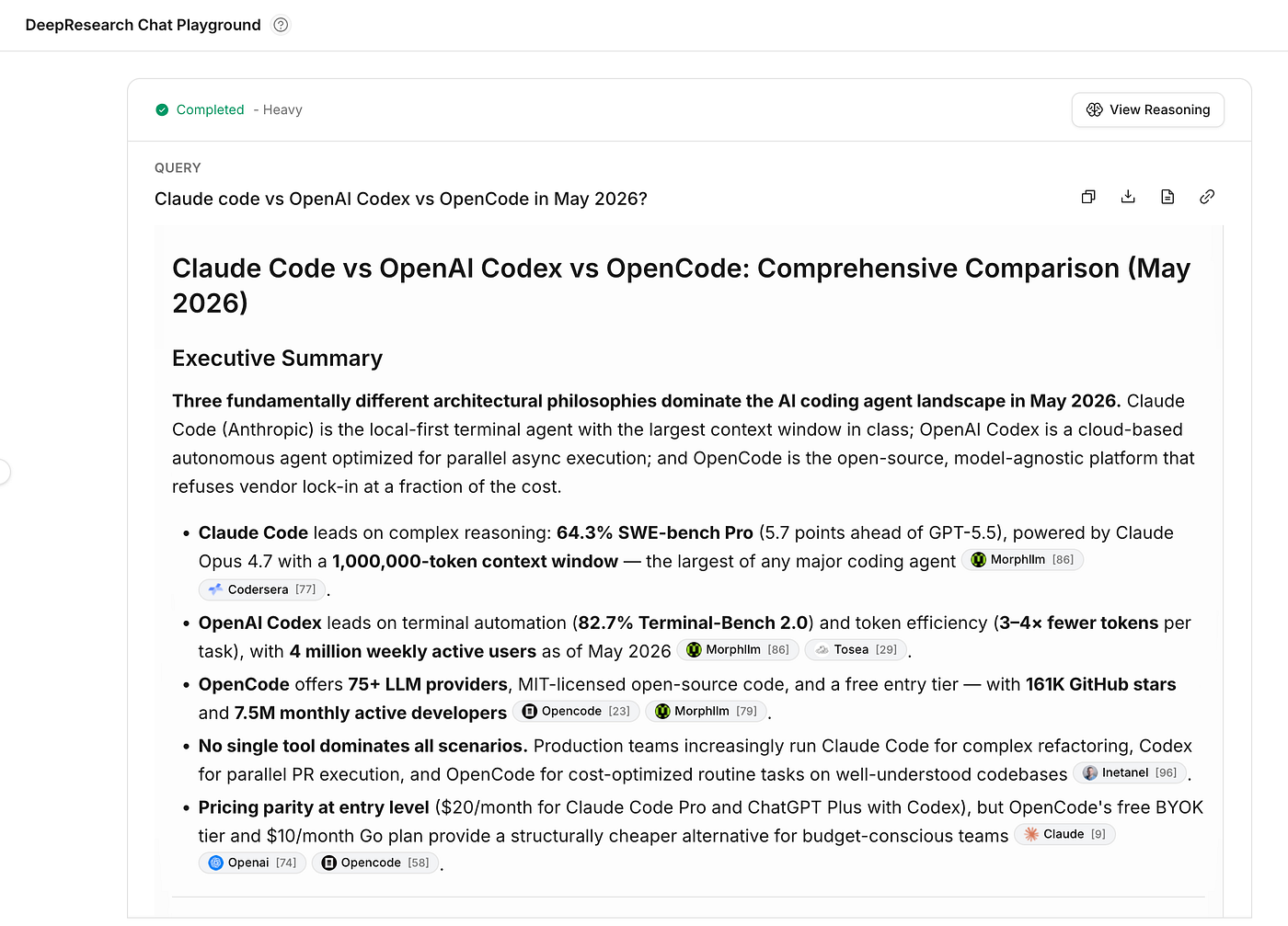
In addition to my personal experience using these tools, I used Valyu deep research to do a very thorough review & comparison of these tools.
Here’s a deep research comparison. The results will shock you!
Frequently Asked Questions
Is Claude Code better than Codex in 2026?
Depends on the task. Claude Code (Opus 4.7) leads on SWE-bench Pro (64.3% vs 58.6%), which tests harder real-world multi-file problems. Codex (GPT-5.5) leads on SWE-bench Verified (88.7% vs 87.6%) and Terminal-Bench 2.0 (82.7% vs 69.4%), which tests shell/system tasks. For most full-stack developers, Claude Code produces higher-quality architectural changes. For systems/terminal work, Codex has a meaningful edge.
Is OpenCode as good as Claude Code?
OpenCode is a model-agnostic agent, not a model. Run Opus 4.7 through OpenCode and you get the same model quality as Claude Code Max at $30–80/month BYOK vs $100–200/month. What you give up is Claude Code’s 29-hook automation system, Skills marketplace, and Agent Teams. If you’re not actively building infrastructure on top of your agent, OpenCode with Opus 4.7 delivers equivalent output quality at lower cost.
What is the cheapest way to use Claude Opus 4.7 for coding?
OpenCode BYOK. Claude Opus 4.7 costs $5/M input tokens and $25/M output tokens directly from Anthropic’s API. Heavy professional coding use typically runs $30–80/month. Claude Code Max with Opus 4.7 starts at $100/month flat.
Does OpenCode work with Claude models?
Yes. OpenCode supports 75+ LLM providers including Anthropic. You can run Claude Sonnet 4.6, Claude Opus 4.7, or any other Claude model through OpenCode with a standard Anthropic API key.
What are the SWE-bench scores for Claude Code vs Codex?
On SWE-bench Verified: GPT-5.5 (Codex) leads at 88.7% vs Claude Opus 4.7 at 87.6%. On SWE-bench Pro (harder, more realistic): Claude Opus 4.7 leads at 64.3% vs GPT-5.5 at 58.6%.
Can I use Claude Code for free?
Claude Code requires a paid Claude plan ($20/month minimum for Pro). There is no permanent free tier for Claude Code. OpenCode is the free alternative, it supports free models (Big Pickle, DeepSeek V4 Flash, Nemotron 3 Super) that require no API key, or you can use a free-tier API from any supported provider.
Which AI coding agent is best for teams in 2026?
For small teams prioritizing cost: OpenCode BYOK with Sonnet 4.6 or Opus 4.7. For teams that need governance, audit trails, and programmatic control over agent behavior: Claude Code Max with its 29-hook system and CLAUDE.md configuration. For enterprise with GitHub-native async workflows and hard security requirements: Codex with OS-level sandboxing.
메타데이터
- post_id
- baa9f6fd5374
- slug
- claude-code-vs-codex-vs-opencode-which-ai-coding-agent-is-actually-the-best-in-2026-baa9f6fd5374
- url
- https://medium.com/@unicodeveloper/claude-code-vs-codex-vs-opencode-which-ai-coding-agent-is-actually-the-best-in-2026-baa9f6fd5374
- canonical_url
- https://medium.com/@unicodeveloper/claude-code-vs-codex-vs-opencode-which-ai-coding-agent-is-actually-the-best-in-2026-baa9f6fd5374
- author_url
- https://medium.com/@unicodeveloper
- status
- ok
- fetched_at
- 2026-06-09 15:37:30