MEL 360: Monitoring, Evaluation and Learning for Systems Change
Author: Suzane Muhereza
MEL 360: Monitoring, Evaluation and Learning for Systems Change
Author: Suzane Muhereza
Contributors: Andrea Estrella Chong, Zazie Tolmer, James Leslie, Xoan Garcia, Charles O’Malley, Grace Lyn Higdon, Alan Hudson, Federica Fregolent
UNDP has set up an M&E Sandbox to nurture and learn from new ways of doing monitoring and evaluation (M&E) that are coherent with the complex nature of the challenges facing the world today. Read more about the Sandbox here.
We convene a series of participatory sessions as part of the MEL Sandbox. In each session we collectively explore a theme in depth, inviting practitioners to speak about their experience testing new ways of doing MEL that helps them navigate complexity. You can read digests and watch recordings of our previous Sandbox sessions here: measuring systems change using pivot metrics, working with complexity, and our first virtual fishbowl session exploring how funding cuts might impact MEL practice. You can also join our MEL Sandbox LinkedIn group to connect, learn and share insights with like minded Sandboxers.
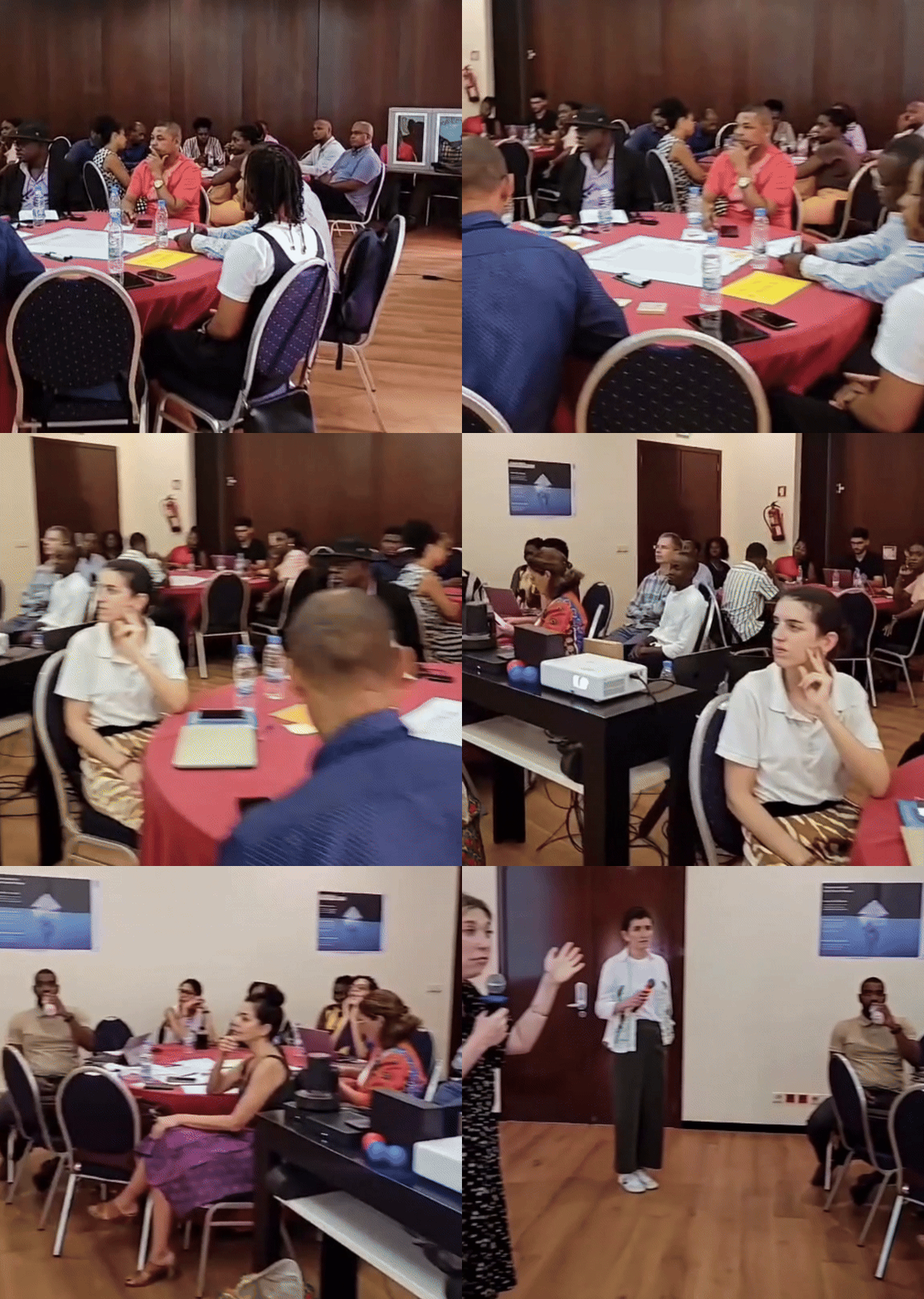
The world’s most pressing challenges — from climate change to inequality — are deeply systemic, demanding a fundamental shift in how development work is monitored and evaluated. In the recent MEL Sandbox session, the Gates Foundation funded UNDP Systems Monitoring Learning and Evaluation (SMLE) Initiative launched the **MEL360 Guidance for systems change**, a new resource designed to meet this demand. This practical, digital set of tools integrates systems thinking into Monitoring, Evaluation, and Learning (MEL), making the practice accessible to a wider audience of practitioners who traditionally operate in the programmatic space.
In the session we heard from **Charles O’Malley (UNDP Food Systems) who reflected on the SMLE journey and how it led to the creation of the digital MEL 360, a set of MEL tools and guidance for food systems and other complex contexts. [Zazie Tolmer](https://www.linkedin.com/in/zazietolmer/) (UNDP Systems Transformation and Innovation) and [Andrea Estrella Chong](https://www.linkedin.com/in/andreaestrellach/) (UNDP Food Systems), co-authors of the Guidance, then shared the core concepts of MEL 360 such as the Orientation lens, the Spiral, the Food Systems toolkit and the tool selector. We then explored practical applications of the MEL 360 within UNDP portfolios with real-world examples from [James Leslie](https://www.linkedin.com/in/james-leslie-29a7946/) (UNDP Food Systems) and [Simone Uriartt](https://www.linkedin.com/in/simoneuriartt/) (UNDP Systems Transformation and Innovation). If this post has sparked your interest, we recommend that you watch the full recording right here.**
MEL 360: A bridge through complexity
“Mel 360 acts as a bridge — helping MEL practitioners transition from traditional, results-based MEL to adaptive, systems-informed learning.”
Kicking off the session, Charles O’Malley, UNDP Senior Systems Change Advisor shared that the initial conceptualization of the UNDP SMLE initiative which led to the MEL 360 Guidance began with a co-inquiry process (2020–22) alongside Hannah Reed from the Gates Foundation, and Soren Vester Haldrup from UNDP to tackle two core framing questions:
- How do we know whether one or multiple systems are showing signals of transforming towards a preferred direction?
- How do we use MEL processes and the insights they provide to learn and adapt when engaging with complex systems?

The resulting MEL 360 guidance is a practical, digital set of tools developed over a multi-year collaborative process involving over 160 contributors from 77 organizations. Its core aim is to integrate systems thinking into Monitoring, Evaluation, and Learning (MEL), making the practice accessible to a wider audience of practitioners. The resulting guidance does not seek to advance the leading edge of the field, but to “help people navigate it,” providing ‘next practice’ rather than ‘best practice.’ It is designed primarily for practitioners who operate in the traditional project space, where as Charles put it, “it feels like there’s a bridge between the two, a sort of… maybe a chasm between the two.” To find out more about our journey and the many people involved, check out the about section on the MEL 360 website.
Core frameworks: Designing and tracking systemic change
*“MEL 360 does not offer a single method, but is a connected framework — from early orientation and design, through iterative learning, to the practical tools that support implementation.”*

The co-authors of the Guidance, Andrea Estrella Chong and Zazie Tolmer, then framed what the Guidance seeks to do, acknowledging that many of the ideas behind systems MEL already exist across disciplines, research, and practitioner communities. However, these ideas have often been scattered, overly theoretical, or hard to apply in real program settings. The guidance aims to bring these ideas together into a coherent, practical framework that helps teams start small, learn iteratively, and grow their systems practice over time. The guidance aims to be pragmatic and flexible — designed by practitioners, for practitioners — built to meet teams where they are and evolve with the field.
The Orientation Lens: Asking the Right Questions at the Start
This framework helps teams to step back and ask: Why are we doing this work? and Where and how are we actually trying to influence the system? Key elements include:
- Strategic Intent: This defines the long-term transformation goal, moving the focus beyond project outputs. As Andrea noted, this question is central: “does it reflect what success would look like for the system, and not necessarily for our project specifically?”.
- System Boundaries: Making complexity manageable by clarifying the specific geography, actors, institutions, and dynamics that are in scope.
- Spheres of Control, Influence, and Interest: Identifying what the team can control, what it can influence through partners, and what it can only observe, ensuring accountability remains realistic.

The Domains of Change
Adapted from systems theory, the Domains of Change framework allows practitioners to track what is shifting underneath the system. These six domains go beyond traditional project indicators to identify the underlying structures that enable or block change:

The Domains of Change inspired a spirited and welcome discussion, with colleagues questioning why specific labels had been chosen for established Domains, Zazie responded, “we had to make a choice that would be a good bridge for people coming into Systems MEL. There are many great system and complexity theories, frameworks, and approaches to make sense of and understand the systems we are working in. This seemed to be a good way to start.” One participant observed that, “DoC selection always sparks debate in all my working contexts. 😅 The debate and contestation over DoCs surfaced in and of itself is incredibly valuable!”
The Spiral
At the core of MEL360 is The Spiral — a way to visualize systems MEL as cyclical, not linear.
It reflects how teams move through continuous learning and adaptation by looping through stages repeatedly — learning, adjusting, and realigning as the system evolves. It’s about building feedback and reflection into the rhythm of work while maintaining a systems gaze.

Finally the team introduced a suite of practical “how-to” tools that are part of MEL 360 — from defining system boundaries or mapping power to identifying leverage points and collective sensemaking. Each tool is modular, and directly linked to the framework. The tools are designed to make systems MEL doable in real projects — not as an extra layer, but an integrated way of working. Leveraging MEL 360 as a bridge between where teams are and where they want to go.

MEL360 in Action: Case Studies
The guidance is already being adopted across UNDP’s portfolio, driving a shift from MEL as an extractive reporting exercise to a generative practice.
Paraguay Case Study: Simone Urriart, a Designer from the System Transformation and Innovation Team at UNDP’s Digital, AI, and Innovation Hub, shared how the UNDP country office in Paraguay is using principles and tools from the guidance as a core part of system portfolios. Collaboration between actors is enabled through recurrent monthly learning sessions where participants share experiences and insights gathered from listening to the Paraguayan people — including trends and signals of change — to inform project adaptation. Simone noted that it was not easy for the country office to make this type of change but a lot was made possible with the principles and guidance available in MEL 360.

James Leslie, the UNDP Food Systems Global Programme Manager, shared how the guidance is being integrated into the work of the Food and Agricultural Commodity Systems (FACS) team. The guidance is helping the country teams within this portfolio work in a more reflective and learning oriented way. James shared that FACS has historically engaged with the complexity of multistakeholder settings in their work — paying attention to power dynamics, relationships, and behaviors — the forces that ultimately enable or block systems change. He added that while FACS have been tracking those dynamics informally for years, the MEL 360 guidance has brought in ways to make those dynamics visible through the Domains of Change — and to treat them as part of our evidence base. The intentional shift toward learning is transforming MEL into a “learning engine,” ensuring that evidence actively informs implementation rather than simply sitting in reports.
James added that the elements of the MEL 360 have sparked interest from partners like the Global Environment Facility, “we found a real alignment around the need to integrate Systems MEL into large, multi-country initiatives. This alignment has directly led to the integration of Systems MEL into the new Blue and Green Islands project, which spans 15 Small Island Developing States across three continents. From the very beginning, we are applying a Systems MEL lens — across sectors, stakeholders, and scales — to design, learn, and adapt as we go.”
One Sandbox colleague highlighted the importance of treating this shift towards systems MEL as an evolution, noting, “I appreciate the focus on evolution rather than shift. I think this is also less threatening for traditional thinking. Evolution also feels aligned with the intent of this resource, which is that each context will offer different possibilities and evolution paths” IG.
Community Reflections: An Anchor Point in Complexity
The launch event also included reflections from Systems practitioners on the guidance’s value and positioning in the field. **Grace Lyn Higdon*, co-founder of Revolution Impact, highlighted that the handbook lends “legitimacy to systems MEL and learning driven practice” by retaining recognizable concepts for the skeptical or uninitiated. She views the guidance as an “anchor point” during external pressures, such as pendulum swings in the sector. “The handbook offers the ability to reflect upon which paradigm will work for the moment/problem a practitioner is facing (there is a time and place for everything). Doing so brings more people to the table to consider the legitimacy of this practice.”*
In his feedback on how the guidance might help practitioners adopt more complexity-informed ways of doing MEL, **Alan Hudson*, a freelance complexity learning partner, focused on the need to prioritize “local learning systems” tailored to the needs of local actors. He also stressed the importance of taking proper account of the “political economy of systems change”, including the crucial dynamics of power, resource flows, and incentives that determine if learning will lead to meaningful action. Having been part of the technical working groups that have feedback on early iterations of MEL 360, Alan shared, “I’ve wondered, throughout this process, whether MEL 360 is intended for just the complex/emergent model that Lynn and Coffman talk about or also for the complicated/system dynamics one. I think it’s more the former (that is where the bigger gap is), but sometimes it seems like the guide is trying to ride both horses. Which MAY be OK, but will also be challenging.”* You can read more of Alan’s reflections on the guidance here.
MEL Sandbox colleagues shared a range of thoughtful reflections in response to the Guidance content, an overview below:

Q: I think this is fantastic work and I am very much looking forward to exploring the resources. One limitation I anticipate is that systemic MEL will take more time and therefore be more costly. How do we ensure donors are onboard and ready to fund this type of work?
A: We agree with you! Which is why we aimed to make the guidance easily implementable and we included a section on the realities of doing Systems MEL. The approach we encourage in the guidance is to start by introducing one tool and then as you build your experience, and/or build the familiarity of others with these tools you will create more space for the practice. We also included a readiness check to help with determining where there is appetite for Systems MEL. When we first tested this tool, colleagues felt that it could be useful in advocating for support from funders and decision makers for Systems MEL. Finally, the guidance was also developed for funders. When we talk about practitioners we also refer to practitioners in funding organisations.
Q: When involving the private sector, how may we harmonise approaches between the MEL 360 approach and the more linear “ESG/CSRD” approach?
A: We feel that it is more about finding ways to leverage the different approaches rather than trying to harmonize them. This is assuming that harmonization refers to making the approaches consistent or compatible. There is real potential in having very different approaches that tell you different things about the system or the work. ESG is very useful in providing an understanding of a business’ corporate governance and its implications for and effects on people and the environment. Systems MEL is very useful in giving funders and implementers a systemic view of their development efforts, including their fit within the systems of interest, their potential for contributing to influencing systems to become more generative for people and the planet. The question is less about how to harmonise and more how to leverage all the intelligence we produce through the different monitoring, evaluation, and learning approaches and frameworks.
Q: Is there preference of scale of project in application of Systems MEL 360?
A: We designed MEL 360 so that it could be applied to projects, programs, or portfolios. It is scalable and is designed to leverage and be combined with any existing MEL.
Q: Is there a given sequence? Would you always start with strategic intent, then system boundaries, then spheres of control, influence, and interest?
A: We designed MEL 360 so that you could start anywhere and with the tool(s) that best fit your situation. We advance that even on their own the tools and techniques shared in MEL 360 bring value. The sequence in which the tools are presented on the website builds on a Business as Usual way of designing and implementing projects, programs, and portfolios. This was done to support the integration of Systems MEL into contexts not designed for Systems MEL.
Q: I am interested in better understanding how UNDP colleagues assess their different roles (in any given initiative) as part of understanding their own contributions to systems change.
A: UNDP colleagues often assess their roles in systems change by reflecting on how their work contributes to shifts beyond individual projects or outputs. There is a shared understanding that we are all part of the systems we aim to transform — and therefore also part of the problems we seek to address. This recognition means that by changing how we think and act, we can also become part of the solution and contribute more meaningfully to systemic change.
Within this perspective, different teams play distinct yet complementary roles. For example, colleagues at the Strategic Innovation Unit (SIU) are introducing systems- and complexity-informed approaches across UNDP and its partners. This involves not only developing methodologies but also building the competencies, mindsets, and institutional systems needed to work in this way — from training and sensemaking practices to supporting internal change processes. Similarly, colleagues in other parts of the organization, such as FACS and regional hubs, apply these approaches within their thematic areas, helping embed systems thinking into everyday decision-making and collective action.
Ultimately, assessing one’s role in systems change is less about individual achievements and more about understanding how our contributions — at different levels — help create the conditions for collective learning, collaboration, and long-term transformation.
To hear more about what was discussed in the lively Q&A session, please watch the session here.
UNDP SMLE is hosting a series of four free, open-access modular training sessions that will be offered throughout November and early December to help practitioners apply the MEL360 Guidance in a practical way. The team invites all practitioners to explore the guidance and register for the training series to contribute to the evolution of this vital field. “MEL 360 in Practice: Monitoring, Evaluation and Learning for Systems Change”. Dates: Tuesdays, November 11, 18, 25 & December 2 | Time: 9 AM EDT / 3 PM CET / 4 PM EAT: **HERE**.
Additionally, if you are interested in joining UNDP SMLE’s Coalition of Partners and/or collaborating with the MEL Sandbox Community, please complete this short expression of interest form **HERE** or contact the team at mel360@undp.org.
Additional Resources
Welthungerhilfe WHH’s Food System Toolkit.
Shifting the locus of learning: catalyzing private sector learning to drive systemic change.
Emily Gates & Pablo Vidueira: A critical, integrative review on integrating systems change and transformation.
메타데이터
- post_id
- babc5ef9a5dd
- slug
- mel-360-monitoring-evaluation-and-learning-for-systems-change-babc5ef9a5dd
- url
- https://medium.com/@undp.innovation/mel-360-monitoring-evaluation-and-learning-for-systems-change-babc5ef9a5dd
- canonical_url
- https://medium.com/@undp.innovation/mel-360-monitoring-evaluation-and-learning-for-systems-change-babc5ef9a5dd
- author_url
- https://medium.com/@undp.innovation
- status
- ok
- fetched_at
- 2026-06-21 07:44:09