Famous Courtesans of Antiquity-Gnathaena and Gnathaeniŏn
How to Party like it’s 399 BCE
Famous Courtesans of Antiquity-Gnathaena and Gnathaeniŏn
How to Party like it’s 399 BCE
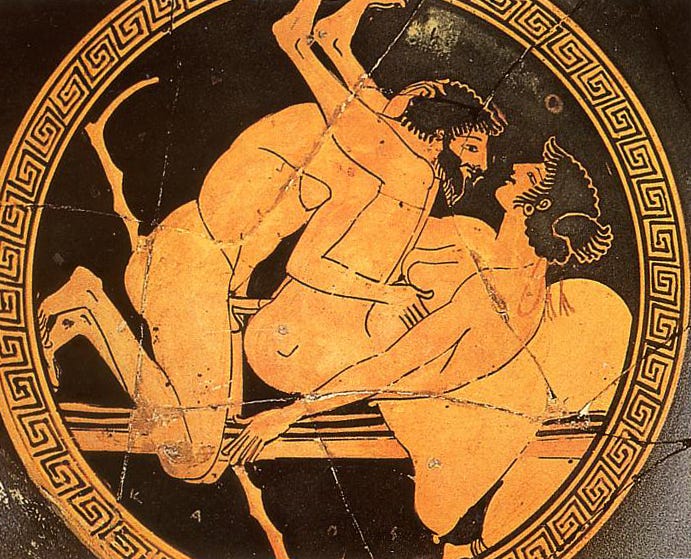
Attic red figure vase-public domain
This is the last installment in the series of famous courtesans from antiquity. In many cases the sources on which the information that we have about these famous or infamous women is somewhat scarce. However, one thing is clear, people have always loved to gossip and particularly about matters of a salacious nature.
There is much debate among historians as to the veracity of some of the accounts of these women that are found in ancient texts and that the women were more than just courtesans or whores and that many of them were intellectually accomplished, astute political operatives or successful businesswomen. I don’t see why they couldn’t have been all of these things. Human beings are complex and not one dimensional.
These disputes aside one thing is clear, throughout history women have always had a degree of agency and have used what talents they have to shape their own destinies as best they can given the opportunities and limitations of any given time.
I thought that I would end this series with Gnathaena and her daughter or granddaughter Gnathaeniŏn . Although Gnathaena was reputed to be an extremely witty woman and Athenaeus recounts a number of examples of her repartee she was also known to be very much about the money. From the sources we know that Gnathaeniŏn received the highest price for a single night of any hetaira for which we have evidence.
Gnathaena was a fourth century Athenian hetaira, envied for her opulent symposiums and witty conversation.
Her status as hetairai gave Gnathaena the privilege of education, the right to control her own finances and to host banquets and symposiums of her own that were attended by the most prestigious and wealthy men of ancient Athens.
To be certain that her parties would go down in history as the most successful in all of Athens, Gnathaena wrote a code of conduct for proper manners at her symposiums called ‘Rules for Dining in Company’.
Gnathaena… even compiled a code of laws for banquets, according to which lovers were to be admitted to her and to her daughters, in imitation of the philosophers, who had drawn up similar documents. And Callimachus has recorded this code of hers in the third Catalogue of Laws which he has given; and he has quoted the first words of it as follows:- “This law has been compiled, being fair and equitable; and it is written in three hundred and twenty-three verses.” (1)
Athenaeus has also collected a number of anecdotes about Gnathaena citing Machon as the source. Machon was a Greek playwright who lived in the 3rd Century BCE. His plays of which only fragments survive are referred to as ‘New Comedies’.
One of the most notable of Gnathaena’s consorts was Diphilus (342–291 BCE), another Athenian comedic playwright of who wrote around 100 plays in the style of New Comedy. Athenaeus cites Machon as his evidence for Diphilus’ and Gnathaena’s relationship.
According to Athenaeus, Gnathaena often made fun of Diphilus and his plays, though he is described as “a man above her other lovers beloved by her”. (2)
For example Athenaues recounts the following anecdote as an example of her acid wit.
Diphilus once was drinking with Gnathaena. Said he, “Your cup is somewhat cold, Gnathaena;” (3) and she replied, “‘Tis no great wonder, Diphilus, for we take care to put some of your plays in it.” (4)
On another ocassion: “Diphilus was once invited to a banquet at fair Gnathaena’s house, as men do say, on the day of Aphrodite’s festival- (He being a man above her other lovers Beloved by her, though she concealed her flame), He came accordingly, and brought with him Two jars of Chian wine, and four, quite full, Of wine from Thasos; perfumes, too, and crowns; sweetmeats and venison; fillets for the head; fish, and a cook, and a female flute-player.
In the meantime, a Syrian friend of hers sent her some snow, and one saperda; she being ashamed lest any one should hear she had received such gifts, and, above all men, fearing lest Diphilus should get at them, and show her up in one of his comedies, she bade a slave to carry off at once the salt fish to the men who wanted salt, as every one did know; the snow she told him to mix with the wine unseen by any one.
And then she bade the boy to fill the cup with ten full cyathie of wine, and bear it at once to Diphilus. He eagerly received the cup, and drained it to the bottom, And, marveling at the delicious coolness, Said- “By Athena, and by all the gods, you must, Gnathaena, be allowed by all to have a most deliciously cool well.” “Yes,” said she, “for we carefully put in, from day to day, the prologues of your plays.” (5)
Another anecdote that Atheaeus tells about Gnathaena to illustrate her wit is as follows:
Gnathaena once was supping with Dexithea, who was a courtesan as well as she; and when Dexithea put aside with care nearly all the daintiest morsels for her mother she said, “I swear by Artemis, had I known how you went on, Dexithea, I would rather have gone to supper with your mother than you.” (6)
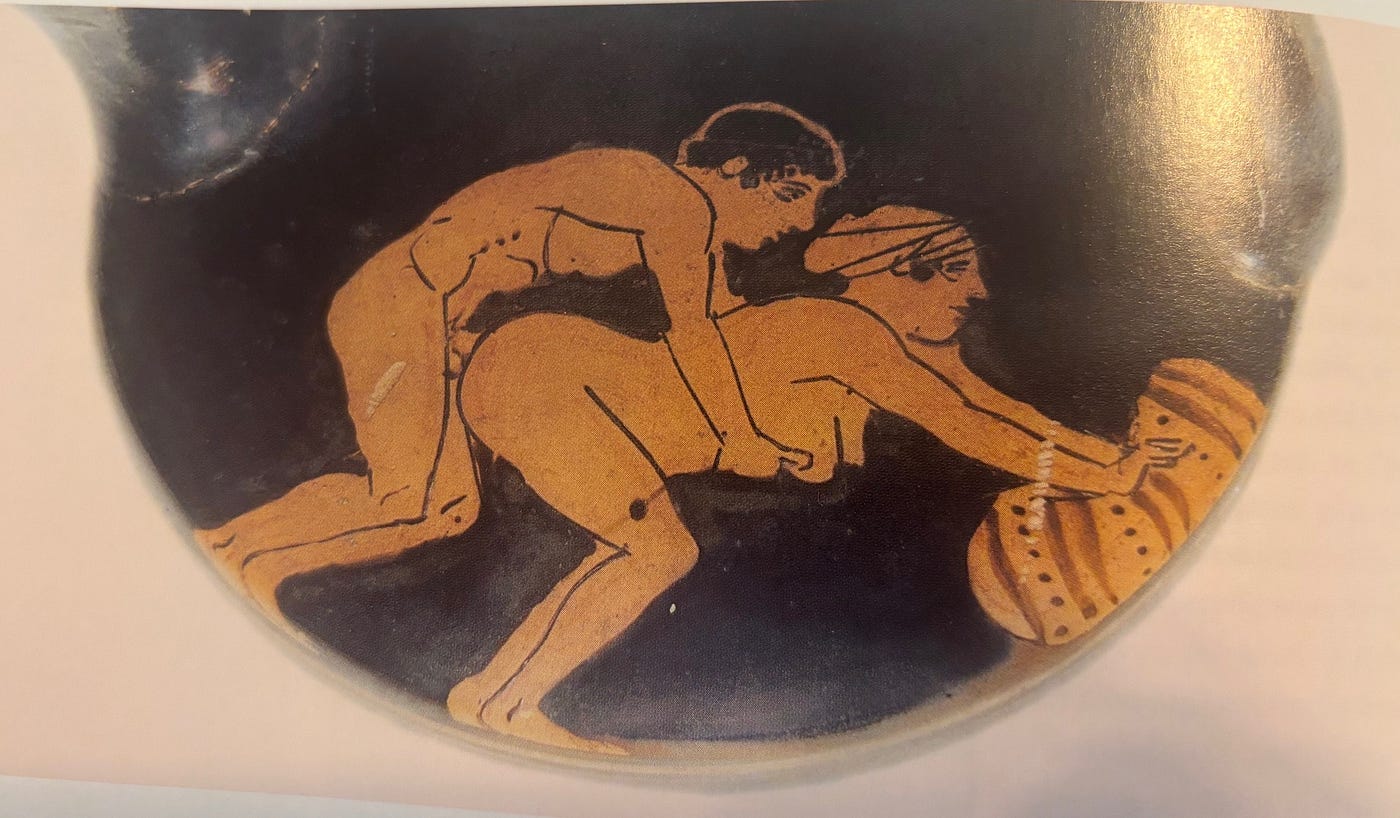
Vaameikos Museum, Athens-public domainse form Aksos c 470 BCE- Ker
The sexual positions used by the hetairae in ancient Greece were divdided into three and the price to be paid for intercourse varied depending upon the position being used.
According to James Davidson there were different prices charged for different sexual positions. The act depicted above was called kubda and was deemed whorish and cheap and cost three obols or about $20.00. The second type of rear entry position with the woman leaning back was called lordo and cost one drachma or about $43.00. The most expensive position was called keles or ‘the racehorse’ which was a woman on top position for which there was no standard price. (7)
Gnathaena was thus insulted in her old age in this regard as Athenaeus tells us.
“When this Gnathaena was advanced in years, hastening, as all might see, towards the grave, they say she once ventured out into the market, and looked at all the fish, and asked the price of every article she saw. And seeing a handsome butcher standing at his stall, just in the flower of youth,- “Oh, in God’s name, tell me, my youth, what is your price (πῶς ἵστης) to-day ?” He laughed, and said, “ Why, if I stoop, three obols.” “But who,” said she, “did give you leave, you wretch, to use your Carian weights in Attica?” (8)
The butcher thus insinuated that she was barely one step above a common prostitute or pornai the fee for which was two obols. Gnathaena attempts to turn it back on him by accusing him of using fraudulent weights, but the insult must have struck home.
It is said that Gnathaena brought her daughter or granddaughter Gnathaeniŏn into the trade. It is not clear if she was in fact her daughter or grandaughter as she is mentioned as either in the sources.
Athenaeus tells several anecdotes about her which give us some insight into the mores and behavior of the people of the time. In this case the tale is illustrative of the personal agency and independence that a woman of Gnathaeniŏn’s stature had. This is in stark contrast to that lack of agnecy which a wife in Ancient Greece would have had.
“There was at Athens once a handsome smith, when she, Gnathaeniŏn, had almost abandoned her trade, and would no longer common be, moved by the love of the actor Andronicus; (But at this moment he was gone away, after she’d brought him a male child;) this smith then long besought the fair Gnathaeniŏn to fix her price; and though she long refused, by long entreaty and liberality, at last he won her over to consent. But being but a rude and ill-bred clown, he, one day sitting with some friends of his in a leather-cutter’s shop, began to talk about Gnathaeniŏn to divert their leisure, saying that he never consorted with her in any other way, except that she rode on top of him, five times over. But after this, when Andronicus came From Corinth back again, and heard the news, he bitterly reproached her, and at supper he said, with just complaint, unto Gnathaeniŏn, that she had never granted him such liberties as this flogged slave had had allowed to him. And then they say Gnathaeniŏn thus replied: ‘That she was her own mistress, and the smith was so begrimed with soot and dirt that she did not wish to embrace him; but after receiving a large sum of gold, she gave in to his request, and cleverly contrived to touch the part of him, which, though small, stuck out the furthest.’” (9)
Finally, here is the account from Athenaeus in which Gnathaeniŏn receives what is the largest sum for a single night recorded in all of the sources.
It happened once that a very aged satrap, full ninety years of age, had come to Athens. And on the feast of Cronus he beheld Gnathaeniŏn with Gnathaena going out from a fair temple sacred to Aphrodite, and noticing her form and grace of motion, he just inquired, “How much she asked a night?” Gnathaena, looking on his purple robe, and princely bodyguard, said, “A thousand drachmas ($43,500).” He, as if smitten with a mortal wound, said, “I perceive, because of all these soldiers, you look upon me as a captured enemy; But take five minae ($21,750), and agree with me, and let them get a bed prepared for us.” She, as the satrap seemed a witty man, received his terms, and said, “Give what you like, O father, for I know most certainly, You’ll give my daughter twice as much at night.” (10)
It appears that even at a rate of 5 minae that Gnathaeniŏn was a bargain compared to the most prominent (or notorious) courtesan of our current period who does not possesses the wit of a hetaira and is, in my opinion the most overpriced pornai that the world has ever seen. On that note we will take our leave of these accomplished women of Ancient Greece.
- Deipnosophistae of Athenaeus, Translation by C D Yonge 1854
- Deipnosophistae. Op. Cit.
- The Greek used here makes this a slur about her ‘cup’ i.e. her vagina being cold.
- Deipnosophistae, Op. Cit.
- Deipnosophistae, Op. Cit.
- Deipnosophistae, Op. Cit.
- Courtesans and Fishcakes, The Consuming Passions of Classical Athens, James Davidson, Fontana Press, London 1997
- Deipnosophistae, Op. Cit.
- Deipnosophistae, Op. Cit.
- Deipnosophistae, Op. Cit.

Glenn M Stewart
Pugilist, polemicist, Oxford Arabist, financial mastermind, international man of mystery, film producer, playwright, part-time-poet, full-time provocateur…
메타데이터
- post_id
- bacf4798f1a6
- slug
- famous-courtesans-of-antiquity-gnathaena-and-gnathaeniŏn-bacf4798f1a6
- url
- https://medium.com/mmm-mondays/famous-courtesans-of-antiquity-gnathaena-and-gnathaeni%C5%8Fn-bacf4798f1a6
- canonical_url
- https://medium.com/mmm-mondays/famous-courtesans-of-antiquity-gnathaena-and-gnathaeni%C5%8Fn-bacf4798f1a6
- author_url
- https://medium.com/@glenn-stewartm
- status
- ok
- fetched_at
- 2026-07-08 23:08:13