When Students Take to the Streets: Inside Jharkhand’s Intensifying Protest Over Recruitment Exams
Why thousands of young people in Jharkhand are demanding transparency, accountability and a fair chance at government jobs
When Students Take to the Streets: Inside Jharkhand’s Intensifying Protest Over Recruitment Exams
Why thousands of young people in Jharkhand are demanding transparency, accountability and a fair chance at government jobs
By Anka Niharika
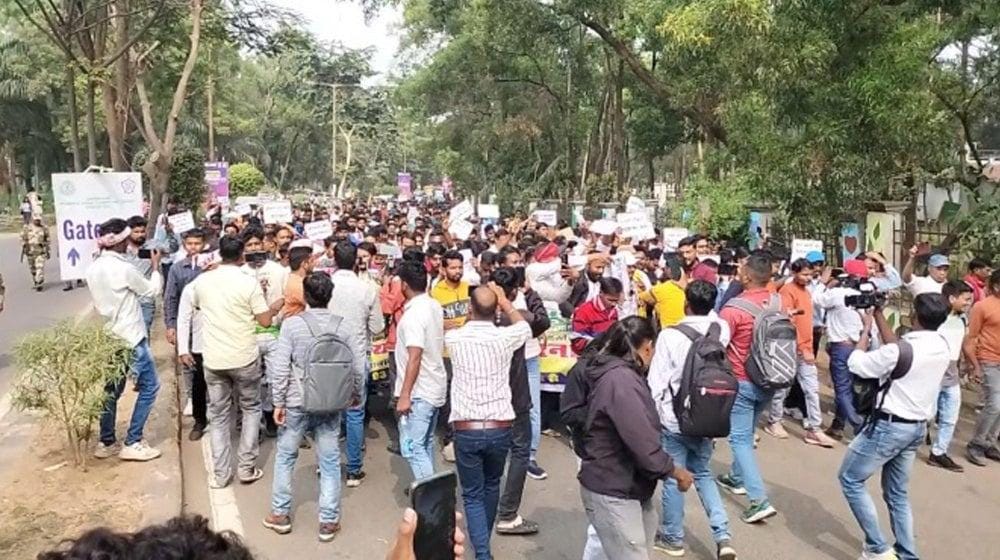
large protest crowd
This article reflects publicly available reporting through August 12, 2026. Allegations concerning examination irregularities remain matters of investigation and should not be treated as established facts.
For thousands of young people in Jharkhand, government examinations are more than tests.
They represent years of preparation, financial sacrifice, family expectations and the hope of securing a stable future.
That is why the student and job-aspirant protests that have gripped Ranchi in recent weeks have become much bigger than an ordinary disagreement over an examination. What began around allegations of irregularities in recruitment examinations has developed into a sustained confrontation involving students, the state government, opposition parties, police and several student organisations.
The agitation entered its 19th day on August 12, with protesters continuing to demand greater transparency in recruitment examinations, cancellation of examinations they consider compromised, an independent investigation and reforms in the recruitment system.
The scenes from Ranchi have been striking: thousands of aspirants gathering at protest sites, marches through the city, hunger strikes, barricades, police deployment, water cannons, tear gas and lathi charges.
But behind the dramatic images lies a more important question:
What happens to the trust of young people when they begin to believe that even years of hard work may not be enough to secure a fair opportunity?
The roots of the anger
The current agitation is closely connected to concerns surrounding recruitment examinations conducted by the Jharkhand Public Service Commission (JPSC) and the Jharkhand Staff Selection Commission (JSSC).
JPSC is responsible for recruitment to important state-level civil services, while JSSC conducts recruitment for various other government positions. For thousands of aspirants, clearing these examinations can mean entering a secure government career.
The controversy intensified around the 14th JPSC Combined Civil Services Examination and other recruitment examinations.
According to reporting by The Indian Express, scrutiny increased after former Jharkhand Chief Secretary L. Khiangte, who had served as JPSC chairperson, resigned amid controversy surrounding alleged irregularities in the 14th Combined Civil Services Examination. The examination was held in April 2026.
Students and aspirants subsequently began demanding answers.
Their argument is straightforward: if an examination process is questioned, candidates need confidence that the selection process is fair, transparent and capable of identifying genuine wrongdoing.
That confidence becomes particularly important in competitive examinations where candidates may spend several years preparing.
July 29: The protest becomes a mass movement
On July 29, thousands of students gathered in Ranchi under the banner of the Joint Students Front and marched from Jaipal Singh Munda Stadium towards Albert Ekka Chowk.

Their slogans reflected the seriousness of their concerns. Among their demands were cancellation of the 14th JPSC preliminary examination, an investigation by the Central Bureau of Investigation (CBI), and action over alleged irregularities in JPSC and JSSC examinations.
The July 29 mobilisation was an important turning point.
The issue was no longer confined to individual candidates discussing their concerns online or outside examination centres. Students from different parts of Jharkhand were gathering together and taking their grievances to the streets.
The movement also attracted political attention.
Student and youth wings of political organisations organised separate demonstrations, while opposition parties increasingly used the controversy to attack the state government.
That political involvement has created another complicated dimension to the protest.
The students insist that their concerns are about their careers and the integrity of recruitment examinations. At the same time, political parties have increasingly entered the conversation, with different groups supporting the protesters or using the issue to criticise the government.
This raises an important challenge for the movement: Can a student protest remain focused on examination reform when political parties become involved?
The demand for a CBI investigation
One of the most consistent demands from the protesting aspirants has been an independent investigation.
Students have called for a CBI investigation or, alternatively, an inquiry by a panel of retired High Court judges from outside Jharkhand. They argue that an investigation must be sufficiently independent to restore confidence in the recruitment system.
The distinction between an investigation and cancellation is important.
Cancelling an examination may give candidates another opportunity to compete. But it does not necessarily answer the question of what went wrong.
If irregularities occurred, students want accountability.
If no wrongdoing occurred, students also want that conclusion to be established through a process they consider credible.
In other words, the demand is not simply:
“Cancel the examination.”
It is also:
“Tell us what happened, who was responsible, and how the system will prevent it from happening again.”
That demand for institutional accountability is one reason the agitation has continued even after the government offered assurances about reforms.
From protest ground to Assembly confrontation
The tension reached a new level when protesters attempted to march towards the Jharkhand Assembly.

Police used barricades to restrict the movement. During confrontations, authorities deployed water cannons and tear gas, and lathi charges were reported. Students alleged that police action caused injuries, while police said that some protesters became aggressive, damaged barricades and pelted stones.
This difference in accounts is significant.
Protesters describe the police response as excessive and argue that their movement was fundamentally peaceful.
Police authorities have maintained that most students were peaceful but that a section of the crowd became aggressive and that officers were injured during the confrontation.
According to Ranchi City Superintendent of Police Paras Rana, around 90 percent of the students were peaceful, while a smaller section allegedly ignored appeals and broke through barricades. Police also alleged stone-pelting during the confrontation.
The competing accounts demonstrate why independent fact-finding is important.
Whenever large crowds confront law enforcement, emotions rise quickly. Individual incidents can be interpreted very differently by protesters, police and political organisations.
A credible investigation should establish what happened based on evidence rather than political claims.
The human cost of a prolonged protest
Perhaps the most serious aspect of the current agitation is the physical toll on the protesters.
The protest has continued for weeks, and some students have resorted to hunger strikes.

The New Indian Express reported on August 12 that six demonstrators were on indefinite hunger strikes, with some requiring hospital treatment. Student leader Devendra Nath Mahto had also been fasting for several days and was reported to be under medical supervision.
A hunger strike is not simply another form of protest.
It is a demonstration of desperation.
For a young person who has spent years preparing for competitive examinations, uncertainty can become emotionally exhausting. The pressure is not only academic.
There are coaching fees.
There are books.
There are travel expenses.
There are application fees.
There are years spent preparing instead of earning.
And, in many families, there is the expectation that one successful examination will change the economic future of the household.
When an examination is questioned, candidates may feel that all those sacrifices are suddenly uncertain.
That is why the protest cannot be understood merely as a political gathering.
For many participants, it is deeply personal.
Why government recruitment matters so much
Government employment carries particular importance in many parts of India.
A government job can offer stability, predictable income and social security. In families where employment opportunities are limited, a government position may be viewed as one of the most reliable paths toward financial independence.
This makes recruitment examinations extremely consequential.
A candidate may spend two or three years preparing for a single examination.
Imagine studying for thousands of hours only to discover that the examination itself is surrounded by allegations of irregularity.
Even if a candidate has done nothing wrong, uncertainty can create a sense of helplessness.
That is the emotional background against which the Jharkhand protests should be understood.
The students are not simply asking for another examination.
They are asking for confidence that the next examination will be fair.
The role of the state government
The Jharkhand government has said that it is committed to reforming the examination system.
Chief Minister Hemant Soren has maintained that his government wants transparency and has assured protesters that the 14th JPSC examination would be cancelled. At the same time, the protesters have continued to demand an independent investigation into the broader allegations.
This difference explains why several rounds of talks have failed to produce a final settlement.
The government appears to be focusing on reforms and actions within its authority.
The protesters want something broader: an investigation that they believe can independently establish responsibility.
The disagreement is therefore not only about an examination.
It is about trust.
If students do not trust the existing investigation, government assurances may not be enough.
If the government believes its existing mechanisms are capable of investigating the allegations, it may not accept every demand for an external investigation.
Bridging that gap requires more than political speeches.
It requires transparent communication, evidence and a process that all sides can accept as credible.
Politics enters the protest
As the agitation continued, political parties increasingly became involved.
Opposition leaders visited protest sites, criticised the government and demanded independent investigations. The BJP also observed a statewide bandh after the police action, while other student organisations organised marches of their own. The Jharkhand Assembly session was disrupted amid arguments over the examination controversy and police action against protesters.
The political involvement has two sides.
On one hand, political pressure can force governments to pay attention to issues that might otherwise be ignored.
On the other hand, it can make it difficult for the public to distinguish between genuine student concerns and political campaigning.
That is why the students’ demands should be judged independently of party politics.
Whether someone supports the ruling alliance, the opposition or no political party at all, the basic principle remains the same:
Competitive examinations should be conducted fairly, transparently and professionally.
The larger problem: examination trust in India
Jharkhand’s situation is not occurring in isolation.
Across India, examination paper leaks, delays, technical problems, disputed results and allegations of irregularities have repeatedly generated anger among students.
The issue is larger than one state.
Modern competitive examinations involve enormous numbers of candidates, technology platforms, outsourced agencies, examination centres, data systems and multiple layers of administration.
A weakness at any stage can damage the credibility of the entire process.
The Jharkhand controversy therefore provides an opportunity to ask a broader question:
How can governments build examination systems that candidates trust even when something goes wrong?
The answer cannot simply be stronger security.
It must include transparency.
Candidates should know how examinations are conducted, how agencies are selected, how complaints are investigated and how responsibility is fixed when irregularities are discovered.
Outsourcing and accountability
One particularly important issue raised in reporting concerns the role of private examination agencies.
According to reporting on the controversy, the JPSC had engaged TSR Data Processing Private Limited (TDPL) for examination-related work. The company had reportedly been blacklisted by JSSC in 2025 following allegations of irregularities, while questions have also been raised about how the company was empanelled and awarded work by JPSC.
These allegations deserve careful investigation.
Outsourcing examination operations is not automatically wrong. Private agencies can provide technological infrastructure and logistical capacity that government institutions may not have internally.
But outsourcing should never mean outsourcing accountability.
If a private company is involved in an examination, the public authority remains responsible for ensuring that the process is secure and fair.
There should be clear eligibility requirements, transparent procurement, background checks, security audits and mechanisms for accountability.
Most importantly, candidates should not have to wonder whether the organisation conducting their examination is trustworthy.
The students’ biggest demand: a future they can believe in
The most powerful aspect of the protest is perhaps its simplicity.
Students want to believe that studying hard can change their lives.
They want to believe that merit will be recognised.
They want to believe that an examination hall is a place where everyone starts with the same opportunity.
When that belief weakens, frustration can quickly become anger.
For many young people, competitive examinations are already difficult enough. They face enormous competition, limited vacancies and years of preparation.
The system does not need to be perfect.
But it needs to be trustworthy.
A candidate should be able to fail an examination and accept the result because they know that everyone was given a fair opportunity.
That is the foundation of a credible recruitment system.
What happens next?
As of August 12, the deadlock had not been resolved.
The protests had entered their 19th day, and the protesters said they would continue their agitation. Government-student talks had failed to produce a breakthrough, while student organisations were discussing further programmes.
The immediate path forward is difficult but not impossible.
First, the government needs to maintain open and meaningful dialogue with representatives of the protesting students.
Second, allegations concerning examinations should be investigated through a process that is transparent enough to restore public confidence.
Third, students need clear information about which examinations will be cancelled, which will continue and what reforms will be introduced.
Fourth, any allegations of wrongdoing should be investigated on the basis of evidence, regardless of whether the accused person is a government official, private contractor or candidate.
Finally, protesters and political organisations also have a responsibility.
Peaceful protest is a democratic right. But violence, stone-pelting, destruction of public property and attacks on police or other citizens cannot be justified as part of a legitimate movement.
The same principle applies to law enforcement.
Maintaining public order is necessary, but force should be proportionate, and allegations of excessive force should themselves be independently examined.
Beyond the headlines
It is easy to look at photographs of crowds, barricades and police lines and reduce the Jharkhand protests to a story of confrontation.
But the deeper story is about young people trying to protect their future.
A student sitting at a protest site is not necessarily rejecting the system.
In many cases, they are demanding that the system work as promised.
They have studied the syllabus.
They have taken mock tests.
They have sacrificed holidays.
They have spent money on preparation.
They have waited for recruitment notifications.
They have travelled to examination centres.
They have imagined seeing their names on a final selection list.
For them, an examination is not just a piece of paper.
It is a possible turning point in life.
That is why allegations of irregularities carry such emotional weight.
A test for more than the students
The Jharkhand protests are ultimately a test not only for the students but also for the institutions responsible for recruitment.
A democratic government is not judged only by how it handles elections or legislation.
It is also judged by how it responds when ordinary citizens question the functioning of public institutions.
The students are asking difficult questions.
The government must provide credible answers.
If the allegations are proven wrong, the investigation should establish that clearly.
If wrongdoing is found, those responsible should face appropriate consequences.
And if weaknesses in the system are identified, they should be corrected before the next examination.
That is how trust can be rebuilt.
The road ahead
The images coming out of Ranchi may eventually disappear from the news cycle.
The barricades will be removed.
The crowds will go home.
The protest banners will come down.
But the underlying issue will remain.
Can a young person in Jharkhand prepare for a government examination with confidence that the process will be fair?
That is the question at the heart of this movement.
The answer cannot be delivered through slogans alone.
It cannot be delivered through political speeches.
And it cannot be delivered through police action.
It can only be delivered through credible institutions, transparent investigations, fair examinations and accountability.
For the students who have spent years preparing for a government job, that is not an unreasonable demand.
It is the minimum they should be able to expect.
And perhaps that is the most important lesson from the protests in Jharkhand:
Students do not merely want a chance to compete. They want to believe that the competition itself is fair.
메타데이터
- post_id
- bb01d10c908e
- slug
- when-students-take-to-the-streets-inside-jharkhands-intensifying-protest-over-recruitment-exams-bb01d10c908e
- url
- https://medium.com/@ankaneha910/when-students-take-to-the-streets-inside-jharkhands-intensifying-protest-over-recruitment-exams-bb01d10c908e
- canonical_url
- https://medium.com/@ankaneha910/when-students-take-to-the-streets-inside-jharkhands-intensifying-protest-over-recruitment-exams-bb01d10c908e
- author_url
- https://medium.com/@ankaneha910
- status
- ok
- fetched_at
- 2026-08-17 22:39:13




