The Map Hasn’t Changed — Darren Bailey’s Problem Is That He Hasn’t Either
Same Map, Same Problems — and a Candidate Caught Between Two Versions of Himself
The Map Hasn’t Changed — Darren Bailey’s Problem Is That He Hasn’t Either
Same Map, Same Problems — and a Candidate Caught Between Two Versions of Himself
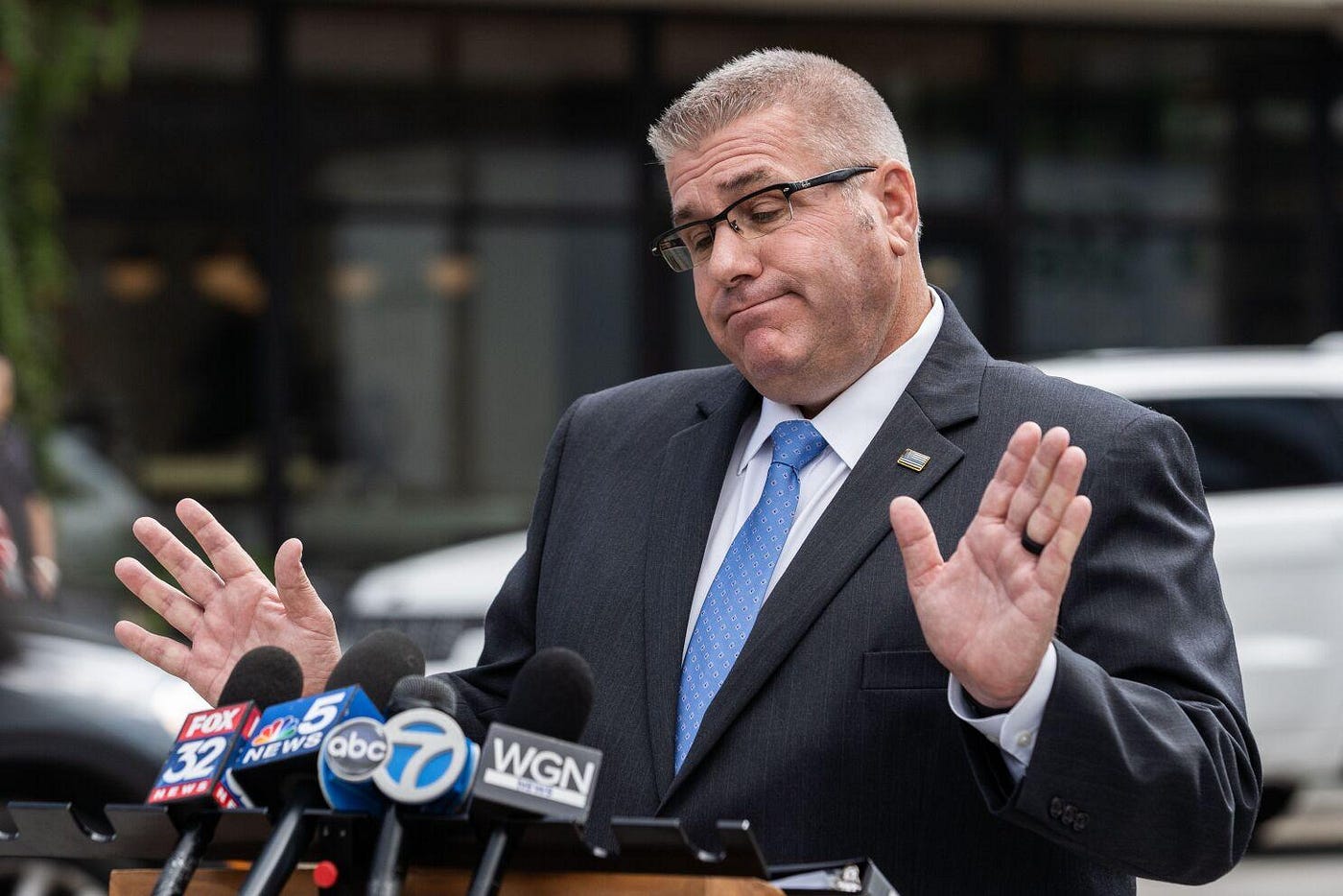
Darren Bailey speaks to Chicago media after relocating to the city he once called a “hellhole” — a move that reflects the tension between his past rhetoric and current political repositioning. Photo by Ashlee Rezin/Sun-Times
There’s a version of this Illinois governor’s race where everything feels new — new tone, new strategy, new candidate.
This is not that version.
As of mid-May, the contours of the race are already becoming clear. What we’re looking at instead is something far more familiar: a rematch of 2022, with slightly worse conditions for Darren Bailey and a clearer path for JB Pritzker.
And the uncomfortable truth for Bailey is this:
The map hasn’t changed. His problems haven’t either.
The Illusion of Reinvention
Bailey has tried to present himself as something of a recalibrated candidate — less inflammatory, more measured, even willing to distance himself from Donald Trump when necessary.
On paper, that’s the right instinct.
In practice, it’s not sticking.
You can’t say “I’m not MAGA” while still moving in MAGA-adjacent spaces, echoing its language, and framing your campaign through many of its priorities. Voters — especially in the suburbs — are remarkably good at spotting when a shift feels cosmetic rather than real.
And that’s the core issue:
This doesn’t feel like evolution. It feels like repackaging.
The Problem With Running a Rematch
Bailey’s 2022 campaign benefited from something that can’t easily be recreated: insurgent novelty.
In 2022, he was the outsider candidate. The anti-establishment disruptor. The rural conservative willing to say things more traditional Illinois Republicans often avoided saying aloud.
But 2026 changes the psychology of the race.
Because Bailey is no longer introducing himself to voters. He’s returning to them after already losing statewide once.
And familiarity cuts differently than novelty.
Rematches tend to favor incumbents unless:
- the incumbent collapses,
- conditions dramatically worsen,
- or the challenger convincingly reinvents themselves.
Right now, Bailey appears caught somewhere between two political identities: the candidate he was in 2022 and the candidate he believes suburban voters might tolerate in 2026.
That middle ground is politically dangerous.
Because voters often interpret ambiguity not as moderation — but as calculation.
Illinois Isn’t a Land Map — It’s a Population Map
If you zoom out and look at Illinois politically, it’s easy to fall into a familiar trap.
There’s a sea of red across rural and downstate counties. There’s deep blue in Chicago. And somewhere in between, a handful of suburban counties that seem less visually dominant but carry enormous electoral weight.
This is where 2022 was decided.
And it’s where 2026 will likely be decided again.
In 2022:
- Pritzker dominated Chicago and Cook County
- He held strong in the collar counties — DuPage, Lake, Will, and Kane
- Bailey ran up the score in rural Illinois
It looked competitive on a map.
It wasn’t.
Because Illinois elections aren’t decided by geography. They’re decided by population concentration.
The Same Battlefield, the Same Weakness
Bailey’s strength hasn’t changed.
He will likely dominate downstate Illinois again. His connection to rural voters is real, and his margins there are already near their ceiling.
But that’s also the problem.
You can’t win Illinois by doing even better where you already won big.
You win Illinois by flipping — or at least significantly narrowing — the suburbs.
And right now, there’s little evidence he’s doing that.
The Suburban Wall
The collar counties are where statewide campaigns go to live or die.
They are:
- more moderate,
- more diverse,
- more college-educated,
- and more sensitive to instability, tone, and national political baggage.
And over the last several election cycles, they have consistently rejected Trump-aligned Republican candidates in statewide races.
Bailey’s current positioning — trying to be both inside and outside that orbit — doesn’t solve the problem.
It reinforces it.
Because for suburban voters, ambiguity isn’t necessarily reassuring.
It can feel evasive.
And if voters believe a candidate is attempting to soften their image without genuinely changing, the recalibration itself can become part of the liability.
The Credibility Gap
There’s another issue that cuts deeper than messaging: governing reality.
Promises to unilaterally undo laws like the TRUST Act or dramatically reshape criminal justice frameworks without legislative support don’t just sound aggressive — they sound implausible.
And when voters begin to sense that a candidate either:
- doesn’t fully understand the limits of the office, or
- is willing to blur them for political effect,
that’s when support erodes quietly but decisively.
Not with outrage.
With doubt.
The Money Gap You Can Actually See
There’s a tendency to talk about campaign finance in abstract terms — fundraising totals, donor networks, self-funding capacity.
But sometimes the gap shows up in a much simpler way.
Turn on the television.
In many parts of Illinois, you’ll see JB Pritzker — again and again. The same ads, the same messaging, the same statewide presence repeated until it becomes politically familiar.
What you won’t see with the same consistency is Darren Bailey.
That imbalance isn’t accidental.
It reflects the difference between a candidate who can sustain an enormous statewide media operation indefinitely and one who cannot.
Bailey didn’t raise nothing. He raised enough to compete in — and win — a Republican primary, a smaller and less expensive contest with a narrower audience.
But a general election in Illinois is something else entirely.
It requires millions not just to persuade voters, but to remain visible to them.
And after winning the primary, candidates typically expect a surge of establishment donor consolidation behind the nominee.
That surge does not appear to have materialized for Bailey at the scale necessary to fundamentally reshape the race.
And in politics, donor hesitation is rarely neutral.
It’s a signal.
Campaigns are fought on ideas.
But they are sustained by visibility.
And right now, one side has far more of it.
The Democratic Advantage Republicans Still Haven’t Solved
Part of the Republican problem in Illinois isn’t simply ideological.
It’s structural.
Since roughly 2018, Illinois Democrats have increasingly consolidated suburban anti-MAGA voters into a durable statewide coalition:
- moderates,
- independents,
- college-educated suburbanites,
- organized labor,
- abortion-rights voters,
- and institutional Democrats.
Not every voter in that coalition loves JB Pritzker.
But many appear comfortable with him.
And comfort matters politically.
Especially when the alternative feels uncertain.
Pritzker has spent years cultivating an image that extends beyond progressive Chicago politics: competence, stability, predictability, and institutional control during periods of national chaos.
That doesn’t make him invulnerable.
But it does mean Bailey isn’t simply running against “a Democrat.”
He’s running against an incumbent who already built — and successfully defended — a statewide coalition once before.
If Pritzker Is the Problem, Where’s the Alternative?
There’s a strain of frustration — especially online — that frames JB Pritzker as uniquely unacceptable.
But elections aren’t decided in a vacuum.
They’re decided in comparison.
And that’s where the argument begins to weaken.
Because if the case against Pritzker is truly as strong as some claim, then the burden shifts to the opposition to offer something measurably more compelling:
- a candidate who can build a statewide coalition,
- reassure suburban voters,
- present a credible governing vision,
- and expand beyond a rural base.
Right now, Darren Bailey has not clearly demonstrated he can do those things.
Which leaves many Illinois voters in a familiar position:
Not necessarily enthusiastic about the incumbent.
But unconvinced by the alternative.
The Likely Outcome
This race doesn’t currently look like a toss-up.
It looks like a replay.
Maybe not identical — but close enough that the ending feels familiar.
Pritzker wins Chicago.
Pritzker holds the suburbs.
Bailey dominates downstate.
And the math does what it did before.
Final Thought
Campaigns don’t just run on ideas.
They run on belief.
And the question hanging over this race isn’t whether Darren Bailey can adjust his messaging.
It’s whether voters believe he actually has.
Right now, that answer looks a lot like 2022.
메타데이터
- post_id
- bb05fa12ae0c
- slug
- the-map-hasnt-changed-darren-bailey-s-problem-is-that-he-hasn-t-either-bb05fa12ae0c
- url
- https://medium.com/the-prairie-dispatch-in-the-land-of-lincoln/the-map-hasnt-changed-darren-bailey-s-problem-is-that-he-hasn-t-either-bb05fa12ae0c
- canonical_url
- https://medium.com/the-prairie-dispatch-in-the-land-of-lincoln/the-map-hasnt-changed-darren-bailey-s-problem-is-that-he-hasn-t-either-bb05fa12ae0c
- author_url
- https://medium.com/@annalkuyperbellettiere
- status
- ok
- fetched_at
- 2026-06-09 15:37:30