NOBODY ASKED ABOUT THE TATTOOS FOR FOUR DAYS
How Georgia Police Arrested a Postal Worker for a Crime Committed by a Tattooed Woman — And Made Her Wait a Year to Clear Her Name
WHEN YOUR OLD ADDRESS BECOMES PROBABLE CAUSE
NOBODY ASKED ABOUT THE TATTOOS FOR FOUR DAYS
How Georgia Police Arrested a Postal Worker for a Crime Committed by a Tattooed Woman — And Made Her Wait a Year to Clear Her Name
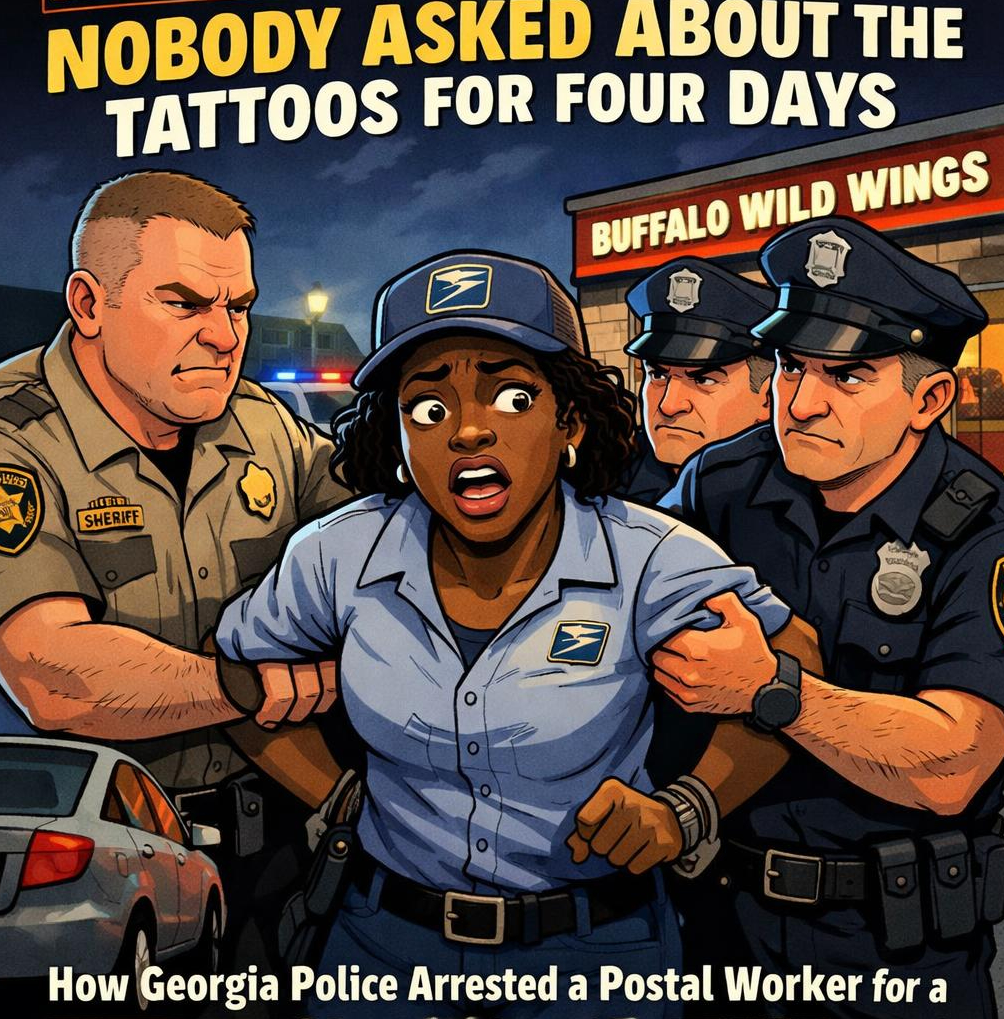
Image created by Dr. Janine Bouey using OpenArt AI (2026).
Picture this: You’re picking up food at Buffalo Wild Wings. You park a little crooked — nothing major, just pulling in quickly to grab your order. A sheriff’s deputy approaches you about your parking. And then, suddenly, there are police cars surrounding you from every direction.
“All of a sudden, it’s a million cops surrounding my car,” Latasha Day recalled. “I’m out there begging the police, ‘Please, sir, don’t take me to jail, please.’”
Customers rushed out of the restaurant to see what was happening. Day stood there, humiliated, as the Walton County Sheriff’s deputy told her something that made absolutely no sense: she had a warrant for her arrest out of Troup County — two hours away — for stealing a car.
Latasha Day is a postal worker. She hadn’t had a traffic ticket in over 15 years. The deputy himself said, “I see you work for the post office, and you haven’t had a ticket in over 15 years. I know this can’t be you.”
He arrested her anyway.
This was October 2023. Latasha Day spent four days in two different jails. And then she spent an entire year — 365 days — fighting felony charges for a crime committed by a woman who looked nothing like her.
The woman who actually committed the crime? She had tattoos covering her body. Tattoos on her breasts. Tattoos everywhere.
Latasha Day doesn’t have a single tattoo on her body.
And for four days while she sat in jail, nobody — not one single law enforcement officer — thought to ask her about tattoos.
The “Evidence” That Destroyed a Year of Her Life

Photograph Latasha Day generated by Perplexiity AI (2026)
Here’s what Troup County Investigator James Robinson had on Latasha Day:
A car.
That’s it. That’s the whole case.
In August 2023, a man and woman stole more than $40,000 in merchandise — including an ATV — from Triad Outdoor and Weathers Honda in LaGrange, Georgia. The thieves were caught on camera. Police had descriptions. They had surveillance footage.
And they had a partial license plate that traced back to a vehicle.
That vehicle was previously registered to an address where Latasha Day had lived three years prior.
Not an address where she currently lived. An address where she used to live. Three years ago.
On that basis alone — a car registered to an old address — Troup County Investigator James Robinson decided Latasha Day was the woman they were looking for. According to documents obtained by 11Alive, Robinson insisted Day was the suspect.
Let me say that again for the people in the back: a Georgia investigator decided a postal worker with 15 years of clean driving was a car thief because a vehicle used in a crime three years later was once registered to an address where she no longer lived.
That’s it. That’s the investigation.
Except it’s not even really an investigation, is it? It’s lazy police work dressed up as probable cause.
The Physical Descriptions That Didn’t Match
Latasha Day had the crime report. She could see what it said about the actual suspect.
“The report said she has tattoos on her breasts, that she has tattoos everywhere,” Day explained.
Day doesn’t have a single tattoo on her body.
But here’s the part that should make your blood boil: “Nobody in the four days I was in jail asked me anything about a tattoo,” Day said.
Four days. Ninety-six hours. And not one officer, not one investigator, not one jail intake worker thought to ask the most basic question: “Do you have tattoos?”
It would have taken five seconds. Five seconds to ask her to show her arms. Five seconds to clear this up. Five seconds to realize they had arrested the wrong person and send her home to her life.
But they didn’t ask. Because why would they? They already “knew” she was guilty. The car told them so.
Never mind that the actual suspect was taller than Day. Never mind that their body types were different. Never mind that the only similarities between them were that both women are Black and both have blonde hair — except Day has short blonde hair while the suspect had blonde braids.
None of that mattered. Because Troup County had made up their minds. They had their suspect. Case closed.
Except it wasn’t the right suspect. And they knew it — or should have known it — from day one.
Four Days in Two Jails
Latasha Day spent four days locked up. She was held in two different jails before being released.
Think about what that means. This is a woman who works for the United States Postal Service. A woman who hadn’t had a traffic ticket in 15 years. A woman whose own arresting officer admitted “I know this can’t be you.”
And they still threw her in jail. For four days. In two different facilities. Accused of being part of a theft ring that stole over $40,000 worth of merchandise.
Four days of being strip-searched, processed, fingerprinted, photographed. Four days of being treated like a criminal. Four days of wondering if anyone would believe her. Four days of knowing that somewhere, the woman who actually committed this crime — the woman with tattoos all over her body — was walking free while Latasha Day sat in a cell.
Four days when one simple question could have cleared the whole thing up.
“Do you have any tattoos?”
They never asked.
A Year of Fighting for Justice That Should Have Been Immediate
Day was released from jail in October 2023. The charges weren’t dismissed until November 2024.
Let that sink in. October 2023 to November 2024.
Thirteen months.
Thirteen months of having felony charges hanging over her head. Thirteen months of being in the system. Thirteen months of wondering if this would destroy her career, her reputation, her life.
For a crime she obviously didn’t commit. For a crime committed by a woman who looked nothing like her. For a crime where the most basic police work would have cleared her name immediately.
And here’s the part that shows exactly how broken this system is: When the district attorney finally asked Day to send four pictures of her legs to prove she didn’t have tattoos like the suspect, the charges were dropped twenty minutes later.
Twenty. Minutes.
The evidence that cleared her took twenty minutes to review. Four photos of her legs. Twenty minutes to look at them and realize “oh, she doesn’t have tattoos. We arrested the wrong person.”
They could have asked for those photos thirteen months earlier. They could have asked to see her legs while she was in jail — during that four-day window when she was begging them to believe her innocence. They could have done basic police work at any point during that entire year.
Instead, they made her wait. They made her fight. They made her prove her innocence for a year while they held her life hostage over charges that never should have been filed.
“I feel like the system failed me,” Day said. “I know it happens, but I never thought it could happen to me.”
The system didn’t fail you, Latasha. The system worked exactly as it was designed to work — to arrest Black people based on the flimsiest of evidence and make them prove their innocence rather than doing actual investigation.
The Humiliation She’ll Never Forget
Close your eyes and picture that scene. You’re at Buffalo Wild Wings picking up food. Maybe you’ve had a long day at work at the post office. You’re tired. You’re hungry. You just want to get your food and go home.
You park a little crooked. A deputy approaches you about your parking. And then suddenly there are police cars everywhere. Customers flooding out of the restaurant to watch. People filming on their phones. Everyone staring.
You’re begging — actually begging — the police not to take you to jail. Trying to explain this must be a mistake. That you work for the post office. That you haven’t even had a parking ticket in 15 years. That you’re not who they’re looking for.
And they take you anyway. In front of all those people. In front of neighbors, community members, strangers with cameras.
That humiliation doesn’t go away. Even after the charges are dropped. Even after you’re proven innocent. That image of being surrounded by police, being handcuffed, being taken away — that sticks with you. It changes how people see you. It changes how you see yourself.
And for what? For a car that was registered to an address where you lived three years ago.
What Troup County Sheriff’s Office Says Now
When contacted about Day’s wrongful arrest and year-long ordeal, the Troup County Sheriff’s Office stated that there was probable cause for her 2023 arrest.
Read that again. They still — even now, after the charges were dismissed, after it’s abundantly clear they arrested the wrong person — they still claim there was probable cause.
A car registered to an old address = probable cause to arrest someone.
Never mind the physical description didn’t match. Never mind the suspect had tattoos all over her body and Day has none. Never mind the height difference. Never mind the body type difference. Never mind the hair difference (short blonde hair vs. blonde braids).
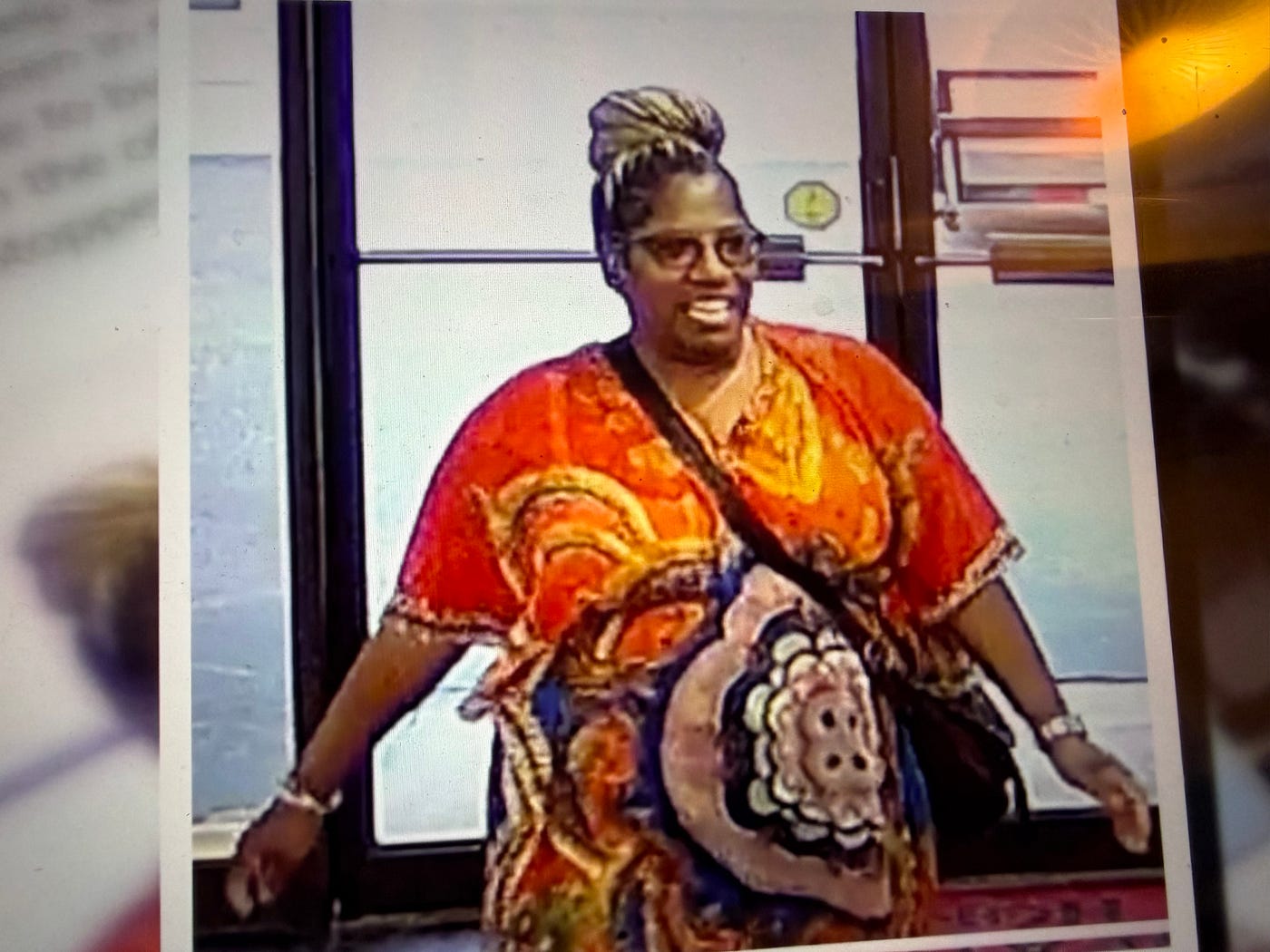
Photograph of Unnamed Suspect generated by Perplexity AI (2026)
Never mind that their own investigator had access to surveillance footage that would have shown them Day wasn’t the woman in the video.
Never mind that Day works for the United States Postal Service and hadn’t had a ticket in 15 years — hardly the profile of someone running a $40,000 theft ring.
Probable cause. That’s what they’re calling this.
This is why people don’t trust the police. Because “probable cause” has become a magic phrase that justifies lazy, incompetent, and sometimes outright malicious police work.
The Troup County Sheriff’s Office said they would provide updates if a review is conducted.
“If” a review is conducted.
Not “when.” “If.”
As if it’s optional. As if destroying a woman’s life for a year over a car registered to her old address doesn’t automatically warrant an investigation into how this happened and how to prevent it from happening again.
What Latasha Day Is Demanding
Day isn’t just sitting back and accepting this disaster as an inevitable consequence of a “flawed” system. She’s demanding accountability.
She’s calling for her record to be cleared. Because even though the charges were dropped, that arrest is still on her record. It still shows up in background checks. It still follows her around. And she shouldn’t have to live with the consequences of Troup County’s failure to do basic police work.
She’s demanding a formal apology from the Troup County Sheriff’s Office, the district attorney, and Investigator James Robinson. Not a “mistakes were made” non-apology. A real apology that acknowledges they arrested the wrong person, held her for four days without asking basic questions that would have cleared her, and then made her fight for a year to clear charges that never should have been filed.
She’s demanding an internal review of how this mistake happened. Because this wasn’t just one bad decision. This was a cascade of failures at every level:
- The investigator who decided a car registered to an old address was sufficient evidence to issue a warrant
- The officers who arrested Day despite her clean record and the arresting deputy’s own doubts
- The jail staff who processed her for four days without asking about the tattoos that were supposedly all over the suspect’s body
- The prosecutors who let this case drag on for a year before asking for simple photos that cleared her in twenty minutes
- The entire system that treated her as guilty until she could prove herself innocent
Every single one of those failures deserves scrutiny. Every person involved in this travesty should have to answer for their role in destroying a year of Latasha Day’s life.
The Question Nobody Asked
This is the sentence that should haunt everyone involved in this case.
The suspect has tattoos everywhere. Visible tattoos. Tattoos on her breasts. Tattoos that would be immediately obvious during a jail intake process when inmates are searched and processed.
And for four days, nobody asked Latasha Day to show her skin. Nobody said, “The suspect we’re looking for has extensive tattoos. Do you have any tattoos?” Nobody did the most basic investigative work that would have cleared her immediately.
This isn’t complicated police work. This isn’t CSI-level forensic analysis. This is “can I see your arms” level investigation.
But they didn’t ask. Because asking the question might have meant admitting they were wrong. Asking the question might have meant acknowledging they had arrested an innocent woman. Asking the question might have required them to do actual work instead of just assuming the car registered to her old address was good enough.
So they didn’t ask. And Latasha Day sat in jail for four days. And then fought charges for a year.
All because nobody asked about the tattoos.
When Being Black Is the Real Evidence
Let’s be brutally honest about what happened here.
Troup County didn’t have evidence that Latasha Day committed this crime. They had a car. A car that was registered to an address where a Black woman with blonde hair once lived.
The actual suspect was a Black woman with blonde hair.
And that — being a Black woman with blonde hair who once lived at an address connected to a vehicle — was enough.
Never mind that Day has short blonde hair and the suspect had blonde braids. Never mind the height difference. Never mind the body type difference. Never mind the EXTENSIVE VISIBLE TATTOOS that Day doesn’t have.
She was Black. She had blonde hair. That was close enough.
This is what “probable cause” looks like when you’re Black in America. You don’t have to match the actual description. You don’t have to have been anywhere near the crime. You don’t even have to vaguely resemble the suspect beyond the most superficial characteristics.
You just have to be Black and exist in the same general area as a crime committed by another Black person.
And then it’s on you to prove you’re not guilty. It’s on you to fight for months or years to clear your name. It’s on you to send photos of your legs to prove you don’t have the tattoos the suspect clearly had. It’s on you to convince them that maybe, just maybe, they should have done some actual investigation before destroying your life.
The Year She’ll Never Get Back
Thirteen months.
From October 2023 to November 2024, Latasha Day lived under a cloud. Felony charges for theft. Charges that could have destroyed her career with the postal service. Charges that showed up every time someone ran a background check. Charges that made her look like a criminal to anyone who didn’t know the full story.
Thirteen months of stress. Of anxiety. Of wondering when — if — this nightmare would end. Of probably having trouble sleeping. Of jumping every time she saw a police car. Of wondering if people at work knew about the charges. Of worrying about what this would mean for her future.
Thirteen months that she’ll never get back. Thirteen months that Troup County stole from her with their lazy police work and refusal to admit they were wrong.
And at the end of all that — when the DA finally asked for photos and saw in twenty minutes that she didn’t have the tattoos the suspect had — what did she get?
Charges dismissed. No apology. No acknowledgment of wrongdoing. Just a quiet dismissal and the expectation that she should be grateful they finally got around to looking at evidence that would have cleared her on day one.
What This Case Reveals About “Justice”
Latasha Day’s case is a perfect example of how the criminal justice system is designed to operate when you’re Black:
Arrest first, investigate later (maybe): Troup County issued a warrant based on a car registered to an old address. No investigation into whether Day actually matched the physical description. No attempt to verify her whereabouts during the crime. Just an assumption that she must be guilty because of a tenuous connection to a vehicle.
Make the accused prove their innocence: Day spent a year fighting to clear her name. She had to provide photos of her legs to prove she didn’t have tattoos. She had to fight to get the charges dismissed. The burden was entirely on her to prove she wasn’t guilty, rather than on the state to prove she was.
Ignore exculpatory evidence: The crime report clearly stated the suspect had tattoos all over her body. Day has none. This should have been verified during her four days in jail. Instead, nobody asked. Nobody checked. Nobody cared about evidence that would have cleared her.
Never admit mistakes: Even now, with charges dismissed and proof that they arrested the wrong person, Troup County Sheriff’s Office claims there was probable cause. No admission of error. No acknowledgment that they destroyed a year of an innocent woman’s life. Just a defensive stance and a maybe-we’ll-do-a-review-if-we-feel-like-it response.
Make them fight for basic dignity: Day has to demand that her record be cleared. She has to demand an apology. She has to demand an internal review. Nothing is being offered voluntarily. Nothing is being done to make this right without her having to fight for it.
This is the system working exactly as designed. And it’s disgusting.
For Latasha Day and Everyone This Has Happened To
They owe you more than dismissed charges.
They owe you the year of your life they stole. The peace of mind they destroyed. The reputation they damaged. The stress they caused. The humiliation of being arrested in front of Buffalo Wild Wings customers. The fear of wondering if your career was over. The frustration of knowing that one simple question could have cleared all this up.
They owe you an apology. A real one. From every person involved in this travesty — from Investigator Robinson who issued the warrant based on an old address, to every officer who processed you without asking about tattoos, to the prosecutors who let this drag on for a year, to the sheriff who still claims there was probable cause.
They owe you accountability. An internal review isn’t optional. It’s mandatory. Every step of this process needs to be examined. Every decision needs to be questioned. Every person involved needs to explain how they let this happen.
And they owe you justice. Which means clearing your record completely. Which means making sure this never happens to anyone else. Which means training officers to do basic investigative work before arresting people. Which means consequences for the people who failed at every level to protect an innocent woman from being destroyed by the system.
Most of all, they owe you an admission of what this really was: a case of lazy police work enabled by the assumption that all Black women are interchangeable. That if a Black woman with blonde hair committed a crime, then any Black woman with blonde hair is close enough. That tattoos don’t matter. That height doesn’t matter. That body type doesn’t matter. That actual investigation doesn’t matter.
You deserved better, Latasha. You deserved officers who did their jobs. You deserved a system that valued truth over convenience. You deserved to be treated as an individual, not as an interchangeable Black body.
The Questions That Should Haunt Troup County
Why did it take a year to ask for photos of Day’s legs when the suspect had visible tattoos and Day has none?
Why did nobody ask about tattoos during the four days Day was in jail?
Why was a car registered to an address where Day lived three years ago considered sufficient evidence for an arrest warrant?
Why were obvious physical differences — height, body type, hair length — ignored?
Why does Troup County Sheriff’s Office still claim there was probable cause when the charges were dismissed and Day clearly didn’t match the description?
When will the internal review happen — and will it be a real investigation or a whitewash?
Who will be held accountable for the year of hell Latasha Day was put through?
And most importantly: How many other people has this happened to? How many other innocent people are sitting in Georgia jails or fighting charges right now because investigators decided a car or an address or a similar hair color was “good enough”?
The System That Failed Her Will Fail Others
Here’s the scariest part of Latasha Day’s story: it’s not unique.
Somewhere right now, another Black person is being arrested based on flimsy evidence. Another innocent person is sitting in jail while officers ignore exculpatory evidence. Another person is fighting charges that should never have been filed while prosecutors drag their feet for months or years before looking at evidence that would clear them immediately.
This isn’t a bug in the system. This is the system functioning exactly as it was designed to function.
And until there are real consequences — not just settlements paid with taxpayer money, not just policy changes that nobody follows, not just “additional training” that changes nothing — this will keep happening.
Latasha Day was lucky. The charges were eventually dismissed. She didn’t lose her job. She didn’t plead guilty to something she didn’t do just to make it go away. She had the strength to fight for a year and demand accountability.
But how many people aren’t that lucky? How many people plead guilty because they can’t afford to fight? How many people lose their jobs because they can’t explain away an arrest record? How many people just give up and accept that the system is designed to crush them?
The answer is: too many. Way too many.
Nobody Asked About the Tattoos
That sentence should be on a billboard outside the Troup County Sheriff’s Office.
It should be printed on the business cards of every officer involved in this case.
It should be the title of the internal review report (if they ever actually do one).
Because it captures everything wrong with this case — and everything wrong with how police treat Black people in America.
They didn’t ask the most basic question. The question that would have cleared her immediately. The question that would have saved her four days in jail and a year of fighting charges.
They didn’t ask because they didn’t care. Because once they decided she was guilty — based on a car registered to her old address — nothing else mattered. Not the physical description. Not the tattoos. Not her clean record. Not her obvious innocence.
They had made up their minds. And asking questions might have forced them to admit they were wrong.
So they didn’t ask. And Latasha Day paid the price.
This can’t keep happening.
But it will. Unless we demand better. Unless we hold people accountable. Unless we force the system to value truth over convenience and innocence over closure.
Latasha Day deserves justice. And so does everyone else this has happened to.
If you believe that a car registered to an old address is not probable cause to arrest someone — especially when the suspect has visible tattoos and the accused has none — please register your peer-reviewed outrage by clapping until your finger gets tired.
Latasha Day is demanding accountability from the Troup County Sheriff’s Office, the district attorney, and Investigator James Robinson. She deserves your support and their apology.
Dr. Janine Bouey is a retired LAPD officer. She brings a unique and informed perspective to issues of policing, justice, and systemic accountability. Dr. Bouey is committed to truth-telling and holding institutions accountable for the harm they cause.
메타데이터
- post_id
- bb077aee4f9f
- slug
- nobody-asked-about-the-tattoos-for-four-days-bb077aee4f9f
- url
- https://medium.com/@jusbouey/nobody-asked-about-the-tattoos-for-four-days-bb077aee4f9f
- canonical_url
- https://medium.com/@jusbouey/nobody-asked-about-the-tattoos-for-four-days-bb077aee4f9f
- author_url
- https://medium.com/@jusbouey
- status
- ok
- fetched_at
- 2026-06-28 10:39:35